Transport · Military · United States
McDonnell Douglas C-17 Globemaster III
- September 15, 1991
- First flight
- 1995
- Introduced
- In service
- Status
- 279
- Units built


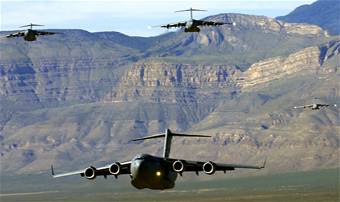


The McDonnell Douglas C-17 Globemaster III is the large strategic military transport that the United States Air Force (USAF) ordered in the 1980s to replace the ageing Lockheed C-141 Starlifter and to take over part of the work of the giant C-5 Galaxy. What sets it apart is that it combines the intercontinental range and cargo hold of a strategic airlifter with the abilities of a tactical transport: it can land heavy loads on short, narrow and austere runways, and it can back up under its own power thanks to its thrust reversers. It grew out of the 1970s AMST programme and, in particular, McDonnell Douglas's YC-15 prototype, from which it inherited externally blown flaps. It won the C-X competition in 1981, first flew on 15 September 1991 at Long Beach, California, and formally entered service on 17 January 1995, after a troubled development in which cost overruns, delays and a failed structural wing test almost led to its cancellation. After the 1997 merger Boeing took over the programme and built the aircraft at Long Beach until 2015: 279 were produced, 223 for the USAF and the rest for the United Kingdom, Australia, Canada, Qatar, the United Arab Emirates, India, Kuwait and the European heavy airlift consortium based at Pápa, Hungary. Powered by four Pratt & Whitney F117 turbofans and flown by a crew of three, it has taken part in everything from the 2003 combat airdrop over northern Iraq to the 2021 Kabul evacuation, when one aircraft carried 823 people on a single flight, and it remains the backbone of American military airlift.
Related events
- McDonnell Douglas wins the C-X competition with the future C-17
- First flight of the McDonnell Douglas C-17 Globemaster III
- First production C-17 delivered to the USAF at Charleston
- Service entry of the McDonnell Douglas C-17 Globemaster III
- Six RAF Chinooks flown to Kandahar by C-17
- Last C-17 built at Long Beach takes flight
Related sheets
Category
McDonnell Douglas C-17 Globemaster III in the news

Three-year agreement covers the training system used by the multinational Heavy Airlift Wing at Pápa Air Base in Hungary
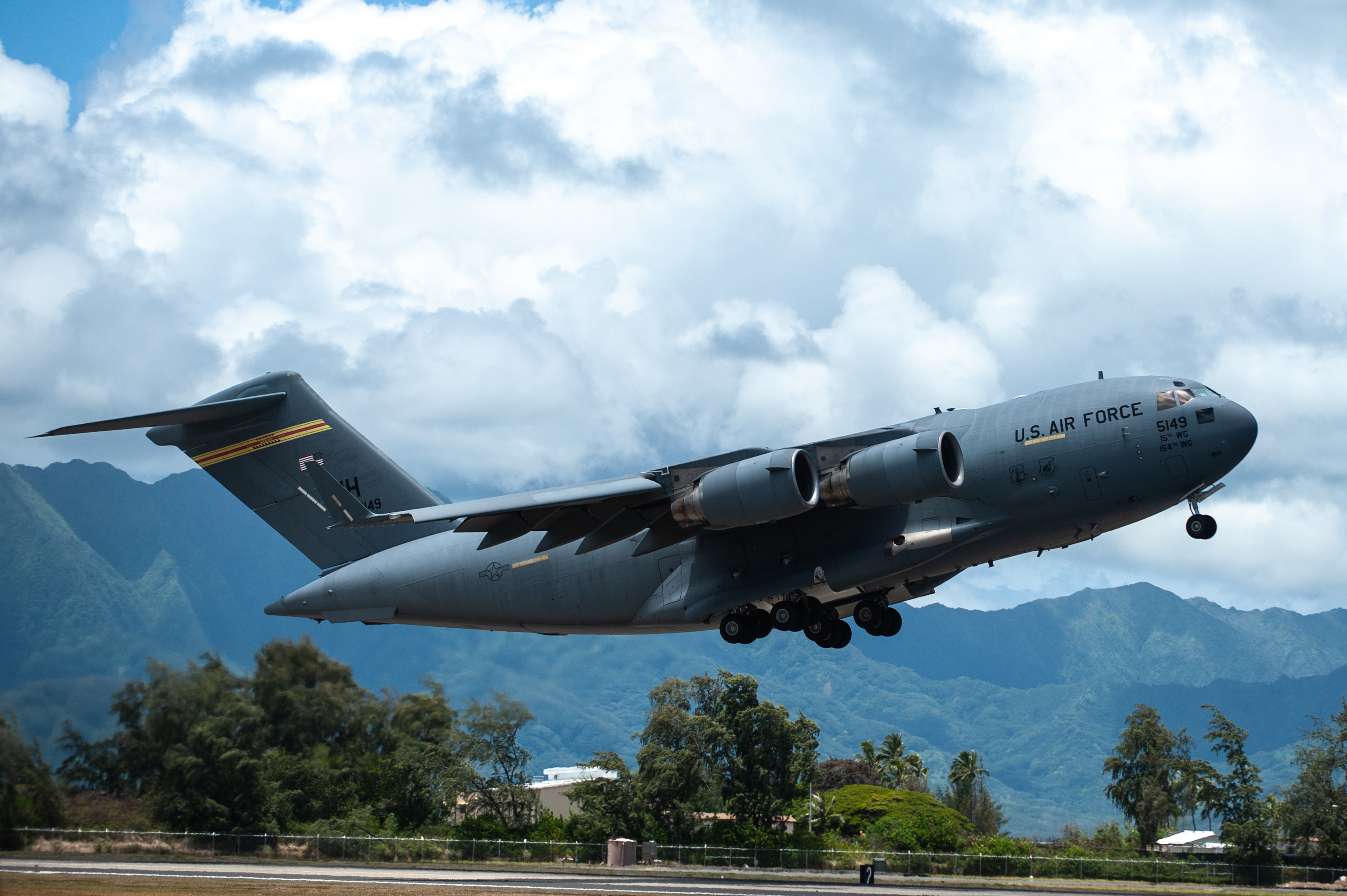
The modernised Apache attack helicopters No. 25 and 26, in the new “Echo” version (AH-64E), are aboard a NATO C-17 en… more…
The Canadian aerobatic display team Snowbirds performed this Friday, Oct. 16, in Moose Jaw, Saskatchewan, their final aerobatic display with the jet trainer…

This article was originally published on idrw.org. Gliders India Limited (GIL), a defence public sector undertaking under Ordnance Parachute Factory, Kanpur has issued an... Read the full article on…

The Canadian Forces Snowbirds marked the end of an era on Friday, October 16, with their final home-closing air show using the iconic CT-114 Tutor aircraft at 15 Wing Moose Jaw, Saskatchewan…


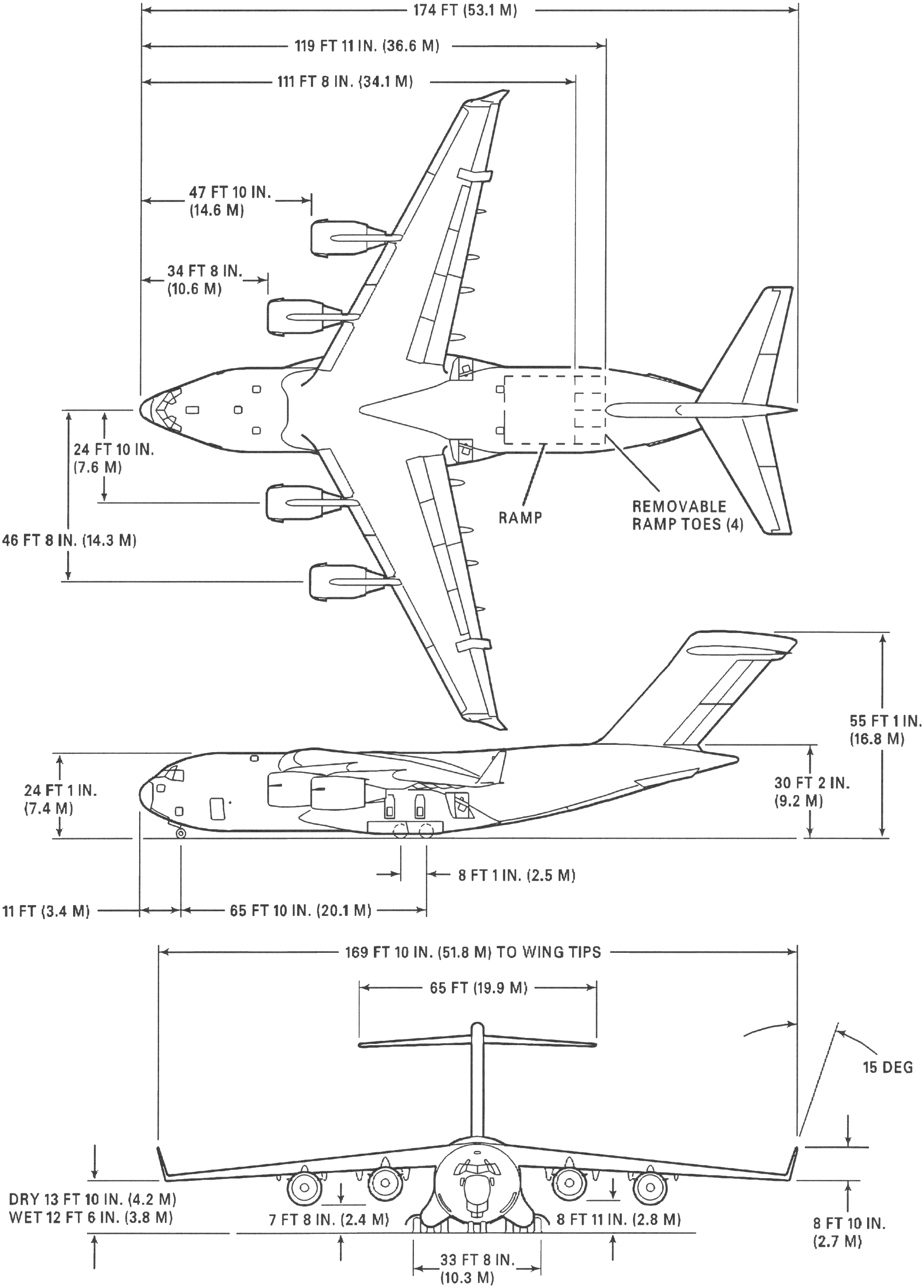
Three-view drawing
History
A gap in military airlift
In the late 1970s the US Air Force faced a twofold problem. Its strategic airlift fleet relied on the Lockheed C-141 Starlifter, an ageing four-jet transport limited by the diameter of its fuselage, and on the C-5 Galaxy, huge but costly to operate and demanding on runways. Tactical airlift, meanwhile, fell to the C-130 Hercules turboprop, which could use rough strips but lacked the hold and the range to move an armoured unit across an ocean. No aircraft could carry outsize cargo from the United States straight to a short runway near the front without transloading on the way.
The direct precedent was the AMST (Advanced Medium STOL Transport) competition, in which Boeing offered the YC-14 and McDonnell Douglas the YC-15. Both prototypes showed that a jet transport could take off and land in very short distances by using engine exhaust to boost the lift of the wing, but the programme was cancelled without series production. The technical lesson, however, was not lost.
The C-X competition and the choice of McDonnell Douglas
In November 1979 the USAF launched the C-X programme to develop a transport larger than the AMST, with enough range to reinforce strategic airlift. Lockheed submitted a C-5-based design and an enlarged C-141; Boeing, a development of its YC-14; and McDonnell Douglas, a new aircraft that scaled up the configuration of the YC-15. On 28 August 1981 the McDonnell Douglas proposal was selected and designated C-17.
The full-scale development contract was not awarded until December 1985, and manufacture of the first aircraft followed at the McDonnell Douglas plant in Long Beach, California. The USAF set a requirement for 210 aircraft, a figure that would not last: in April 1990 Secretary of Defense Dick Cheney cut it to 120.
A development on the brink of cancellation
The first C-17 took off from Long Beach on 15 September 1991 and landed at Edwards Air Force Base, roughly a year behind schedule. The problems had only just begun. The programme was running over budget, production was late, and the wing failed its static structural test: after some 100 million dollars had been spent on a redesign, it broke again in September 1993 at 145 per cent of limit load, short of the required margin.
The Department of Defense responded with an ultimatum: the contractor had two years to solve its production and cost problems, or the contract would be terminated after delivery of the 40th aircraft. In parallel, a programme was set up to study buying commercial freighters as an alternative or a supplement. Accepting those terms cost McDonnell Douglas a loss of nearly 1.5 billion dollars on the development phase, but the company sorted out the line and the programme survived: in 1996 the Department of Defense ordered another 80 aircraft, for a total of 120.
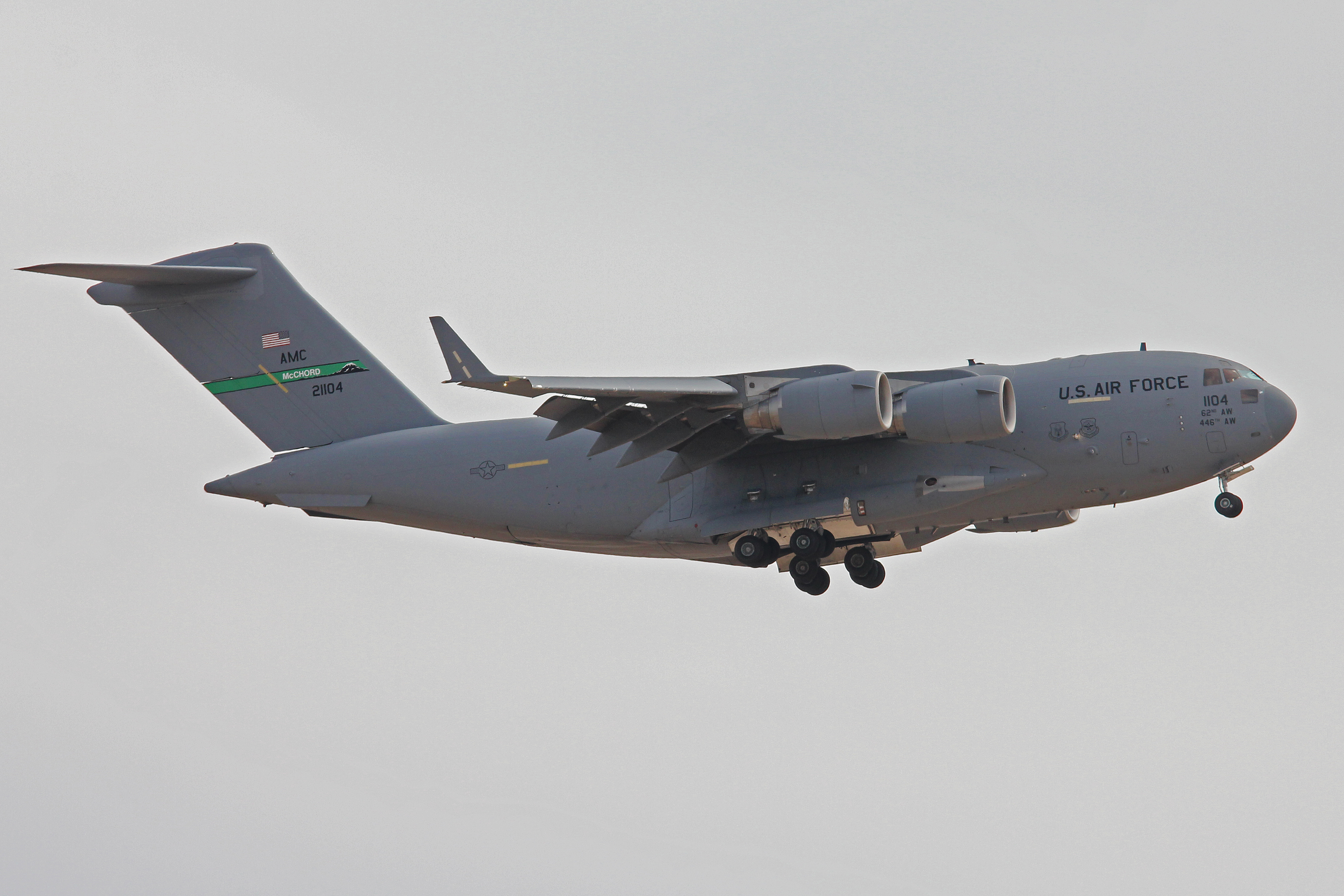
Meanwhile, in early 1993 the aircraft had been named Globemaster III, in tribute to two Douglas freighters, the C-74 Globemaster and the C-124 Globemaster II. The first production aircraft arrived at Charleston Air Force Base, South Carolina, on 14 July 1993, and the C-17 formally entered service on 17 January 1995.
Design: a strategic airlifter that behaves like a tactical one
The C-17 is a high-wing monoplane with a T-tail, four engines in pods under the wing and a large rear ramp. Its supercritical wing gives it a cruise speed of around Mach 0.74. The key to its short take-off and landing performance lies in the externally blown flaps inherited from the YC-15: engine exhaust is directed over the lowered flaps and increases lift at low speed, allowing steep, slow approaches with a heavy load.
It is powered by four Pratt & Whitney F117-PW-100 turbofans, the military version of the PW2040 used on the Boeing 757. Their thrust reversers direct the exhaust upwards and forwards, which reduces the risk of the engines ingesting runway debris and provides enough force for the aircraft to taxi backwards on ramps and narrow taxiways, a manoeuvre most large jets cannot perform.
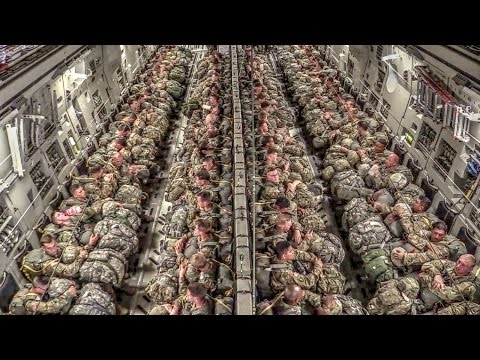
The flight deck is designed for two pilots with head-up displays, and the basic crew is completed by a single loadmaster, who handles the hold. The hold can take one M1 Abrams tank, two Bradley vehicles or three Strykers, up to 18 standard 463L pallets, 102 paratroopers or 134 seated troops, or an aeromedical evacuation layout with 36 litters. The aircraft can operate from runways as short as 3,500 ft and as narrow as 90 ft.
Service with the USAF
Since entering service the C-17 has taken part in almost every American operation. It played a key logistical role in Afghanistan and Iraq. On 26 March 2003, fifteen C-17s dropped 1,000 paratroopers of the 173rd Airborne Brigade at night over Bashur in northern Iraq: the largest combat airdrop since the invasion of Panama in 1989.

Since 1999 the aircraft has flown to Antarctica every season on Operation Deep Freeze, supporting the US Antarctic programme and replacing the C-141s used before. It has also delivered humanitarian aid after disasters such as the 2010 Haiti earthquake. In August 2021, during the evacuation of Kabul airport, a C-17 of the 816th Expeditionary Airlift Squadron carried 823 Afghan civilians on a single flight, a record for the type.
The USAF eventually decided to cap its fleet at 223 aircraft and received the last one on 12 September 2013. Aircraft from the later batches carry additional fuel tanks in the centre wing section, and Boeing informally calls them C-17 ER because of their greater range.
Exports and international use
Among foreign customers, the Royal Air Force operates eight aircraft from Brize Norton. Australia followed with eight, and Canada operates five under the designation CC-177; in April 2010 one of them landed for the first time at Alert, the most northerly airfield in the world, and in 2013 Canadian aircraft flew an air bridge to the Philippines after Typhoon Haiyan.
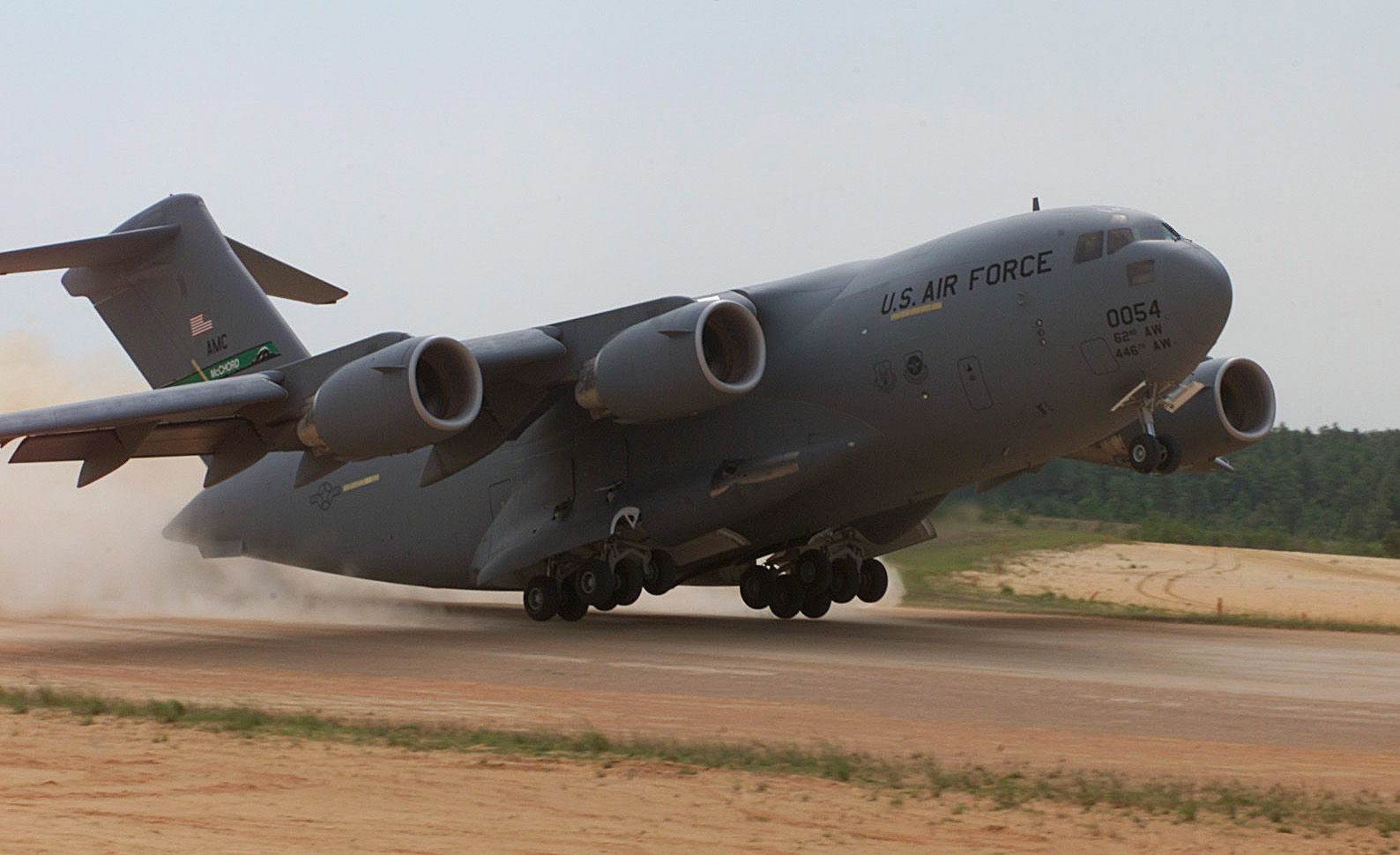
Qatar received its first C-17 on 11 August 2009, and the United Arab Emirates and Kuwait joined the list. India expressed interest in 2010 and became the largest foreign customer, with 11 aircraft based at Hindon. In Europe, a group of NATO members and partners signed a letter of intent at the 2006 Farnborough Airshow to share aircraft through the Strategic Airlift Capability programme: its Heavy Airlift Wing operates three C-17s from Pápa Air Base in Hungary.
End of production and legacy
After the 1997 merger with McDonnell Douglas, Boeing took over the programme. With international sales slowing, partly because of competition from the Airbus A400M, Boeing announced the closure of the line: in October 2014 the main wing spar of the 279th and last aircraft was completed; it was finished at Long Beach and flown in November 2015, after which the California plant closed. That final aircraft went to India, bringing its fleet to 11 C-17s.
There was no direct successor. A civil version for the airlines of the Civil Reserve Air Fleet (BC-17X) and a tactical C-17B with double-slotted flaps, an extra main landing gear and more powerful engines were studied, but neither left the drawing board. More than three decades after its first flight, the Globemaster III remains the freighter that allows the United States and its allies to move heavy equipment anywhere in the world and set it down on short runways close to where it is needed, and it is a regular at air shows, where its short take-offs and tight turns belie its size.
Variants
| C-17A | BC-17X | C-17A Block 16 | C-17A Block 21 | C-17A ER | C-17B | C-17FE | CC-177 Globemaster III | KC-17 | |
|---|---|---|---|---|---|---|---|---|---|
| First flight | September 15, 1991 | — | — | — | — | — | — | — | — |
| Aircraft type | Strategic and tactical military airlifter | — | — | — | — | — | — | — | — |
| Powerplant | 4 × Pratt & Whitney F117-PW-100 (PW2040) turbofans | — | — | — | — | — | — | — | — |
| Powerplant | 4 × Pratt & Whitney F117-PW-100 (PW2040) | — | — | — | — | — | — | — | — |
| Thrust per engine | 180 kN | — | — | — | — | — | — | — | — |
| Length | 53 m | — | — | — | — | — | — | 53 m Best value in this row | — |
| Wingspan | 51.8 m Best value in this row | — | — | — | — | — | — | 51.7 m | — |
| Height | 16.8 m Best value in this row | — | — | — | — | — | — | 16.8 m Best value in this row | — |
| Wing area | 350 m² | — | — | — | — | — | — | — | — |
| Empty weight | 128,140 kg | — | — | — | — | — | — | — | — |
| MTOW | 265,352 kg Best value in this row | — | — | — | — | — | — | 265,350 kg | — |
| Cruise speed | 830 km/h | — | — | — | — | — | — | — | — |
| Service ceiling | 13,716 m | — | — | — | — | — | — | — | — |
| Range | 4,480 km | — | — | — | — | — | — | 10,279 km Best value in this row | — |
| Ferry range | 11,540 km | — | — | — | — | — | — | — | — |
| Range conditions | Range with partial payload; extendable by aerial refueling | — | — | — | — | — | — | — | — |
| Armament | None | — | — | — | — | — | — | — | — |
| Max weapons load | 0 kg | — | — | — | — | — | — | — | — |
| Payload | 77,519 kg | — | — | — | — | — | — | — | — |
| Cargo capacity | Cargo on 18 463L pallets or vehicles (one M1 Abrams tank); 102 paratroopers, 134 troops or 36 litter and 54 ambulatory patients | — | — | — | — | — | — | — | — |
| Crew | 3 | — | — | — | — | — | — | — | — |
| Passengers | 134 | — | — | — | — | — | — | — | — |
| Units built | — | 0 Best value in this row | — | — | — | 0 Best value in this row | 0 Best value in this row | — | 0 Best value in this row |
Where to see it today
| Serial | Variant | Place | City | Country | Status |
|---|---|---|---|---|---|
| 87-0025 | C-17A | National Museum of the United States Air Force | Dayton | United States | On display |
| First C-17 built (T-1), test prototype at Edwards from 1991; retired and flown to the museum in April 2012. Displayed outdoors in the air park. | |||||
List reviewed on October 31, 2026 against Wikipedia (en): List of aircraft at the National Museum of the United States Air Force, Aerial Visuals Airframe Dossier: McDD C-17A 87-0025.
Images
Elsewhere
- JetPhotosBoeing C-17A Globemaster III 03-3122, USAF, Sydney (2006) ↗
- JetPhotosBoeing C-17A Globemaster III, USAF ↗
- JetPhotosBoeing C-17A Globemaster III 99-0060, USAF 455th AW, Phoenix (2012) ↗
- Airplane-Pictures.netBoeing C-17A Globemaster III 00-0172, USAF, RIAT 2010 Fairford ↗
- IrishAirPicsBoeing C-17A Globemaster III 00-0172 'Spirit of Denali', USAF ↗
- IrishAirPicsBoeing C-17A Globemaster III A7-MAA, Qatar Air Force, Belfast ↗
- IrishAirPicsBoeing C-17A Globemaster III ZZ172, Royal Air Force ↗
- AirHistory.netBoeing C-17A Globemaster III 03, Hungarian Air Force, Eindhoven (2020) ↗
- AirHistory.netBoeing C-17A Globemaster III 1227, UAE Air Force, Prestwick (2024) ↗
- AviationCorner.netBoeing C-17A Globemaster III ↗
- AviationCorner.netBoeing C-17A Globemaster III ↗
- SpottingLogBoeing C-17A Globemaster III 00-0176, fotos de spotters ↗
Show the 6 more
- Airman Magazine (USAF)C-17 Globemaster III (galería Airman Magazine) ↗
- Air Mobility Command (USAF)C-17 Globemaster III (galería Air Mobility Command) ↗
- AFCENT (USAF)C-17 Globemaster III (galería AFCENT) ↗
- DVIDSC-17 Globemaster III, Charleston (DVIDS) ↗
- Getty ImagesVista frontal aire-aire de un C-17 Globemaster III ↗
- Net-MaquettesBoeing C-17A Globemaster III, walkaround ↗
Videos


Show the 97 more
 Salvaging and Restoring the Legendary Boeing C-17 Globemaster III After Decades Beneath the Atlantic
 [4K] Il Boeing C-17A Globemaster III dell'aeronautica militare statunitense al RIAT 2025 il 20 lu...
 Perché la Boeing ha interrotto la produzione del C-17 Globemaster III e perché la produzione potr...
 Perché la Boeing ha interrotto la produzione del C-17 Globemaster III e perché potrebbe essere ri...
 [4K] POWERFUL CLOSE-UP SUNSET TAKEOFF | US Air Force Boeing C-17 Globemaster III at Belgrade Airport