Dassault Rafale variant
Dassault Rafale M
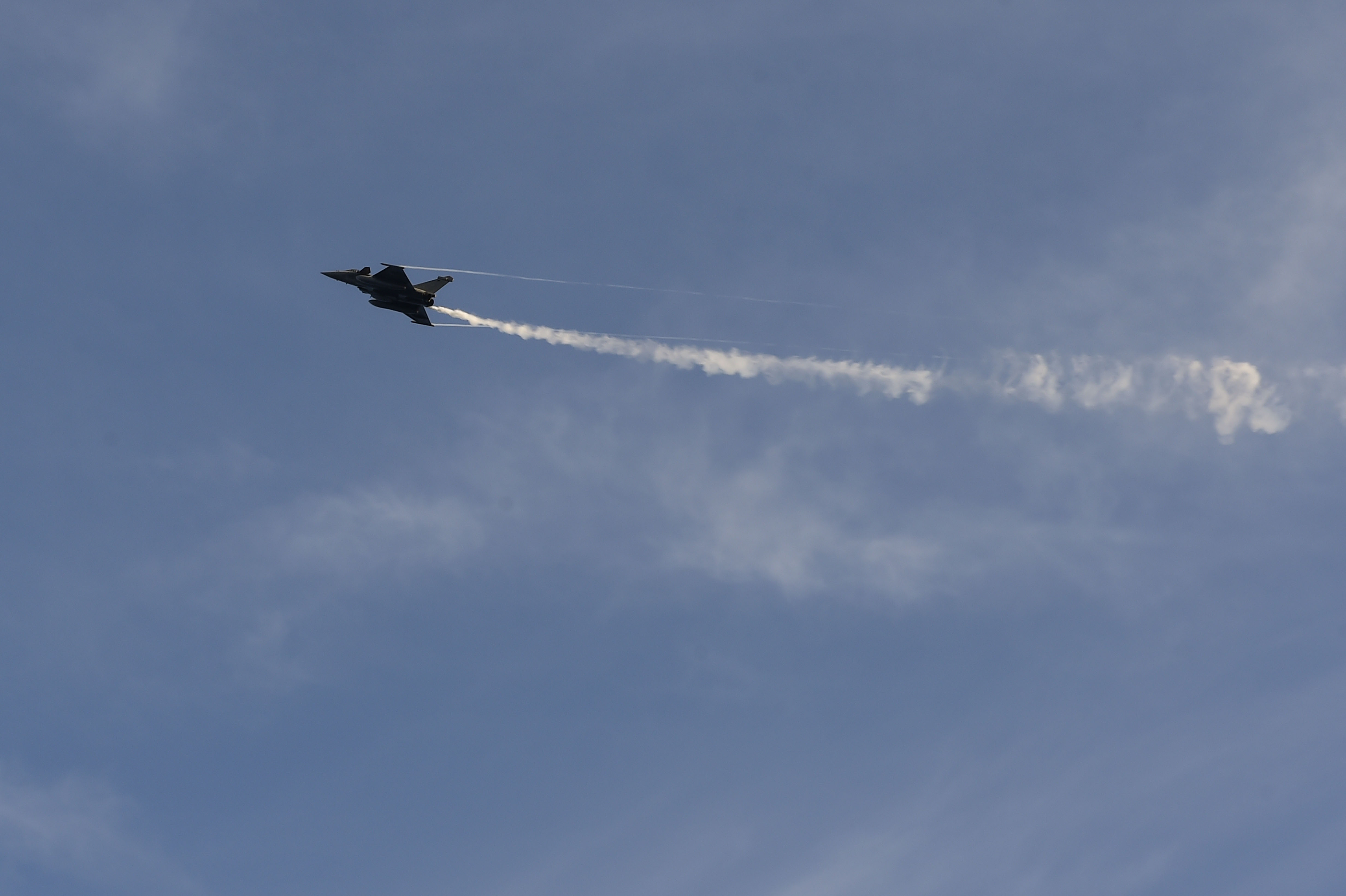
The Rafale M (Marine) is the single-seat carrier-borne version of the Rafale, designed for the catapult-and-arrester-wire aircraft carriers of the French Navy. It shares about 95 percent of its parts with the Air Force Rafales but has a reinforced undercarriage, a nose gear with a catapult bar and jump strut, a stronger arrester hook, a built-in ladder and one hardpoint fewer (13 instead of 14); it keeps the 30 mm cannon. Prototype M01 first flew on 12 December 1991 and made the first Rafale deck landing aboard Foch on 19 April 1993. The Navy was the first service to receive the Rafale, urgently replacing its F-8 Crusaders: Flottille 12F was reactivated at Landivisiau on 18 May 2001 and the F1 standard was declared operational on 25 June 2004. After the F2 and F3 standards and the upgrade of the first ten aircraft, the Navy fields three squadrons (11F, 12F and 17F) from the carrier Charles de Gaulle, and the Rafale M has flown combat over Afghanistan, Libya, Iraq and Syria. It is also the only non-US fighter cleared to operate from US Navy carriers.

- December 12, 1991
- First flight
History
A version of its own for the Navy
In the late 1980s the French Navy needed to replace its F-8 Crusaders and, later, its Super-Étendards. The Navy, which funded around 20 percent of the Rafale programme, went as far as studying the purchase of American F/A-18s for its carrier; a later National Assembly report criticised that attempt to obtain an aircraft different from the Air Force's. The final decision kept a single aircraft for both services, and to bridge the gap 17 Crusaders had their lives extended and 71 Super-Étendards were upgraded to the SEM standard. The result was the Rafale M (for Marine), a single-seat version adapted to operations from carriers equipped with catapults and arrester wires. The two naval prototypes, M01 and M02, were ordered on 6 December 1988.
Prototypes and trials in the United States and on Foch
M01 made its first flight on 12 December 1991, flown by Yves Kerhervé, Dassault's naval test pilot; in its grey paint it was almost identical to the land-based C01 prototype. Because France had no land-based catapult test facility, the first 39 catapult launches and four simulated runway arrested landings were carried out between 8 July and 23 September 1992 at the US Navy facilities at Lakehurst, New Jersey, and Patuxent River, Maryland; two further campaigns with heavy loads followed in January and March 1993. On 19 April 1993 Kerhervé made the first deck landing of a Rafale M aboard the carrier Foch, and the first catapult launch followed the next day; Foch, shorter than the future Charles de Gaulle, was fitted with a small ski-jump to compensate. The second prototype, M02, flew on 8 November 1993 at Istres with Éric Gérard, another Dassault naval test pilot who later became the Rafale display pilot. Deck landing trials continued from Istres with touch-and-goes on Foch, sailing some 50 km south of Marseille. In 1996, when the government decided to sell Foch, it asked for the first production Rafales, all destined for the Navy, to be delayed from 1998 to 2000. In June 1999 M02 resumed catapult and arrested landing trials, now aboard the new nuclear-powered carrier Charles de Gaulle.
What differs from the Rafale C
The changes are concentrated in the landing gear and deck equipment. The Messier-Bugatti-Dowty main gear is reinforced and the nose gear mass rises from 50 to 200 kg so that it can absorb a vertical landing speed of 6.5 m/s. The nose leg carries a catapult bar, which required a stronger titanium and high-strength steel gear box, and a jump strut that stores energy during the catapult stroke and releases it at the end of the deck; catapult acceleration is 5.5 g and the end speed about 260 km/h. The bulk of this nose gear reduces the weapon hardpoints from 14 to 13. The aircraft also receives a heavier arrester hook than the emergency hook of the Rafale C, able to take a 75-tonne pull when stopping, a telescopic ladder built into the fuselage, two batteries instead of one, a carrier-based microwave landing system and, on the fin tip, the Sagem TELEMIR system that aligns the inertial navigation at sea. English-language sources put the extra weight at about 500 kg; the French Wikipedia gives 700 kg. Maximum take-off mass from a runway remains 24.5 tonnes, but is limited to 21.5 tonnes for a catapult launch; speeds, load factors and landing distances are unchanged, and the 30 mm Giat 30M791 cannon is retained. Unusually for a carrier aircraft its wings do not fold: commonality with the land versions is about 95 percent, and the larger size of Charles de Gaulle compared with Foch and Clemenceau offset that limitation. It is credited with supercruise at Mach 1.4 carrying six MICA missiles.
Entry into service: F1 and F2 standards
The Navy received its first production Rafales in late 2000 (the French Wikipedia dates deliveries from September; the English one reports the first two arriving in December). The first ten, M1 to M10, were F1 standard, air-to-air only, delivered urgently to relieve the Crusaders. On 18 May 2001 Flottille 12F, a former Crusader unit and the first Rafale squadron, was reactivated at Landivisiau naval air base and immediately took part in exercise Trident d'Or aboard Charles de Gaulle. In 2002 seven Rafale Ms embarked for Mission Héraclès, the French part of Enduring Freedom: they flew over Afghanistan without attacking, since F1 had no air-to-ground capability, and in June patrolled near the India-Pakistan border. F1 was declared operational on 25 June 2004. The first F2 Rafale M, with air-to-ground capability, was delivered in May 2006 starting with M11, and 17 had been received by May 2008; the Rafale M F2 was declared operational on 21 May 2008. In March 2007 three Navy Rafales aboard Charles de Gaulle began supporting forces in Afghanistan and, on 28 March 2007, a Rafale M F2 dropped a GBU-12 laser-guided bomb at the request of Dutch troops, although it relied on other aircraft to designate the target.
F3 standard, upgrade and three squadrons
In December 2004 twelve single-seat Rafale Ms were ordered as part of an F3 order. Once enough F2 aircraft were available, M2 to M10 were placed in storage from 2008 to 2013, while M1 remained a test aircraft. The ten F1 aircraft were then taken directly to the F3 standard in a major operation from 2013 to 2018, going back through Dassault's Mérignac assembly line, at a cost equivalent to about three new aircraft. Flottille 11F converted from the Super-Étendard Modernisé to the Rafale M F3 in summer 2011, and 17F followed with the aim of being operational by the end of 2016. At the end of 2015, after the losses of M18, M22, M24 and M25 and with the ten aircraft in upgrade, the Navy had 41 Rafale Ms, 36 of them on the line at F3 standard. In 2017 it received the last upgraded F1s (M5 to M1) and M46, reaching 42 F3 Rafales. The M47 airframe was taken by the DGA for fatigue tests and the order for M48 was cancelled, so the fleet settled at 42: M1 for trials, three squadrons of 12 aircraft (11F, 12F and 17F), three at the Saint-Dizier conversion centre and two in reserve.
Operations
In the 2011 Libya campaign the Navy's Rafales flew 616 sorties and more than two thousand flight hours over 226 days, and Rafale Ms also served as tankers with buddy refuelling tanks. Charles de Gaulle sailed from Toulon on 13 January 2015 and its Rafales first struck the Islamic State in Iraq on 25 February 2015; they struck the group again in 2016. During the 2017 deployment, the first with an all-Rafale air wing, the 24 aircraft on board maintained 94 percent availability.
Interoperability with the US Navy
The Rafale M is the only non-US fighter cleared to use the catapults and arrester gear of American carriers. In 2008 six Rafales of 12F were integrated into the air wing of USS Theodore Roosevelt; on 4 June 2010, aboard USS Harry S. Truman, a Rafale became the first fighter of a foreign navy to have an engine changed on a US carrier. In May 2018, in Operation Chesapeake, twelve Rafales of Flottilles 11F, 12F and 17F and nearly 350 support personnel spent two weeks aboard USS George H.W. Bush after a month of training at Naval Air Station Oceana. In January 2025, during Mission Clemenceau 25, Rafale Ms flew air defence drills with Indian Air Force Su-30MKIs and Jaguars.
Accidents
On 22 May 2008 M16 of 12F overran the runway on landing at Lann-Bihoué without injury and was repaired. On 24 September 2009 M22 and M25 collided in flight while returning to Charles de Gaulle, some 30 km from Perpignan; the pilot of M22, François Duflot, was killed. On 28 November 2010 M18 crashed into the sea off Pakistan after a fuel management problem, and on 2 July 2012 the pilot of M24 ejected over the Mediterranean during mock combat with an F-18 from USS Dwight D. Eisenhower; both pilots were rescued.
F4 standard and derivatives
M1, brought to an interim F4 standard, was used to test an automatic deck landing aid similar to the US Navy's magic carpet system; the first deck landing of a Rafale Marine F4 on Charles de Gaulle took place at the end of 2021. From 21 to 30 March 2023 the CEPA/10S trials centre evaluated three Rafale Marine F4.1 aircraft on board in maritime missions. The Rafale M gave rise to the Rafale N, a two-seat naval version studied from summer 1999 and abandoned in 2004, and to the Rafale MH chosen by the Indian Navy, adapted to ski-jump carriers.
Multimedia


