Dassault Rafale variant
Dassault Rafale A
Technology demonstrator of the ACX programme and the only one built: first flown on 4 July 1986 with two F404s, it later tested the M88 engine and, after 867 flights, retired in January 1994; it is now at the Musée de l'Air et de l'Espace.

- July 4, 1986
- First flight
- 1
- Units built
History
The Rafale A was the technology demonstrator with which Dassault shaped the ACX (Avion de Combat Expérimental) programme, the multirole fighter France chose to develop on its own after the talks with the European partners that would eventually produce the Eurofighter Typhoon broke down. According to the Musée de l'Air et de l'Espace, the programme was launched on 12 December 1982 and the ACX was to bring together the most advanced technologies of the day: moving canards governed, like all the other flight controls, by a central computer, fibre-optic signalling, voice control and a large proportion of composites and titanium in the airframe. On 13 April 1983 the French government awarded a contract for two demonstrators, later cut to a single aircraft.
AMD-BA launched the demonstrator studies in March 1983, and Marcel Dassault himself chose the name Rafale, a nod to the Ouragan, the company's first jet aircraft. Construction started in 1984; the team twice brought the schedule forward and finished the aircraft in under eighteen months, nine months ahead of plan. It was Dassault's 92nd prototype in forty years, and it was designed entirely with the company's in-house digital tools, the work that led to the CATIA software. The demonstrator was rolled out at Saint-Cloud with Marcel Dassault present; when the press needled him about the aircraft not being European, he retorted that it would be a world aircraft.

Dassault wanted to use the Rafale A to continue its approach of risk reduction through incremental improvement and, above all, to test the aerodynamically unstable delta wing and canard configuration. The aircraft had fly-by-wire controls, a side-stick and a short-travel throttle under the “3M” hands-on concept, a semi-low double-delta wing without boundary-layer suction, a tall fin, semi-ventral air intakes without the moving shock cones of the Mirage III, 2000 and 4000, and canards set behind the cockpit to improve the pilot's view. To reduce first-flight risk, and because Snecma needed three years to finish its new engine, it was powered by two General Electric F404s from the F/A-18 Hornet, each rated at 68.8 kN, instead of M88s. Because the F404 is bulkier, the airframe, which made wide use of carbon fibre, aramid fibre and aluminium-lithium alloys, ended up larger than the one planned for production aircraft.
Marcel Dassault died on 17 April 1986 and never saw the first flight, which took place on 4 July 1986 from the DGA test centre at Air Base 125 Istres, with Guy Mitaux-Maurouard at the controls. It was an exceptional sortie: the aircraft went supersonic without afterburner, reached Mach 1.32 and pulled 5 g. Before its public debut at Farnborough in September it had already reached Mach 1.9 at 15 km altitude, Mach 0.95 at very low level, a minimum speed of 180 km/h and a sustained +8 g. At Farnborough, facing its British rival the EAP, it flew aerobatics and landed in 250 m without a brake parachute; the following year it thrilled the crowds again at the Paris Air Show at Le Bourget. On 4 March 1987, on its 93rd flight, it reached Mach 2 on its two F404s, and in February that year President François Mitterrand announced the launch of an operational aircraft derived from the Rafale A.
The French Navy still had to be won over, since it preferred to buy or lease second-hand F/A-18 Hornets. On 30 April 1987 Yves Kerhervé, the Navy test pilot on the programme, flew the first seven simulated deck landings on the carrier Clemenceau, going around 50 cm above the deck: the demonstrator could not touch down because its structure was not strong enough. They were followed by 85 simulated deck landings on the Foch from 4 to 8 July 1988, 124 at Istres and 160 at the Nîmes-Garons naval air station. At the Paris Air Show in June 1987 Prime Minister Jacques Chirac stated that the Rafale would equip the Air Force and the Navy from 1996, and the programme was formally launched on 26 January 1988.
The first test phase ended on 12 July 1989 with the 460th flight, after 431 flight hours. The aircraft then spent six months in the workshop to replace its port F404 with a 72.9 kN Snecma M88-2 while the starboard engine remained an F404-GE-400, an unprecedented mixed-engine configuration that allowed the M88 to be tested safely. The second phase began on 27 February 1990 with Alain Rabion, Snecma's chief test pilot, and focused on the French engine, which proved fully satisfactory; with this powerplant the aircraft reached Mach 1.4 without reheat, demonstrating supercruise.
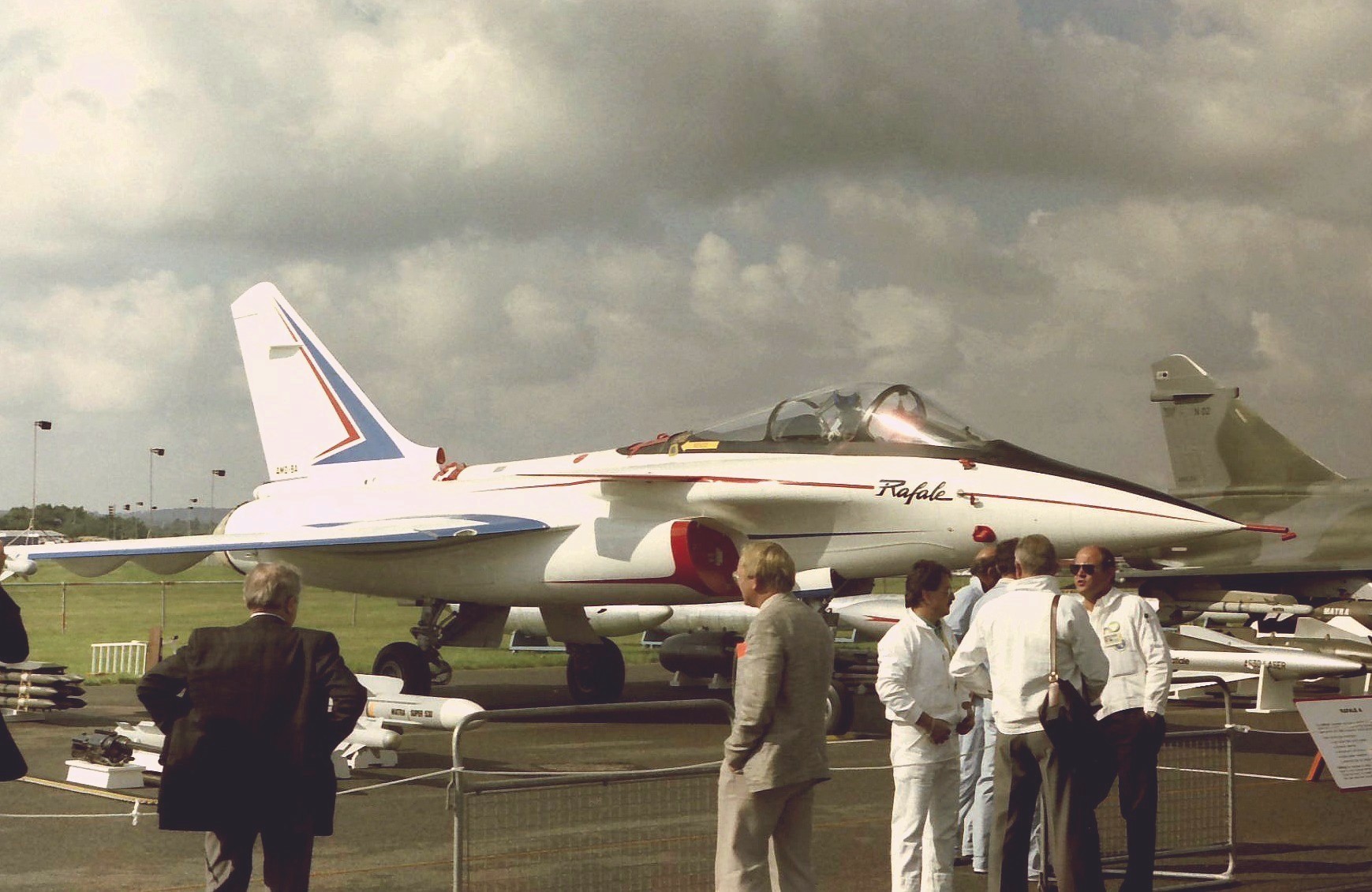
The Rafale A was not the production Rafale. The C01 prototype, with the more compact M88, was a tonne lighter (8.5 against 9.5 t), 50 cm shorter (15.27 against 15.80 m), had 0.34 m less span (10.86 against 11.20 m) and 2.3 m² less wing area (45.70 against 47 m²); it was also almost entirely redesigned to reduce its radar signature, with a smaller fin and relocated intakes. The demonstrator had a single nosewheel (two on the C01), three elevons and three slats per wing, a seat reclined at 32° (29° in production) and 30% non-conventional materials against 50% on the production aircraft. The museum gives it a height of 5.18 m, a loaded mass of 20 t, a service ceiling of 18 km, a range of 2350 km and 6800 kg of external stores.
On 24 January 1994, flying in formation with the four development prototypes C01, B01, M01 and M02, the Rafale A made its 867th and final flight. It was taken by road to the Musée de l'Air et de l'Espace, which added it to its collections on 29 April 2009; the restoration workshops reassembled it and it spent more than a year in storage at Dugny, shown to the public on European Heritage Days, before going on display among the museum's prototypes.
Multimedia


