Canadair CT-114 Tutor variant
Canadair CT-114 Tutor (Snowbirds)
The CT-114 Tutors of the training fleet fitted to the standard of 431 Air Demonstration Squadron, the Snowbirds, who flew them from 1971 to 2026: smoke system, unique paint scheme, tuned engine and luggage bays. Not a factory designation but an in-service modification standard.

History
The Snowbirds' CT-114 Tutors are not a separate factory series: they are aircraft from the Canadian air force training fleet fitted to the standard of 431 Air Demonstration Squadron, Canada's national aerobatic team. Since 1971 the Tutor has been the only aircraft the team has ever flown, and the 2026 season, its 55th anniversary, was announced as the type's last.
The roots lie in the Golden Centennaires, the team formed in 1967 for Canada's centennial, for which ten Tutors were modified as formation aerobatic aircraft; when that team was disbanded at the end of the season, the aircraft returned to training. In 1969 Colonel O. B. Philp, base commander of CFB Moose Jaw and former commander of the Golden Centennaires, considered using the leftover Golden Centennaire Tutors, which were still fitted for aerobatic flying and, because of some minor corrosion, had been painted with white anti-corrosive paint. He was not given approval for a new team, but single Tutors were cleared for flypasts, and he began informal formation practice with the instructors of 2 Canadian Forces Flying Training School. In 1970 four-aircraft formations were already flying past fairs, festivals and Armed Forces Day at Moose Jaw; in July that year a white Tutor joined the formation, and four white Tutors flew together at the Abbotsford Air Show. Known as the "2 Canadian Forces Flying Training School Formation Team", or informally the "Tutor Whites", the group grew in 1971 to seven aircraft and eleven pilots.
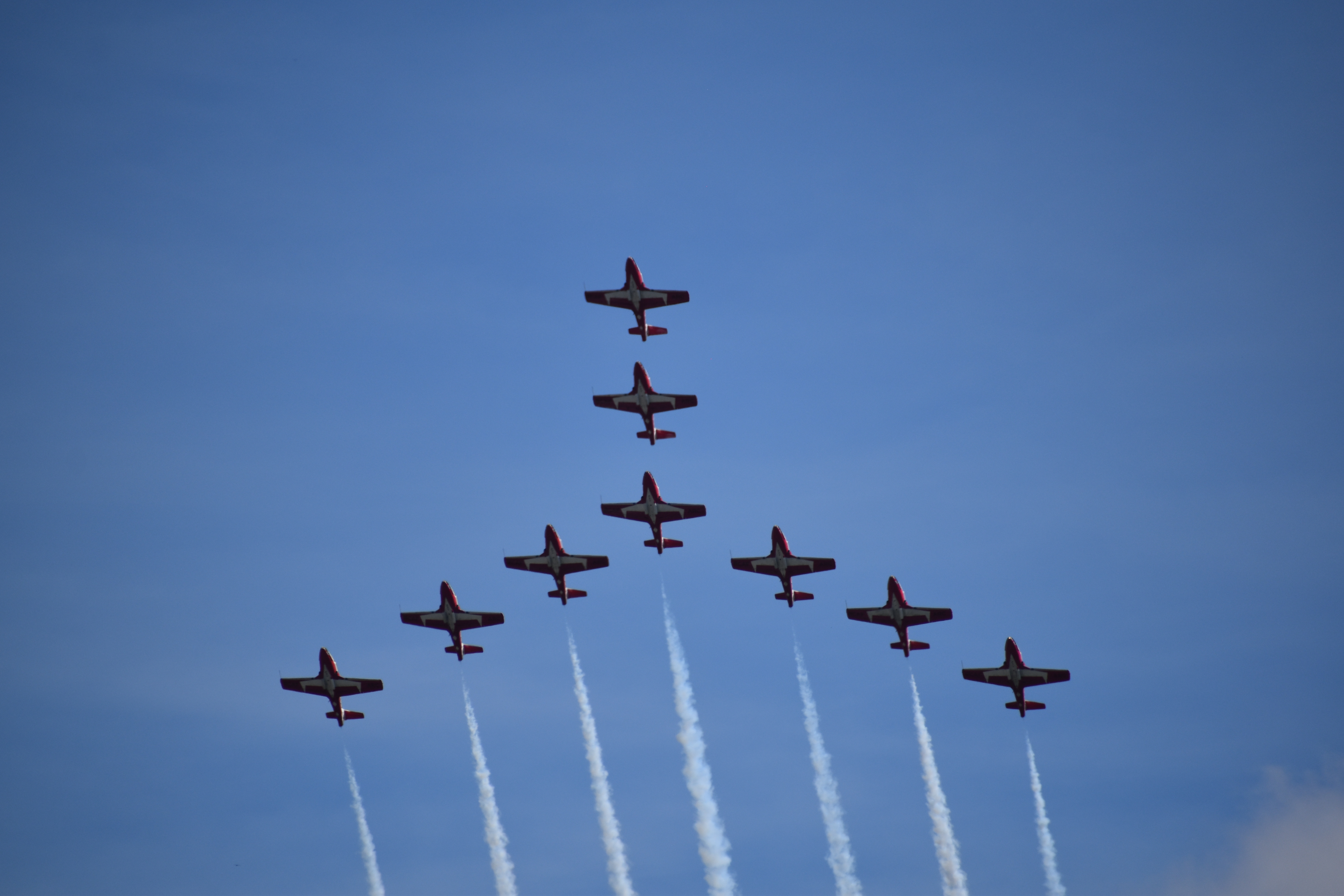
The name came from a contest at Bushell Park Elementary School on the base: "Snowbirds" reflected the mostly white paint scheme of the time and was formally adopted on 25 June 1971. The first show under that name was flown on 11 July 1971 at Moose Jaw, and the first abroad on 27 November 1971 at Williams Air Force Base near Phoenix, Arizona. On 15 January 1975 the team was authorised as the Canadian Forces Air Demonstration Team, and on 1 April 1978 it became a squadron when 431 Squadron was reactivated as 431 Air Demonstration Squadron.
The main modification is the smoke generating system, with a pair of under-fuselage pods for the pressurised diesel fuel; red dye was soon dropped because it proved highly corrosive, although coloured smoke returned on special occasions such as the opening ceremonies of the 1988 Calgary Winter Olympics and the team's 20th anniversary in 1990. To this are added a unique paint scheme and a highly tuned engine for greater responsiveness at low level. These modifications are routinely installed and removed, because airframes are regularly cycled with the training fleet, letting the team fly aircraft with comparatively low accumulated hours. Display pilots reportedly flew with above-average nose-down trim so that pushing the stick became unnecessary. The Snowbirds have no support aircraft: spares and luggage travel in storage areas in the nose and wing root, and an 18-wheeler mobile support unit follows the team across the country with the rest of the equipment.
The formation is nine CT-114s, plus two spare aircraft whose pilots provide the show commentary. The team flies between 190 and 590 km/h, with 1.8 m separation in many formations; according to journalist Guy Norris, its hallmark is physically demanding formation flying and locally developed manoeuvres such as the Big Goose. It was the first aerobatic team in the world to use music in its shows. In 1974 it flew a midnight show at Inuvik, north of the Arctic Circle, and in 1993 it performed at Zapopan near Guadalajara, Mexico; its record stands at nearly 2900 official shows and more than a thousand flypasts before more than 150 million spectators.
Accidents have killed seven pilots and two passengers: among them the collision between the two solos at Trenton on 10 June 1972, the horizontal stabiliser failure at Grande Prairie on 3 May 1978, the midair collision over Lake Ontario on 3 September 1989, the training collisions of 1998 and 2004 and the crashes of 2007 and 2008. On 17 May 2020, during the pandemic tour "Operation Inspiration", aircraft 114161, then 57 years old, crashed at Kamloops after an engine stall caused by a bird strike; Captain Jennifer Casey was killed and the pilot was seriously injured. After that crash and another in October 2019, limits on altitude, speed and runway length were tightened and maintenance and inspections were increased.

Ageing shaped the final decades: a 2003 study advised retiring the aircraft by 2010, a 2008 review extended them to 2020, and the 2015 report "CT-114 Life Extension Beyond 2020" outlined new ejection seats, wing components and brakes. With the replacement project discontinued, a life extension programme run by L3Harris was to take them to 2030 with modernised avionics and an upgraded escape system. On 19 May 2026 it was announced that the team would be grounded after the 2026 season until it receives the CT-157 Siskin II, a version of the Pilatus PC-21, by 2030 or later.
Multimedia


