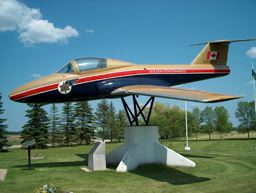
Canadair CT-114 Tutor variant
Canadair CT-114 Tutor CL-41
The two prototypes with which Canadair developed and demonstrated the CL-41 as a private venture, registered as civil aircraft CF-LTW-X and CF-LTX-X. They flew with a Pratt & Whitney JT12A-5 turbojet, and the first took off on 13 January 1960, opening the way to the order for 190 CL-41As for the RCAF.

- January 13, 1960
- First flight
- 2
- Units built
- 2,157 km
- Range
History
During the 1950s, Montreal-based Canadair Limited had prospered by adapting American designs for the Royal Canadian Air Force (RCAF), such as the CL-13 Sabre and the CT-133 Silver Star, the Canadian development of the Lockheed T-33 trainer. The CL-41 was the first aircraft the company designed from scratch, and it began as a private venture: Canadair developed it in the second half of the decade in the hope that the RCAF would buy it to replace its piston-powered trainers and to train the pilots who would fly the newly acquired F-86 Sabre. Much like the American Cessna T-37 Tweet, it was meant to be a student's introduction to jet flying after learning on light piston aircraft, and it was intended to cover everything from elementary jet training up to advanced levels.
The design came from the company's in-house Preliminary Design department. By August 1957 the basic configuration had been settled: a single-turbojet, low-wing aircraft with a tricycle undercarriage and a side-by-side cockpit. Although the Canadian Government gave the effort no official backing, the Jet Trainer Liaison Committee of the RCAF's Directorate of Training worked closely with Canadair, and its involvement reportedly had a significant impact on the final design. Many controls were the same as the Sabre's, but both seats had identical controls so that the instructor, on the right, could monitor the student or take over if necessary. The Government and Canadair financed two flight-capable prototypes and several static test airframes, whose construction began in November 1957, in some secrecy, at Plant 4 of the Missiles and Systems Division.
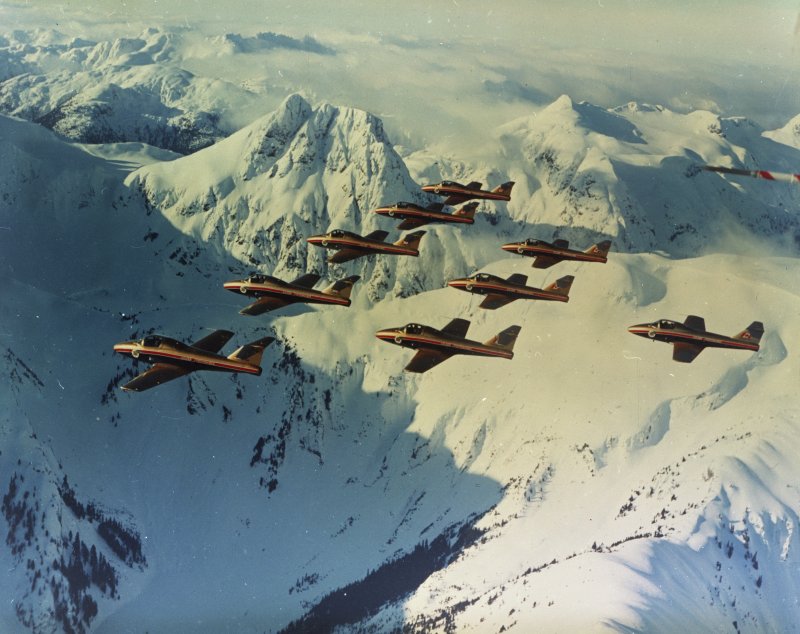
By 1958 the two prototypes, CF-LTW-X and CF-LTX-X, were complete except for their engines. The fuselage had been designed to take a range of engines without structural modification, and the Armstrong Siddeley Viper ASV11, the Continental Gabizo, the Rolls-Royce RB.108, the Fairchild J83-R-1 and the General Electric J85 were all studied. Availability problems and the cancellation of several engine programmes led to the prototypes being fitted with the Pratt & Whitney JT12A-5. The first flight, originally planned for early 1959, slipped because of engine development: the first JT12 was installed on 18 September 1959 (a date the National Air Force Museum of Canada instead gives as the aircraft's manufacture date) and, after further testing, the aircraft was expected to fly in December, but mechanical issues pushed it back. On 13 January 1960 project pilot Ian MacTavish finally took CF-LTW-X aloft near Montreal.
In March 1960 an RCAF survey team, which had already evaluated trainers from France, the United States and the United Kingdom, flew the prototype over the course of one week; according to historian Bill Upton, those who flew it universally praised its handling and performance. The prototypes went through an extensive test regime, part of it outside the usual scope of such work. On 11 September 1961 Minister of National Defence D. S. Harkness announced an initial order for 190 CL-41As, more than a year and a half after the first flight; the production aircraft replaced the JT12 with the J85 without any redesign, and began arriving in 1963 at 425,000 Canadian dollars each.
Prototype 000 (CF-LTW-X) carried on as a testbed through a number of redesigns and engine variants. In 1971 it was loaned to Canadair for the London to Victoria air race, held to mark the centennial of British Columbia joining Confederation. It was later mounted on a plinth at CFB Portage la Prairie, Manitoba, painted in Golden Centennaires colours with the number 114000, until in 2013 the National Air Force Museum of Canada acquired it and moved it to Trenton for restoration; other sources, such as Wikipedia's list of survivors, still place it at Portage la Prairie. The second prototype, CF-LTX-X, received the radar nose of a CF-104, became the sole CL-41R and was shown at the 1963 Paris Air Show; today it is in the reserve collection of the Reynolds-Alberta Museum in Wetaskiwin, Alberta.
Multimedia