Bristol Britannia variant
Bristol Britannia 312
Long-range production version of the Series 310 for BOAC: 18 aircraft delivered from September 1957, with which the airline opened in December of that year the first non-stop turboprop transatlantic services between London and North America.

- 18
- Units built
- 7,130 km
- Range
- 139
- Passengers
History
The Britannia 312 was the long-range production version of the Bristol Type 175 and the aircraft that defined the Series 310: as the 305, but with strengthened fuselage skin and undercarriage and long-range fuel capacity, which is why it was originally known as the 300LR. The family produced a single prototype, the 311, and the 312 was the production model built for BOAC, of which 18 were completed. Its development carried the long and troubled gestation of the Britannia: the second prototype, G-ALRX, was lost in February 1954 after a failed reduction gear led to an engine fire and a landing on the mudflats of the Severn Estuary, and the Proteus turboprops proved susceptible to inlet icing, a problem only mitigated by selecting a different cruising height. With the modified Proteus 765, which greatly reduced breakdowns, a full Certificate of Airworthiness was awarded at the end of 1955, and the Series 100 did not enter service with BOAC until February 1957, roughly two years late.
The 312 came out of that original order: of the 25 Britannia 102s BOAC had ordered, the last ten were cancelled in favour of the Series 300 for transatlantic flights, and the order for seven Model 302s was never taken up either. Deliveries of the 312s began in September 1957, and on 19 December 1957 BOAC introduced the type on the first-ever non-stop flight from London to Canada; in late December of the same year regular London–New York services began. Sources differ slightly here: according to aviastar, 19 December 1957 was the date on which BOAC began the first turbine-powered North Atlantic service by putting the 312 on the London–New York route, and on that same day El Al flew a Britannia 10,328 km non-stop from New York to Tel Aviv. In 1959 BOAC extended the Britannia network across the Pacific to Tokyo and Hong Kong, with the westbound routing London–New York–San Francisco–Honolulu–Wake Island–Tokyo–Hong Kong, thereby closing a round-the-world network. In March 1964 BOAC owned 50 aircraft, ten of them Britannia 312s.
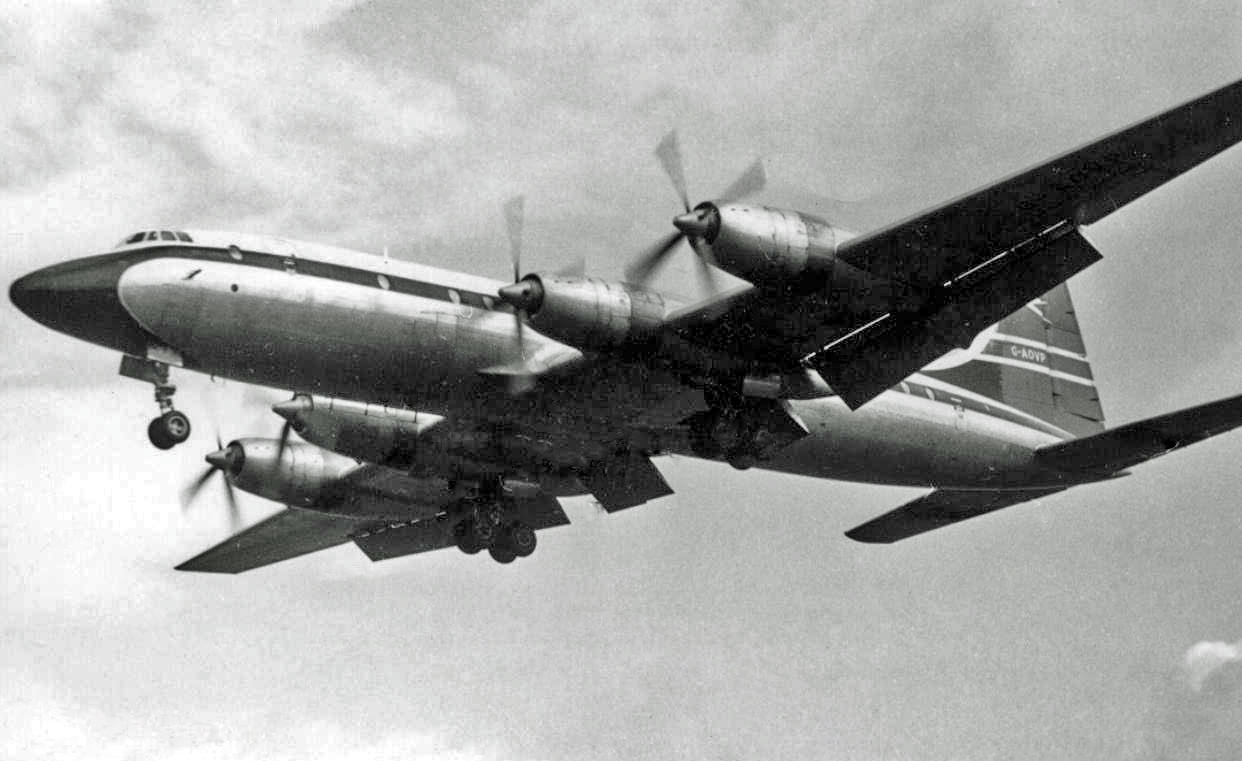
The series also suffered the best-remembered accident of the BOAC fleet. On 24 December 1958 G-AOVD, a 312 on a test flight to renew its certificate of airworthiness, departed London Heathrow at 10:10 with twelve people on board, five of them crew; at about 11:55 the crew requested descent from 12,000 to 3,000 feet for an approach to Hurn Airport, and three minutes later the aircraft struck the ground in a field near Winkton, Dorset, with the south of England blanketed in thick fog. Two of the five crew and all seven passengers were killed. The investigation found that the crew had misread the three-pointer altimeter, believing they were at 11,500 feet when they were at only 1,500, and flew the aircraft into ground hidden by fog. The Ministry of Transport ordered all three-pointer altimeters replaced in British-registered aircraft operating above 20,000 feet before September 1959, and from this and similar incidents came the requirement for altimeters to display a chequered flag below 1,500 feet. A year earlier, on 6 November 1957, the Series 300 prototype had been lost at Downend, near Bristol, with fifteen dead, in a crash whose cause was never fully established and in which the autopilot could not be ruled out.
The 312's career with BOAC was short, because by the time development was complete the pure jets from France, the United Kingdom and the United States were about to enter service and, against the Boeing 707, the turboprop airliner had become passé; only 85 Britannias were built before production ended in 1960. The ex-BOAC aircraft passed to the British independents. British Eagle launched daily London Heathrow–Glasgow services in November 1963 with 103-seat, two-class Britannias, the inaugural flown by ex-BOAC Britannia 310 Enterprise, followed by Edinburgh and Belfast, and leased two more aircraft from BOAC for extra capacity. On 29 February 1964 one of its 312s, G-AOVO, operating flight EG 802/6 from London Heathrow to Innsbruck, hit the steep eastern flank of the Glungezer at 8,500 ft on final approach through cloud, killing all 83 people aboard. Caledonian Airways received its first turboprops in December 1964, a pair of ex-BOAC Britannia 300s, went on to operate nine and disposed of the last in May 1971. Monarch Airlines started with two ex-Caledonian Britannias at Luton, in 1969 added more aircraft from the administrators of the failed British Eagle to reach six, retired its last passenger-configured Britannia in 1974 — flying the type's final commercial passenger flight in Europe on 9 October that year — and sold its last one to the Greek cargo carrier Afrek on 21 May 1976. During the 1960s five 312s were converted to 312F freighters and another became the 319 for Ghana Airways.
Two 312s survive: G-AOVF is displayed at the Royal Air Force Museum Cosford in RAF Air Support Command colours as XM497 Schedar, and G-AOVT, in Monarch livery, at the Imperial War Museum Duxford; the fuselage of 312F G-AOVS lies derelict on the fire training dump at London Luton Airport in Redcoat Air Cargo colours. In Series 310 figures: length 37.87 m, wingspan 43.36 m, height 11.43 m, wing area 192.8 m², maximum take-off weight 185,000 lb (83,915 kg), four Proteus 765 turboprops of 4,450 shp equivalent each, maximum speed 639 km/h, cruise 575 km/h at 22,000 ft and up to 139 passengers in coach class.
Multimedia


-1600.webp)
-1600.webp)