Boeing KC-135 Stratotanker variant
Boeing KC-135 Stratotanker KC-135R
KC-135As and some KC-135Es re-engined with CFM56 (F108) turbofans: more fuel to offload, lower fuel burn and noise; the main Stratotanker version in service.
Boeing KC-135 Stratotanker sheet

- 2,400 km
- Range
- 80
- Passengers
History
The KC-135R is the CFM56-powered Stratotanker and the version that has carried the type into its seventh decade of service. It is not a new-build aircraft: the designation was given to KC-135As, and to some KC-135Es, re-engined in the second and largest modification programme applied to the fleet. That programme replaced the original powerplants with CFM International CFM56 high-bypass turbofans, known by the military designation F108 and produced jointly by General Electric and Safran. The English-language sources give two figures for its scope that measure different things: 500 aircraft retrofitted across the whole programme, which also covered the KC-135Q tankers that became KC-135Ts, and more than 417 airframes converted to the R standard itself. The Spanish-language article speaks of more than 420 KC-135As fitted with the new engines.
The gain was considerable. The CFM56 delivers 22,000 lbf (98 kN) of thrust, nearly double that of the J57 turbojet it replaced; the specification table for the KC-135R lists the F108-CF-100 at 21,600 lbf (96.2 kN). Re-engined, the tanker can offload up to 50% more fuel on a long-duration sortie, is 25% more fuel-efficient and costs 25% less to operate than with the earlier engines. It is also far quieter: take-off noise fell from 126 to 99 decibels, a 27-decibel reduction that leaves a sound pressure level of roughly 5% of the original. For comparable fuel offloads, the KC-135R's operational range is 60% greater than that of the KC-135E, which gives planners a wider choice of bases.
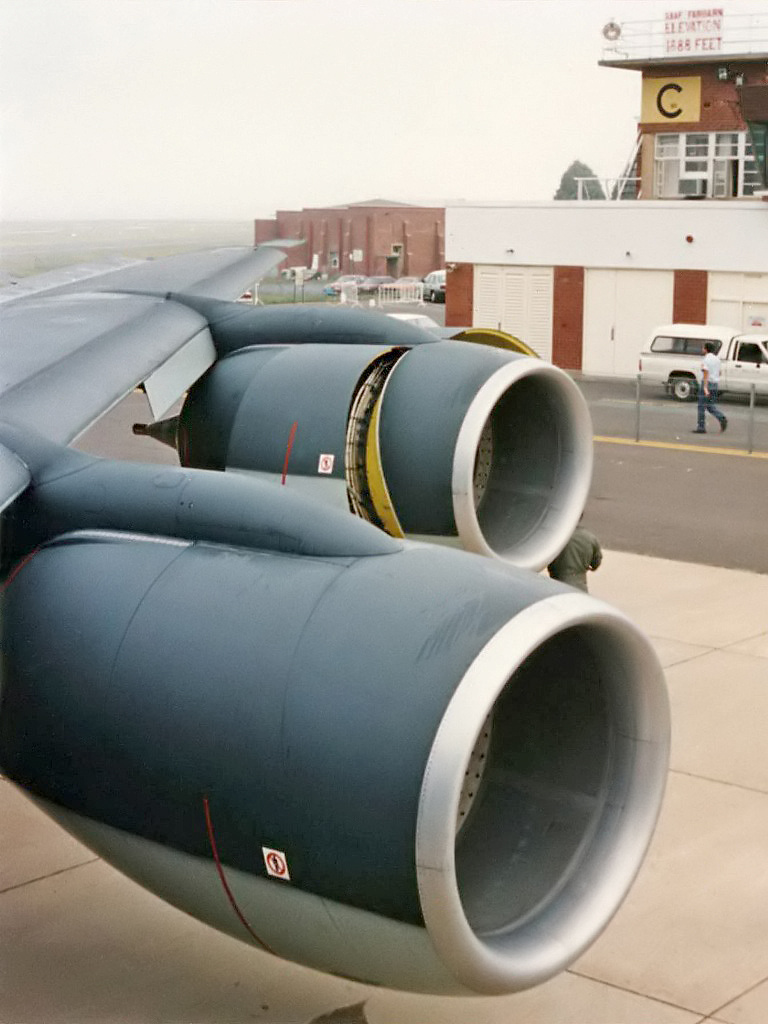
The airframe keeps the classic Stratotanker layout. Four turbofans hang under wings swept at 35 degrees and lift the aircraft at gross weights of up to 322,500 pounds (146,300 kg). Nearly all of the internal fuel can be pumped through the flying boom, the primary transfer method, controlled by a boom operator who lies prone in the rear fuselage and watches the receiver through a window at the bottom of the tail, an arrangement inherited from the KC-97. The basic crew is three, pilot, co-pilot and boom operator, with a navigator added on some missions, and the cabin can take up to 80 passengers or six 463L pallets.
The R fleet has gone through successive avionics programmes. Pacer-CRAG (compass, radar and GPS), run from 1999 to 2002, removed the navigator's station from the standard crew and replaced the fuel-management system; Rockwell Collins developed it and BAE Systems installed it at Mojave. Block 40.6 brought compliance with global air-traffic management, and Block 45 added a glass cockpit with digital displays, a radio altimeter, a digital autopilot and flight director and new computers, replacing analogue instruments that could no longer be procured; the first 45 upgraded aircraft had been delivered by January 2017, with the work done at Tinker AFB. The Multi-point Refueling Systems modification hangs Flight Refueling Limited MK.32B pods under the wings, so that Navy, Marine Corps and most NATO tactical jets can refuel by probe and drogue while the tail boom is retained, and two receivers can be served at once. Eight aircraft were further modified to receive fuel themselves, the KC-135R(RT).
The R model has also been the hardest-worked member of the family. In 2006 the KC-135R fleet averaged 710 flying hours per aircraft per year, against 350 for the KC-135E. The USAF set a lifetime limit of 39,000 hours for the R, against 36,000 for the E, and projected that only a few aircraft would reach it by 2040. A 2005 study estimated that KC-135Es brought up to R standard could serve until 2030, but converting the remaining Es was finally dropped: it would have cost around US$3 billion, some $24 million per aircraft. In fiscal year 2001 the R models averaged about $3.7 million per aircraft in total costs, against $4.6 million for the E.
Outside the United States, the Republic of Singapore Air Force received four former USAF KC-135Rs from September 1999 and used them occasionally for VIP, aeromedical and support flights until June 2019, when six Airbus A330 MRTTs replaced them. The Turkish Air Force operates seven. Israel, offered KC-135s again in 2013, rejected the KC-135E but said it would consider up to a dozen of the newer R models. The private company Metrea, formerly Meta Aerospace, bought the four Singaporean aircraft in October 2020 and took delivery in late 2020; with eleven more purchased from the French Air and Space Force in June 2024, it lists fifteen KC-135Rs.

The type's record includes several losses. On 10 December 1993 a Wisconsin Air National Guard KC-135R, 57-1470, exploded during routine ground maintenance at General Mitchell ANGB because of an overheated fuel pump, killing six maintenance NCOs. On 7 April 1999, 57-1418 was destroyed at Tinker AFB during a cabin pressurisation check, its relief valves having been left secured after earlier maintenance; nobody was hurt. On 26 September 2006, 63-8886 was struck at Manas Air Base by an Altyn Air Tu-154 taking off, and was written off. On 3 May 2013, 63-8877 broke up in flight after leaving Manas when an unrecognised Dutch roll, caused by a rudder power control unit malfunction, overstressed the tail; its three crew died near Chorgolu, Kyrgyzstan. On 12 March 2026 two KC-135Rs, believed to be 63-8017 and 60-0347, collided over western Iraq during the 2026 Iran war; 63-8017 landed at Ben Gurion, while U.S. Central Command confirmed the next day that all six aboard 60-0347 had died. KC-135R 60-0329 is displayed in the Air Park of the National Museum of the United States Air Force at Dayton, Ohio.
Multimedia


Elsewhere


Where to see it today
| Serial | Place | City | Country | Status |
|---|---|---|---|---|
| 60-0329 | National Museum of the United States Air Force | Dayton | United States | On display |
List reviewed on October 31, 2026 against Wikipedia (EN): Boeing KC-135 Stratotanker, Aerial Visuals Airframe Dossier.