Boeing KC-135 Stratotanker variant
Boeing KC-135 Stratotanker KC-135E
Air National Guard and Air Force Reserve KC-135As re-engined in the 1980s with TF33-PW-102 turbofans from retired Boeing 707s; the only Stratotanker with thrust reversers, retired in 2009.
Boeing KC-135 Stratotanker sheet

History
The KC-135E was the first major re-engining of the Stratotanker and the version that kept the Air National Guard and Air Force Reserve tanker squadrons flying through the 1980s and 1990s. All KC-135s had been delivered with Pratt & Whitney J57-P-59W turbojets, rated at 10,000 lbf (44 kN) dry and about 13,000 lbf (58 kN) with water injection on take-off, a technique that used 670 US gallons of water over three minutes. In the 1980s the first modification programme took KC-135As belonging to the reserve components and fitted them with Pratt & Whitney TF33-PW-102 turbofans removed from Boeing 707 airliners retired in the late 1970s and early 1980s. The English-language article gives two totals: 157 tankers in its section on engine retrofits and 161 in its list of variants; the Spanish-language article also gives 157.
The second-hand engines brought a clear improvement. The KC-135E was 14% more fuel-efficient than the KC-135A and could offload 20% more fuel on long-duration flights. It was also the only Stratotanker version fitted with thrust reversers, useful on aborted take-offs and for shorter landing rolls. It was, however, an interim solution: for comparable fuel offloads the CFM56-powered KC-135R that followed has an operational range 60% greater than the E's. The KC-135D, the four former RC-135A photo-mapping aircraft, was brought to the same standard in 1990 with TF33 engines and a KC-135E-style cockpit update, and the KC-135E airframe 55-3132, as the test-configured NKC-135E Big Crow I, served as an airborne target for the Boeing YAL-1 Airborne Laser.
The E model's later years were dominated by cost and age. In 2006 the KC-135E fleet averaged 350 flying hours per aircraft per year, against 710 for the KC-135R. The USAF set its lifetime limit at 36,000 hours, against 39,000 for the R, and a 2005 study estimated that KC-135Es upgraded to R standard could remain in use until 2030. That conversion was finally ruled out: re-engining the remaining E models would have cost around US$3 billion, some $24 million per aircraft. In fiscal year 2001 the older E models averaged about $4.6 million per aircraft in total operating and support costs, including personnel, fuel, maintenance, modifications and spare parts, against about $3.7 million for the R.
The fleet was therefore either converted to the R configuration or placed in long-term storage, coded XJ, because Congress had prevented the Air Force from formally retiring the aircraft. All E models were withdrawn to the 309th Aerospace Maintenance and Regeneration Group at Davis-Monthan AFB, Arizona, by September 2009, when the 101st Air Refueling Wing delivered the last one, tail number 56-3630, and were replaced by R models. The type found a second life abroad: the Chilean Air Force operates three KC-135Es and received the first in February 2010. Israel, by contrast, had turned down ageing KC-135s twice because of the cost of keeping them flying, and when they were offered again in 2013 it rejected the KC-135E, saying it would consider up to a dozen of the newer R models instead.
The E fleet's record includes several notable accidents. A KC-135E, 57-1481, exploded on the ground at Eielson AFB, Alaska, because of an overheated fuel pump while the crew was shutting down the engines, and two of the seven on board were killed. On 11 January 1990, 59-1494 caught fire on the ramp at Pease Air National Guard Base during maintenance and was destroyed, without injuries. On 6 February 1991, over Saudi Arabia, 58-0013 flew into severe wake turbulence from another KC-135 and lost both engines on its left wing; the crew recovered the aircraft and landed it, it was repaired and returned to service, and the whole crew received the Distinguished Flying Cross. On 13 January 1999 a Washington Air National Guard KC-135E, 59-1452, crashed on approach at Geilenkirchen, Germany, with its horizontal stabiliser trimmed 7.5 degrees nose-up, killing all four crew.
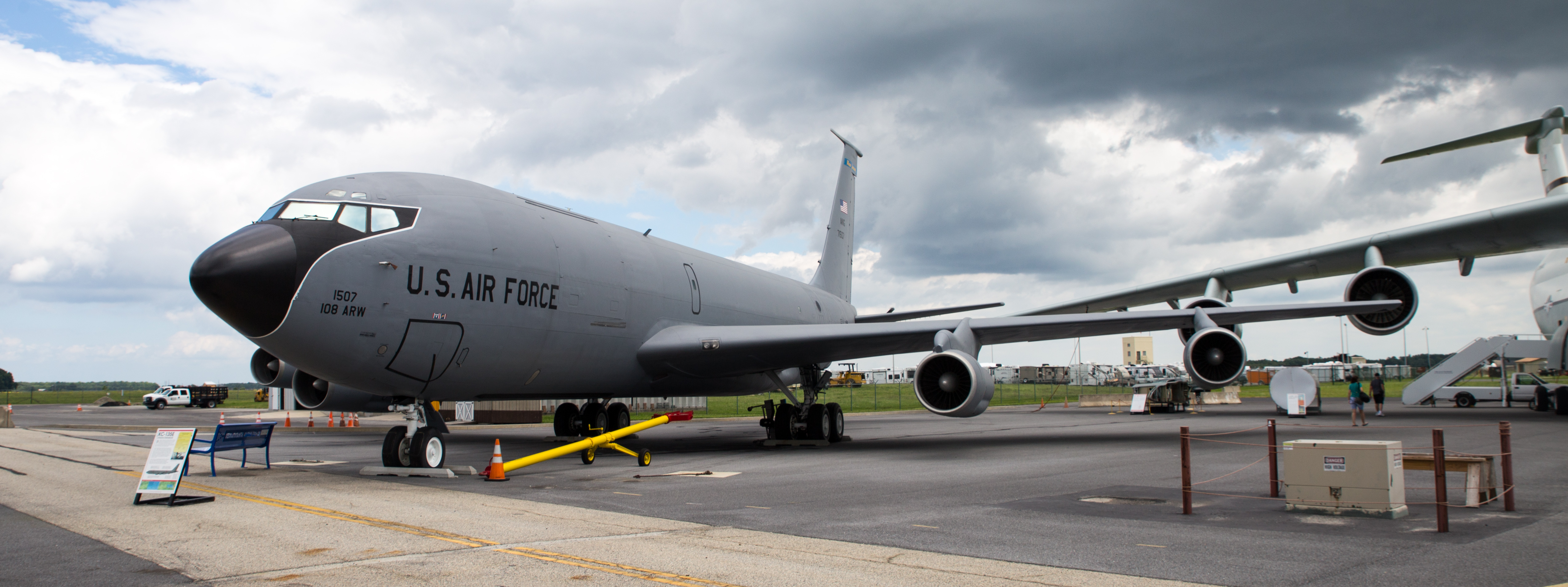
Many retired E models are now on display. Examples include 56-3611 at the Scott Field Heritage Air Park and 59-1487 at the 126th Air Refueling Wing complex, both at Scott AFB, Illinois; 56-3658 Iron Eagle at the Kansas Aviation Museum; 57-1429 at the Museum of the Kansas National Guard at Forbes Field, Topeka; 57-1455 at Pease ANGB, New Hampshire; 57-1458 at Eielson AFB, Alaska; 57-1507 at the Air Mobility Command Museum at Dover AFB, Delaware; 57-1510 Never Forget at the Hill Aerospace Museum, Utah; and 59-1497 at Joint Base McGuire-Dix-Lakehurst, New Jersey, while 57-1495 is stored at Lincoln ANGB, Nebraska.
Multimedia


Elsewhere


Where to see it today
| Serial | Place | City | Country | Status |
|---|---|---|---|---|
| 57-1507 | Air Mobility Command Museum | Dover | United States | On display |
| 57-1510 «Never Forget» | Hill Aerospace Museum | Roy | United States | On display |
| 59-1497 | Joint Base McGuire-Dix-Lakehurst | Browns Mills | United States | On display |
| 56-3658 «Iron Eagle» | Kansas Aviation Museum | Wichita | United States | On display |
| 57-1429 | Museum of the Kansas National Guard | Topeka | United States | On display |
| 56-3611 | Scott Field Heritage Air Park | Shiloh | United States | On display |
List reviewed on October 31, 2026 against Wikipedia (EN): Boeing KC-135 Stratotanker, Aerial Visuals Airframe Dossier, Aerial Visuals Airframe Dossier, Aerial Visuals Airframe Dossier, Aerial Visuals Airframe Dossier, Aerial Visuals Airframe Dossier, Aerial Visuals Airframe Dossier, Living History Registry (actualizado 2021-02-07).