Transport · Military · United States
Boeing KC-135 Stratotanker
- August 31, 1956
- First flight
- 1957
- Introduced
- In service
- Status
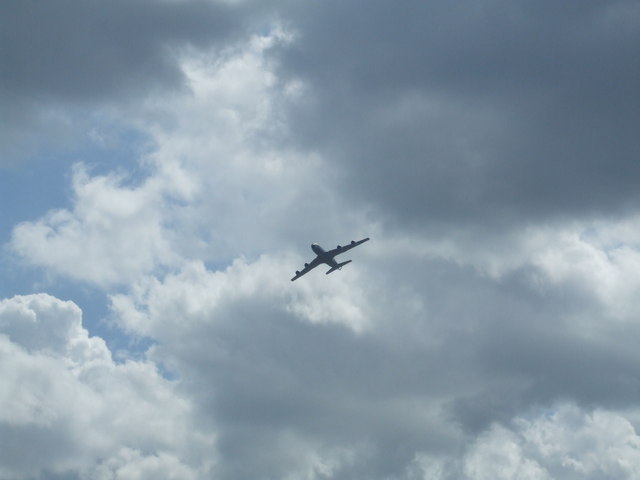


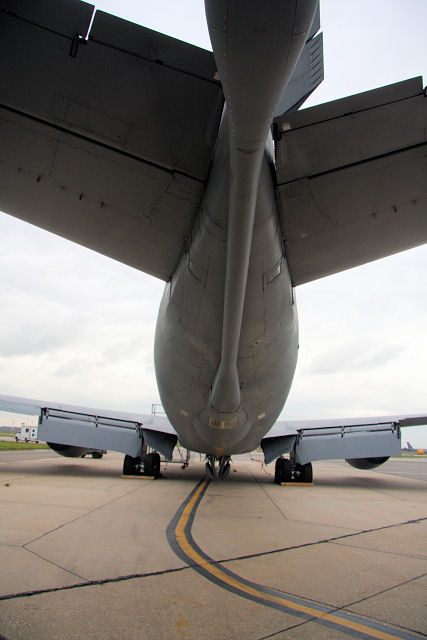

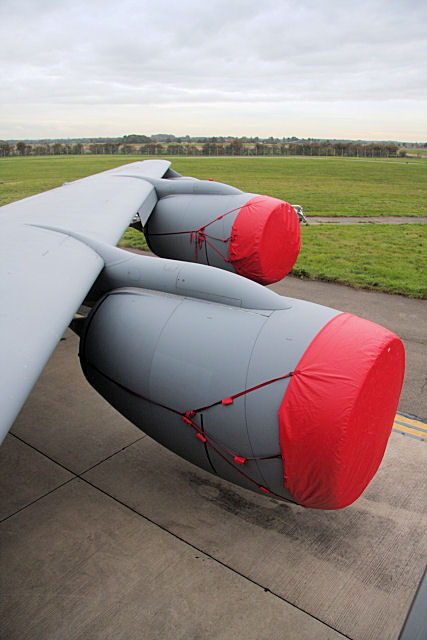


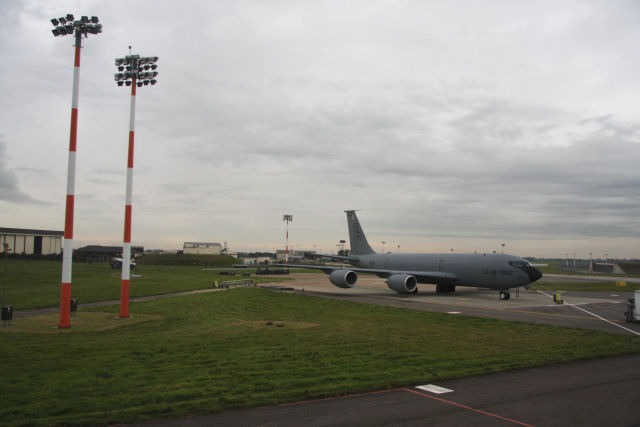


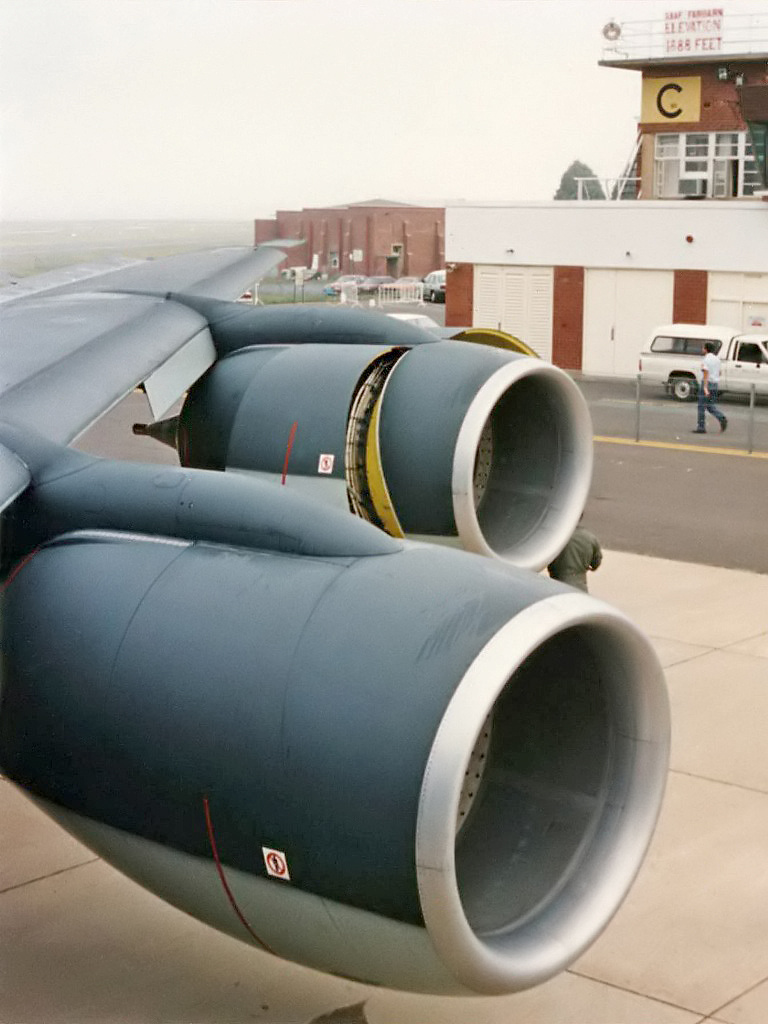


The Boeing KC-135 Stratotanker is the jet tanker with which the United States Air Force left piston-engined tankers behind. It grew out of the same demonstrator as the Boeing 707, the 367-80 or "Dash-80", but it is not a militarised 707: it has a narrower, shorter fuselage and a structure of its own, and Boeing gave it the internal designation Model 717. It first flew on 31 August 1956, entered service with Strategic Air Command in 1957, and the last example was delivered in 1965, as part of a C-135 family that exceeded 820 aircraft. Designed to refuel nuclear bombers, it became a force multiplier for tactical fighters and bombers over Vietnam and has taken part in every American air campaign since. Two re-engining programmes (TF33 on the E model, CFM56 on the R and T) and several avionics upgrades have kept it in the front line for almost seven decades, while the KC-46 Pegasus gradually takes over.
Related events
Related sheets
Category
Boeing KC-135 Stratotanker in the news
In a brief statement on its official website, the Chilean Air Force (FACh) announced that it deployed F-16 fighters, KC-135 refueling aircraft, and early-warning…

Lockheed Martin F-16 fighters and Embraer A-29B Super Tucano advanced training and light attack aircraft, the latter from Aviation Group No. 1 of the I Air Brigade, arrived at the base…
The skies over the Chilean capital drew attention on Monday 26 October due to a display of air capabilities carried out by the Chilean Air Force…
KC-135 The Boeing Company’s model 367-80 was the basic design for the commercial 707 passenger plane as well as the KC-135A Stratotanker. In 1954, the Air Force purchased the first 29 of its future…
A $14 billion spares shortfall for such aircraft as the Lockheed Martin [LMT] F-35A fighter and the 1950s-era KC-135 tanker and B-52 bomber by Boeing [BA] is a major challenge […]


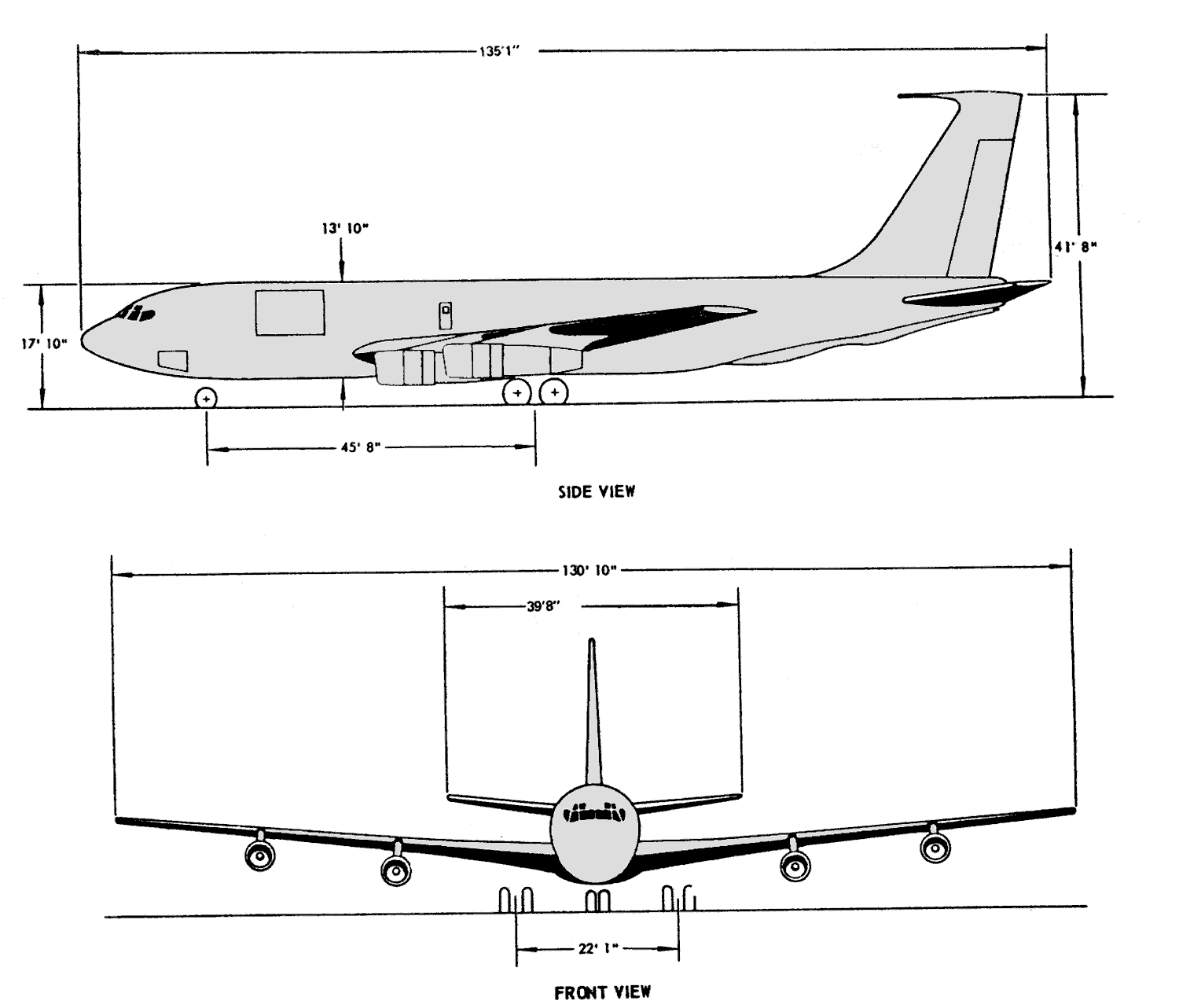
Three-view drawing
History
**A tanker for the jet age**
In the early 1950s the US Air Force's aerial refuelling relied on the Boeing KC-97 Stratofreighter, a piston-engined derivative of the Stratocruiser that already carried the rigid "flying boom" developed by Boeing. The arrangement had two basic flaws. The first was fuel: the KC-97 ran on aviation gasoline and needed separate kerosene tanks for its receivers, an awkward mix that a jet tanker would solve by using one fuel for its own engines and for the offload. The second was speed: with a cruise of about 370 km/h, the KC-97 forced the new jet bombers and fighters to slow right down to hook up to the boom.
The answer came from an aircraft Boeing had built at its own risk: the 367-80, the "Dash-80", the jet transport proof-of-concept demonstrator that would also lead to the commercial 707. In 1954 Strategic Air Command (SAC) held a competition for a jet tanker and in 1955 Lockheed's entry, a tanker version of its proposed L-193 airliner with engines on the rear fuselage, was declared the winner. But Boeing's design was already flying and could be delivered about two years earlier, so Air Force Secretary Harold E. Talbott ordered 250 Boeing tankers while the Lockheed design matured. In the end the Air Force chose not to support two tanker types and the Lockheed aircraft was dropped; Lockheed never built its jet airliner and Boeing went on to dominate that market with the 707 family.
The first order, for 29 KC-135As, was placed in 1954. Boeing designated the type Model 717 (the first 29 were Model 717-100A and the following batches of 68 and 635 aircraft were 717-146 and 717-148), a number the company would later reuse for a different aircraft. Although it looks very much like the 707 and 720 from outside, the KC-135 came first and is structurally different: a narrower and shorter fuselage, without the row of cabin windows, and a main deck able to take about 80 passengers or the equivalent cargo, while all the tanker equipment sits on the lower deck. It shares with the family the 35-degree swept wing, the four engines in underwing pods, the horizontal tail with positive dihedral, and the distinctive high-frequency antenna that projects forward from the top of the fin.
The first KC-135A flew on 31 August 1956 and the first production aircraft was delivered to Castle Air Force Base, California, on 28 June 1957. Production moved fast: 732 KC-135As were built, and the last member of the family reached the Air Force in 1965, by which time the C-135 variants as a whole (Stratotanker tankers, Stratolifter transports and special-mission aircraft) exceeded 820 airframes.
**How it works: the boom and the prone operator**
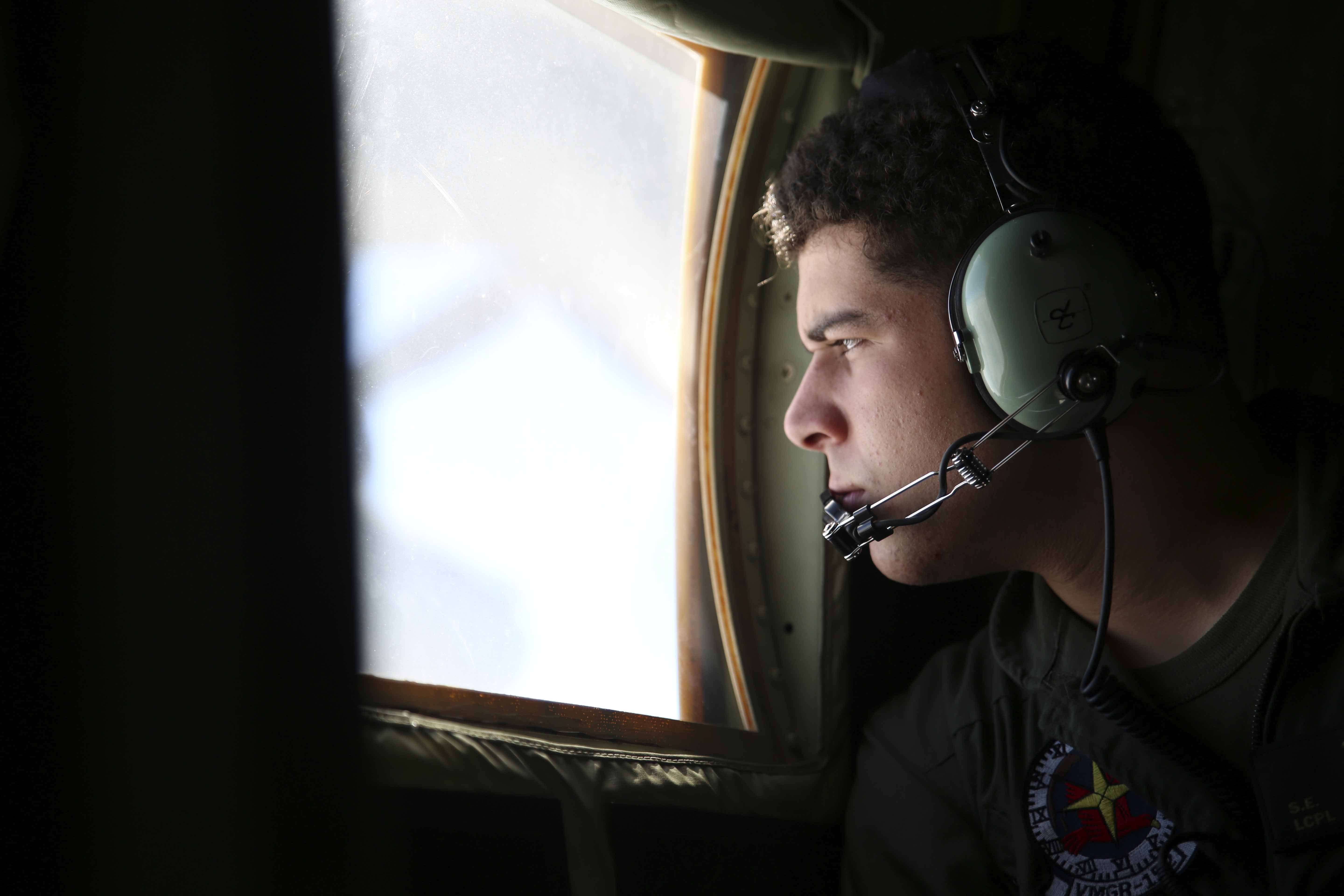
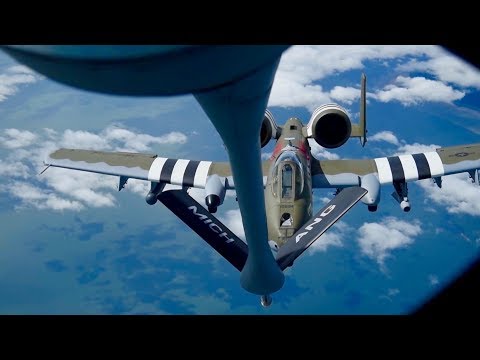
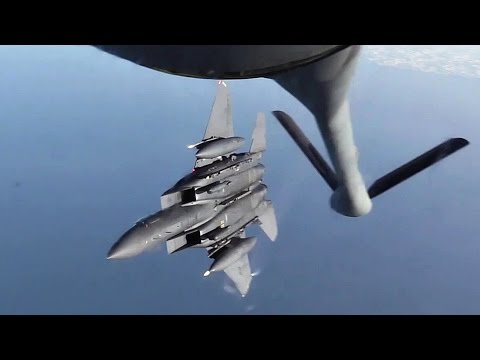
The primary transfer method is the rigid boom. The boom operator rides in the rear of the aircraft lying face down, looking through a window in the underside of the tail while steering the boom into the receiver's receptacle; both the boom and the operator's station descend directly from those of the KC-97. Nearly all of the aircraft's internal fuel can be pumped through it. For probe-equipped aircraft, such as those of the Navy and Marine Corps, a shuttlecock-shaped drogue adapter is fitted to the end of the boom. That adapter is far less forgiving of errors by the receiving pilot than a conventional trailing hose and, while it is fitted, the tanker cannot refuel by boom. That is why the MPRS (Multi-point Refueling System) modification was added later, hanging two Flight Refueling Mk.32B pods under the wings: with them the aircraft keeps its boom and can serve two probe-equipped receivers at the same time. Above the refuelling system there is a cargo deck that can carry a mix of passengers and freight.
**From Strategic Air Command to Vietnam**
The KC-135 was born for SAC: its job was to give the B-52 fleet the reach of its strategic mission. In the late 1960s, in Southeast Asia, the aircraft found another trade. Refuelling F-105 and F-4 fighter-bombers, as well as B-52s, put distant targets within reach and let fighters spend hours over the front rather than the few minutes their fuel reserves allowed. Crews served Air Force, Navy and Marine Corps aircraft, switching to the drogue adapter as the mission required, and more than once they shepherded aircraft with punctured tanks, feeding them fuel while still connected all the way to a runway or to a point where the crew could ditch. That force-multiplier experience was repeated in Desert Storm and every campaign since.
Service with regular SAC units ran from 1957 to 1992; from 1975 aircraft also began to pass to the Air National Guard and the Air Force Reserve. When SAC was inactivated in 1992, most went to the new Air Mobility Command (AMC), and a few to the air forces in Europe and the Pacific and to the training command. In May 2018 AMC managed 396 Stratotankers, of which the Reserve and the Guard flew 243. The KC-135 is one of the few fixed-wing military aircraft with more than sixty years of continuous service with its original operator. The oldest of all, 57-1419, built in 1957, was still flying in 2025 with the 161st Air Refueling Wing of the Arizona Air National Guard at Goldwater, and was the oldest active aircraft in the US military.
**Two engine lives**
Every KC-135 left the factory with Pratt & Whitney J57-P-59W turbojets, giving about 44 kN dry and around 58 kN with water injection. That "wet" thrust came from injecting some 670 US gallons of water into the inlet and diffuser over roughly three minutes of take-off: the water cooled the air, made it denser and lowered the turbine temperature, allowing more fuel to be burned for a short time, much like the war emergency power of piston engines.
The first re-engining came in the 1980s. Reserve and Air National Guard aircraft received TF33-PW-102 turbofans taken from retired 707 airliners: 157 according to the account of the programme, 161 according to the list of variants. These KC-135Es were 14% more fuel-efficient than the A, could offload 20% more fuel on long sorties and were the only aircraft in the fleet with thrust reversers. Their career was short: the Es were either converted to R standard or put into storage, and the last one, 56-3630, was delivered by the 101st Air Refueling Wing to the Davis-Monthan boneyard in September 2009.
The second re-engining was the decisive one. Around 500 aircraft of the family received high-bypass CFM56 turbofans (F108 in military designation), built by General Electric and Safran, with 98 kN of thrust, nearly double the J57. KC-135As and some Es became KC-135Rs (more than 417 conversions) and the KC-135Qs became KC-135Ts. The gain was huge: up to 50% more fuel offloaded on a long sortie, 25% better fuel efficiency, 25% lower operating cost and take-off noise cut from 126 to 99 decibels. The R's operational range is 60% greater than the E's for a comparable offload, which widened the choice of bases from which it could operate.
**A new cockpit for an old aircraft**
The avionics were renewed as well. The Pacer CRAG programme (compass, radar and GPS), from 1999 to 2002, modified the whole fleet and eliminated the navigator position; the fuel-management system was also replaced. Rockwell Collins handled development and BAE Systems the installation at Mojave Airport. Block 40.6 brought the aircraft into line with global air-traffic management, and Block 45 added a glass cockpit with digital displays, a radio altimeter and a digital autopilot and flight director; the first 45 upgraded aircraft had been delivered by January 2017, with the work done at Tinker.
**Variants with a trade of their own**
The KC-135Q was modified to carry the JP-7 fuel of the Lockheed SR-71 Blackbird separately from its own fuel: the fuselage tanks carried JP-7 and the wing tanks JP-4 or JP-8. There were 56 of them; the survivors, once fitted with CFM56 engines, became the 54 KC-135Ts, distinguishable from the R only by a clear window under the tail housing a remote-controlled searchlight. Eight KC-135Rs received a receptacle so that they could themselves be refuelled, the KC-135R(RT), all with the 22nd Air Refueling Wing at McConnell, Kansas, in 1994. Four RC-135As returned to tanker configuration in 1979 as KC-135Ds, and 17 KC-135Bs were built as turbofan-powered airborne command posts. For France, 12 dual-role tanker/transport C-135Fs were built with a drogue adapter on the boom; 11 survivors received F108 engines between 1985 and 1988 as C-135FRs. Many KC-135As and Bs were also converted into command, electronic reconnaissance and observation aircraft of the EC-135, RC-135 and OC-135 families.
**Test bed and "Vomit Comet"**
As the NKC-135, the aircraft also served science. Between 1979 and 1980 an NKC-135A lent to NASA tested at Edwards the wingtip winglets designed by Richard Whitcomb of the Langley centre: they reduced drag and increased range by up to 7% at cruise speed, and today they are found on most new commercial and transport jets. NASA also used several KC-135s without tanker equipment as its zero-gravity aircraft, the famous "Vomit Comet"; the longest-serving, from 1973 to 1995, was 59-1481, named Weightless Wonder IV and registered N930NA. Two KC-135As also served with the Federal Aviation Administration to check navigation aids across the country.
**The long search for a successor**
Keeping such a veteran fleet flying grew ever more expensive: between 1993 and 2003 depot maintenance work doubled and the overhaul cost per aircraft tripled. The Air Force calculated that only a few aircraft would reach their flying-hour limits by around 2040, when some would be about 80 years old, and a 2005 study put 2030 as the horizon for upgraded aircraft. The replacement turned into a saga: the KC-767 lease agreed in 2003 (80 bought and 20 leased) was frozen that same year and cancelled in January 2006 after irregularities in its award came to light; the KC-X competition, opened in January 2007, was won in February 2008 by the EADS/Northrop Grumman KC-30, but the Government Accountability Office upheld Boeing's protest in June 2008. Relaunched in February 2010, the competition was won in February 2011 by Boeing's 767-based tanker, the KC-46, the first of which was delivered in January 2019. France and Singapore, the other users, replaced their Stratotankers with Airbus A330 MRTTs.
**Still at war**
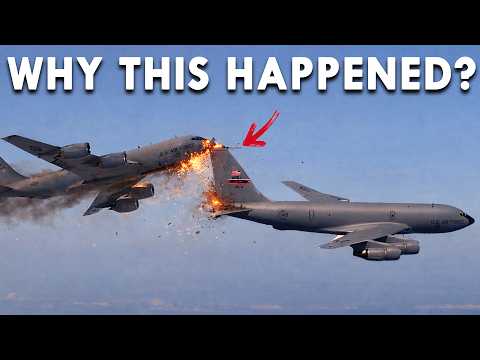
Far from retiring, the KC-135 stayed in the front line. On 28 February 2026 it refuelled aircraft in the joint US-Israeli operation against Iran, for which more than 30 KC-135 and KC-46 tankers were deployed to Israel. On 12 March 2026 a KC-135 crashed in western Iraq, killing all six crew members, in what is thought to have been an incident involving another tanker. According to a Pentagon inspector general report cited by The Intercept, Iranian attacks on US bases in the Middle East destroyed or damaged 12 KC-135s during that conflict. Almost seventy years after its first flight, the Stratotanker remains the backbone of the American tanker fleet while the KC-46 gradually replaces it.
Variants
| KC-135A | KC-135D | KC-135E | KC-135Q | KC-135R | KC-135R (Rivet Stand) | KC-135R(RT) | KC-135T | NKC-135E | |
|---|---|---|---|---|---|---|---|---|---|
| First flight | August 31, 1956 | — | — | — | — | — | — | — | — |
| Aircraft type | — | — | — | — | Aerial refueling tanker and military transport | — | — | — | — |
| Powerplant | — | — | — | — | 4 × CFM International F108-CF-100 (CFM56) turbofans, 96.2 kN thrust each | — | — | — | — |
| Powerplant | 4 × Pratt & Whitney J57-P-59W | 4 × Pratt & Whitney TF33 | 4 × Pratt & Whitney TF33-PW-102 | 4 × Pratt & Whitney J57 | 4 × CFM International F108-CF-100 | 4 × Pratt & Whitney J57 | 4 × CFM International CFM56 (F108) | 4 × CFM International CFM56 (F108) | 4 × turbofan |
| Thrust per engine | 44 kN | — | — | — | 96.2 kN Best value in this row | — | — | — | — |
| Length | — | — | — | — | 41.5 m | — | — | — | — |
| Wingspan | — | — | — | — | 39.9 m | — | — | — | — |
| Height | — | — | — | — | 12.7 m | — | — | — | — |
| Wing area | — | — | — | — | 226 m² | — | — | — | — |
| Empty weight | — | — | — | — | 44,630 kg | — | — | — | — |
| MTOW | — | — | — | — | 146,284 kg | — | — | — | — |
| Top speed | — | — | — | — | 933 km/h | — | — | — | — |
| Cruise speed | — | — | — | — | 850 km/h | — | — | — | — |
| Cruise altitude | — | — | — | — | 9,100 m | — | — | — | — |
| Service ceiling | — | — | — | — | 15,240 m | — | — | — | — |
| Initial climb rate | — | — | — | — | 25 m/s | — | — | — | — |
| Range | — | — | — | — | 2,400 km | — | — | — | — |
| Ferry range | — | — | — | — | 17,727 km | — | — | — | — |
| Range conditions | — | — | — | — | Range with 68,039 kg of transferable fuel; ferry range 17,727 km | — | — | — | — |
| Armament | — | — | — | — | None | — | — | — | — |
| Max weapons load | — | — | — | — | 0 kg | — | — | — | — |
| Payload | — | — | — | — | 38,000 kg | — | — | — | — |
| Cargo capacity | — | — | — | — | Up to 80 passengers or 38,000 kg of cargo (6 463L pallets); crew of 3 (pilot, co-pilot and boom operator), with a navigator on some missions | — | — | — | — |
| Crew | — | — | — | — | 3 | — | — | — | — |
| Passengers | — | — | — | — | 80 | — | — | — | — |
| Units built | 732 | — | — | — | — | — | — | — | — |
Where to see it today
| Serial | Variant | Place | City | Country | Status |
|---|---|---|---|---|---|
| 57-1507 | KC-135E | Air Mobility Command Museum | Dover | United States | On display |
| 58-0070 | KC-135A | Altus Air Force Base | Altus | United States | On display |
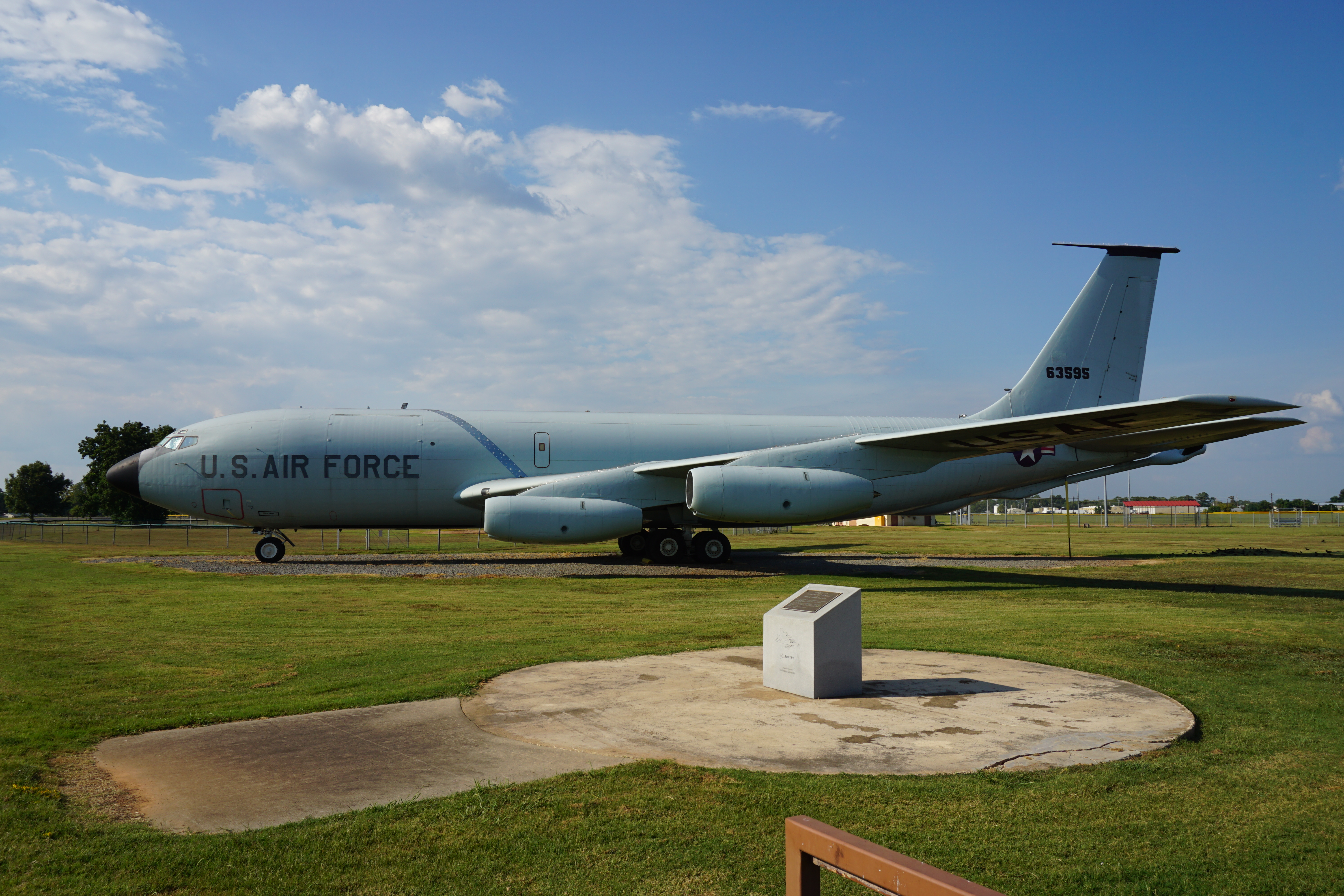
| 56-3595 | KC-135A | Barksdale Global Power Museum | Bossier City | United States | On display |
| 55-3139 «City of Atwater» | KC-135A | Castle Air Museum | Atwater | United States | On display |
| 56-3639 | KC-135A | Dyess Linear Air Park | Abilene | United States | On display |
| 59-1481 | KC-135A | Ellington Field Joint Reserve Base | Houston | United States | On display |
| 57-1510 «Never Forget» | KC-135E | Hill Aerospace Museum | Roy | United States | On display |
| 59-1497 | KC-135E | Joint Base McGuire-Dix-Lakehurst | Browns Mills | United States | On display |
| 56-3658 «Iron Eagle» | KC-135E | Kansas Aviation Museum | Wichita | United States | On display |
| 55-3130 «Old Grandad» | KC-135A | March Field Air Museum | Riverside | United States | On display |
| 55-3118 «City of Renton» | KC-135A | McConnell Air Force Base | Wichita | United States | On display |
| 57-1429 | KC-135E | Museum of the Kansas National Guard | Topeka | United States | On display |
| 60-0329 | KC-135R | National Museum of the United States Air Force | Dayton | United States | On display |
| 63-7998 | KC-135A | Pima Air & Space Museum | Tucson | United States | On display |
| 56-3611 | KC-135E | Scott Field Heritage Air Park | Shiloh | United States | On display |
List reviewed on October 31, 2026 against Wikipedia (EN): Boeing KC-135 Stratotanker, Aerial Visuals Airframe Dossier, Aerial Visuals Airframe Dossier, Aerial Visuals Airframe Dossier, Aerial Visuals Airframe Dossier, Aerial Visuals Airframe Dossier, Aerial Visuals Airframe Dossier, Aerial Visuals Airframe Dossier, Aerial Visuals Airframe Dossier, Aerial Visuals Airframe Dossier, Aerial Visuals Airframe Dossier, Aerial Visuals Airframe Dossier, Aerial Visuals Airframe Dossier, Aerial Visuals Airframe Dossier, Aerial Visuals Airframe Dossier, Aerial Visuals Airframe Dossier, Living History Registry (actualizado 2023-02-03, foto 2022), Living History Registry (actualizado 2021-02-07).
Images
Videos



Show the 89 more
 ¡Cómo duermen, comen y trabajan las mujeres piloto y la tripulación del KC-135 durante toda una sema
 Quelle est la structure du KC-135 ? Capacité du Boeing KC-135 Stratotanker | Le ravitaillement en...
 BOEING KC-135 STRATOTANKER “The One That NEVER Stops Flying! 👌 This is the KC-135” 👉 Argentina wa...
 Houthis schockiert: Pilot und Besatzung eines KC-135 Stratotankers der US Air Force starten mit Voll
 Utah ANG KC-135 Stratotanker Refuels F-35A Lightning II Stealth Fighters | Hill Air Force Base, Utah
 Boeing KC-135R Stratotanker United States Air Force USAF departure at RAF Fairford RIAT 2017 AirShow












Did you know… about Boeing KC-135 Stratotanker
- How many KC-135s were built?
The original production version, powered by four Pratt & Whitney J57 turbojet engines, was built in 732 examples. These tankers transferred fuel mainly…