Boeing F/A-18E/F Super Hornet variant
Boeing F/A-18E/F Super Hornet EA-18G Growler
Carrier-based electronic-warfare version of the two-seat F/A-18F, replacing the EA-6B Prowler in the US Navy and also flown by the Royal Australian Air Force.
Boeing F/A-18E/F Super Hornet sheet

- 2,346 km
- Range
History
The EA-18G Growler is the carrier-based electronic-warfare version of the two-seat F/A-18F Super Hornet, conceived to replace the Northrop Grumman EA-6B Prowler in United States Navy service. Boeing is the prime contractor, building the forward fuselage and wings and carrying out final assembly; Northrop Grumman, the principal airframe subcontractor, supplies the centre and aft fuselage and, above all, the electronic combat system that gives the aircraft its purpose.
Its origins lie in a demonstration flown on 15 November 2001, when Boeing flew F/A-18F "F-1" fitted with the ALQ-99 electronic-warfare system as an airborne electronic attack concept aircraft. In December 2003 the Navy awarded Boeing the EA-18G development contract, expecting at the time to receive 90 aircraft. The first test aircraft entered production on 22 October 2004. Known as EA-1, it was rolled out on 3 August 2006 and made its maiden flight at St. Louis on 15 August 2006; on 22 September it was ferried to Naval Air Station Patuxent River, Maryland, where it was used mainly for ground testing inside an anechoic chamber. The second aircraft, EA-2, flew on 10 November 2006 and was delivered to Patuxent River on 29 November; it carried the flight testing of the electronic attack system, first over Pax River's Atlantic Test Range and then over the Electronic Combat Range at China Lake, California. Both were in fact F/A-18Fs pulled from the St. Louis line and modified, so the Navy designated them NEA-18G. By June 2008 five Growlers were flying in the test programme.
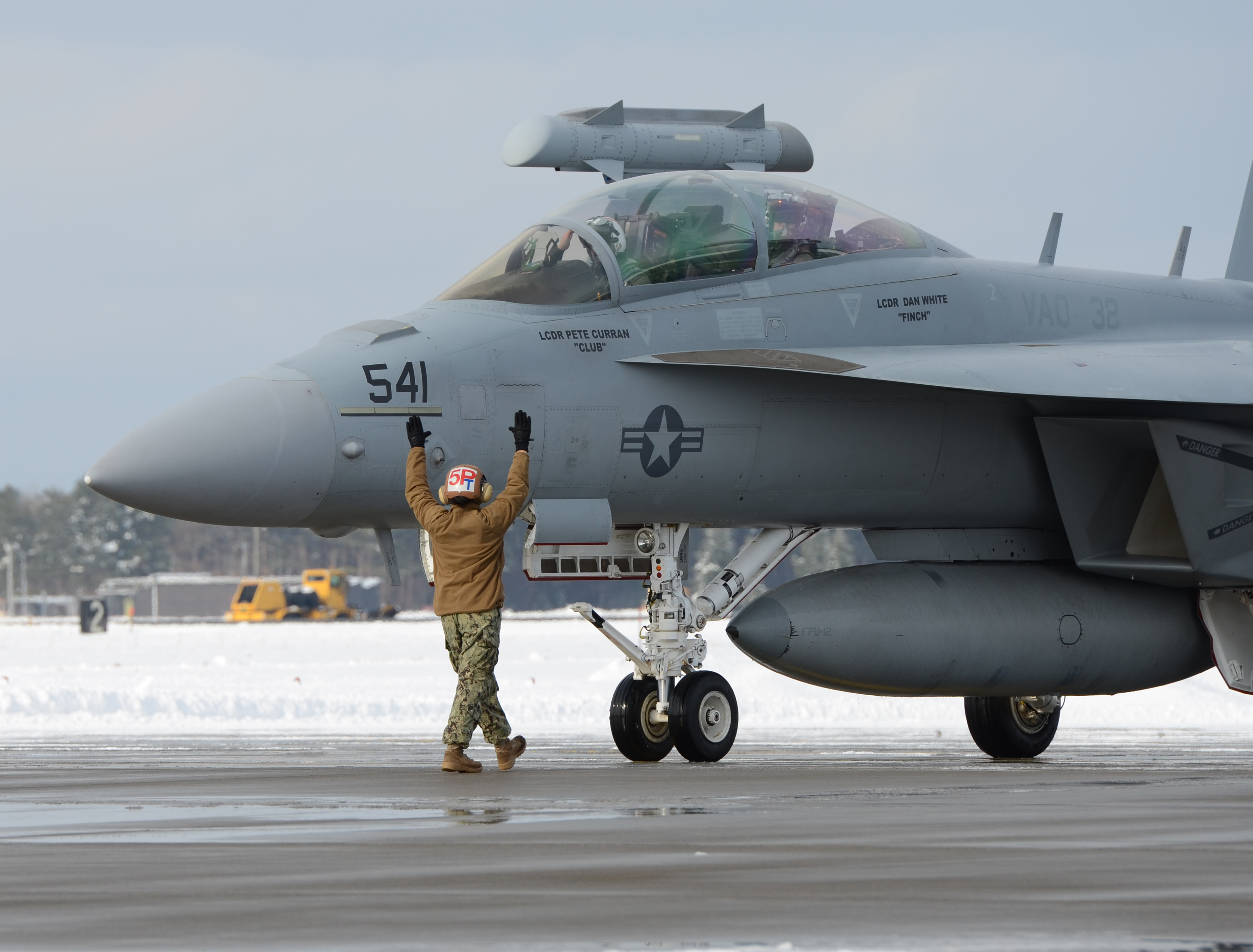
The road to production was not smooth. In April 2006 the Government Accountability Office warned that the electronic-warfare systems were not yet mature and that there was a risk of cost growth and schedule delays; in 2008 the Pentagon's operational test director also questioned the workload placed on a two-person crew expected to take over from the four crew members of the Prowler. Even so, the Department of Defense approved low-rate initial production in 2007 and full-rate production on 23 November 2009. In May 2010 a multiyear contract added 58 more Growlers, bringing the total on order to 114. An operational assessment in February 2011 still judged the aircraft not operationally suitable, but in December 2011 its software was declared operationally effective and suitable. At the end of 2014 the Navy asked to slow production from three aircraft a month to two and bought 15 additional Growlers, which kept the St. Louis line running through 2017.
Outwardly the Growler retains more than 90% of a standard Super Hornet: the airframe, the AN/APG-79 AESA radar and the stores management system. Its flight performance is similar, allowing it to accompany strike fighters through every phase of a mission and to fly both escort jamming and standoff jamming. To steady it for the electronic-warfare role, Boeing changed the leading-edge and wing-fold hinge fairings and added wing fences and aileron tripper strips. The internal 20 mm cannon is deleted and its bay holds a plate of electronic equipment. The wingtip rails that carry Sidewinder missiles on the Super Hornet house AN/ALQ-218 wideband receivers instead, and up to five ALQ-99 jamming pods can be hung under the wings and fuselage, alongside AIM-120 AMRAAM or AGM-88 HARM missiles for self-defence and for attacking radars. It also carries the INCANS interference cancellation system, which keeps voice communications open while jamming enemy communications, something the EA-6B could not do. The ALQ-99, however, has poor reliability, interferes with the AESA radar and reduces top speed, and in May 2012 the Navy chose the Growler as the first platform for the Next Generation Jammer, a new AESA-based jamming system. Three networked Growlers can also locate emitters by triangulation without using their own radar, a concept demonstrated in 2015 with the TTNT datalink.
The first fleet Growler was accepted by squadron VAQ-129 at Whidbey Island on 3 June 2008. On 5 August 2009 squadrons VAQ-129 and VAQ-132 made their first arrested carrier landings aboard USS Harry S. Truman, and in October 2009 VAQ-132 became the first deployable squadron. The type's combat debut came in 2011 during Operation Odyssey Dawn over Libya. Its radio call name is "Grizzly", because "Growler" sounded too much like "Prowler". With the cancellation of the EB-52H standoff jammer it became the only crewed tactical jammer left in the United States inventory, and Air Force electronic-warfare officers of the 390th Electronic Combat Squadron fly on it. During Operation Prosperity Guardian a Growler destroyed a Houthi Mi-24 helicopter on the ground with an AGM-88E missile and scored its first air-to-air kill, a drone. In late 2024 VAQ-133 became the first squadron to deploy with the new ALQ-249 pod.
Australia is the only other operator. After choosing in 2009 to have 12 of its 24 F/A-18Fs wired on the production line for possible later conversion, in May 2013 it opted instead to buy 12 new-build Growlers. The first was delivered on 29 July 2015 and the last arrived at RAAF Base Amberley on 7 July 2017 for No. 6 Squadron. Australian aircraft also carry the AN/ASQ-228 ATFLIR targeting pod and AIM-9X missiles. One was written off after an engine fire during Exercise Red Flag at Nellis in January 2018 and a replacement taken from Navy stock arrived in February 2023. Japan studied the type and Finland was offered it, but Finland selected the F-35 in February 2022.
Multimedia


