Airliner · Civil · United Kingdom
BAe 146
- September 3, 1981
- First flight
- 1983
- Introduced
- In service
- Status
- 387–394
- Units built

-1600.webp)

-1600.webp)
-1600.webp)

-1600.webp)
-1600.webp)

-1600.webp)
-1600.webp)

-1600.webp)
-1600.webp)

_Thai_Airways_Bangkok_1990-10-14_5955-1600.webp)


-1600.webp)


-1600.webp)



The BAe 146 is a British four-engined high-wing regional jet that first flew on 3 September 1981 and entered service with Dan-Air in 1983. Together with its modernised Avro RJ development, 394 were built, making it the most successful British civil jet airliner programme.
Related events
Related sheets
Category
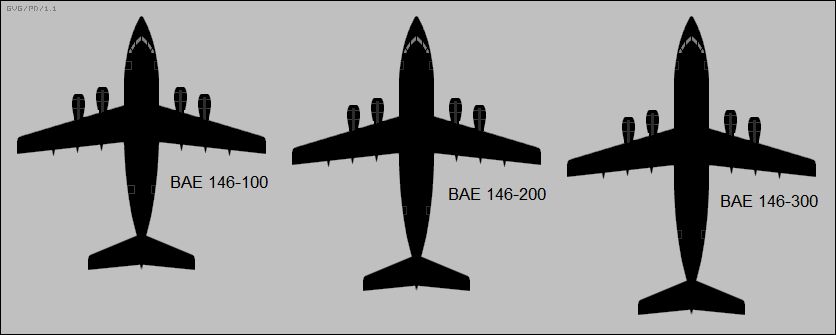
Three-view drawing
History
The 146 began in August 1973, when Hawker Siddeley launched the HS.146 project: a seventy-seat airliner meant to fill the gap between the turboprops of the day — its own HS.748, the Fokker F27 — and small jets such as the BAC One-Eleven and the Boeing 737. The chosen configuration, a high wing and a T-tail, was aimed at short-field performance, and the powerplant was four Avco Lycoming ALF 502H turbofans of 6,500 lbf. The British government agreed to fund half the development in exchange for a share of the revenue from every aircraft sold, but in October 1974, with the recession triggered by the oil crisis, all work stopped. The project survived on a low flame until British Aerospace, Hawker Siddeley's successor, relaunched it in 1978.
Fitting four engines to such a small aircraft was controversial from the start, and it was the engine that dictated it: the ALF 502, rugged, quiet and fuel-efficient, could not on its own deliver the power and range the concept demanded. British Aerospace turned the drawback into a selling point, advertising exceptional three-engine performance that appealed to operators in mountainous country and at hot, high or poor-surface airfields. The rest of the design was deliberately simple: a high wing with an uninterrupted upper surface and no leading-edge devices, a fixed tailplane, and no thrust reversers — in their place a large two-petal airbrake below the rudder, usable in flight, and full-width spoilers that deploy on touchdown. It was the second aircraft after Concorde to use carbon brakes.
The first aircraft took off from Hatfield on 3 September 1981, quickly followed by two more prototypes, with better take-off and climb figures than predicted. The 146-200 then cost eleven million pounds and the programme had absorbed 350 million; in 1982 British Aerospace reckoned it needed to sell 250 aircraft to break even. The Certificate of Airworthiness came on 8 February 1983 and in May Dan-Air flew the first revenue service, between London Gatwick and Bern. The press hailed it as the world's quietest jetliner and the manufacturer sold it as the Whisperjet.
That quietness, together with short-field capability, opened airports no other jet could use. In 1985 Aspen Airways used a 146-100 to inaugurate the first scheduled jet service into Aspen, in the Rockies, from an airfield 7,820 feet above sea level, and in January 1987 the type was chosen to launch jet services from London City, with its steep approach and short runway: for years it was the only conventional jet able to work there. Pacific Southwest Airlines received the first of its twenty aircraft on 1 July 1984, Air Wisconsin replaced its Fokker F27s with it, and in Australia it became the aircraft of long, thin routes, with eighteen in service with Ansett in 1999 and a career that lasted until National Jet Express ended passenger operations in June 2022, after 32 years and 33 aircraft of the type. The Royal Air Force flew it as a VIP transport from 1986 to 2022.
In 1993 the original series gave way to the Avro RJ, built at Woodford by Avro International Aerospace: higher-thrust LF 507 engines in redesigned nacelles, an EFIS flight deck and three sizes matching the earlier ones, RJ70, RJ85 and RJ100. Production was spread across the country — rear fuselage at Chadderton, centre section at Filton, fin at Brough, engine pylons at Prestwick — and beyond it: the wings came from Textron in the United States and the tailplane from Saab-Scania in Sweden. The engines, however, brought trouble. Derived from the T55 turboshaft of the Chinook helicopter, the ALF 502 owed its quietness to a geared fan that kept blade tip speed below the speed of sound, but its electronics could overheat and shut an engine down automatically with no inflight relight, and rare atmospheric conditions could cause thrust loss through internal icing. Fume events, in which irritant vapours reached the cabin through the pressurisation system, added to the record.
The end came with the RJX, a third generation powered by Honeywell AS977 turbofans promising 15% lower fuel burn and 17% more range. The RJX85 prototype flew on 28 April 2001 and the RJX100 on 23 September, but on 27 November BAE Systems cancelled the programme and closed its regional aircraft business, with 1,669 job losses and a £400m charge; the division had already forced a £1bn write-off in 1992. The last Avro RJs were delivered in late 2003. In all, 394 aircraft were built: 221 BAe 146s, 170 Avro RJs and the three RJXs.
With the line closed, the type kept flying. The QT Quiet Trader freighters and QC convertibles found their niche at curfew-restricted airports, 146-200s and RJ85s retired from passenger work were converted into air tankers in North America, and governments and air forces kept their VIP and transport examples. In July 2020, 54 aircraft were still in airline and aerial-firefighting service, and the very first 146 built still flies as the British FAAM's atmospheric laboratory, with the intention of keeping it operating until 2040.
Variants
| BAe 146-100 | BAe 146-200 | BAe 146-300 | Avro RJ85 | Avro RJ100 | Avro RJX85 | Avro RJX100 | Avro RJ115 | Avro RJ70 | BAe 146-200QC «Quick Change» | BAe 146-200QT «Quiet Trader» | BAe 146-300QT «Quiet Trader» | BAe 146-301 ARA | BAe 146 / Avro RJ85 Airtanker | BAe 146 CC Mk2 (Queen's Flight) | BAe 146 C Mk3 | BAe 146M | BAe 146STA | |
|---|---|---|---|---|---|---|---|---|---|---|---|---|---|---|---|---|---|---|
| First flight | September 3, 1981 | August 1, 1982 | May 1, 1987 | March 23, 1992 | May 13, 1992 | April 28, 2001 | September 23, 2001 | — | — | — | — | — | — | — | — | — | — | — |
| Aircraft type | Regional jet airliner | Regional jet airliner | Regional jet airliner | Regional jet airliner | Regional jet airliner | Regional jet airliner | Regional jet airliner | Regional jet airliner | Regional jet airliner | Convertible passenger/freight regional jet | Regional jet freighter | Regional jet freighter | Atmospheric research aircraft | Firefighting air tanker | Military VIP transport | Military tactical transport | Multi-role military transport | Sideloading tactical airlifter (demonstrator) |
| Powerplant | 4 × Avco Lycoming ALF 502R-5 turbofans of 31.0 kN each (6,970 lbf for take-off). Early airframes left the line with 30.0 kN ALF 502R-3s, and the type certificate allows R-3, R-3A and R-5 to be mixed provided the aircraft is flown at the lower rating. | 4 × Avco Lycoming ALF 502R-5 turbofans of 31.0 kN each (6,970 lbf for take-off), hung on pylons under the high wing. The geared fan keeps the blade tips below the speed of sound, which is where the aircraft's reputation for quietness comes from. | 4 × Avco Lycoming ALF 502R-5 turbofans of 31.0 kN each; the type certificate also approves four Textron Lycoming LF 507-1H of 7,000 lbf, with no intermixing allowed. A 7,500 lbf ALF 502R-7 with winglets was proposed, but the production Series 300 took neither. | 4 × Textron Lycoming LF 507-1F turbofans of 31.1 kN each (7,000 lbf for take-off; 6,548 lbf maximum continuous), in nacelles redesigned from the BAe 146 and fitted with FADEC. | 4 × Textron Lycoming LF 507-1F turbofans of 31.1 kN each (7,000 lbf for take-off). | 4 × Honeywell AS977-1A turbofans of 31.1 kN each (7,000 lbf), a two-spool design with dual FADEC. Against the Avro RJ's LF 507 it promised 5% more climb thrust, 15% lower fuel burn and 20% lower direct engine costs. | 4 × Honeywell AS977-1A turbofans of 31.1 kN each (7,000 lbf), two-spool with dual FADEC, in the integrated engine/nacelle/pylon package BAE Systems called IPPS. | 4 × Textron Lycoming LF 507-1F turbofans of 31.1 kN each (7,000 lbf for take-off). | 4 × Textron Lycoming LF 507-1F turbofans of 31.1 kN each (7,000 lbf for take-off, flat-rated to 23.3 °C), with single-channel FADEC and hydromechanical backup. Bypass ratio 5.0:1 and overall pressure ratio 13:1. | 4 × Avco Lycoming ALF 502R-5 turbofans of 31.0 kN each. | 4 × Avco Lycoming ALF 502R-5 turbofans of 31.0 kN each. It was precisely the low noise footprint that opened night-curfew airports to the QT. | 4 × Avco Lycoming ALF 502R-5 turbofans of 31.0 kN each. | 4 × Honeywell LF 507-1H turbofans of 31.1 kN each (7,000 lbf), the powerplant the type certificate approves on the Series 300. | 4 × Textron Lycoming LF 507-1F turbofans of 31.1 kN each on Avro RJ85 conversions; those built on the BAe 146-200 keep the 31.0 kN Avco Lycoming ALF 502R-5. The four engines are precisely the type's selling point for flying low over mountainous terrain. | 4 × Avco Lycoming ALF 502R-5 turbofans of 31.0 kN each. | 4 × Avco Lycoming ALF 502R-5 turbofans of 31.0 kN each (6,970 lbf for take-off). | 4 × Avco Lycoming ALF 502R-5 turbofans of 31.0 kN each — the engines of the second-hand 146-200 and 146-300 airframes the conversion was built on. | 4 × Avco Lycoming ALF 502R-5 turbofans of 31.0 kN each. |
| Powerplant | 4 × Avco Lycoming ALF 502R-5 (o ALF 502R-3) | 4 × Avco Lycoming ALF 502R-5 | 4 × Avco Lycoming ALF 502R-5 (o Textron Lycoming LF 507-1H) | 4 × Textron Lycoming LF 507-1F | 4 × Textron Lycoming LF 507-1F | 4 × Honeywell AS977-1A | 4 × Honeywell AS977-1A | 4 × Textron Lycoming LF 507-1F | 4 × Textron Lycoming LF 507-1F | 4 × Avco Lycoming ALF 502R-5 | 4 × Avco Lycoming ALF 502R-5 | 4 × Avco Lycoming ALF 502R-5 | 4 × Honeywell LF 507-1H | 4 × Textron Lycoming LF 507-1F (Avro RJ85) o Avco Lycoming ALF 502R-5 (BAe 146-200) | 4 × Avco Lycoming ALF 502R-5 | 4 × Avco Lycoming ALF 502R-5 | 4 × Avco Lycoming ALF 502R-5 | 4 × Avco Lycoming ALF 502R-5 |
| Thrust per engine | 31 kN | 31 kN | 31 kN | 31.1 kN Best value in this row | 31.1 kN Best value in this row | 31.1 kN Best value in this row | 31.1 kN Best value in this row | 31.1 kN Best value in this row | 31.1 kN Best value in this row | 31 kN | 31 kN | 31 kN | 31.1 kN Best value in this row | 31.1 kN Best value in this row | 31 kN | 31 kN | 31 kN | 31 kN |
| Length | 26.2 m | 28.6 m | 31 m Best value in this row | 28.6 m | 31 m Best value in this row | 28.6 m | 31 m Best value in this row | 31 m Best value in this row | 26.2 m | 28.6 m | 28.6 m | 31 m Best value in this row | 31 m Best value in this row | — | 26.2 m | 28.6 m | — | — |
| Wingspan | 26.3 m Best value in this row | 26.3 m Best value in this row | 26.3 m Best value in this row | 26.3 m Best value in this row | 26.3 m Best value in this row | 26.3 m Best value in this row | 26.3 m Best value in this row | 26.3 m Best value in this row | 26.3 m Best value in this row | 26.3 m Best value in this row | 26.3 m Best value in this row | 26.3 m Best value in this row | 26.3 m Best value in this row | — | 26.3 m Best value in this row | 26.3 m Best value in this row | — | — |
| Height | 8.6 m Best value in this row | 8.6 m Best value in this row | 8.6 m | 8.6 m Best value in this row | 8.6 m | 8.6 m Best value in this row | 8.6 m | 8.6 m | 8.6 m Best value in this row | 8.6 m Best value in this row | 8.6 m Best value in this row | 8.6 m | 8.6 m | — | 8.6 m Best value in this row | 8.6 m Best value in this row | — | — |
| Wing area | 77.3 m² Best value in this row | 77.3 m² Best value in this row | 77.3 m² Best value in this row | 77.3 m² Best value in this row | 77.3 m² Best value in this row | 77.3 m² Best value in this row | 77.3 m² Best value in this row | 77.3 m² Best value in this row | 77.3 m² Best value in this row | 77.3 m² Best value in this row | 77.3 m² Best value in this row | 77.3 m² Best value in this row | 77.3 m² Best value in this row | 77.3 m² Best value in this row | 77.3 m² Best value in this row | 77.3 m² Best value in this row | 77.3 m² Best value in this row | 77.3 m² Best value in this row |
| Empty weight | 23,288 kg | 23,882 kg | 24,878 kg | 24,600 kg | 25,600 kg | 24,500 kg | 25,450 kg | — | 23,900 kg | — | — | 23,126 kg Best value in this row | 25,400 kg | — | — | — | — | — |
| MTOW | 38,101 kg | 42,184 kg | 44,225 kg | 43,998 kg | 46,039 kg Best value in this row | — | — | 46,039 kg Best value in this row | 43,091 kg | 42,184 kg | 42,184 kg | 44,225 kg | 42,000 kg | — | 38,101 kg | 42,184 kg | — | — |
| Top speed | 787 km/h | 783 km/h | 794 km/h Best value in this row | 789 km/h | 789 km/h | — | — | 789 km/h | 789 km/h | — | — | — | — | — | — | — | — | — |
| Max speed altitude | 9,449 m | 9,449 m | 9,449 m | 10,668 m | 10,668 m | — | — | 10,668 m | 10,668 m | — | — | — | — | — | — | — | — | — |
| Cruise speed | 767 km/h | 767 km/h | 790 km/h Best value in this row | 763 km/h | 763 km/h | — | — | — | 763 km/h | — | — | — | — | — | — | — | — | — |
| Cruise altitude | 9,449 m | 9,449 m | 9,449 m | 10,668 m | 10,668 m | — | — | 10,668 m | 10,668 m | — | — | — | — | — | — | — | — | — |
| Service ceiling | 9,449 m | 9,449 m | 9,449 m | 10,668 m Best value in this row | 10,668 m Best value in this row | — | — | 10,668 m Best value in this row | 10,668 m Best value in this row | 9,449 m | 9,449 m | 9,449 m | 10,668 m Best value in this row | — | 9,449 m | 9,449 m | — | — |
| Initial climb rate | — | 9.1 m/s Best value in this row | — | 9.1 m/s Best value in this row | — | — | — | — | — | — | — | — | 5 m/s | — | — | — | — | — |
| Range | 3,000 km | 2,910 km | 2,817 km | 2,965 km | 2,760 km | 3,295 km | 3,020 km | — | 3,075 km | — | — | — | 3,700 km Best value in this row | — | — | — | — | — |
| Combat radius | 0 km Best value in this row | 0 km Best value in this row | 0 km Best value in this row | 0 km Best value in this row | 0 km Best value in this row | 0 km Best value in this row | 0 km Best value in this row | 0 km Best value in this row | 0 km Best value in this row | 0 km Best value in this row | 0 km Best value in this row | 0 km Best value in this row | 0 km Best value in this row | 0 km Best value in this row | 0 km Best value in this row | 0 km Best value in this row | 0 km Best value in this row | 0 km Best value in this row |
| Endurance | — | — | — | — | — | — | — | — | — | — | — | — | 360 min | — | — | — | — | — |
| Range conditions | 3,000 km on standard fuel and 1,630 km with maximum payload, always below the certified ceiling of 31,000 ft. | 2,910 km on standard fuel and 2,095 km with maximum payload; Flight International quotes 3,650 km on a 100-seat service. Cruise is flown at 31,000 ft, the highest altitude certified for the 146 series. | 2,817 km on standard fuel and 1,927 km with maximum payload; maximum operating speed Mach 0.73. | 2,965 km with full tanks and 2,130 km at maximum payload; cruise at 35,000 ft, the Avro RJ's certified ceiling. | 2,760 km with full tanks and 2,130 km at maximum payload, with a certified ceiling of 35,000 ft. | 3,295 km, up to 17% more than the RJ85 thanks to the AS977. It flew on 28 April 2001 and the programme was cancelled on 27 November of the same year: this was the only one completed. | 3,020 km. It flew on 23 September 2001; two were completed before the programme was cancelled on 27 November 2001. | Maximum take-off weight of 46,039 kg, the highest in the family; range was never published because the model never entered production. | 3,075 km with full tanks and 2,665 km at maximum payload. The certified ceiling rises to 35,000 ft against the 31,000 ft of the BAe 146. | 1,935 km on standard fuel in the freighter configuration. | Range matches the passenger 146-200, subject to the load carried. | Range matches the passenger 146-300, subject to the load carried. | Up to 3,700 km and 6 h airborne at minimum scientific payload with full tanks; at maximum scientific payload endurance falls to about 2 h. It can measure from 50 ft above the sea up to 35,000 ft. | The type pairs a good transit speed with excellent short-field and slow-flight performance on the drop run. By 2017 fourteen aircraft were in North American service across Conair, Neptune Aviation and Air Spray. | 146-100 range performance, with the certified ceiling of 31,000 ft. | 146-200 airframe range; the two aircraft entered service at Camp Bastion, Afghanistan, in April 2013 with No. 32 Squadron RAF. | Additional fuel tanks over the civil configuration, plus improved steep-approach and unpaved-runway capability. | The demonstrator carried a nose refuelling probe — a dummy on the display aircraft — and was shown at the 1989 Paris Air Show without winning orders. |
| Armament | None | None | None | None | None | None | None | None | None | None | None | None | None | None | None; the aircraft carried an electronic self-protection suite for higher-risk sorties. | None; it carries infrared countermeasures, flare dispensers, an armoured flight deck and fuel tank inerting. | None; offered with defensive aids fitted. | None |
| Max weapons load | 0 kg Best value in this row | 0 kg Best value in this row | 0 kg Best value in this row | 0 kg Best value in this row | 0 kg Best value in this row | 0 kg Best value in this row | 0 kg Best value in this row | 0 kg Best value in this row | 0 kg Best value in this row | 0 kg Best value in this row | 0 kg Best value in this row | 0 kg Best value in this row | 0 kg Best value in this row | 0 kg Best value in this row | 0 kg Best value in this row | 0 kg Best value in this row | 0 kg Best value in this row | 0 kg Best value in this row |
| Payload | 8,612 kg | 11,233 kg | 11,781 kg | 11,233 kg | 11,781 kg | — | — | — | 8,612 kg | 10,039 kg | 11,827 kg | 12,490 kg Best value in this row | 11,000 kg | — | — | 10,659 kg | — | — |
| Cargo capacity | Single-class cabin seating 70 five abreast at 84 cm pitch, 82 six abreast at the same pitch, or up to 94 six abreast at 74 cm pitch. Maximum payload 8,612 kg, carried with two underfloor holds. | Up to 112 seats six abreast at 74 cm pitch; the usual layout was 85 five abreast at 84 cm pitch. Maximum payload 11,233 kg between the two underfloor holds. | Fuselage stretched 2.34 m over the 146-200: up to 128 seats six abreast at 74 cm pitch, 116 six abreast or 100 five abreast at 84 cm pitch. Maximum payload 11,781 kg. | Up to 112 seats six abreast at 74 cm pitch; the typical layout is 85 five abreast at 84 cm pitch and 100 six abreast. Maximum payload 11,233 kg with 18.25 m³ of hold volume. | Up to 128 seats six abreast at 74 cm pitch; the usual layouts were 100 five abreast at 84 cm pitch and 116 six abreast. Maximum payload 11,781 kg with 22.98 m³ of hold volume. | Typical layout of 85 seats five abreast or 100 six abreast. The airframe is identical to the RJ85 apart from nacelles and pylons. | Typical layout of 100 seats five abreast or 112 six abreast. Operating empty weight 25,450 kg, around 227 kg less than the equivalent RJ100. | Same fuselage as the RJ100 but with a higher maximum take-off weight and different emergency exits — two Type III overwing hatches: 116 seats as standard and up to 128 in high density, with 124 maximum occupants including crew. It was marketed but never produced. | Single-class «Spaceliner» cabin: 70 seats five abreast at 84 cm pitch, 82 six abreast, or up to 94 six abreast at 74 cm pitch. Maximum payload 8,612 kg. | Convertible between passenger and freight layouts in a matter of hours, with a cargo door on the left side of the rear fuselage. Maximum payload 10,039 kg; Class E cargo compartment. | Pure freighter: six standard LD3 containers and a maximum payload of 11,827 kg. No passenger seating. | Pure freighter on the long fuselage: standard 2.74 × 2.24 m pallets or LD3 containers, with a maximum payload of 12,490 kg. Operating empty weight drops to 23,126 kg once the passenger cabin comes out. | The 146-300 prototype airframe (G-LUXE) converted by BAE Systems between 2001 and 2004: two pilots and one operator, 18 scientist stations and a maximum scientific payload of 11,000 kg, of which around 4,000 kg is typically flown. | Converted from retired airliners: the passenger cabin comes out and a pressurised retardant tank with drop doors is fitted under the fuselage. No commercial cargo capability. | 146-100 airframe with a bespoke interior: 19 passengers and six cabin crew, marketed by British Aerospace as the «Statesman». No commercial cargo capability. | Military conversion of two BAe 146-200QCs bought from TNT Airways: a 3.33 × 1.93 m side door, 94 passengers or 54 seats in a mixed layout, and a maximum load of 10,659 kg (23,500 lb). | Programme announced by BAE Systems in 2009 to convert civil 146-200s and 146-300s to military use, in passenger or freighter form. No rear cargo door was added. | Sideloading Tactical Airlifter derived from the 146QT freighter: it keeps the cargo door on the left side of the rear fuselage and adds an air-openable paratroop door. |
| Crew | 2 Best value in this row | 2 Best value in this row | 2 Best value in this row | 2 Best value in this row | 2 Best value in this row | 2 Best value in this row | 2 Best value in this row | 2 Best value in this row | 2 Best value in this row | 2 Best value in this row | 2 Best value in this row | 2 Best value in this row | 3 | 2 Best value in this row | 2 Best value in this row | 2 Best value in this row | 2 Best value in this row | 2 Best value in this row |
| Passengers | 94 | 112 | 128 Best value in this row | 112 | 128 Best value in this row | 100 | 112 | 128 Best value in this row | 94 | — | — | — | — | — | 19 | 94 | — | — |
| Units built | 37 | 113 Best value in this row | 71 | 87 | 71 | 1 | 2 | 0 | 12 | — | — | — | 1 | — | 3 | 2 | — | — |
Images