Airbus A350 variant
Airbus A350-800
Unbuilt project: shortened version of the A350-900, launched in 2006 and cancelled in September 2014 in favour of the A330neo after losing its customers.
- 15,270 km
- Range
History
The A350-800 was the smallest member of the A350 XWB family and the only one that was never built. The designation already existed in the first A350, the A330 derivative Airbus showed in the middle of the decade: in that scheme the -800 was a 245-seat aircraft meant to fly about 15,900 km. When the programme was redesigned as the XWB, the Airbus board approved the industrial launch of all three versions, -800, -900 and -1000, on 1 December 2006, with a staggered timetable: the -900 was due for delivery in mid-2013 and the -800 twelve months later. In the engine competition, General Electric offered its 390 kN GEnx-3A87 for the -800 and -900, but Rolls-Royce was selected in December 2006 as launch engine supplier.
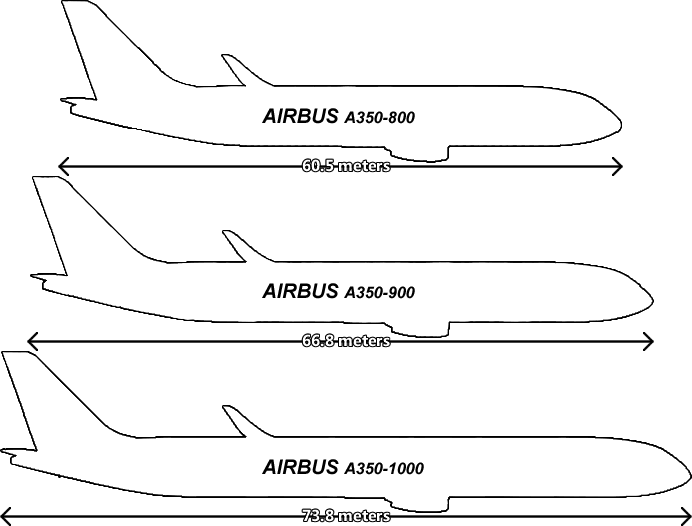
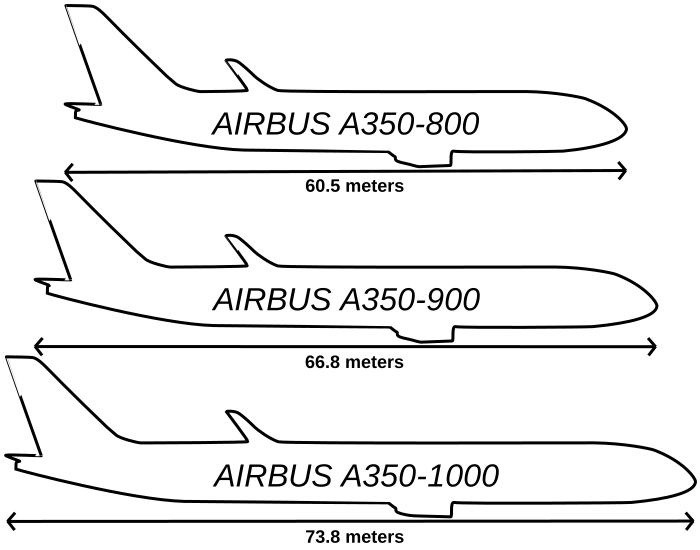
The -800 was conceived as a successor and complement to the A330-200 on thinner long-haul routes. In its final form it was 60.45 m long, sized for 276 passengers in a typical three-class layout, and promised a range of 15,270 km at a maximum take-off weight of 259 t. Those figures came from a change of course in January 2010: instead of an optimised variant with its own structure and landing gear, Airbus chose to make the -800 a straightforward shrink of the baseline -900. The fuselage lost ten frames, six ahead of the wing and four behind it. The simplification eased development and allowed maximum take-off weight to rise by 11 t over the planned 248 t, worth 3 t more payload or 460 km more range; the price was a fuel burn penalty of "a couple of percent", as Airbus chief operating officer John Leahy acknowledged. The company expected to trim structural weight as production went on, around airframe 20.
Commercially the -800 started strongly. Qatar Airways, later launch customer for both the -900 and the -1000, ordered twenty -800s in 2007; Hawaiian Airlines announced a firm order for six in February 2008, and by mid-2008 the variant's backlog had reached 182 aircraft. From 2010 onwards, however, customers drifted to the larger -900. CIT Group cancelled its five -800s in July 2011; Afriqiyah Airways turned its six into ten -900s in October 2012; Qatar converted its twenty into three -900s and seventeen -1000s in December 2012; AerCap/ILFC and Libyan Airlines swapped their -800s for -900s in January 2014, and in April 2014 the twelve-aircraft order placed by Air One, inherited by Alitalia after the two merged in 2009, vanished from the order book. That left 34 aircraft: eight for Aeroflot, eight for Asiana Airlines, six for Hawaiian, ten for Yemenia and two for lessor AWAS. Airbus, for its part, had long made clear it had no desire to build the smallest version.
The decisive blow came in July 2014. Airbus launched the A330neo at the Farnborough Airshow and Hawaiian swapped its six A350-800s for as many A330-800neos, to be delivered from 2019; the trade press read it as the -800's death sentence, with 28 orders from four customers left. Airbus chief executive Fabrice Brégier said he believed all customers would convert either to the A350-900 or to the A330neo, and at a press conference in September 2014 he confirmed that A350-800 development had been "cancelled". By December that year, with Yemenia already switched to the -900, only Aeroflot's eight and Asiana's eight remained on the books, both airlines also holding -900 orders. Aeroflot and Airbus announced the cancellation of its -800s in January 2017, and Asiana later negotiated the conversion of its eight -800s and one -1000 into nine -900s, removing the type's last order. The niche the -800 was meant to fill was in the end taken by the A330-800neo.
Multimedia