Airbus A350 variant
Airbus A350-1000
Stretched A350 XWB with eleven extra frames, Trent XWB-97 engines and six-wheel main gear; first flown in 2016, certified in 2017 and introduced by Qatar Airways in 2018.

- November 24, 2016
- First flight
- 16,100 km
- Range
- 480
- Passengers
History
The A350-1000 is the stretched version of the A350 XWB family and, at 73.78 m, its longest member. It was born together with the rest of the programme: on 1 December 2006 the Airbus board approved the joint industrial launch of the -800, -900 and -1000, but from the outset the -1000 was planned as the final step, with its first delivery due some 24 months after that of the -900.
The 2011 redesign. In 2011 Airbus reworked the -1000 with higher weights and a more powerful engine variant to give it the range demanded by trans-Pacific routes. The change made it more attractive to Cathay Pacific, Singapore Airlines and United Airlines, which was looking for a 747-400 replacement, but a dissatisfied Emirates cancelled its order for 50 A350-900s and 20 A350-1000s rather than move the whole order to the bigger model. At the 2011 Paris Air Show, entry into service was pushed back two years to mid-2017. General Electric did not offer an engine with the thrust this version needed, so the -1000 became tied exclusively to the Rolls-Royce Trent XWB-97, rated at 97,000 lb (about 430 kN): it keeps the fan diameter of the smaller variants but turns slightly faster, has a new fan blade design and runs hotter thanks to newer materials.
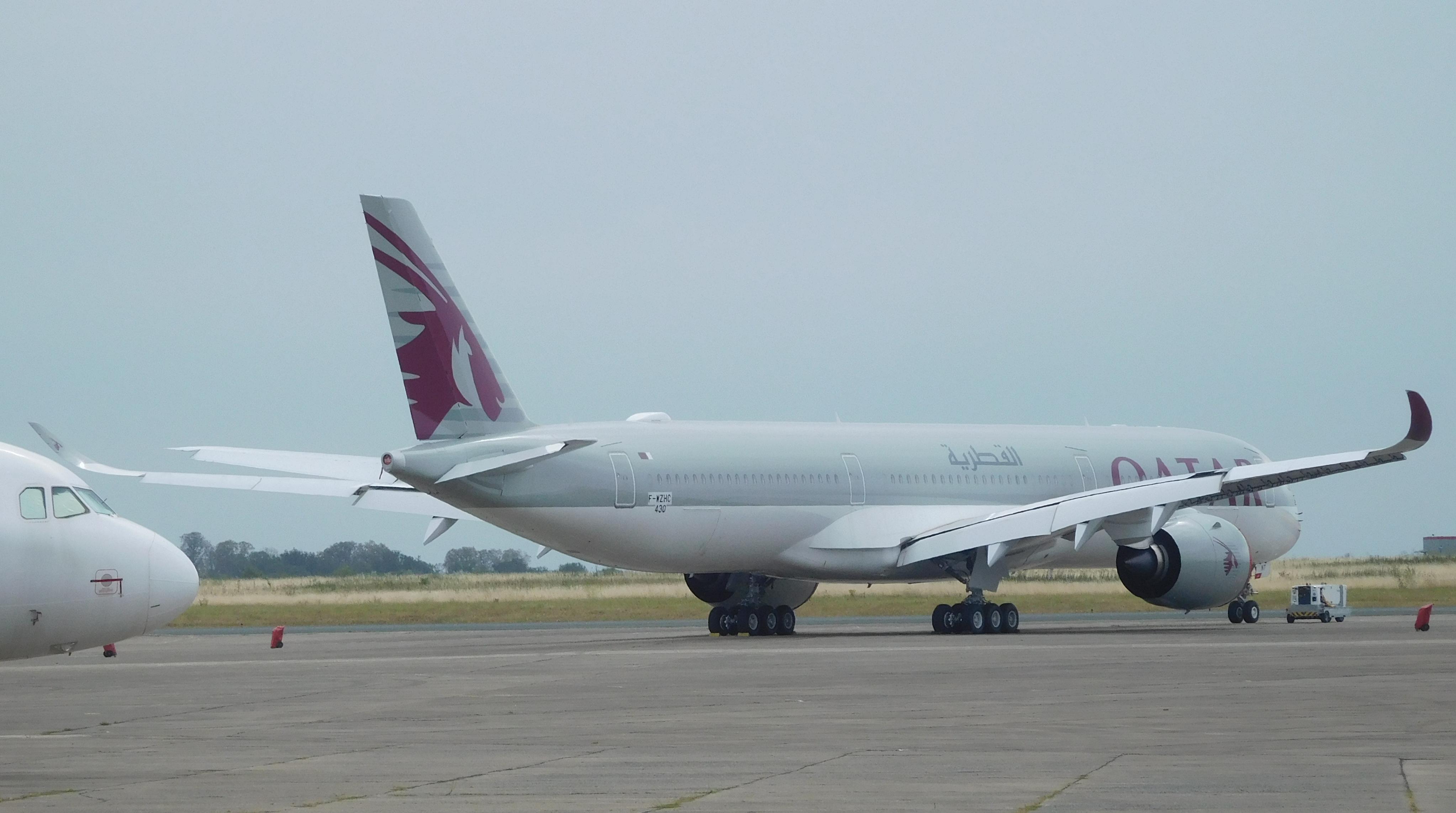
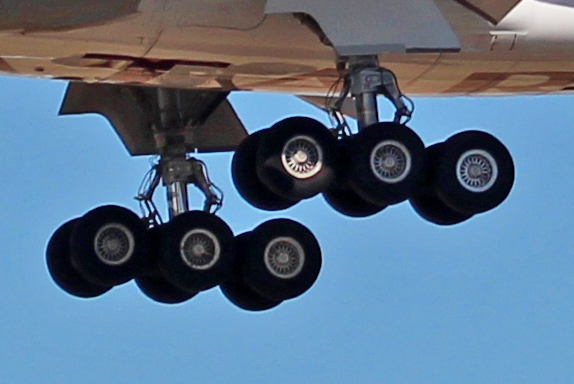
What changes over the -900. The fuselage grows by eleven frames, roughly 7 m, which makes room for 40 more passengers and 40 % more premium floor area; Airbus quotes 350 to 410 seats in three classes. The wing gains a 30 cm extension to the trailing edge of its inboard sections, adding 22.3 m² (about 4 %) and lengthening the chord of the flaps and ailerons by some 400 mm. The main landing gear switches to six-wheel bogies, housed in a bay one frame longer and supplied by UTC Aerospace Systems. Even so, the aircraft shares 95 % of its systems part numbers with the -900 and the same type rating, so pilots can fly both on a single qualification. Maximum fuel capacity reaches 159,000 litres and usable cargo volume 208.2 m³.
Assembly and testing. Work on the first major fuselage components began in September 2015 and final assembly, on the A350 line in Toulouse, in February 2016; the first aircraft completed its body join on 15 April 2016. Prototype MSN59 made its maiden flight from Toulouse-Blagnac on 24 November 2016. The campaign planned about 1,600 hours across three aircraft: MSN59 took some 600 hours for the flight envelope, systems and powerplant; MSN71 some 500 hours for cold and hot weather, landing gear and high-altitude work; and MSN65 another 500 hours for route proving and ETOPS assessment, fitted with a cabin interior for certification. In March 2017 cold-weather trials took one aircraft to Iqaluit, Canada, where it was soaked overnight at -37 °C, and in May 2017 a long-distance flight was flown with 310 people on board. On an early eleven-and-a-half-hour test flight the aircraft cruised at Mach 0.854 (911.9 km/h) at 35,000 ft, burning 6.8 tonnes of fuel per hour at a weight of 259 t. The results allowed the maximum take-off weight to be raised from 308 to 316 t. The -1000 also introduced an automatic emergency descent to about 3,000 m that alerts air traffic control if the crew fails to respond to a depressurisation warning, and it met its performance targets while staying within its weight specification, unlike the early -900s.
Certification. EASA and the FAA granted type certification on 21 November 2017, less than a year after the first flight. The documents were signed by Trévor Woods, EASA's certification director, and Bob Breneman of the FAA, and handed to Charles Champion, Airbus executive vice president engineering. The three test aircraft had logged over 1,600 flight hours, 150 of them in an environment simulating airline operations. By then 11 customers on five continents had ordered 169 aircraft.
Entry into service. The first production aircraft flew on 7 December 2017, but delivery to launch customer Qatar Airways slipped into 2018 because of problems installing the business class seats. The aircraft, registered A7-ANA, was handed over on 20 February 2018 and opened commercial service on the Doha to London Heathrow route on 24 February 2018. Qatar had reached the -1000 by converting its original A350-800 order: on 3 December 2012 it became 3 A350-900s and 17 A350-1000s. In 2018 the list price was US$366.5 million, and in 2019 Airbus delivered 25 aircraft of this version.
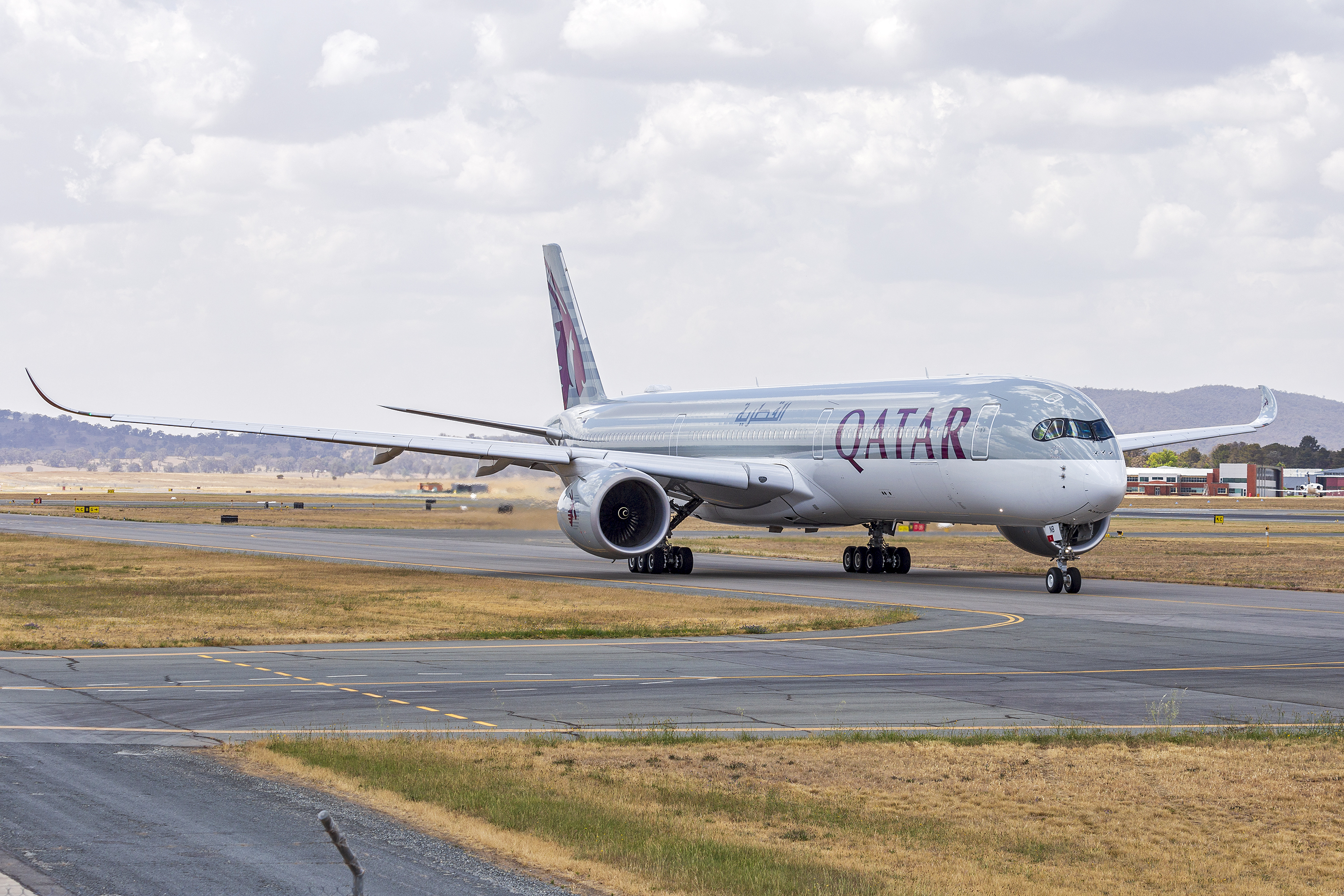
Growing weights and seating. The basic 308 t maximum take-off weight rose to 311 t and then to 316 t, a figure that has appeared on the type certificate data sheet since 29 May 2018 and that extended range from 7,950 to 8,400 nautical miles (14,720 to 15,560 km). A further 3 t increase, to 319 t, was studied for availability from 2020, and Airbus now quotes 322 t and 8,700 nautical miles (16,100 km). In November 2019 maximum capacity rose from 440 to 480 seats thanks to new "Type-A+" exits with dual-lane slides; French Bee took the first aircraft in that layout on 17 December 2021, leased from Air Lease Corporation for its Paris to Réunion service, with 40 premium and 440 economy seats.
Customers. The -1000 order book was largely built from conversions. Cathay Pacific switched 16 A350-900s to the longer version and ordered 10 more on 8 August 2012, although it moved 6 back to the shorter model on 13 September 2017; United converted its order into 35 A350-1000s on 20 June 2013 before returning to the -900 in 2017, and LATAM went back and forth in a similar way. Later orders came from Air Canada (8 plus 8 options), Philippine Airlines (9 in June 2023), Delta Air Lines (20 in January 2024), Korean Air (27 on 21 March 2024) and China Airlines (5 more on 18 December 2025), while Starlux received its first -1000 on 6 January 2026. As of October 2024 Airbus counted 88 A350-1000s delivered. The version is also the basis of what followed: the A350F freighter derives from it and Qantas chose it for Project Sunrise, giving rise to the A350-1000ULR, while a further stretch (the A350-2000) was shelved in 2017, partly for fear that it would take sales from the -1000 itself.
Multimedia




Elsewhere
- AirbusPrimer vuelo del A350-1000 (MSN059), Toulouse, 24-11-2016 ↗
- Aviation Week (ATW)Galeria: el Airbus A350-1000 inicia su primer vuelo ↗
- Flightradar24 BlogEl Airbus A350-1000 despega en su primer vuelo ↗
- FlightAwareAirbus A350-1000 de British Airways (G-XWBI) ↗
- Lufthansa Group Media LoungeImagen del Airbus A350-1000 (Lufthansa Group Media Lounge) ↗
- JetPhotosAirbus A350-1000 (JetPhotos) ↗
- JetPhotosAirbus A350-1000 (JetPhotos) ↗
- JetPhotosAirbus A350-1000 (JetPhotos) ↗
- Flight-ReportGaleria de fotos de viajeros del Airbus A350-1000 ↗