Aero L-39 Albatros variant
Aero L-39 Albatros L-39ZA
The light attack and reconnaissance variant of the L-39 Albatros, derived from the L-39ZO weapons trainer: sturdier landing gear, four underwing hardpoints, K-13 or R-60 missiles on the outer pylons and, as its hallmark, a twin-barrel 23 mm GSh-23L cannon in a ventral pod with 150 rounds. Sources place its first flight in 1976 or 1977; 208 were delivered. It served with Czechoslovakia and its successor states and was exported to Algeria, Bulgaria, Nigeria, Romania, Syria and others; in Syria it fought in the civil war.

- September 29, 1976
- First flight
- 208
- Units built
History
Origins and concept
The L-39ZA is the light attack and reconnaissance variant of the first-generation Aero L-39 Albatros, and the one that takes the armed-trainer idea furthest. It descends directly from the L-39ZO, the export weapons trainer that had introduced a strengthened wing and four underwing hardpoints. Both versions grew out of the prototypes X-09, X-10 and X-11, built between 1973 and 1976, which completed their testing in 1977. On that airframe the ZA added sturdier landing gear, a higher payload and, as its defining feature, a cannon under the fuselage.
Sources disagree on the first flight. The variant list in the English Wikipedia mentions two prototypes, the first of which flew on 29 September 1976, while the development narrative in the same work, and in the Czech Wikipedia, places the maiden flight of the first L-39ZA in 1977. The English list gives 208 aircraft delivered.
Armament and equipment
The key item is the Gryazev-Shipunov GSh-23L twin-barrel 23 mm cannon (index 9A472), carried in a conformal pod under the cockpit. Its 150-round magazine sits inside the airframe; the German Wikipedia specifies that the ammunition box is under the rear seat. To this are added the four underwing hardpoints inherited from the ZO, able to carry bombs, UB-16-57 pods with 16 unguided S-5 rockets each, or auxiliary fuel tanks. The outer pylons were wired for K-13 or R-60 air-to-air missiles, giving the aircraft a limited capability against aerial targets. Total external load is 1,290 kg according to the English and Spanish Wikipedias; the German one gives up to 1,500 kg for the ZO and ZA variants together.
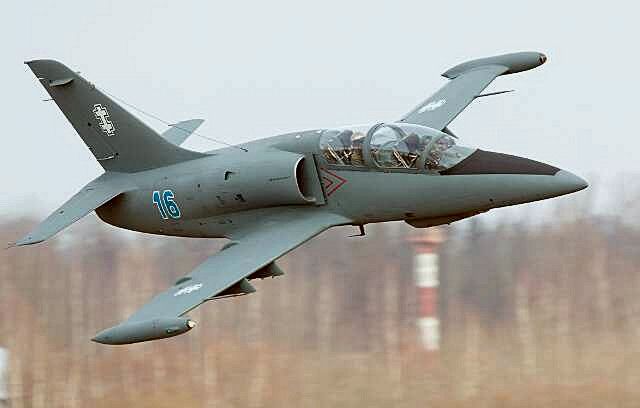
With this equipment the ZA could serve as a weapons trainer, a ground-attack aircraft and a light reconnaissance platform, a very attractive profile for air forces on modest budgets.
Czechoslovakia and its successors
The Czechoslovak Air Force had 30 L-39ZAs before the country split. In the 1993 division Slovakia received nine (registrations 4701, 4703, 4705, 4707, 4711, 1701, 1725, 1730 and 3905). Five went to the 1st Fighter Regiment at Sliač, one to the 2nd Mixed Regiment at Trenčín and the remaining three to the 3rd Fighter-Bomber Regiment at Kuchyňa. After several moves, in 1995 all of them joined the 31st Fighter Wing at Sliač, and at the end of 2001 they were assigned to the training squadron. Aircraft 1701 wore the colours of the Biele Albatrosy aerobatic team and was shown at the Radom Air Show in 2005. Slovakia lost two: 3905 crashed near Ožďany on 14 September 2000 and 4705 near Kalša on 29 October 2002; in both cases the pilots ejected. This fleet gave rise to the Slovak L-39ZAM upgrade, which is a separate variant.
In the Czech Republic, the Czech Wikipedia places four L-39ZAs with the 213th Training Squadron at Čáslav; the German one lists nine in the Czech inventory.
Exports
According to the German Wikipedia, the ZA went to Algeria (32), Bangladesh (8), Bulgaria (12), Cambodia (8), Nigeria (24), Romania (32 acquired, none still in service), Syria (66 in 2015) and Uganda (3), as well as Lithuania, which bought two from the Czech Republic. These figures mix current and former users and different dates, so they must not be added up as a production total.
In service
In Romania, on 26 September 1987, Mihai Smighelschi, a 21-year-old student of the Air Force Academy, flew an L-39ZA to Turkey and requested political asylum. The aircraft was recovered, and its recorders showed he had flown no higher than 150 m above ground at 700 km/h to evade radar.

The Syrian Arab Air Force used its armed L-39ZAs in counter-insurgency missions from the early stages of the civil war. They were first used operationally in the Battle of Aleppo, striking rebel-held positions, and it has been claimed that the L-39 was the first fixed-wing aircraft employed against the rebels. Several were shot down by ground fire.
In Lithuania, an L-39ZA acquired in 1998 crashed on 30 August 2011 after colliding with a French Dassault Mirage 2000; both occupants survived. In 2024 Lithuania transferred its last L-39ZA to Ukraine. In Bulgaria, on 13 September 2024, an L-39ZA crashed near Graf Ignatievo Air Base during an air show rehearsal, killing both pilots, Major Petko D. Dimitrov and First Lieutenant Vencislav A. Dunkin. Bangladeshi L-39ZAs have been photographed armed with the GSh-23L cannon and rocket pods.
Legacy
Besides the Slovak ZAM, the ZA also led to the Thai L-39ZA/ART, fitted with Elbit avionics, which has its own variant page.

Multimedia


