Aero L-39 Albatros variant
Aero L-39 Albatros L-39C
The Albatros standard basic trainer and its most numerous version: about 2,260 built for the USSR, Czechoslovakia and export, with an AI-25TL turbofan and two underwing pylons for drop tanks and practice stores.

- 2,260
- Units built
- 1,100 km
- Range
History
The L-39C is the Albatros in its purest form: the production basic trainer from which Aero Vodochody developed every other version of the family. The C stands for cvičná («training»), but it was not there at first: the aircraft was simply called L-39 and only gained the suffix once later variants made it necessary to tell the basic model apart from the rest.
Its story begins with the second prototype, X-02 (registered OK-32), which made the type's first flight on 4 November 1968 in the hands of factory test pilot Rudolf Duchoň. Chief designer Jan Vlček's team had worked in close cooperation with the USSR, and after the preliminary flight tests the intake trunks were made slightly larger and longer. Series production of the initial version, now designated L-39C, began in 1971. In 1972 most Warsaw Pact countries, Poland excepted as it kept its own PZL TS-11 Iskra, formally recognised it as their preferred trainer, and large orders followed from across the bloc, many of them from the Soviet Air Forces. The Czechoslovak Air Force took it into service on 28 March 1972.
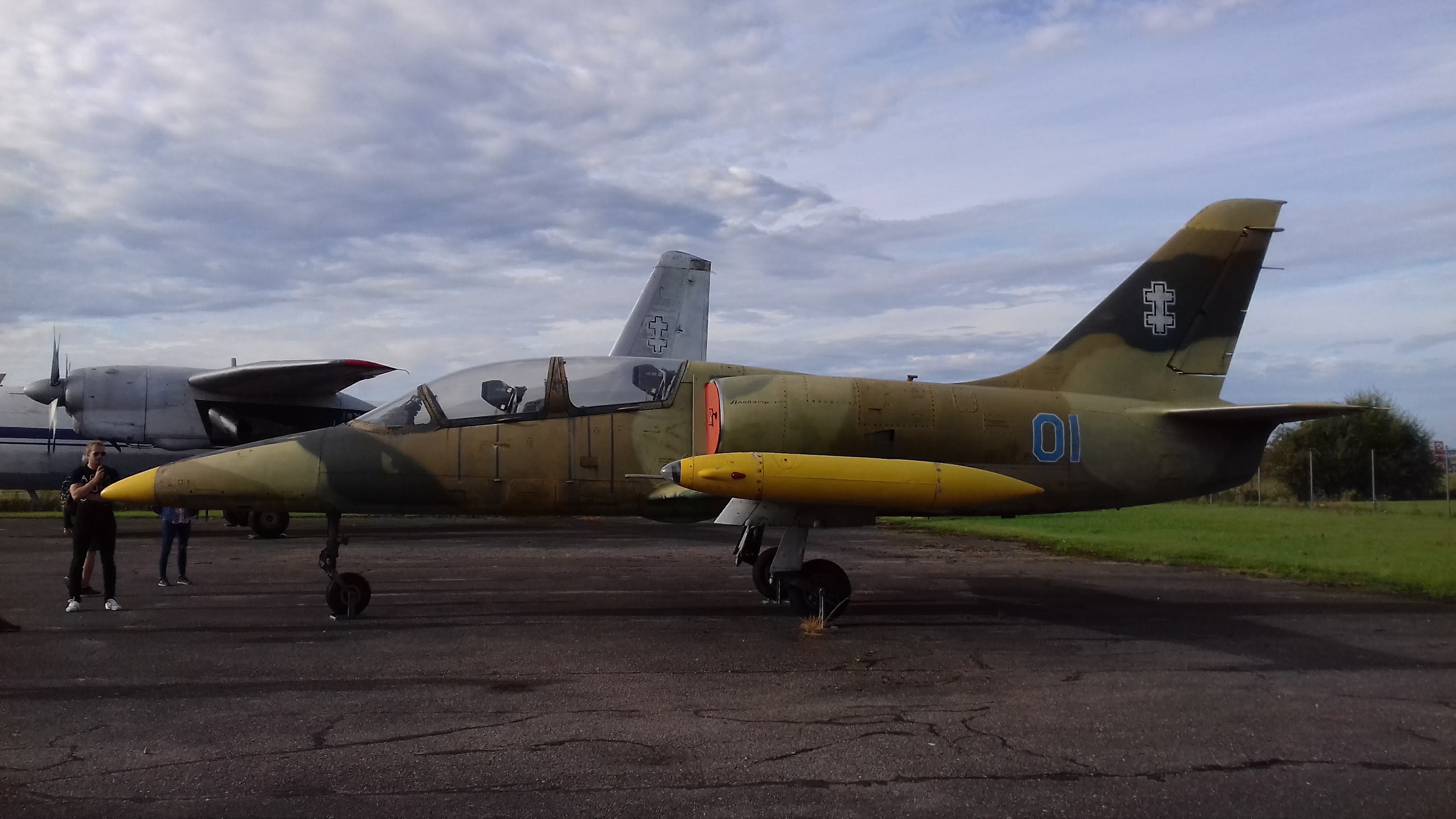
According to Jane's, the C served with the air forces of Afghanistan, Czechoslovakia, East Germany and the USSR, where until the mid-1990s it was, alongside the L-29, the main advanced trainer. In Czechoslovakia all pilot training went through the Albatros, helicopter pilots included, and pupils soloed after about 12 hours of dual instruction. The aircraft was part of a complete training system with the TL-39 flight simulator, the NK-TL-29/39 ejection trainer and the AKC-KL-39 mobile test equipment, and it could operate from grass strips at up to 4,600 kg take-off weight. By May 1977, when the Albatros made its Western debut at the Paris Air Show, some 400 to 500 were already in service. Approximately 2,260 examples of the C were built, the bulk of Albatros production, which ended in 1996.
It is an all-metal, semi-monocoque low-wing monoplane with a straight wing of modified NACA 64A012 section, 2° 30′ of dihedral, double-slotted flaps that retract automatically at 310 km/h and fixed 100-litre wingtip tanks that also house the landing lights. The fuselage is built in two portions: the rear one, carrying the tail, is held by five bolts and comes off quickly for engine removal. The two ventral air brakes deploy automatically as the aircraft nears Mach 0.8. The crew sit in tandem in a pressurised, air-conditioned cockpit on rocket-assisted VS-1-BR1 zero-height ejection seats, under individual canopies hinged to starboard; the rear instructor's seat is slightly raised to watch the student. Power comes from a Soviet Ivchenko AI-25TL turbofan of 16.87 kN fed by semicircular intakes on each side of the fuselage. Five bag tanks behind the cockpit hold 1,055 litres, rising to 1,255 litres with the tip tanks; two 150 or 350-litre underwing drop tanks bring the total to 1,955 litres, and the fuel system allows up to 20 seconds of inverted flight. Standard avionics included the R-832M radio, RKL-41 ADF, RV-5 radio altimeter, SRO-2 IFF and the RSBN-5S navigation and landing system, with VOR/ILS optional.
Using Jane's 1988–89 data, the L-39C is 12.13 m long, spans 9.46 m and stands 4.77 m high, with 18.8 m² of wing area, 3,455 kg empty and 4,700 kg at maximum take-off. It reaches 750 km/h at 5,000 m, climbs at 21 m/s, has an 11,000 m ceiling and covers 1,100 km on internal fuel or 1,750 km with external tanks, with endurances of 2 h 30 min and 3 h 50 min. Its g limits at 4,200 kg are +8 and −4. The two underwing pylons take up to 284 kg of drop tanks or practice stores, although they are not usually fitted.
After Czechoslovakia split, the Czech Republic kept training pilots on the C at the Pardubice flight training centre. Slovakia received eight L-39Cs in 1993, assigned from 1 January that year to the 1st squadron of the 5th training regiment at Košice; in 1996 and 1997 six of them received new forward fuselages and five more years of life, and in 2000–2001 it was decided to give them new wings, rear fuselages and avionics, which produced the L-39CM. The Bílé Albatrosy aerobatic team lost two of its Cs: one on 17 June 1997, whose pilots ejected, and another on 3 June 2000 at Sliač, which killed Major Ľuboš Novák. In Afghanistan the Taliban put around five inherited L-39Cs into combat during the 1996–2001 civil war; in Vietnam an L-39C of the 910th Regiment crashed on 26 August 2016. Ukraine had converted six L-39Cs into L-39M1s by 2014. The C is also the most common version in private hands: in March 2018 four of the five Albatroses on New Zealand's civil register were listed as L-39Cs, and Elon Musk owned one, registered N97NL, from 2002 to 2007. Examples are displayed at the National Technical Museum in Prague, at Čáslav air base and in several museums in the United States.
Multimedia


Where to see it today
| Serial | Place | City | Country | Status |
|---|---|---|---|---|
| 230108 | Caslav Air Base | Čáslav | Czechia | On display |
| 230107 | National Technical Museum | Prague | Czechia | On display |
| 931531 | Lithuanian Aviation Museum | Kaunas | Lithuania | On display |
| 533526 | Hiller Aviation Museum | San Carlos | United States | On display |
| 430405 | Southern Museum of Flight | Birmingham | United States | On display |
| 131907 | Teton Aviation Center | Driggs | United States | On display |
List reviewed on October 28, 2026 against Wikipedia (EN): Aero L-39 Albatros, Aerial Visuals Airframe Dossier, Aerial Visuals Airframe Dossier.