Family: R-7 (Soyuz) · RKTs Progress
Soyuz 2.1b/Volga
Launch statistics
- 1
- Launches (as of July 27, 2026)
- 1
- Successes
- 0
- Failures
- 100.0 %
- Success rate


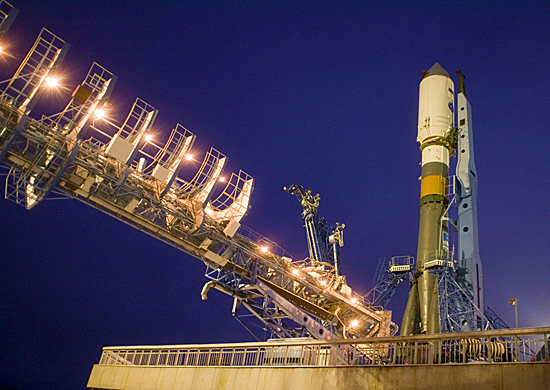


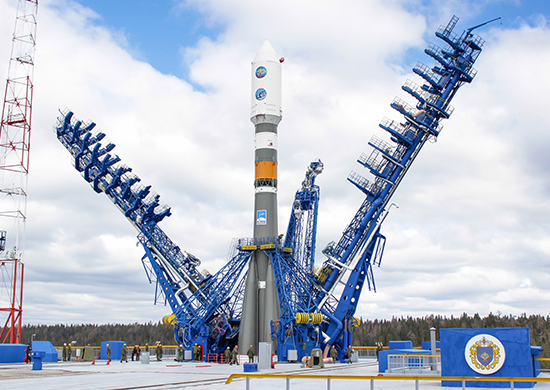


Soyuz 2.1b/Volga is not a distinct rocket but a specific configuration: a Soyuz-2.1b launch vehicle fitted with the Volga upper stage. Soyuz-2 is the Russian series of expendable medium-lift launch vehicles and the seventh major iteration of the Soyuz family, produced by the Progress Rocket Space Centre in Samara, with improved engines and a digital flight control system that enables launches from fixed platforms and supports larger payload fairings. Within that series, the 2.1b variant differs from the 2.1a in its third stage: it replaces the RD-0110 engine with the RD-0124, an oxygen-rich staged-combustion design that raises specific impulse from 326 to 359 seconds. Maximum thrust drops slightly, from 298 to 294 kN, but the longer burn time with the same propellant load improves overall performance: from Baikonur, low Earth orbit capacity rises from about 7,430 kg for the 2.1a to 8,670 kg for the 2.1b. Volga is a Russian upper stage from RKTs Progress derived from the propulsion module of the Yantar satellite and closely related to the retired Ikar stage. It serves as a lighter, more cost-effective alternative to Fregat, the upper stage used on most Soyuz-2 missions: is particularly suited to Sun-synchronous orbits of around 850 km, and costs up to four times less than Fregat. In short, it is the combination meant to place medium payloads into high or multiple orbits without paying for a Fregat.
History
The Soyuz-2 series
Soyuz-2 development began in the early 1990s as the "Rus" programme, led by RKTs Progress with support from the Russian government. After the dissolution of the Soviet Union the aim was to consolidate Soyuz production inside Russia, eliminate reliance on foreign-supplied components and modernise the ageing Soyuz-U and Molniya-M, which still depended on 1960s-era analogue flight control electronics developed in Ukraine. Work on the digital flight control system began in 1993 at NPO Avtomatiki in Yekaterinburg, using triple-redundant computers and dual gyroscopes. Together the upgrades increased payload capacity by approximately 1,200 kg.
The 2.1b variant
Budget constraints in the late 1990s forced a phased rollout: the RD-107A and RD-108A engines entered service first on the transitional Soyuz-FG, the new avionics debuted with Soyuz-2.1a on 8 November 2004, and the RD-0124 engine followed with Soyuz-2.1b, whose debut is dated 27 December 2006.
The Volga stage
RKTs Progress began developing Volga in 2008 and finalised the design in 2010, proposing it during the development of the Soyuz-2.1v as an inexpensive third stage. Accommodating it required modifications to the Soyuz payload section: antennas, connectors, pyrotechnic devices and the foam insulation inside the fairing. Typical missions last between 60 and 120 minutes and can deploy a single or multiple payloads with Volga providing attitude control; afterwards the stage either deorbits or moves to a safe distance, its maximum operational life being 24 hours.
The 2.1b/Volga pairing
Volga's first use atop a Soyuz came in 2016 with the inaugural launch from Vostochny, in that case on a Soyuz-2.1a. The specific pairing with the 2.1b variant only arrived on 16 April 2026, when a Soyuz-2.1b/Volga lifted off at 23:18 UTC from Site 43/4 at the Plesetsk Cosmodrome with multiple Kosmos military payloads — only the second time a Soyuz had used this upper stage. Volga itself, counting its flights on the Soyuz-2.1v as well, has accumulated eleven launches with ten successes and one partial failure.
Launch timeline
| Date | Launch site | Program | Outcome | Payload |
|---|---|---|---|---|
| Apr 16, 2026, 11:17 PM | 43/4 (43R) | — | Success | Unknown satellite(s) for the Russian military. |
Images