Did you know…
How long is the saturn v?
Short answer
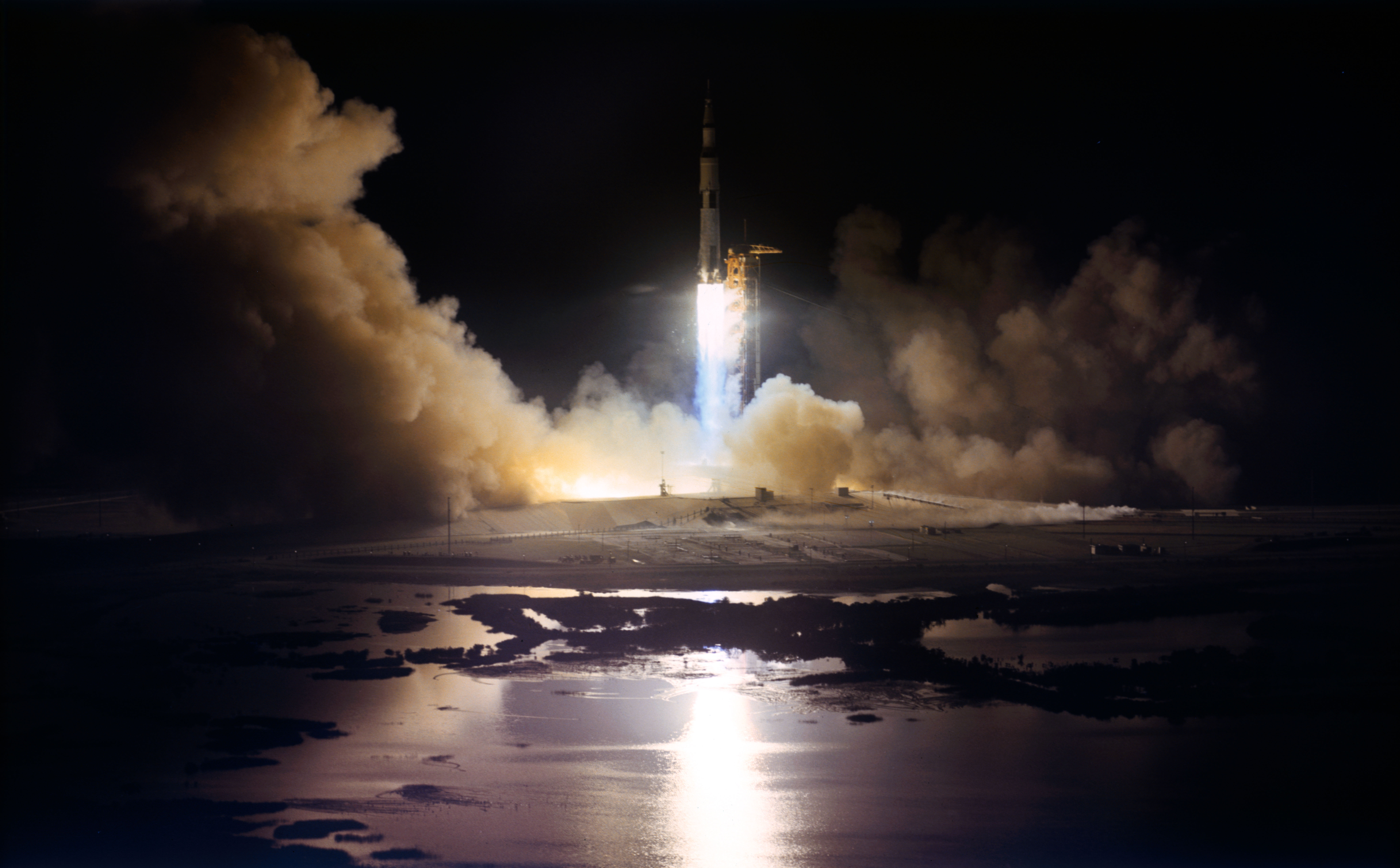
The Saturn V stood 110.6 m (363 ft) tall with the Apollo spacecraft and escape tower in place, and its first stage was 10.1 m (33 ft) in diameter. It held the record as the tallest rocket ever flown until SpaceX's Starship, which stands 121 m (397 ft). Its five F-1 engines produced about 7.5 million pounds of thrust at lift-off.

What the 110 metres include
The height usually quoted for the Saturn V is that of the complete vehicle on the pad, not of the launcher alone. Beneath the Apollo command and service module and the slender launch escape tower sat three stages — the S-IC, the S-II and the S-IVB — with the lunar module folded into an adapter between spacecraft and booster. Strip the payload away and the rocket proper is noticeably shorter, which is worth remembering when comparing published heights, since different builders measure different things.
Wide as well as tall
Height is only half the picture. The first two stages were 10.1 m (33 ft) across, a diameter set by the volume of kerosene, liquid oxygen and liquid hydrogen needed to push a crew all the way to lunar orbit. Five F-1 engines clustered at the base produced roughly 7.5 million pounds of thrust at lift-off, and the first stage was spent and discarded within the opening minutes of flight. A vehicle that size could not be assembled lying down: it was stacked upright inside the Vehicle Assembly Building and carried to the pad standing, on a crawler-transporter that still serves NASA today.
How it compares now
The Saturn V remained the tallest rocket ever flown for half a century, until SpaceX began launching Starship, whose booster and upper stage together stand 121 m (397 ft). Height, though, is a poor measure of a launcher; what matters is the mass it can place on a given trajectory. What still sets the Saturn V apart is that it is the only vehicle ever to have carried people out of Earth orbit, a job no rocket has repeated since the Apollo programme ended.
More questions
- Image pending
Astronauts and life in space
Why does astronauts float in space?
Because they are in free fall, not because gravity is absent. At the International Space Station's altitude of about 400 km, Earth still pulls almost as hard… more…
- Image pending
Astronauts and life in space
Why did yuri gagarin die?
Gagarin died in an aircraft crash, not in a spacecraft. On 27 March 1968 the MiG-15UTI trainer he was flying with instructor Vladimir Seryogin went down in… more…
- Image pending
Astronauts and life in space
How much an astronaut is paid?
NASA's civilian astronauts are ordinary federal employees, paid on the General Schedule grade-and-step scale with no bonus per flight, per spacewalk or per… more…
.png)
Astronauts and life in space
Why is blue origin so slow?
Blue Origin was built on deliberate, owner-funded incrementalism: its motto is Gradatim Ferociter, step by step, and it spent its first two decades on… more…
Astronauts and life in space
When did astronauts last walk on the moon?
Apollo 17, in December 1972. Eugene Cernan and Harrison Schmitt landed in the Taurus-Littrow valley on 11 December 1972, worked on the surface for three days… more…
- Image pending
Astronauts and life in space
How high do astronauts orbit the earth?
Crewed spaceflight today happens a few hundred kilometres up. The International Space Station orbits at about 400 km, lapping the planet roughly every 90… more…
