Did you know…
How long does it take a rocket to reach space?
Short answer
A rocket crosses the conventional boundary of space, the Kármán line at 100 km altitude, two to three minutes after launch. But reaching space isn't the same as staying there: entering low orbit requires continuing to accelerate to about 7.8 km/s, which a Falcon 9 completes in just under nine minutes.

Three minutes to the Kármán line
The most widely used definition of where space begins is the Kármán line, at 100 km altitude, which the Fédération Aéronautique Internationale uses for its records; the US Air Force and NASA use 50 miles, about 80 km. A typical orbital launcher passes that mark two to three minutes into flight, roughly when the first stage separates. A Falcon 9 shuts down its first-stage engines around 2 min 30 s, at about 70-80 km, and crosses 100 km shortly after. A much lighter suborbital rocket like New Shepard reaches it in a little under four minutes and comes back down in just over ten.
Nine minutes to orbit
Being at 100 km isn't enough to stay in space: without horizontal velocity the vehicle falls back down. Sustaining a low orbit requires reaching about 7.8 km/s, and gaining that speed is what takes up most of the ascent. The space shuttle reached main engine cutoff at 8 min 30 s; a Falcon 9 shuts down its second stage at about 8 min 50 s on a typical low-orbit mission; a Saturn V needed about 11 min 40 s. For higher destinations, such as geostationary orbit, the second stage reignites after a 20-30 minute coast phase.
Beyond Earth orbit
For other destinations the clock stretches out considerably. Capsules headed to the International Space Station reach orbit in nine minutes but dock between six hours and two days later, depending on the mission profile. Apollo missions took about three days to reach the Moon, and a probe to Mars travels for six to nine months. Launch, then, is the shortest part of the journey: space is only minutes away, but the destination, almost always, is much farther.
More questions
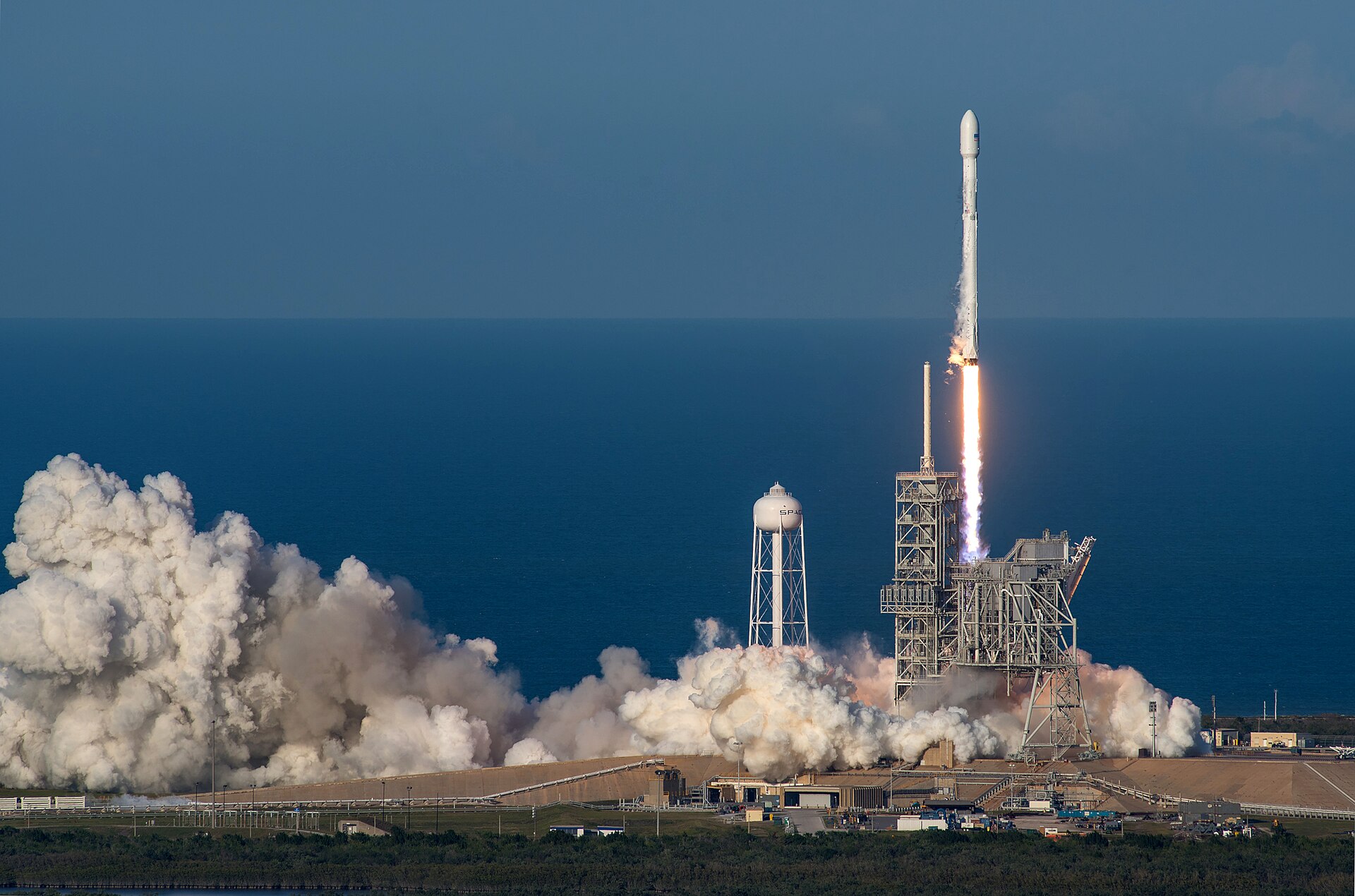
Foto: SpaceX (CC0) Rockets and launches
How many horsepower does the Falcon 9 have?
Rockets aren't measured in horsepower, but in thrust: the Falcon 9's first stage's nine Merlin engines deliver 7,686 kN (1,710,000 lbf) combined at sea level… more…
Foto: SpaceX (CC0) Rockets and launches
How much a rocket weight?
Rockets range from about 13 t for Rocket Lab's Electron to roughly 549 t for Falcon 9, 2,800 t for Saturn V and close to 5,000 t for Starship with its Super… more…

Rockets and launches
What does the saturn v look like?
Saturn V looked like a white needle 110.6 m (363 ft) tall and 10.1 m wide at the base, painted with black roll-pattern stripes, the words UNITED STATES and… more…
Foto: SpaceX (CC0) Rockets and launches
Why do rockets launch from florida?
Rockets launch from Florida because the Cape sits at 28.5 degrees north, low enough to gain about 410 m/s from the Earth's rotation on an eastward launch, and… more…
Foto: SpaceX (CC0) Rockets and launches
How much falcon 9 launch cost?
SpaceX lists a standard Falcon 9 mission at 69.75 million dollars, with the booster recovered (data as of January 2025). Small satellites can share a ride… more…
Rockets and launches
How does the saturn v work?
Saturn V worked by staging: a kerosene first stage with five F-1 engines (about 34,000 kN) lifted the 2,800 t rocket for two and a half minutes, a… more…
