Airliner · Civil · Russia
Yakovlev Yak-42
- March 7, 1975
- First flight
- 1980
- Introduced
- In service
- Status
- 185–187
- Units built

%2C_Moscow_Sheremetyevo_(3)-800.webp)
-1600.webp)
_at_Kriviy_Rig_technical_school-1600.webp)
_(3)-800.webp)
_at_Lviv%2C_1995-1600.webp)
-800.webp)
-800.webp)

_preserved_at_VDNKh%2C_Moscow-800.webp)

-800.webp)
%2C_Moscow_Sheremetyevo_(2)-800.webp)

-1600.webp)
_preserved_at_Smolensk%2C_nose-1600.webp)
_preserved_at_Smolensk%2C_rear-1600.webp)
_at_ILA_Sch%C3%B6nefeld%2C_1994-1600.webp)
-1600.webp)


%2C_Moscow_Sheremetyevo_(1)-800.webp)
-1600.webp)


-1600.webp)
-1600.webp)
_at_Helsinki-Vantaa%2C_1981-82-800.webp)


-1600.webp)

_with_the_D-236_propfan_on_the_pylon%2C_Aeroflot-800.webp)
_at_Le_Bourget_1981-800.webp)


-1600.webp)

_at_Naryan_Mar_Airport-800.webp)
_Yakovlev_Yak-42D_UR-42377_(25029337382)-800.webp)


%2C_last_pre-series_aircraft%2C_preserved_at_Smolensk-1600.webp)


_preserved_at_Smolensk%2C_side_view-1600.webp)


_at_Yegoryevsk_technical_school-1600.webp)
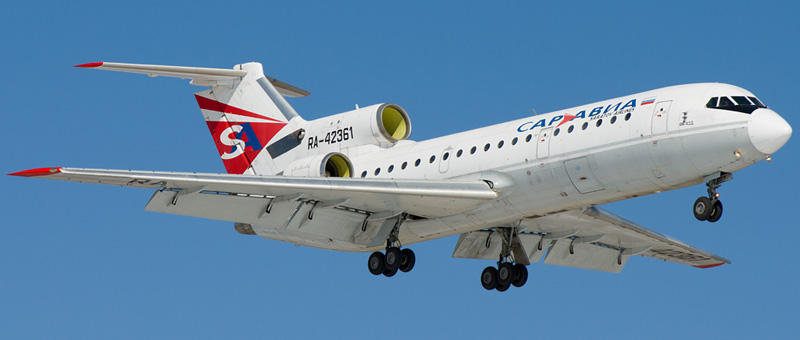
The Yakovlev Yak-42 is a narrow-body trijet for mid-range routes and the first Soviet airliner powered by modern high-bypass turbofans. It first flew on 7 March 1975 and began scheduled service on 22 December 1980.
Related sheets
Category
History
The Yak-42 was Yakovlev's leap from the small Yak-40 to a genuinely capable airliner, sized for 100 to 120 passengers on mid-range routes. Its most advanced feature was its trio of Lotarev D-36 three-shaft high-bypass turbofans, which made it the first airliner built in the Soviet Union with this modern, efficient kind of propulsion. The prototype flew on 7 March 1975 and, after an unhurried development, scheduled service began on 22 December 1980.
The programme was scarred on 28 June 1982, when an Aeroflot Yak-42 lost its tailplane in flight owing to the failure of its actuator screw jack, killing all 132 people aboard. The entire fleet stayed grounded until October 1984 while the mechanism was redesigned, a stoppage that eroded confidence in the type just as it was being deployed.
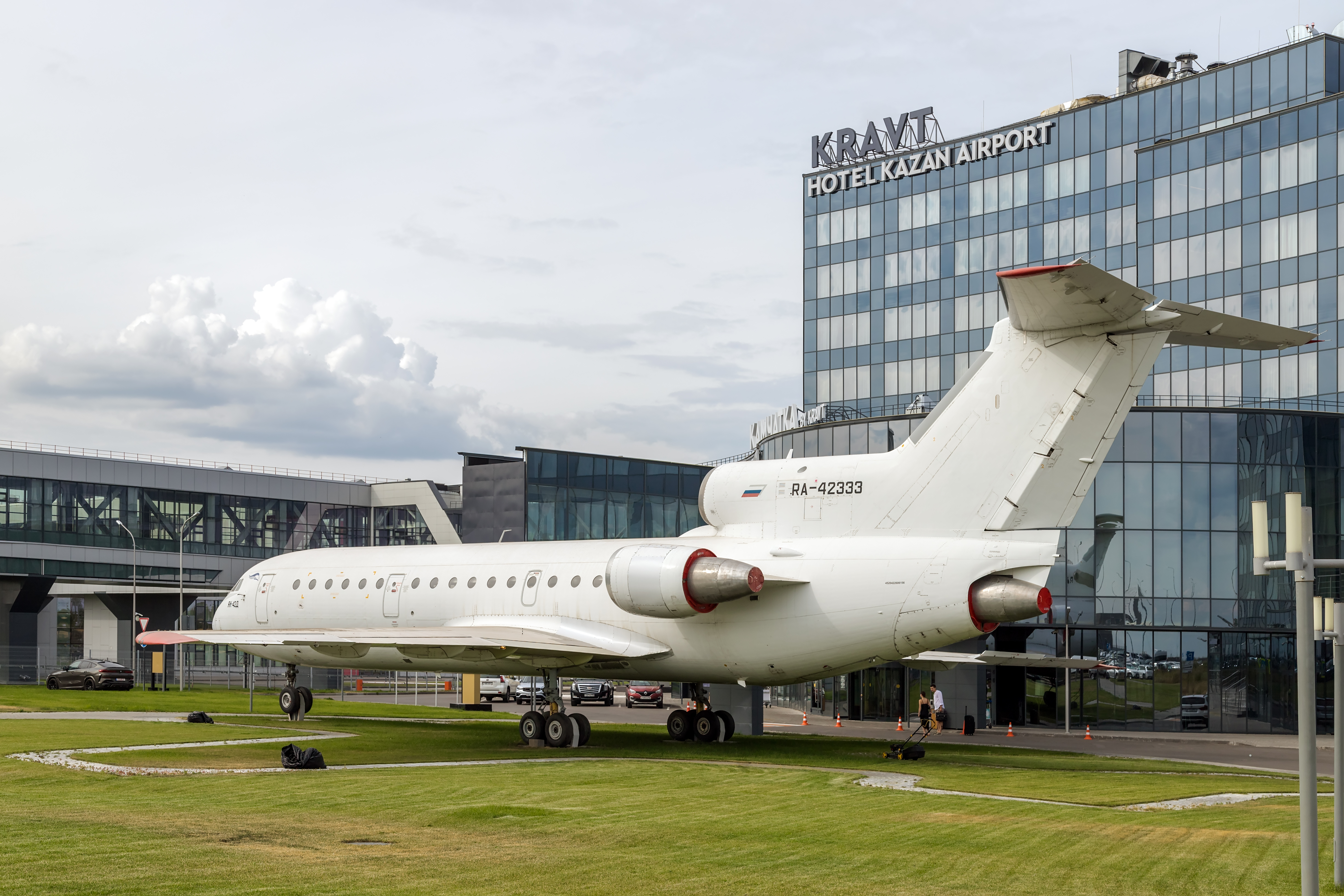
Production, based at the Saratov plant, continued until 2003 with 187 aircraft completed. From 1991 the improved Yak-42D enabled limited export sales to countries such as Bosnia, China, Cuba and Iran, and a handful of aircraft were still flying in restricted service decades after the prototype's maiden flight.
Variants
| Yak-42 SSSR-1974 | Yak-42LL / Yak-42E-LL | Yak-142 / Yak-42A | Yak-242 | Yak-42 | Yak-42B | Yak-42D | Yak-42D-100 | Yak-42D «Rosgidromet» | Yak-42F | Yak-42M | Yak-42ML | Yak-42R | Yak-42 SSSR-1975 | Yak-42 SSSR-1976 | Yak-42T | |
|---|---|---|---|---|---|---|---|---|---|---|---|---|---|---|---|---|
| First flight | March 7, 1975 | March 15, 1991 | — | — | — | — | — | — | — | — | — | — | — | — | — | — |
| Aircraft type | Short/medium-haul airliner prototype | Propulsion test-bed aircraft | Short/medium-haul airliner | Short/medium-haul airliner project | Short/medium-haul airliner | Short/medium-haul airliner | Short/medium-haul airliner | Short/medium-haul airliner | Atmospheric-monitoring flying laboratory | Geophysical survey and environmental monitoring aircraft | Short/medium-haul airliner project | Short/medium-haul airliner | Radar test-bed aircraft | Short/medium-haul airliner prototype | Short/medium-haul airliner prototype | Short/medium-haul freighter project |
| Powerplant | 3 × Lotarev (ZMKB Progress) D-36 turbofans. | Conversion carrying a contra-rotating Progress D-236 propfan in place of the starboard engine, on a tall pylon that clears the 4.2 m propellers, plus the two remaining Lotarev D-36 turbofans. | 3 × Lotarev (ZMKB Progress) D-36 Series 1 turbofans of 63.74 kN each, with acoustic lining in the nacelles. | 2 × underwing Aviadvigatel PS-90A12 turbofans of 118 kN each, dropping the family's trijet layout. | 3 × Lotarev (ZMKB Progress) D-36 Series 1 turbofans of 63.74 kN each. | 3 × Lotarev (ZMKB Progress) D-36 Series 1 turbofans of 63.74 kN each. | 3 × Lotarev (ZMKB Progress) D-36 Series 1 turbofans of 63.74 kN each: two in pods flanking the rear fuselage and the third buried in the tail with an S-duct intake. No thrust reversers. | 3 × Lotarev (ZMKB Progress) D-36 Series 1 turbofans of 63.74 kN each. | 3 × Lotarev (ZMKB Progress) D-36 Series 1 turbofans of 63.74 kN each. | 3 × Lotarev (ZMKB Progress) D-36 Series 1 turbofans of 63.74 kN each. | 3 × Progress D-436M turbofans, planned alongside an entirely new wing and fly-by-wire controls. | 3 × Lotarev (ZMKB Progress) D-36 Series 1 turbofans of 63.74 kN each. | 3 × Lotarev (ZMKB Progress) D-36 Series 1 turbofans of 63.74 kN each. | 3 × Lotarev (ZMKB Progress) D-36 turbofans. | 3 × Lotarev (ZMKB Progress) D-36 turbofans. | 3 × Lotarev (ZMKB Progress) D-36 Series 1 turbofans of 63.74 kN each. |
| Powerplant | 3 × Lotarev (ZMKB Progress) D-36 | 3 × Progress D-236 propfan + 2 × Lotarev D-36 | 3 × Lotarev (ZMKB Progress) D-36 Series 1 | 2 × Aviadvigatel PS-90A12 | 3 × Lotarev (ZMKB Progress) D-36 Series 1 | 3 × Lotarev (ZMKB Progress) D-36 Series 1 | 3 × Lotarev (ZMKB Progress) D-36 Series 1 | 3 × Lotarev (ZMKB Progress) D-36 Series 1 | 3 × Lotarev (ZMKB Progress) D-36 Series 1 | 3 × Lotarev (ZMKB Progress) D-36 Series 1 | 3 × Progress D-436M | 3 × Lotarev (ZMKB Progress) D-36 Series 1 | 3 × Lotarev (ZMKB Progress) D-36 Series 1 | 3 × Lotarev (ZMKB Progress) D-36 | 3 × Lotarev (ZMKB Progress) D-36 | 3 × Lotarev (ZMKB Progress) D-36 Series 1 |
| Thrust per engine | — | — | 63.7 kN | 118 kN Best value in this row | 63.7 kN | — | 63.7 kN | 63.7 kN | 63.7 kN | 63.7 kN | — | 63.7 kN | 63.7 kN | — | — | 63.7 kN |
| Length | — | — | — | — | 36.4 m Best value in this row | — | 36.4 m Best value in this row | — | — | — | — | — | — | — | — | — |
| Wingspan | — | — | — | — | 34.9 m Best value in this row | — | 34.9 m Best value in this row | — | — | — | — | — | — | — | — | — |
| Height | — | — | — | — | 9.8 m Best value in this row | — | 9.8 m Best value in this row | — | — | — | — | — | — | — | — | — |
| Wing area | — | — | — | — | 150 m² Best value in this row | — | 150 m² Best value in this row | — | — | — | — | — | — | — | — | — |
| Empty weight | — | — | — | — | — | — | 33,000 kg | — | — | — | — | — | — | — | — | — |
| MTOW | — | — | 57,500 kg | 64,600 kg | 54,000 kg | — | 57,500 kg | — | — | — | 66,000 kg Best value in this row | — | — | — | — | — |
| Top speed | — | — | — | — | 810 km/h Best value in this row | — | 810 km/h Best value in this row | — | — | — | — | — | — | — | — | — |
| Cruise speed | — | — | — | — | 750 km/h Best value in this row | — | 740 km/h | — | — | — | — | — | — | — | — | — |
| Service ceiling | — | — | — | — | — | — | 9,600 m | — | — | — | — | — | — | — | — | — |
| Initial climb rate | — | — | — | — | — | — | 13 m/s | — | — | — | — | — | — | — | — | — |
| Range | — | — | — | 5,000 km Best value in this row | 2,790 km | — | 4,000 km | — | — | — | — | — | — | — | — | — |
| Ferry range | — | — | — | — | — | — | 4,000 km | — | — | — | — | — | — | — | — | — |
| Combat radius | 0 km Best value in this row | 0 km Best value in this row | 0 km Best value in this row | 0 km Best value in this row | 0 km Best value in this row | 0 km Best value in this row | 0 km Best value in this row | 0 km Best value in this row | 0 km Best value in this row | 0 km Best value in this row | 0 km Best value in this row | 0 km Best value in this row | 0 km Best value in this row | 0 km Best value in this row | 0 km Best value in this row | 0 km Best value in this row |
| Range conditions | — | — | — | An estimated 5,000 km with maximum fuel and regulatory reserves. | 2,790 km practical range; 1,530 km with the normal payload. | — | 4,000 km with maximum fuel. The D (Dahl'niy, long-range) comes from enlarging the fuel capacity of the original Yak-42, which reached 2,790 km. | — | — | — | — | Avionics adapted to international routes; entered service in July 1981 on the Leningrad-Helsinki run. | — | — | — | — |
| Armament | None | None | None | None | None | None | None | None | None | None | None | None | None | None | None | None |
| Max weapons load | 0 kg Best value in this row | 0 kg Best value in this row | 0 kg Best value in this row | 0 kg Best value in this row | 0 kg Best value in this row | 0 kg Best value in this row | 0 kg Best value in this row | 0 kg Best value in this row | 0 kg Best value in this row | 0 kg Best value in this row | 0 kg Best value in this row | 0 kg Best value in this row | 0 kg Best value in this row | 0 kg Best value in this row | 0 kg Best value in this row | 0 kg Best value in this row |
| Payload | — | — | — | — | 14,500 kg Best value in this row | — | 13,500 kg | — | — | — | — | — | — | — | — | 12,000 kg |
| Cargo capacity | — | Test airframe with no passenger service. | 120 seats, with a 39-seat VIP version also offered. Enlarged wing tanks, enclosed luggage racks and drop-down oxygen masks. | 130 to 180 passengers. The programme stopped in 1997 with roughly 30 % of the design done; its line led to the Irkut MC-21. | 90 to 126 seats depending on layout; 14,500 kg maximum payload and 10,500 kg normal payload. | — | Up to 120 economy seats (102 in a two-class layout) and a maximum commercial payload of 13,500 kg carried in two underfloor holds. | Yak-42D derivative with western AlliedSignal/Honeywell avionics, a widened cabin door for jet bridges and in-flight deployable spoilers. | Cabin given over to the Russian weather service's atmospheric monitoring instruments rather than to passengers. | Conversion carrying large underwing pods for electro-optical sensors; no passenger service. | Stretched Yak-42 fuselage with a DC-10-style centre engine installation and a cruciform tail. Never built. | — | Airframe dedicated to flight-testing the radar of the Yakovlev Yak-141 fighter; no commercial use. | — | — | Proposed freighter with a 2.5 × 2.0 m cargo door and a 12,000 kg maximum load: six pallets over the floor and eight below it. It never left the study stage. |
| Crew | 2 Best value in this row | 2 Best value in this row | 2 Best value in this row | — | 2 Best value in this row | 2 Best value in this row | 2 Best value in this row | 2 Best value in this row | 2 Best value in this row | 2 Best value in this row | 2 Best value in this row | 2 Best value in this row | 2 Best value in this row | 2 Best value in this row | 2 Best value in this row | 2 Best value in this row |
| Passengers | — | — | 120 | 180 Best value in this row | 120 | — | 120 | 120 | — | — | 168 | 120 | — | — | — | — |
| Units built | — | — | — | — | — | — | 105 | — | — | — | — | — | — | — | — | — |
Images


![El accidente militar que España nunca superó | Yak-42 (2003) – Despresurizados [Especial 22 años]](https://i.ytimg.com/vi/4yN6hVY7oSQ/hqdefault.jpg)













![Saratov Airlines (Saravia) Yakovlev Yak-42 Saratov to Moscow DME [AirClips full flight series]](https://i.ytimg.com/vi/th0M_uLN0qM/hqdefault.jpg)