Vickers Vanguard variant
Vickers Vanguard Vickers Type 952
Vickers Vanguard version for Trans-Canada Air Lines, with more powerful Tyne 512 engines and a strengthened airframe for higher weights; 23 delivered, in service from 1 February 1961.
-1600.webp)
- May 21, 1960
- First flight
- 23
- Units built
- 2,945 km
- Range
- 139
- Passengers
History
The Type 952 is the version of the Vickers Vanguard built for Trans-Canada Air Lines (TCA), the Canadian national carrier later renamed Air Canada. It came about because, while British European Airways (BEA) was defining a successor to the Viscount for its short European routes, TCA also approached Vickers with its own list of requirements: a Viscount-like airliner able to serve its transcontinental routes. The Canadian requests shaped the whole design. TCA wanted a low-mounted wing, which made the aircraft easier to refuel, de-ice and service and improved survival chances in a water landing; and while BEA was interested in sub-1,000-mile sectors, the fuel tanks were progressively enlarged over several revisions to give a range of 4,200 km precisely so that the airliner would be acceptable to TCA.
TCA did not commit at once, partly because the basic model did not entirely meet its needs, for example in air-mail capacity. Vickers also recognised that a high-density layout for up to 139 passengers would appeal to more operators, and designed the Type 952 for that market. After a particularly vigorous evaluation, TCA announced in early January 1957 an order for 20 Type 952s. According to the airline's own magazine, the choice came out of a seven-year study in which TCA engineers "flew" hypothetical and competing aircraft on paper over the airline's routes, varying weather, holding patterns and mechanical factors, until the DC-8 and the Vanguard emerged as best suited to Canadian requirements. The order was increased to 23 aircraft during 1960.
Compared with BEA's initial version, the Type 952 received a more powerful engine and a strengthened fuselage and wing for higher weights. It was powered by four Rolls-Royce Tyne RTy.11 Mk 512 turboprops of 4,135 kW (5,545 shp), against the 3,717 kW (4,985 hp) of the Tyne 506 fitted to the BEA Vanguards, and maximum take-off weight rose to about 66,451 kg. It was 37.45 m long and 10.64 m high, with an empty weight of 37,421 kg, a cruising speed of 684 km/h and a ceiling of 9145 m. It could seat up to 139 passengers, although TCA planned a mixed tourist and first-class cabin of only 96 seats. Its stronger airframe later became the basis of the Type 953 that BEA ordered to replace the 951.
TCA's in-flight magazine of June 1959 set out what the airline expected: some 160 km/h more speed than the Viscount and twice the passengers; the "double-bubble" fuselage, whose two large lower holds left the main deck entirely to passengers and allowed all-freight schedules in the early-morning hours; twin-door boarding on self-contained retractable airstairs; and 40 deep oval Viscount-type windows. TCA president Gordon McGregor made two landings and a take-off during the Vanguard's 33rd test flight and summed it up as being as good as the Viscount and twice as big. TCA's own engineering department contributed to the joint effort with Vickers and Rolls-Royce, and the airline expected that, once the Vanguard was in service, it would be the first intercontinental airline in the world to operate an all-turbine fleet.
Problems with the new engine delayed the programme, but TCA was first to put the type into scheduled service: on 1 February 1961 it began Vanguard schedules with two flights from Toronto and Montreal to Vancouver via intermediate stops, one month ahead of BEA. All 23 aircraft passed to Air Canada when the airline was renamed in June 1964, and period photographs show them under registrations such as CF-TKA (Toronto, March 1971) and CF-TKE (Calgary, 1967). In 1966 Air Canada converted one of them into a pure freighter, the Cargoliner, which has its own page; it was the last Canadian Vanguard to be retired, in December 1972.
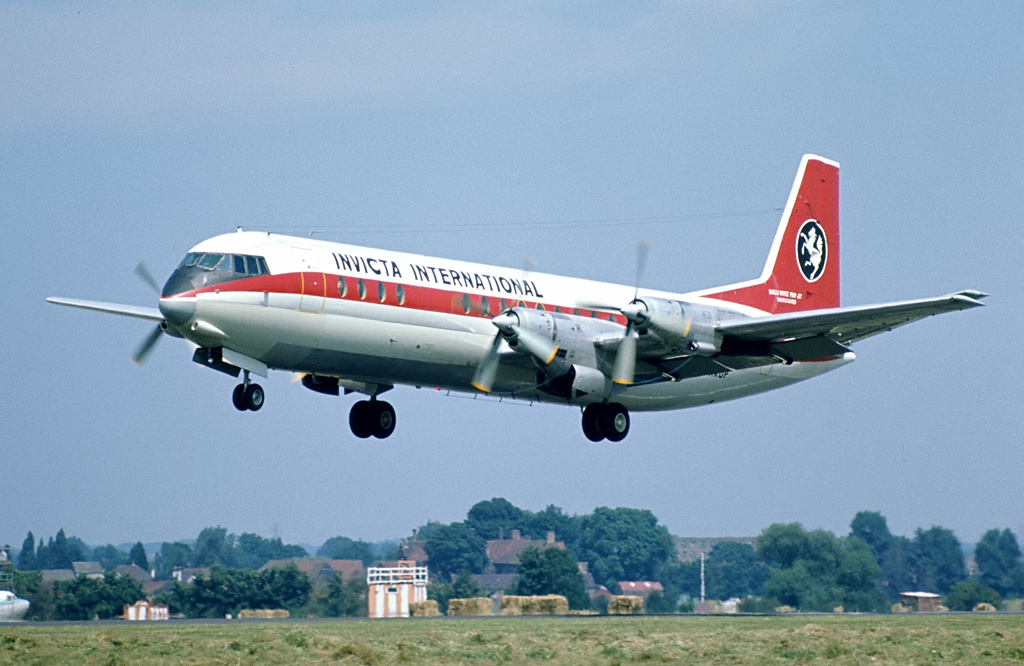
After Air Canada, many Type 952s kept flying with other operators. France's Europe Aero Service bought several aircraft from Air Canada and used them mainly for passenger charters. A 952, G-AXOP of Britain's Invicta International Airlines, was involved on 10 April 1973 in the deadliest accident in Vanguard history and the deadliest on Swiss soil: on a charter flight from Bristol to Basel-Mulhouse, the crew misidentified the approach radio beacons in a heavy snowstorm and the aircraft struck a wooded hillside in the Jura near Hochwald, killing 108 of the 145 people on board. On 6 February 1989 another 952 converted to a freighter, F-GEJE of Inter Cargo Service, crashed into the sea just after take-off from Marseille-Marignane. The last Vanguard built, also a Type 952 (construction number 746), flew until 1984 with Indonesia's Merpati Nusantara Airlines as PK-MVH.
Multimedia

-1600.webp)
-1600.webp)
-1600.webp)
-1600.webp)
-1600.webp)
-1600.webp)


