Tupolev Tu-95 variant
Tupolev Tu-95MS
Strategic missile carrier built on the Tu-142M airframe to launch the Kh-55 cruise missile (NATO «Bear-H»). It flew in 1979, entered service in 1982-1983 and, upgraded as the Tu-95MSM, remains in front-line use.
%2C_28_September_2006_(0609-1600.webp)
- September 14, 1979
- First flight
- 15,000 km
- Range
History
The Tu-95MS is not a rebuild of the old Tu-95 and Tu-95M but a new production series. In the mid-1970s attempts had been made to arm existing Tu-95s with cruise missiles — the Tu-95M-5 with the KSR-5 and then the Tu-95M-55 test aircraft, which from 1978 trialled elements of the Kh-55 system — but that work was judged not worthwhile given the limited remaining life of the old airframes. In parallel with the Tu-160, the Tupolev bureau therefore drew up a strategic carrier based on the production Tu-142M anti-submarine aircraft. The project was first called Tu-142MS and envisaged two multi-position catapult launchers in the bay for twelve Kh-55s, matching the Tu-160's salvo; for centre-of-gravity reasons it was cut back to a single internal launcher, with the option of ten more missiles on underwing catapult launchers, and in that form it became the Tu-95MS (bureau designation VP-021).
Compared with the Tu-142M, the new aircraft changed the armament and much of the avionics: a new radar matched to the missile system, new electronic countermeasures and more precise navigation systems. It lacks the 178 cm forward fuselage plug of the maritime aircraft and keeps the shorter fin and horizontal refuelling probe of the bomber versions; the nose resembles that of the Bear-C and Bear-G but with a deeper, shorter radome and cable ducts along both sides of the fuselage. It has an electrically trimmed stabiliser, integral fuel tanks, pressure-refuelling points on the wings and, on part of the fleet, a TA-12 auxiliary power unit in the fin root. The MKU-6-5 rotary launcher in the bay holds up to six missiles and, because the aircraft has no suitable hydraulic circuit, runs on its own self-contained hydraulic system. It cannot carry free-fall bombs. Defence is limited to a tail turret with two AM-23 cannon or, in another fit, two twin-barrel GSh-23 cannon. The crew of seven comprises the commander, co-pilot, two navigators, a communications operator, a flight engineer and the defensive gunnery commander.
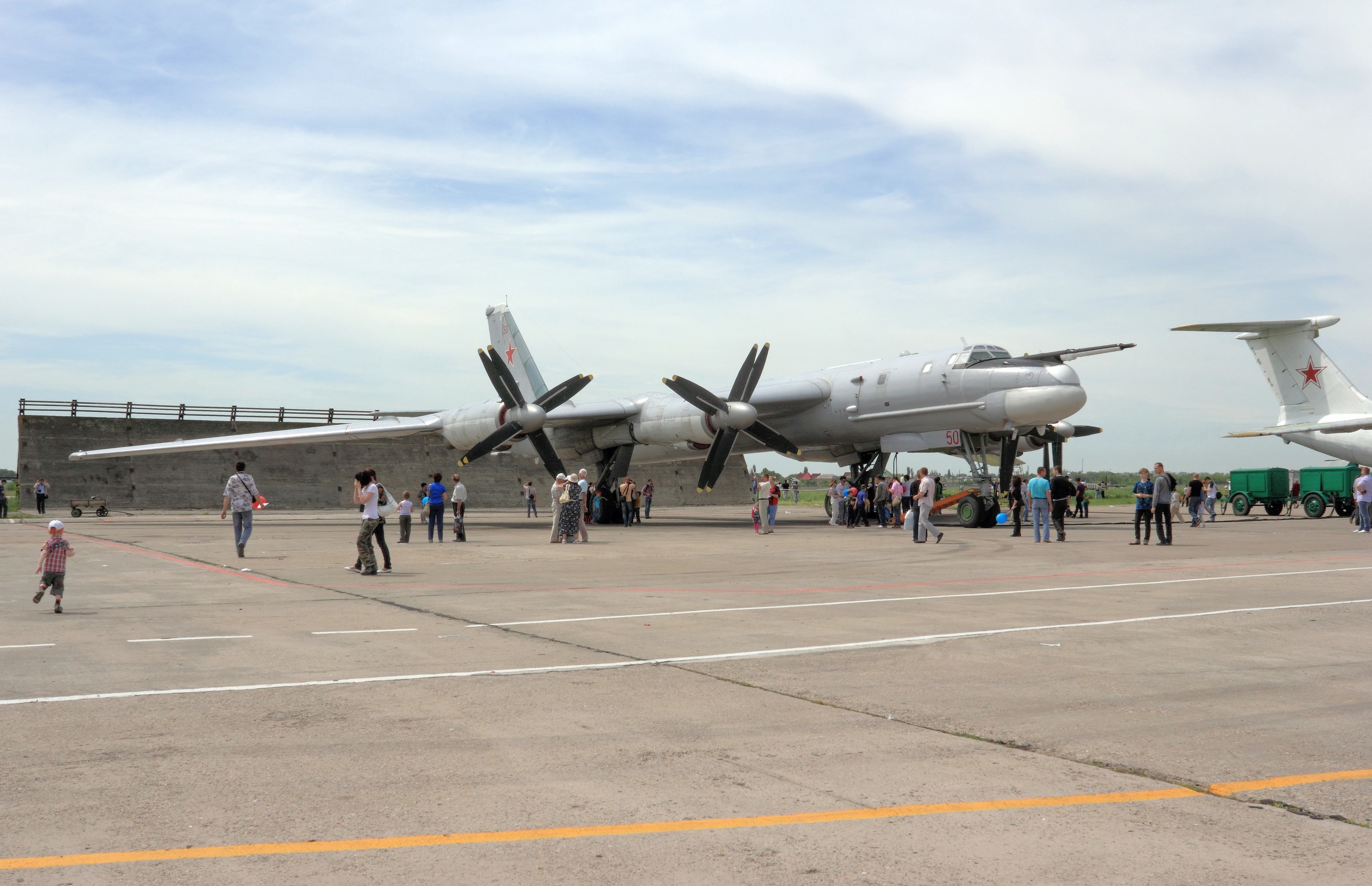
The first prototype flew on 14 September 1979. Series production began in 1981 at the Kuibyshev plant; the first six Tu-95MS were built at plant No. 86 in Taganrog, and six Tu-142M airframes were converted to Tu-95MS standard. It was the first newly built strike version of the Bear since the 1960s, and for a time in the 1980s the US military referred to it as a Tu-142 before its true designation became known. It was built in two configurations: the Tu-95MS6, with six Kh-55s on the internal drum, and the Tu-95MS16, which adds four underwing mounts for up to sixteen Kh-55s (fourteen Kh-55SMs) and a weapons control system similar to the Tu-160's. The system began reaching units in 1982 and was formally accepted into service in 1983; delivery of the last Tu-95MS in 1992 ended Tu-95 production, and the line was dismantled in 1995. Build figures differ between sources (see note).
The first Long-Range Aviation regiment to convert was the 1023rd at Semipalatinsk in 1982, followed by the 1226th in 1984, the 1006th at Uzin in 1985 and the 182nd at Mozdok by the end of 1988. Within a year of the first deliveries crews were already firing Kh-55s and flying long sorties with several refuellings; after conversion, non-stop demonstration flights were made around the borders of the USSR and towards the United States and Canada over the North Pole. By 1988 Bear-Hs were regularly observed simulating attacks against North America. In the early 1980s the bureau also studied, on this basis, the Tu-95MA carrier for the «Meteorit-A» hypersonic missile, later frozen for lack of funding.
The break-up of the USSR split the fleet. The aircraft in Kazakhstan — thirteen MS16s and twenty-seven MS6s, according to FAS — returned to Russia in exchange for tactical aircraft. Ukraine inherited between 23 and 29; in 2000 it handed Russia three Tu-95MS and 581 Kh-55 missiles for gas-debt relief, scrapped the rest with Nunn–Lugar funds, kept one in the Poltava museum, and two more, converted to ecological reconnaissance aircraft at Mykolaiv, were sold for scrap in 2013.
In Russia, the Stability 2008 exercise in October 2008 saw the first live cruise-missile launches since 1984, and in July 2010 two Tu-95MS stayed airborne for more than 43 hours and flew more than 30,000 km with four refuellings, a record for their class. The fleet had been made compatible with the Kh-555 in 2003; after a research and development contract of 23 December 2009, adaptation to the Kh-101/102 arrived in 2015 — eight missiles on four double pylons plus the six internal ones. The first was the «Saratov», rolled out at Taganrog and handed over in March 2015, and Aviakor in Samara delivered its first, the «Dubna», on 18 November 2015. Only MS16s with the K-016 «Sprut» system, built from 1986 onwards, are upgraded. The larger step, the Tu-95MSM, adds the Novella-NV1.021 radar, SOI-021 display system, Meteor-NM2 defensive suite and NK-12MPM engines with AV-60T propellers, deletes the tail turret, and first flew on 22 August 2020; a further upgrade contract was signed in August 2021.
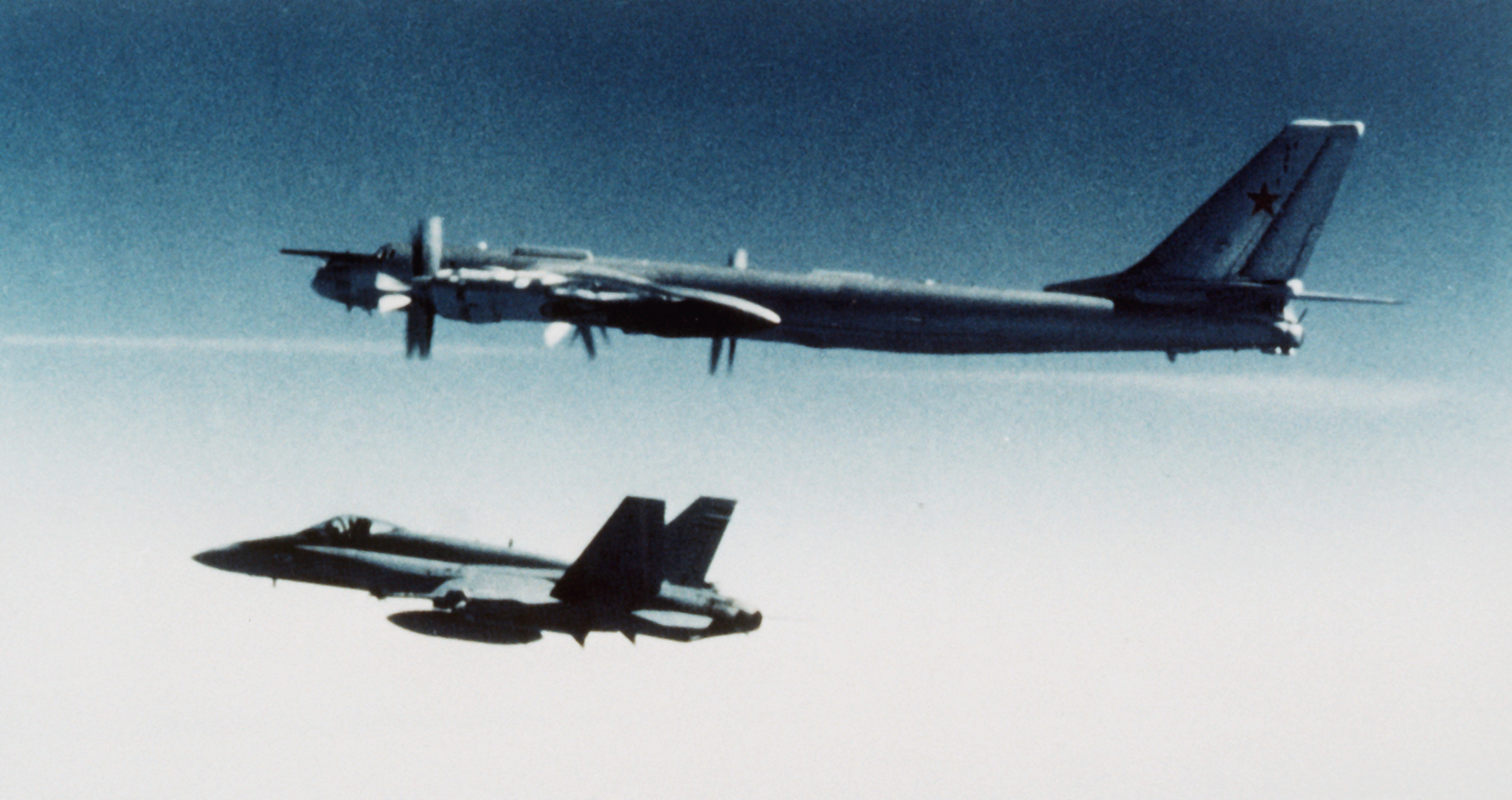
In combat, Tu-95s made their debut over Syria on 17 November 2015, and Tu-95MSs fired Kh-101s there on 17 November 2016. On 14 July 2015 one crashed near Khabarovsk, killing two crew. In December 2017 they landed at Biak in Indonesia, and since 2019 they have flown joint patrols with Chinese H-6 bombers. Since 24 February 2022 they have launched missiles against Ukraine; on 5 December 2022 an attack on Engels-2 damaged two Tu-95s, and on 1 June 2025 Ukraine's Operation Spiderweb destroyed seven to eight Tu-95MSs at Belaya and Olenya air bases.
Multimedia


