Tupolev Tu-95 variant
Tupolev Tu-95K
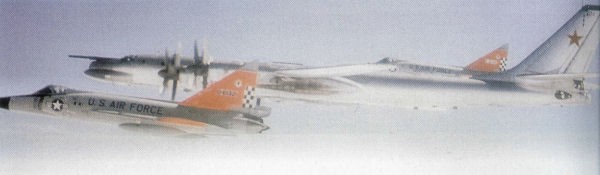
First missile-carrying version of the Tu-95 ("Bear-B"): carrier of the K-20 system, with the supersonic Kh-20 cruise missile semi-recessed under the fuselage and the YaD radar in a broad chin radome. It first flew on 1 January 1956 and was built at Kuibyshev until 1962.
- January 1, 1956
- First flight
History
The Tu-95K was the first missile-carrying version of the Tu-95 strategic bomber and the carrier aircraft of the K-20 air-launched missile system, which paired it with the supersonic Kh-20 cruise missile (NATO AS-3 "Kangaroo"; NATO called the aircraft "Bear-B"). Using the Tu-95 as an air-to-surface missile carrier had been foreseen while the bomber was still being designed: it offered long range, a large payload and a layout that allowed a big missile to be slung under the fuselage, and according to Ugolok Neba that last point decided the choice of carrier over the Myasishchev M-4 (3M).
A Council of Ministers decree of 11 March 1954 tasked Tupolev's OKB-156 with developing the Tu-95K carrier for the K-20 system on the basis of the Tu-95MA; the same document assigned the long-range Kh-20 missile to Mikoyan's OKB-155, where it was designed by Mikhail Gurevich, and its guidance system to KB-1 under V. M. Shabanov. The "20" index came from the official Tu-20 designation originally intended for the bomber: so many documents and drawings had been issued with the "95" index that the military accepted the name Tu-95, and "20" survived only in the names of the system, the missile and the control system. When information on the K-20 reached the West in the late 1950s, the aircraft went on being called Tu-20 there for a long time. Some sources, such as MilitaryFactory, call the combination "Tu-95K-20"; GlobalSecurity argues that "K-20" already covers aircraft and missile and that this form may be in error.
_at_the_Ryazan_Museum_of_Long-Range_Aviation_%E2%80%94_photo_340-35.jpg)
Tupolev signed the preliminary design on 26 October 1954 and the military approved the mock-up a year later. Compared with the bomber, the nose received the twin-antenna YaD radar for target search and missile guidance, housed in a broad, flat-bottomed radome, the most visible change from the Tu-95M, whose 3.3-metre I-band scanning antenna NATO named "Crown Drum"; the bomb bay received the BD-206 beam carrier that held the missile semi-recessed and launched it; the fuselage fuel tanks were reconfigured and an extra tank was added to feed the Kh-20's engine. En route the carrier and missile stayed retracted and the Kh-20's nose was covered by a fairing; before launch the carrier was lowered into the airflow, the missile's engine was started and the missile was released towards its target.
For the prototypes, Plant No. 18 at Kuibyshev set aside two production Tu-95s still on the assembly jigs, Nos. 401 and 404. Conversion began on 1 March 1955 and ended on 31 October, and the lead aircraft first flew on 1 January 1956; the second Tu-95K followed that summer. Factory testing of the system was carried out in three stages on both aircraft: the first from 4 August to 15 October 1956; the second, devoted to preparing the carrier for launches, from 15 August to 13 October 1956; and the third, completed on 24 January 1957, to refine the missile control system and homing equipment on Kh-20 analogues derived from the MiG-19, the unmanned SM-20 and the piloted SM-20P. They took off hanging under the Tu-95K, were released and then flew under the K-20 guidance signals; the test pilots included Hero of the Soviet Union Amet-khan Sultan. These trials explain the English Wikipedia entry that lists the Tu-95K as an "experimental version for air-dropping a MiG-19 SM-20".
Kh-20 launches ran from 6 June 1957 to 29 July 1958 according to Ugolok Neba (English Wikipedia dates the start of the missile's flight testing to 17 March 1958). In 1958 the missile and the aircraft were shown to Nikita Khrushchev, and in July series production was approved. Joint state trials, from 15 October 1958 to 1 November 1959, used the first production Tu-95Ks, built at Kuibyshev from early 1958 with the first one rolled out in March, and comprised 16 launches, 11 of them judged successful, although accuracy still left much to be desired. Further launches over the Barents Sea showed that the K-20 could also be used against moving naval groups, including carrier strike groups. FAS places operational deployment in September 1959; formal adoption came with a decree of 9 September 1960.
The production Kh-20M, with an improved 2,300 kg thermonuclear warhead of 0.8 to 3.0 Mt, was 14.95 m long with a 9.15 m wingspan, weighed 12,000 kg at launch and cruised at Mach 2 on an AL-7FK turbojet; English Wikipedia gives it a range of 380 to 600 km and GlobalSecurity 350 km, enough to launch outside enemy air defences. Intended for retaliatory strikes against the United States, arming a Tu-95K took 22 hours, later cut to 4, and the missile was relegated to follow-up strikes and to carrier groups. The initial allocation was two Kh-20s per aircraft, 130 missiles for about 40 Tu-95Ks and 25 Tu-95KDs, later reduced to one per aircraft.
_at_the_Ryazan_Museum_of_Long-Range_Aviation_%E2%80%94_photo_340-34.jpg)
The missile and the extra tanks added weight and drag and cut the aircraft's range, by about 2,000 km according to Russian Wikipedia. To offset this, a hose-and-drogue in-flight refuelling system was developed from May 1960 and completed in 1961; the aircraft so equipped were designated Tu-95KD, and some Tu-95Ks were brought up to that standard. Tu-95K production ("izdeliye VK") continued at Plant No. 18 until 1962. MilitaryFactory speaks of two prototypes and 47 new-build aircraft; no cross-checked production figure exists. The West first identified the "Bear-B" on 9 July 1961, according to FAS. The Tu-95Ks that were not converted served until the mid-1980s, by which time the Kh-22 had replaced the Kh-20; some became Tu-95KU trainers ("izdeliye VKU") and the rest were scrapped.
Ugolok Neba gives the Tu-95K a wingspan of 50.04 m, a length of 46.90 m, a height of 12.50 m and a wing area of 283.7 m²; an empty weight of 86,000 kg and a maximum take-off weight of 182,000 kg; four NK-12MV turboprops; a maximum speed of 860 km/h and a cruising speed of 770 km/h; a range of 12,200 km, a combat radius of 7,000 km and a service ceiling of 11,600 m, with a crew of 8 or 9. Defensive armament was six 23 mm AM-23 cannon in pairs in the DT-V12 dorsal, DT-N12 ventral and DK-12 tail turrets, with 2,500 rounds, and the payload reached 12,000 kg.
Multimedia
_at_the_Ryazan_Museum_of_Long-Range_Aviation_%E2%80%94_photo_340-35-1600.webp)
_at_the_Ryazan_Museum_of_Long-Range_Aviation_%E2%80%94_photo_340-34-1600.webp)
_at_the_Ryazan_Museum_of_Long-Range_Aviation_%E2%80%94_photo_340-33-1600.webp)
_at_the_Ryazan_Museum_of_Long-Range_Aviation_%E2%80%94_photo_340-32-1600.webp)
_at_the_Ryazan_Museum_of_Long-Range_Aviation_%E2%80%94_photo_340-31-1600.webp)