General aviation · Civil · United States
Lockheed Vega
- July 4, 1927
- First flight
- 1928
- Introduced
- In service
- Status
- 132
- Units built





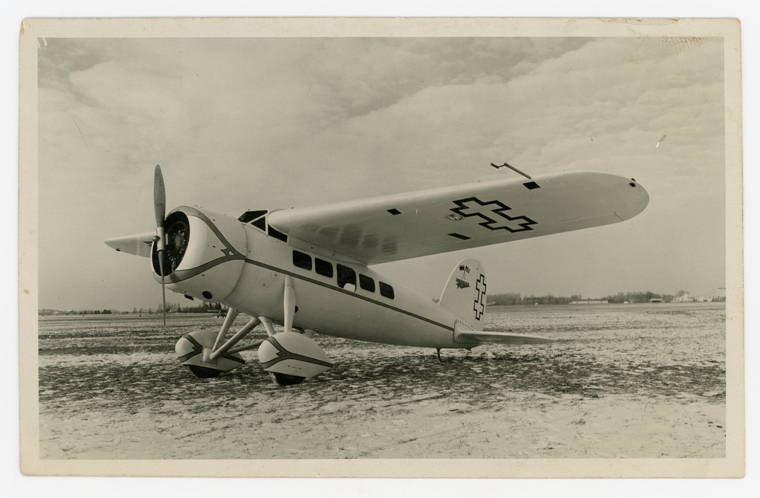
The Lockheed Vega was a closed-cabin high-wing monoplane that Lockheed began building in 1927, and its reputation rested on the speed and range delivered by a wooden monocoque fuselage and a cantilever wing. Amelia Earhart crossed the Atlantic alone in one, and Wiley Post circled the globe twice with his.
Category
History
The Vega began as an in-house requirement: Lockheed wanted an aircraft for its own routes and asked John Knudsen Northrop and Gerald Vultee, both of whom would later start companies of their own, for a rugged machine carrying a pilot and four passengers that would also be among the fastest of its day. The answer was a plywood monocoque fuselage laminated in a concrete mould and closed over a separate framework of wooden ribs, plus a single-spar cantilever wing which, unable to pass through that shell, was mounted on top of it. Only the engine and the landing gear escaped the aerodynamic clean-up, and even there production aircraft wrapped the wheels in teardrop fairings. The first Vega 1, named Golden Eagle and powered by a 225 hp Wright J-5 Whirlwind radial, flew from the Los Angeles plant on 4 July 1927, cruising at 120 mph with a top speed of 135 mph.
Demand came from private owners before it came from airlines. By the end of 1928, 68 had been delivered, and at the 1929 National Air Races in Cleveland the Vegas took every speed award. That same year Lockheed introduced the Vega 5, whose 450 hp Pratt & Whitney Wasp and NACA cowling improved performance enough to add two more seats and raise cruising speed to 155 mph and top speed to 165 mph; 64 of that variant were built, many for executive transport but also for carriers such as Pan American and Transcontinental and Western Air. In 1931 the United States Army Air Corps bought two metal-fuselaged Vegas built by the Detroit Aircraft Corporation. Total production is counted as between 128 and 132 aircraft depending on the source, a spread that reflects how the work was split between Lockheed, Detroit and other shops.
The record flights explain the Vega's standing better than its sales figures do. In 1928 the Yankee Doodle was used to attack the transcontinental records: on 19 and 20 August, Arthur C. Goebel flew Los Angeles to Garden City in 18 hours and 58 minutes, also the first non-stop west-to-east flight, and on 25 October Charles B. D. Collyer covered the opposite direction in 24 hours and 51 minutes, only to die on 3 November attempting to better the mark. In a Vega 5B registered NC7952, Amelia Earhart made the first solo transatlantic crossing by a woman, from Newfoundland to Ireland; in the Winnie Mae, Wiley Post went around the world twice and proved the existence of the jet stream; and Hubert Wilkins used a float-equipped Vega on pioneering flights over the Arctic and Antarctica. It was not a forgiving machine: forward and side visibility from the cockpit was severely limited, and Elinor Smith wrote that it glided like a boulder falling off a mountain. Earhart's aircraft and the Winnie Mae are both preserved today at the National Air and Space Museum in Washington.
Variants
| Vega 1 | DL-1 | DL-1A Special | DL-1B | UC-101 | Vega 2 | Vega 2A | Vega 2D | Vega 5 | Vega 5A Executive | Vega 5B | Vega 5C | Y1C-12 | Y1C-17 | |
|---|---|---|---|---|---|---|---|---|---|---|---|---|---|---|
| First flight | July 4, 1927 | — | — | — | — | — | — | — | — | — | — | — | — | — |
| Aircraft type | Pioneering airliner | Pioneering airliner | Record-setting aircraft | Pioneering airliner | Light military transport | Pioneering airliner | Pioneering airliner | Pioneering airliner | Pioneering airliner | Pioneering airliner | Record-setting aircraft | Pioneering airliner | Light military transport | Light military transport |
| Powerplant | 1 × Wright J-5 Whirlwind radial of 164 kW (220 hp); the first airframes flew with bare cylinders, before the NACA cowling. | 1 × Pratt & Whitney R-1340 Wasp C radial of 336 kW (450 hp). | 1 × Pratt & Whitney R-1340 Wasp SC1 radial. | 1 × Pratt & Whitney R-1340 Wasp C radial of 336 kW (450 hp). | 1 × Pratt & Whitney R-1340 Wasp C radial of 336 kW (450 hp). | 1 × Wright J-6 Whirlwind radial of 224 kW (300 hp), a third more power than the Vega 1's J-5 on the same airframe. | 1 × Wright J-6 Whirlwind radial of 224 kW (300 hp). | 1 × Pratt & Whitney R-985 Wasp Junior radial of 224 kW (300 hp), replacing the Whirlwind on two converted Vega 1s and one Vega 2. | 1 × Pratt & Whitney R-1340 Wasp radial of 336 kW (450 hp) in Wasp B form; Wasp A of 410 hp and Wasp C1 of 420 hp were also certificated. The NACA cowling introduced here cut drag enough to allow two more seats. | 1 × Pratt & Whitney R-1340 Wasp C radial of 336 kW (450 hp). | 1 × Pratt & Whitney R-1340 Wasp B radial of 336 kW (450 hp); the aircraft Amelia Earhart flew solo across the Atlantic had that Wasp B swapped for a Wasp C before the flight. | 1 × Pratt & Whitney R-1340 Wasp C nine-cylinder air-cooled radial rated at 336 kW (450 hp), with NACA cowling and a two-blade propeller; in continuous civil rating the same Wasp C was certificated at 420 hp at 2,000 rpm at sea level. | 1 × Pratt & Whitney R-1340 Wasp C radial of 336 kW (450 hp). | 1 × Pratt & Whitney R-1340 Wasp SC radial of 336 kW (450 hp), on a DL-1B Special airframe with single-strut landing gear. |
| Powerplant | 1 × Wright J-5 Whirlwind | 1 × Pratt & Whitney R-1340 Wasp C | 1 × Pratt & Whitney R-1340 Wasp SC1 | 1 × Pratt & Whitney R-1340 Wasp C | 1 × Pratt & Whitney R-1340 Wasp C | 1 × Wright J-6 Whirlwind | 1 × Wright J-6 Whirlwind | 1 × Pratt & Whitney R-985 Wasp Junior | 1 × Pratt & Whitney R-1340 Wasp (Wasp A/B/C1) | 1 × Pratt & Whitney R-1340 Wasp C | 1 × Pratt & Whitney R-1340 Wasp B | 1 × Pratt & Whitney R-1340 Wasp C | 1 × Pratt & Whitney R-1340 Wasp C | 1 × Pratt & Whitney R-1340 Wasp SC |
| Power per engine | 220 hp | 451 hp Best value in this row | — | 451 hp Best value in this row | 451 hp Best value in this row | 300 hp | 300 hp | 300 hp | 451 hp Best value in this row | 451 hp Best value in this row | 451 hp Best value in this row | 451 hp Best value in this row | 451 hp Best value in this row | 451 hp Best value in this row |
| Length | — | 8.4 m Best value in this row | — | — | — | — | — | — | — | — | — | 8.4 m Best value in this row | — | — |
| Wingspan | — | 12.5 m Best value in this row | — | — | — | — | — | — | — | — | — | 12.5 m Best value in this row | — | — |
| Height | — | — | — | — | — | — | — | — | — | — | — | 2.6 m | — | — |
| Wing area | — | — | — | — | — | — | — | — | — | — | — | 25.5 m² | — | — |
| Empty weight | — | — | — | — | — | — | — | — | — | — | — | 1,163 kg | — | — |
| MTOW | — | — | — | — | — | — | — | — | — | — | — | 2,041 kg | — | — |
| Top speed | 217 km/h | 286 km/h | — | — | — | 249 km/h | — | — | 266 km/h | — | 290 km/h | 298 km/h | — | 356 km/h Best value in this row |
| Cruise speed | 190 km/h | 246 km/h | — | — | — | 214 km/h | — | — | 249 km/h | — | 249 km/h | 266 km/h Best value in this row | — | — |
| Service ceiling | — | — | — | — | — | — | — | — | — | — | — | 5,800 m | — | — |
| Initial climb rate | — | — | — | — | — | — | — | — | — | — | — | 6.6 m/s | — | — |
| Range | 1,448 km Best value in this row | 966 km | — | — | — | 1,287 km | — | — | 1,167 km | — | 1,110 km | 1,167 km | — | — |
| Combat radius | 0 km Best value in this row | 0 km Best value in this row | 0 km Best value in this row | 0 km Best value in this row | 0 km Best value in this row | 0 km Best value in this row | 0 km Best value in this row | 0 km Best value in this row | 0 km Best value in this row | 0 km Best value in this row | 0 km Best value in this row | 0 km Best value in this row | 0 km Best value in this row | 0 km Best value in this row |
| Range conditions | Range of about 1,448 km, enough for the ocean and polar crossings that made the type famous. | Range of 966 km at a 246 km/h cruise, with a 286 km/h maximum. | — | — | — | Range of 1,287 km at a 214 km/h cruise, with a 249 km/h maximum. | — | — | Range of 1,167 km at a cruise of about 249 km/h. | — | Standard range of 1,110 km at a 249 km/h cruise; record aircraft carried extra tankage that multiplied it. | Range of 1,167 km at a 266 km/h cruise, with a 298 km/h maximum, a 5,800 m service ceiling and an initial climb of 6.6 m/s. Standard tankage was 610 litres; record aircraft carried auxiliary tanks far beyond that. | — | At 356 km/h it was, at the time, the fastest aeroplane on the US Army inventory. |
| Armament | None | None | None | None | None | None | None | None | None | None | None | None | None | None |
| Max weapons load | 0 kg Best value in this row | 0 kg Best value in this row | 0 kg Best value in this row | 0 kg Best value in this row | 0 kg Best value in this row | 0 kg Best value in this row | 0 kg Best value in this row | 0 kg Best value in this row | 0 kg Best value in this row | 0 kg Best value in this row | 0 kg Best value in this row | 0 kg Best value in this row | 0 kg Best value in this row | 0 kg Best value in this row |
| Cargo capacity | Five seats: pilot and four passengers in an enclosed cabin. | Metal-fuselage Vega: Detroit Aircraft Corporation replaced the wooden monocoque with a duralumin one, leaving the wooden wing unchanged. | One-off racing and record aircraft with a metal fuselage, extra fuel tankage and customer modifications; it flew on the US, British and Australian registers. | Seven seats on Detroit's duralumin fuselage; one example came from the rebuild of the DL-1 prototype. | One civil Vega 5C impressed by the US Army Air Forces in 1942 and used as an unarmed light transport. | Five seats including the pilot. | Seven seats. Redesignation of a single Vega 2 recertificated for higher gross weight. | Standard Vega passenger cabin; one example flew on floats. | Six passengers and pilot after the seating increase the Wasp made possible. | Executive version of the Vega 5, with a plush interior and fewer seats than the airline layout. | Seven seats including the pilot, at higher gross weights than the Vega 5 for scheduled airline work. | Six passengers and one pilot. The moulded plywood monocoque fuselage carried no internal bracing, leaving a clear cabin for passengers, baggage and mail; the 5C added enlarged tail surfaces for higher gross weights. | Single service-test aircraft for the US Army Air Corps: a metal-fuselage DL-1 with additional tankage, flown as an unarmed fast transport. | Single unarmed service-test aircraft for the US Army Air Corps. |
| Crew | 1 Best value in this row | 1 Best value in this row | 1 Best value in this row | 1 Best value in this row | 1 Best value in this row | 1 Best value in this row | 1 Best value in this row | 1 Best value in this row | 1 Best value in this row | 1 Best value in this row | 1 Best value in this row | 1 Best value in this row | 1 Best value in this row | 1 Best value in this row |
| Passengers | 4 | 6 Best value in this row | — | 6 Best value in this row | — | 4 | — | — | 6 Best value in this row | — | 6 Best value in this row | 6 Best value in this row | — | — |
| Units built | 28 | 4 | 1 | 4 | 1 | 5 | 1 | 3 | 64 Best value in this row | 9 | 29 | 30 | 1 | 1 |
Images