Gunship Development And Combat Tactics | Lockheed C-130 Hercules | HD Upscaled Original Footage
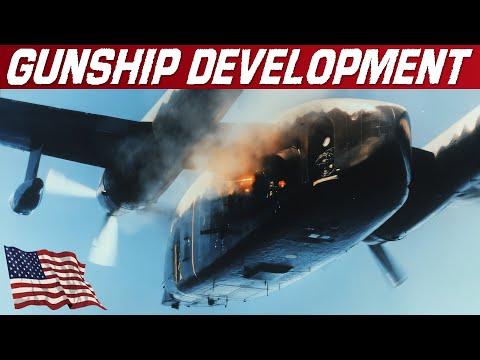
Video from the channel DroneScapes about Lockheed C-130 Hercules, linked on its Above Ten Thousand entry. Duration: 56:04. Language: English. Video type: Archive footage.
What it shows
A compilation of three period US Air Force films about the C-130 Hercules. The first follows the conversion of a C-130 into the AC-130 Gunship II prototype at Wright-Patterson Air Force Base: inerting foam in the fuel tanks, an armored, soundproofed cabin for the sensor operators, four 20mm rotary cannons and four 7.62mm miniguns, radar, an NOD night observation device, side-looking infrared, a xenon illuminator, and a flare dispenser. It shows live-fire tests at Eglin, where the first mounts let the guns vibrate and scattered the rounds, followed by a second round with reinforced mounts and tight grouping. The second film is a training film for AC-130 crews: it explains the geometry of the left-orbit firing pattern with 30 degrees of bank, wind correction, the role of each of the fourteen crew members, and the fire control system, and includes combat footage with onboard communications against trucks and boats. The third is a 1955 report on the C-130: assembly of the first units, maiden flight, and structural testing.
When and where it was filmed
The first two pieces were filmed during the Vietnam War, at Wright-Patterson, at Eglin, and in Southeast Asia; the training film already covers the Pave Pronto and Pave Spectre configurations, the latter for the AC-130E. The third covers 1955 at Lockheed's Georgia division, in Marietta.
Context
According to the narration, the prototype deployed to Southeast Asia on 15 September and flew more than 70 combat missions over Vietnam and Laos; in one week of night interdiction over the Ho Chi Minh Trail it destroyed 23 trucks and damaged 8 more. The first production C-130, serial number 3001, made its maiden flight on 7 April 1955, lasting one hour and seven minutes; the second aircraft was dedicated to static testing, for which a hydrostatic fuselage test tank was built. The film ends with the aircraft's first long-distance flight, from Marietta to Philadelphia for the National Air Show, and with the expectation that it would enter operational service by late 1956.