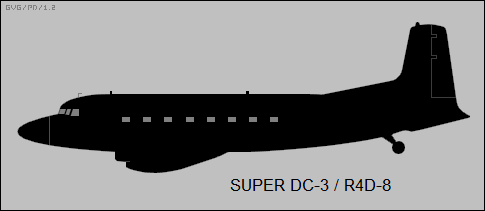
Douglas DC-3 variant
Douglas DC-3S (Super DC-3)
DC-3S or Super DC-3: a 1949 redesign of the DC-3 with a stretched fuselage, new outer wings and tail and more powerful engines; only five were completed for civil use.

- June 23, 1949
- First flight
- 5
- Units built
- 38
- Passengers
History
By the late 1940s thousands of DC-3s and war-surplus C-47s were flying with airlines around the world. In the United States, proposed changes to the airworthiness requirements of the Civil Air Regulations threatened to restrict the use of these aircraft, chiefly because of their take-off and single-engine performance. Douglas answered with an ambitious offer: not a new type, but a conversion of the existing airframe so thorough that it almost amounted to one. The result was the DC-3S, better known as the Super DC-3, launched in 1949 to positive reviews.
The fuselage was strengthened and lengthened by 3 ft 3 in (0.99 m) ahead of the wing. The wing centre section was retained, but the outer panels were new, with 4 degrees of trailing-edge sweep and squared-off tips that reduced the span by 5 ft 5 in (1.65 m). A new square fin with a large dorsal fillet stood 1 ft (0.30 m) taller than the DC-3's to cope with the extra torque of more powerful engines. Two powerplants were offered: the 1,475 hp (1,100 kW) Wright R-1820-80 Cyclone or the 1,450 hp (1,080 kW) Pratt & Whitney R-2000 Twin Wasp, both with short jet-ejector exhaust stacks. The main landing gear was fully enclosed when retracted, the tailwheel partly retractable, the door became a small airliner-style door, and flush rivets and low-drag antennas cleaned up the airframe. With more than 75 per cent of the original DC-3/C-47 configuration changed, it was in practice a different aircraft.
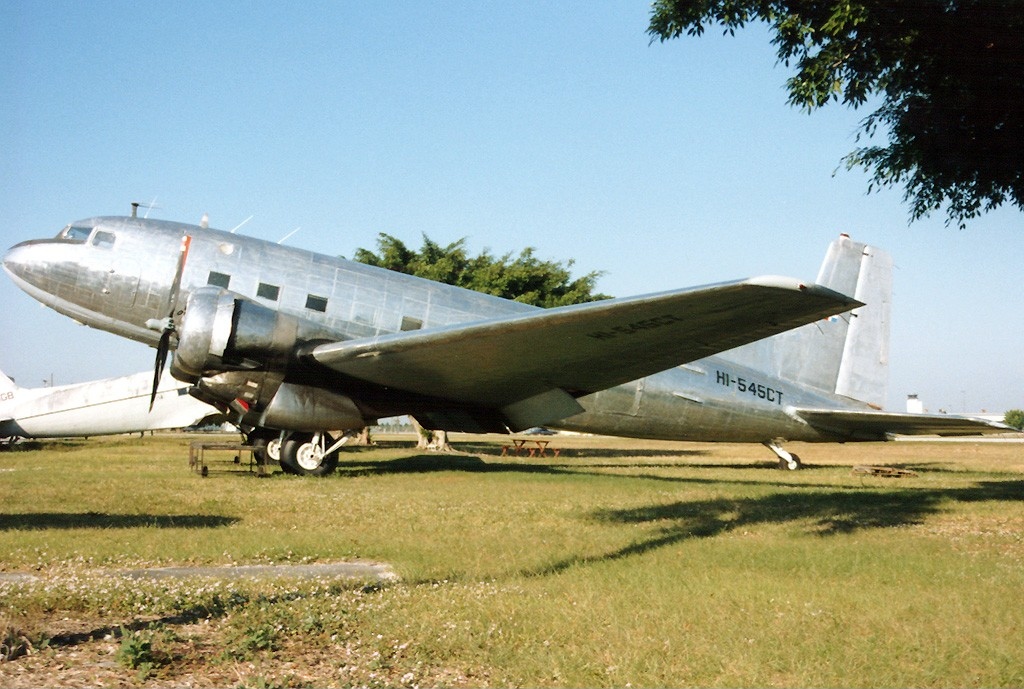
The DC-3S first flew on 23 June 1949. It met the new 4B airworthiness requirements, carried 38 passengers and was faster, so that it could compete with newer airliners. Douglas offered to convert existing aircraft for 150,000 dollars each, but airlines showed little interest. The market was flooded with much cheaper ex-military transports, and newer, more capable designs were also available for civil service. Only five Super DC-3s were completed for civil use, built from surplus second-hand airframes, and just three were sold to an airline: Capital Airlines operated them from 1950 to 1952.
One aircraft became a military demonstrator. Having failed with the airlines, Douglas offered the US Air Force a 21-seat VIP transport version, configured much like the C-117B, which was evaluated as the YC-129 and later redesignated YC-47F. The Air Force declined and bought a version of the Convair CV-240, the C-131 Samaritan, instead. In 1951 it transferred the YC-129 to the US Navy, which evaluated it as the R4D-8X. Unlike the Air Force, the Navy was convinced, and had Douglas convert 100 existing R4D-5s, R4D-6s and R4D-7s to the same standard as the R4D-8, redesignated C-117D in 1962. All of these naval aircraft used Wright R-1820 Cyclone engines, and the DC-3S designation was also applied to those that entered civil use after retirement from military service. The operational story of the R4D-8 is told on the C-47 Skytrain page, where it belongs as a variant.
The last US Navy C-117 was retired on 12 July 1976, and the last US Marine Corps example, serial 50835, in June 1982. In 2006 several were still flying with small airlines in North and South America. TransNorthern of Alaska acquired a cargo-configured C-117, registered N28TN, from Kenn Borek Air in 2007, and keeps a second, N30TN, fitted with a passenger cabin, which has not flown since about 2019. Other examples are preserved in museums, including those displayed at the National Naval Aviation Museum in Pensacola, Florida, and the Pima Air & Space Museum in Tucson, Arizona.
The Super DC-3 also had a later experimental career: Conroy Aircraft converted one into the Conroy Super-Turbo-Three, the same as its Turbo-Three but based on a Super DC-3 airframe, with two Rolls-Royce Dart turboprops. Commercially the programme was a disappointment, but it showed that the DC-3 structure could absorb a large increase in weight, power and speed, something the turboprop conversions of later decades would confirm.
Multimedia