Bomber · Military · United States
Boeing B-52 Stratofortress
- April 15, 1952
- First flight
- In service
- Status
- 744
- Units built
-1600.webp)

_(cropped)-800.webp)

-1600.webp)
-1600.webp)


-1600.webp)


_061219-F-1234S-001-1600.webp)


-800.webp)


_in_flight_dropping_bombs_061128-F-1234S-004-800.webp)




-1600.webp)

_(51425086562).png)


-1600.webp)
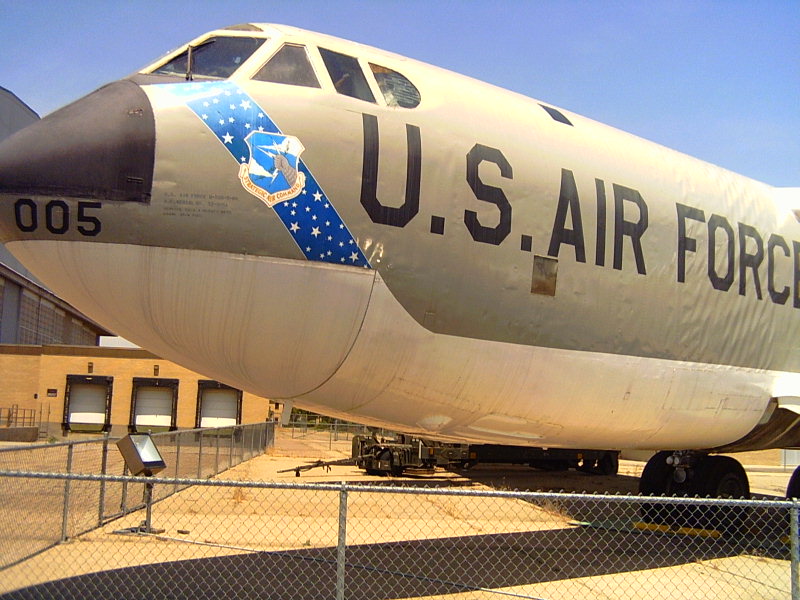
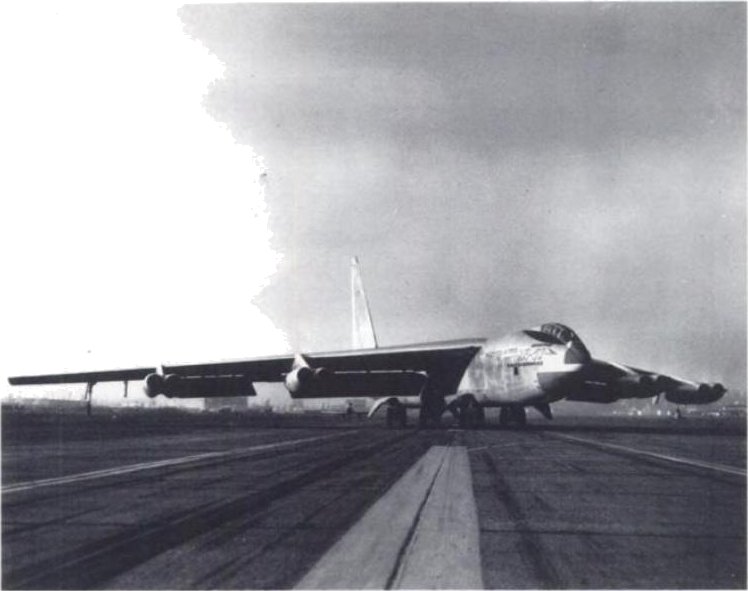
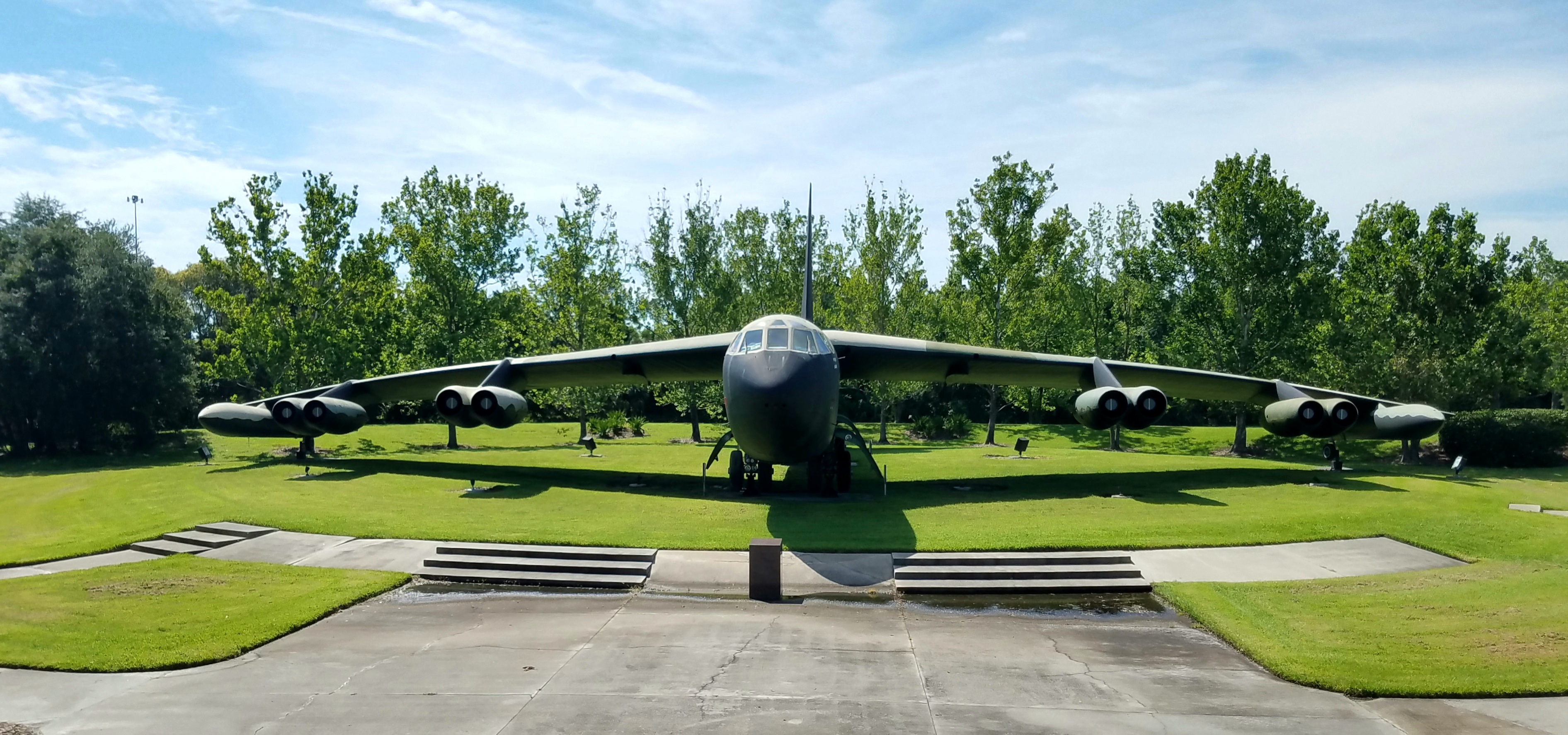
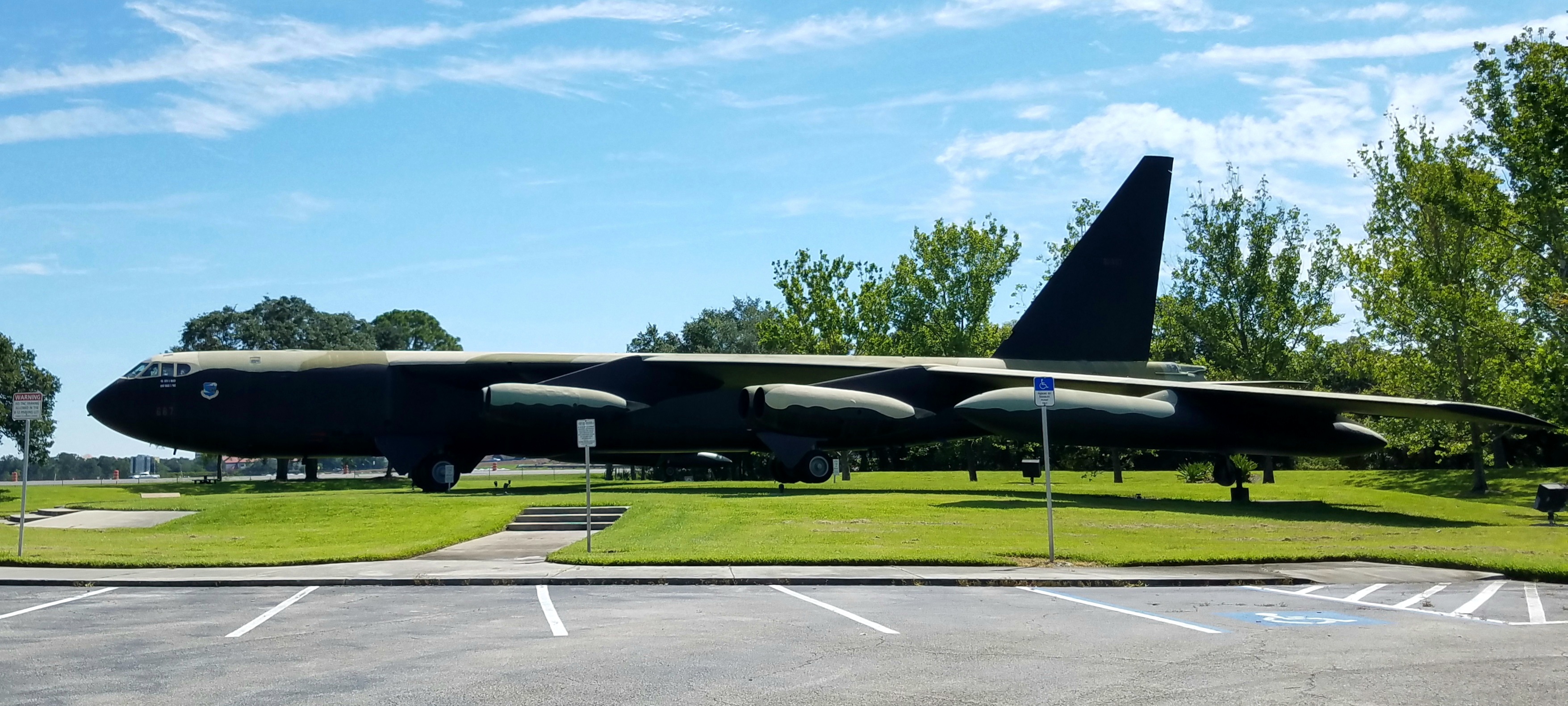
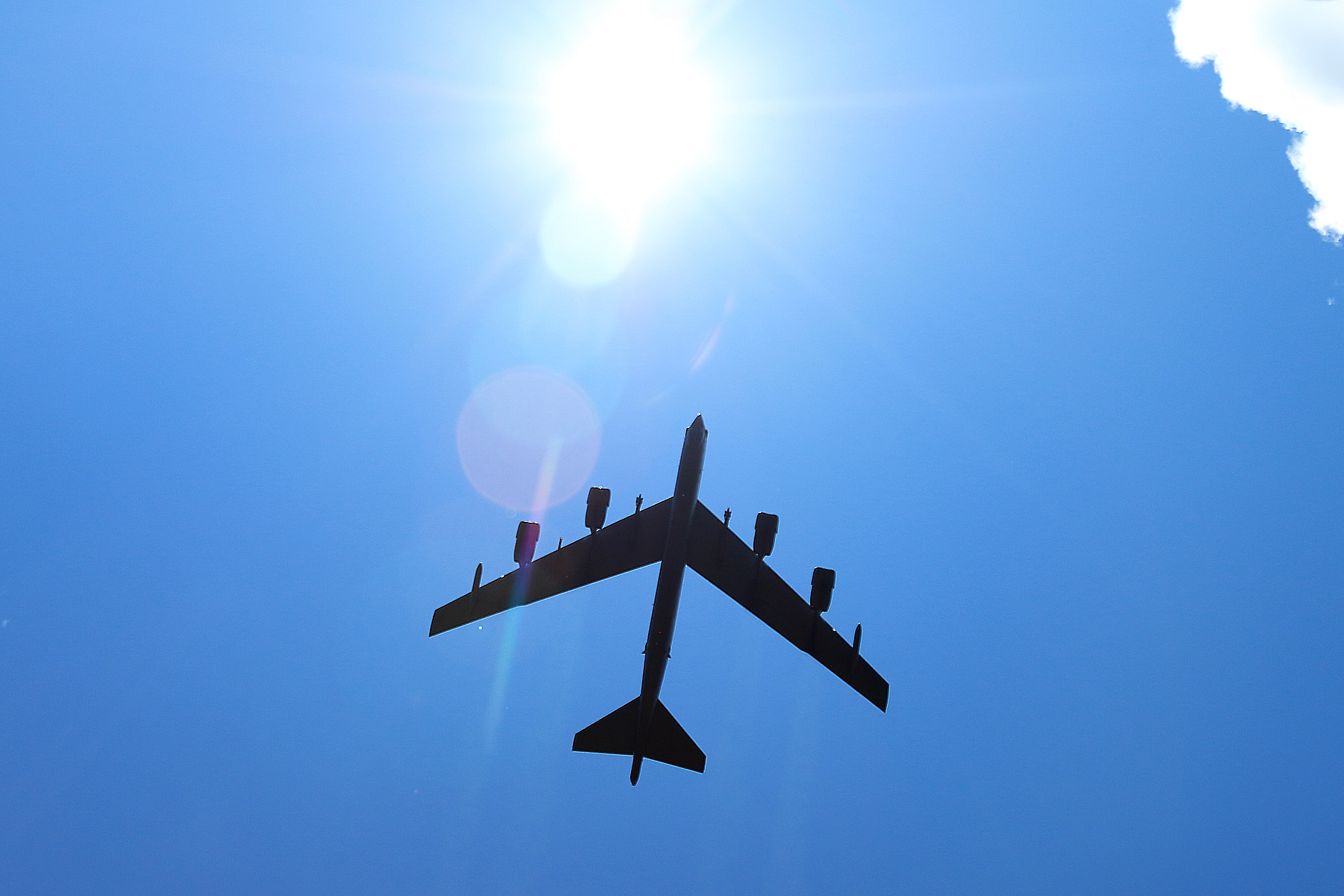
The Boeing B-52 Stratofortress is a subsonic, eight-engined heavy strategic bomber conceived in the early Cold War to deliver nuclear weapons anywhere on the globe without relying on intermediate bases. It has flown with the United States Air Force since 1955 and can carry up to 32,000 kg of weapons with a typical combat range of about 14,200 km without aerial refuelling. Its official name is seldom used: in the aviation community the aircraft is known by the nickname BUFF. It is the survivor of an entire generation of bombers — the B-58 Hustler, the B-1 Lancer and the B-2 Spirit all came later, and several retired first — and its blend of long reach, enormous payload and comparatively modest operating cost explains that longevity. The programme began with the performance characteristics circulated by Air Materiel Command on 23 November 1945 for a bomber able to carry out the strategic mission without depending on bases controlled by other countries. Boeing won the competition in June 1946 with Model 462, a straight-wing aircraft powered by six turboprops that bore little resemblance to the final machine. Two years of successive revisions followed — Model 464 and its derivatives, USAF pressure on speed and range, and a cancellation narrowly averted in December 1947 — until, over a weekend in a Dayton, Ohio hotel in October 1948, Boeing's engineering team recast the proposal as a swept-wing jet bomber. From that came the definitive layout of eight turbojets in four twin pods. The YB-52 prototype made its first flight on 15 April 1952 from Boeing Field, Seattle, with test pilot "Tex" Johnston at the controls. Production was split between the Seattle and Wichita plants to speed deliveries and ended in 1962 with the last series, the B-52H; 744 aircraft were built in all. The first operational B-52B reached the 93rd Bombardment Wing at Castle Air Force Base, California, on 29 June 1955, and the wing became fully operational in March 1956. Under Strategic Air Command the type became the airborne pillar of American nuclear deterrence, with standing ground alert and, for years, armed airborne patrols. In January 1957 three B-52Bs completed Operation Power Flite, a non-stop round-the-world flight covering 39,147 km in 45 hours and 19 minutes with several aerial refuellings — a deliberate demonstration of the bomber's global reach. Its combat debut was far removed from that nuclear brief. On 18 June 1965 thirty B-52Fs opened Operation Arc Light over South Vietnam; to exploit the conventional role, B-52Ds received the Big Belly modification, which raised the internal load to 27,000 kg carried as 108 bombs. The campaign culminated in December 1972 with Operation Linebacker II, the type's most intense and also most costly action, with losses to surface-to-air missiles and North Vietnamese fighters. Operation Desert Storm followed from 16 January 1991, and in September 1996 a bomber mission launched conventional CALCM cruise missiles on a 34-hour, 26,000 km round trip — an example of the global strike from home territory that defines the aircraft today. Since the mid-1990s only the B-52H remains in service; 102 were built and delivered between May 1961 and October 1962, and the USAF holds an inventory of 76 aircraft. It is the only version that left the factory with Pratt & Whitney TF33 turbofans instead of the J57 turbojets of earlier series. The upgrades under way — the CONECT avionics and datalink programme, an AESA radar and, above all, re-engining with the Rolls-Royce F130 selected in September 2021, which will bring the B-52J designation — are meant to keep the fleet in the line into the 2050s, more than a century after the prototype first flew. In parallel, NASA operated its own airframes from 1959 to 2007 as motherships that air-launched the X-15, X-24, X-38 and X-43, a chapter of the aerospace story the bomber shares with its military record.
Related events
Related sheets
Category
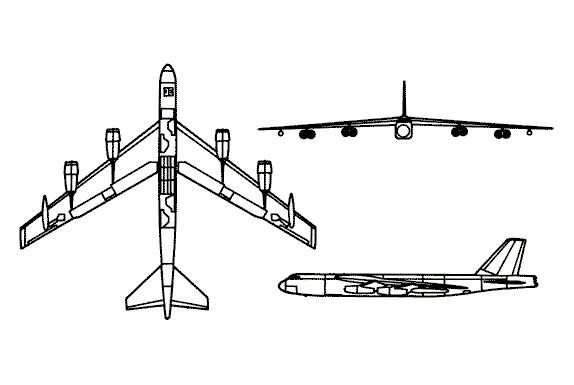
Three-view drawing
.png)
.png)
History
A 1945 requirement for a war that did not yet exist
The B-52 grew out of a specification written before the adversary it would face had been identified. On 23 November 1945, barely three months after the end of the Second World War, Air Materiel Command circulated the desired characteristics for a strategic bomber able to carry out its mission "without dependence upon advanced and intermediate bases controlled by other countries". That sentence contains the doctrine that would dominate the next three decades: intercontinental reach from home soil. The document asked for an aircraft cruising at 480 km/h at 10,000 m, with a combat radius of 8,000 km, 20 mm turret armament and a bomb load modest by later standards. The competition opened in February 1946, with Boeing, Consolidated and Glenn L. Martin taking part.
Boeing won in June 1946 with the Model 462, an aircraft unrecognisable today: straight wing, six Wright T35 turboprops and an enormous gross weight for a radius that still fell short of the requirement. The initial contract — 1.7 million dollars for a full-scale mock-up and preliminary work — was the first link in a chain of revisions that ran for more than two years. By October 1946 the Air Force itself was uneasy about the aircraft's size and its inability to meet the specification; Boeing answered with the smaller, four-engined Model 464. Shortly afterwards General Curtis LeMay, then heading Research and Development on the Air Staff, asked for higher cruise speed, and the design grew again.
The programme came close to death twice. In June 1947 it became clear that even with updated performance the aircraft would be obsolete by the time it entered production and would barely improve on the Convair B-36; the project was suspended for six months. In December 1947 the Heavy Bombardment Committee set requirements — 800 km/h top speed and 13,000 km range — far beyond anything Boeing could offer, and the contract was about to be cancelled on the 11th of that month. It was saved by a personal appeal from company president William M. Allen to Air Force Secretary Stuart Symington: the argument was that the design was adaptable, that it could absorb technology which did not yet exist. Without knowing it, Allen had described the career the B-52 was about to have.
The weekend at the Van Cleve Hotel
In May 1948 Air Materiel Command asked Boeing to look again at jet propulsion, previously ruled out on fuel consumption. The answer was the Model 464-40, with Westinghouse J40 turbojets in place of turboprops, but the command still preferred the conservative route: General Howard A. Craig accepted that the future belonged to the jet engine while doubting that the turboprop stage could be skipped.
The turn came on Thursday 21 October 1948 in Dayton, Ohio. Boeing engineers George Schairer, Art Carlsen and Vaughn Blumenthal presented yet another turboprop variation to Colonel Henry E. "Pete" Warden, the bomber development project officer. Warden — who on his own authority had been pushing Pratt & Whitney to deliver the J57 — told them to throw away the propellers and come back with a swept-wing pure jet. That night, at the Van Cleve Hotel, the team, joined by engineering vice-president Ed Wells and by Bob Withington and Maynard Pennell, who were in town on other business, rebuilt the proposal from scratch. On Friday Warden asked for more. Over Saturday and Sunday the team finished what was, in practice, an entirely new aeroplane.
The result was the Model 464-49: the architecture of the B-47 Stratojet taken to another scale, with a 35-degree swept wing, eight engines paired in four underwing pods, tandem bicycle landing gear and outrigger wheels at the wingtips. One of its most ingenious features was the ability to steer the forward and aft main gear up to 20 degrees off the aircraft centreline, so that the bomber could land crabbed — aligned with the runway while the nose pointed into the wind. The wing was enormous, some 4,000 square feet of area, and deliberately flexible: test pilot Tex Johnston recalled watching the wingtip of the static test article travel through a large arc between the −1 G and +4 G load cases. That flexibility, alarming to anyone seeing it for the first time, was what allowed the aircraft to absorb gusts and manoeuvre loads without punishing the structure.
On Monday, Schairer handed Warden a bound 33-page proposal and a balsa model carved by hand over the weekend. It is one of the very few "designed on a napkin" stories in aviation that survives documentary checking.
From prototypes to the production line
The full-scale mock-up review in April 1949 went well, but range remained the weak point: the J40 and the early J57 drank too much fuel. LeMay, by then commanding Strategic Air Command, refused to trade away performance to compensate for engine delays. His direct interventions unblocked the programme: on 14 February 1951 Boeing received a production contract for thirteen B-52As. The last significant change was also his — replacing the tandem cockpit inherited from the B-47 with a conventional side-by-side layout, which made the copilot far more useful and reduced crew fatigue. The two prototypes kept the original arrangement.
Development was not without alarms. On 29 November 1951, during a full-pressure test, the XB-52's pneumatic system burst and tore out the wing trailing edge; repairs took months. So the second prototype flew first: the YB-52 lifted off from Boeing Field, Seattle, on 15 April 1952, with Tex Johnston at the controls and Lieutenant Colonel Guy M. Townsend as copilot, on a two-hour, twenty-one-minute flight to Larson Air Force Base. The XB-52 followed on 2 October that year. Behind them lay 670 days of wind-tunnel work and 130 days of aerodynamic and aeroelastic testing, and it showed: the flight-test programme was remarkably clean. The Air Force raised its order to 282 aircraft.
Of the thirteen B-52As contracted, only three were built, and all three stayed in the test programme; the remaining ten were completed as B-52Bs. At the rollout ceremony on 18 March 1954, Air Force Chief of Staff General Nathan Twining summarised the programme's ambition with an image that stuck: the long rifle had been the decisive weapon of its age, and this aircraft was "the long rifle of the air age".
Production was split between Seattle and Wichita to speed deliveries. More than 5,000 companies took part in the effort, and subcontractors built 41 per cent of the airframe. The prototypes and the A, B and C models came out of Seattle; engine-test noise forced curfews and the movement of aircraft 240 km east to Larson to finish testing. Wichita came in with the B-52D as B-47 production wound down, and both plants shared the E and the F. In 1957 Boeing concentrated all B-52G manufacture in Wichita and freed Seattle for commercial aircraft. The line closed in 1962 with the B-52H: 742 production aircraft plus the two prototypes, 744 in all. The last of them, an H model, was delivered on 26 October 1962.
Entry into service and teething troubles
The first operational model was the B-52B, developed in parallel with the prototypes from 1951. It flew in December 1954, and the first aircraft entered service with the 93rd Heavy Bombardment Wing at Castle Air Force Base, California, on 29 June 1955; the wing was declared operational on 12 March 1956. Transition from the B-47 was demanding: a thousand flying hours were required simply to qualify for the copilot's seat, and training ran to five weeks on the ground and four in the air, with 35 to 50 hours of flight time. The B-52Bs replaced B-36s one for one.
The early years were hard. Ramps and taxiways sank under the aircraft's weight; the fuel system leaked and froze; bombing and fire-control computers were unreliable. The two-deck cabin created an almost comic air-conditioning problem: sunlight heated the flight deck while the navigator and observer on the lower level worked with a freezing floor, so that a comfortable temperature upstairs condemned the crew below, and vice versa. The J57s disappointed too: an alternator failure caused the first fatal accident in February 1956 and grounded the fleet; in July it was grounded again over fuel and hydraulic problems. The answer was the "Sky Speed" teams, fifty contractors stationed at each base for maintenance and overhaul at a rate of one week per aircraft.
Records: deterrence made visible
The B-52 quickly became an instrument of strategic publicity as important as its actual striking power. On 21 May 1956 a B-52B dropped a Mk-15 bomb over Bikini Atoll in the Cherokee test — the first air-dropped thermonuclear weapon. Between 24 and 25 November that year, eight aircraft of the 93rd and 42nd Bomb Wings flew non-stop around the perimeter of North America in Operation Quick Kick, nearly 25,000 km in thirty-one and a half hours; SAC noted that five or six hours would have been saved had the refuelling been done by jet tankers instead of propeller-driven KC-97s, an argument that accelerated the KC-135.
The definitive demonstration came from 16 to 18 January 1957, when three B-52Bs flew non-stop around the world in Operation Power Flite: 39,147 km in 45 hours and 19 minutes with several aerial refuellings. Records followed: two world closed-course speed marks on 26 September 1958, an unrefuelled distance record on 14 December 1960 and another on 10-11 January 1962, when a B-52H flew without refuelling from Kadena, Okinawa, to Torrejón, Spain, passing over Seattle, Fort Worth and the Azores.
Alert: the daily life of SAC
The B-52's contribution to the Cold War was measured not in missions flown but in hours of waiting. The alert system began on 1 October 1957: aircraft had to be airborne within fifteen minutes of the order to take off, the margin allowed by a Soviet ballistic missile attack. Aircraft were kept "cocked", and an experienced crew could have engines running in two minutes and be taxiing in five. Dispersal of the fleet, forced from 1957 to complicate Soviet targeting, meant that by 1 October 1963 there were 42 B-52 squadrons at 38 bases, with the aim of keeping a third of the force on alert at all times.
The human cost of that regime rarely appears in specification tables. Working weeks of 60 to 80 hours, temporary duty separations and a week of alert duty each month wore down crews and their families. And it contained a paradox no earlier war had posed: in a real conflict the warrior's family was in greater danger than the warrior, who might return from his mission to find his home destroyed.
Layered on top of that routine were the armed airborne patrols with names such as Head Start, Chrome Dome, Hard Head, Round Robin and Giant Lance, in which nuclear-armed bombers orbited near Soviet borders to guarantee immediate retaliation. During the Cuban Missile Crisis of October 1962 that presence was part of the standoff: Nikita Khrushchev acknowledged in his memoirs that armed B-52s permanently on orbit weighed on his calculations.
Down on the deck
The shooting down of Francis Gary Powers's U-2 in 1960 confirmed what planners had feared since the late 1950s: altitude was no longer a refuge. The B-52, conceived to fly high and fast, was redirected to low-level penetration, using terrain to hide from radar. The planned profile was to approach the target at 640-710 km/h and release from 120 m or less. The aircraft had never been designed for that, and the regime imposed brutal stresses on airframe and crews; that it endured for decades says more about the generosity of the original design than about the foresight of its authors.
To adapt it, SAC launched the Big Four programme, also known as Modification 1000, in November 1959, completed by 1963 on every operational B-52 except the earliest B models. It brought four new capabilities: carriage of the AGM-28 Hound Dog nuclear cruise missile, the ADM-20 Quail decoy, an advanced electronic countermeasures suite, and an all-weather low-level interdiction capability.
Meanwhile the intended successors failed one after another. The Convair B-58 Hustler disappointed and the North American XB-70 Valkyrie was cancelled, leaving the "interim" bomber alone in the role. On 19 February 1965 LeMay warned Congress that the absence of a replacement posed a real risk: that the B-52 would wear out before there was anything to replace it with. Sixty years later the aircraft is still in service and the warning reads as unintended irony.
Palomares and Thule: the accidents of deterrence
Keeping nuclear weapons continuously airborne carried a statistical price, and it was paid twice in two years.
On 17 January 1966 a B-52G of the 68th Bombardment Wing collided with a KC-135 during refuelling over Palomares, Almería, in Spain. All four tanker crew and three of the bomber's seven crew were killed. Of the four B28 weapons aboard, two were recovered essentially intact while the conventional explosive in the other two detonated on impact with the ground: no nuclear yield, but plutonium and uranium were scattered. Some 1,400 tonnes of contaminated soil were shipped to the United States, and in 2006 the two countries agreed to investigate and clean up the remaining contamination — four decades on, the accident was still open.
On 21 January 1968 the pattern repeated at the other end of the world when a B-52G on a Chrome Dome patrol crashed onto the sea ice of North Star Bay, near Thule Air Base in Greenland, after a fire on board. One crew member died and the weapons' conventional explosive detonated on impact, contaminating the ice. The clean-up operation, Crested Ice, was carried out in the depth of the Arctic winter. That accident ended the permanent armed airborne patrols: the risk of keeping nuclear weapons in the air no longer looked worth taking.
Vietnam: the long rifle turned into artillery
The B-52 took almost ten years to reach combat, and when it did it was in the war it had least prepared for. In June 1964, 28 B-52Fs received external racks for 24 bombs of 340 kg under Project South Bay, and another 46 aircraft were similarly modified under Project Sun Bath.
The first mission, part of Operation Arc Light, was flown on 18 June 1965 from Andersen AFB, Guam, by B-52Fs of the 9th and 441st Bombardment Squadrons — assigned to the 7th and 320th Bomb Wings — against a communist stronghold near Bến Cát district in South Vietnam, some forty miles north of Saigon. It was a disastrous debut: the first wave arrived early at the rendezvous and, manoeuvring to hold position, two B-52s collided and were lost with eight crew. The remaining twenty-seven bombed a rectangle of 1.6 by 3.2 km from between 5,800 and 6,700 m, with barely half the bombs falling inside the box; ground inspection confirmed that the Viet Cong had left before the strike.
Despite the opening, demand for sorties grew without restraint: from around 300 a month in early 1966 to a peak of 3,150 a month in 1972. In late 1965 the Big Belly modifications began on the B-52D, raising internal capacity from 27 to 84 bombs of 230 kg (or 42 of 340 kg) while keeping the 24 external stores: up to 108 bombs and some 27,000 kg of load, 10,000 kg more than a B-52F. The modified Ds entered combat in April 1966 from Andersen, on Guam, on missions of ten to twelve hours with one aerial refuelling each; in the spring of 1967 they began operating from U-Tapao in Thailand, which made refuelling unnecessary.
The tactical use of the strategic bomber was established at the battle of Ia Drang in November 1965 — the first time the B-52 directly supported troops in contact — and above all at the siege of Khe Sanh, where 2,548 sorties dropped 59,542 tons of bombs on the North Vietnamese besiegers. General William Westmoreland said the campaign "broke their back". Crews trained to penetrate Soviet airspace at low level with nuclear weapons had become arbiters of the battlefield, called in by ground commanders for close air support.
Linebacker II
The B-52 was not invulnerable. On 22 November 1972 a B-52D flying from U-Tapao was hit by an SA-2 over Vinh and the crew had to abandon it over Thailand: the first B-52 destroyed by enemy fire.
The climax came a month later. Between 18 and 29 December 1972, Operation Linebacker II — the "Christmas bombings" — sent waves of B-52s, mostly D models but also Gs without the full jamming fit, against Hanoi, Haiphong and other northern targets. In eleven days of bombing, 741 sorties were dispatched, of which 729 completed their missions, and 15,237 tons of bombs were dropped. Fifteen B-52s were shot down, five were badly damaged — one of them crashing in Laos — and five more suffered medium damage; 25 crew members died. The survival difference between models was revealing: nine B-52Ds hit by missiles managed to land, while of the six B-52Gs hit only one returned, because their wet wing, with fuel carried directly in the structure, was far more vulnerable than the bladder tanks of the earlier models.
Across the war 31 B-52s were lost, ten of them shot down over North Vietnam, and the force flew 126,615 sorties during eight years of Arc Light. The last mission flown without fighter escort took place on 15 August 1973.
The tail gunners
Linebacker II also produced the most improbable episode in the aircraft's career: a heavy bomber credited with air-to-air kills. On 18 December 1972 Staff Sergeant Samuel O. Turner, a tail gunner, opened fire with his quadruple 12.7 mm mount on a MiG-21 that had latched onto him after the bomb run; the fighter exploded and the kill was confirmed by the gunner of another B-52. Turner received a Silver Star and his aircraft is preserved at Fairchild Air Force Base with the kill markings painted on. On 24 December, Airman First Class Albert E. Moore repeated the feat from the B-52 "Diamond Lil", now displayed at the Air Force Academy: he was the last bomber gunner credited with shooting down an enemy aircraft with machine guns. North Vietnamese aviation never acknowledged either loss, although Vietnamese sources credit a B-52 with a third victory in April 1972. The gunner's position was eliminated in 1991 and the turrets were permanently deactivated from 1 October that year.
After Vietnam: permanent reinvention
The older models fell away. The B-52Bs exhausted their structural life in the mid-1960s and were retired in June 1966; the Cs in September 1971. Most Es were withdrawn between 1969 and 1970 and the Fs between 1967 and 1973, though 23 survived as trainers until 1978. The Ds lasted far longer: eighty were rebuilt in the 1970s under the Pacer Plank programme, which replaced the lower wing and fuselage skin and renewed structural components; the fleet stayed almost intact until 1978 and the last aircraft were retired in 1982-1983.
The Gs and Hs remained as the airborne leg of the nuclear triad, on permanent alert. Experience of operating against dense defences translated into a round of deep upgrades: the SRAM supersonic short-range nuclear missile, up to twenty per aircraft — eight on an internal rotary launcher and twelve on two underwing pylons — allowing heavily defended targets to be attacked without entering the terminal defences; the sixth generation of electronic countermeasures, "Rivet Ace", which consumed almost all the B-52G's spare electrical capacity; and the electro-optical viewing system, with low-light television and forward-looking infrared cameras, which made night low-level flight far safer. Together these added close to 11,000 kg of weight and cost between 8 and 11 per cent of range, a price judged acceptable. An undeployed decoy, the SCUD, also gave rise to the concept that led to the air-launched cruise missile.
The maritime mission
Less well known is the bomber's naval reinvention. In the 1970s the US Navy feared that a combined attack by Soviet bombers, submarines and surface ships could overwhelm its carrier defences; after the Falklands War the concern focused on the long-range missiles of the Tu-22M Backfire and of Soviet surface combatants. Some B-52Gs were modified to carry Harpoon anti-ship missiles and were based on Guam and in Maine to cover the Pacific and the Atlantic. Their role was to attack naval targets on the flanks of the battle groups and to mine the chokepoints — the Kuriles, the GIUK gap — forcing the Soviet fleet to disperse and leaving isolated ships exposed. A pair of B-52s could survey 360,000 km² of ocean in two hours.
The mission did not disappear with the Soviet Union. The expansion of the Chinese navy brought mining and anti-ship attack back into focus: the fleet is certified to employ Quickstrike-family mines with guided glide kits, allowing extensive fields to be laid in a single pass from more than 64 km away, and has been cleared for the AN/ASQ-236 Dragon's Eye AESA radar pod to sweep large areas of the Pacific quickly. In 2018 B-52s practised mining off the Swedish coast during exercise Baltops.
Desert Storm and the long post-Cold War
The end of the Cold War had two opposite consequences. In 1991 the B-52s came off SAC's round-the-clock alert and every surviving B-52G was destroyed under the START treaty; 365 B-52s in all were cut up at Davis-Monthan, verified by Russian satellite and on-site inspection. At the same time the aircraft found a second career in conventional conflicts.
The Gulf War began for the B-52 on 16 January 1991, when seven B-52Gs of the 2nd Bomb Wing took off from Barksdale, Louisiana, refuelled en route, fired 35 AGM-86C conventional cruise missiles at Iraqi targets and returned home: 35 hours and some 23,000 km, the longest combat mission flown to that date. Next came the first low-level attack in SAC history — three decades of training finally applied, at less than a hundred metres above the ground, against four Iraqi airfields — and thereafter high-altitude bombing by three-aircraft cells. In all, the B-52s flew about 1,620 sorties and delivered 40 per cent of the ordnance dropped by the coalition, with no combat losses, though one aircraft crashed while returning to Diego Garcia.
The rest of that decade and the two that followed were a succession of campaigns: Operation Desert Strike in September 1996, in which two B-52Hs struck targets in Baghdad after a 34-hour flight of some 26,000 km from Guam, the longest distance ever flown on a combat mission; Operation Allied Force over Yugoslavia from March 1999, with 270 sorties and 11,000 bombs; the Afghan campaign from 2001, where ten B-52s delivered a third of the tonnage used and the aircraft demonstrated something new — the ability to loiter for hours over the battlefield and provide close air support with guided munitions, a mission until then reserved for fighters and attack aircraft; and the invasion of Iraq in 2003, which opened on 21 March with around a hundred AGM-86C missiles.
Since the mid-1990s the B-52H has been the only version in service, split between the 5th Bomb Wing at Minot, North Dakota, and the 2nd Bomb Wing and the Air Force Reserve's 307th Bomb Wing at Barksdale, plus isolated aircraft at Edwards for testing and with NASA.
Flying laboratory
An entire branch of the B-52's history has nothing to do with bombing. The third B-52A, redesignated NB-52A, and above all B-52B number 008 served as mother ships, launching experimental vehicles from a pylon under the right wing. The hypersonic X-15 was the most famous of a very long list that reached as far as the X-38 demonstrators and hypersonic propulsion tests. The NB-52B kept flying at Edwards long after its production siblings had gone: it was retired in 2004, almost fifty years after leaving the factory, and was for decades the oldest flying B-52 in the world. Another B-52H took over for NASA's heavy air-launch programme. The ability to carry something large, heavy and experimental under the wing turned the bomber into a piece of research infrastructure that is hard to replace.
CONECT, IWBU and the B-52J
The fleet flying today keeps the airframe of the 1960s and little else. In July 2013 the CONECT programme — Combat Network Communications Technology — began replacing cockpit electronics with servers, software-programmable radios, data links, digital displays and crew workstations; the AN/ARC-210 radio allows intelligence, mapping and target data to be received in flight by machine-to-machine transfer, where coordinates had previously to be copied by hand. The first modernised aircraft was delivered in May 2014.
In parallel, the Internal Weapons Bay Upgrade, with a MIL-STD-1760 digital interface and a rotary launcher, increased guided-weapon capacity by 66 per cent and allowed JDAM bombs, JASSM-ER cruise missiles and MALD-J decoys to be carried inside the bay rather than on the pylons. Besides multiplying the number of guided weapons, moving them inside cut drag and with it 15 per cent of fuel consumption: two bombers now carry what previously required three.
The largest transformation is under way. After a competition decided in September 2021, the Air Force chose the Rolls-Royce F130 to replace the Pratt & Whitney TF33, with similar thrust — around 17,000 pounds per engine — but far lower fuel burn and maintenance; the order covers the eight engines for each of the 75 aircraft in the fleet plus spares. The package includes an AN/APQ-188 AESA radar derived from the AN/APG-79, a simplified nose without the electro-optical blisters, new pylons, new displays and the deletion of one crew position. The resulting aircraft will be designated B-52J, with initial operational capability planned for 2033. The programme has not been a straight road: a Government Accountability Office report of July 2026 put the engine programme's cost overrun at three billion dollars and criticised the Air Force for not using digital engineering methods to keep it under control.
An aircraft that outlived its successors
The Air Force expects to keep the B-52H in service until 2050, ninety-five years after the type entered service and some eighty-eight years after the last airframe was delivered: a longevity without precedent in aviation, military or civil. The reasons are prosaic. In the absence of sophisticated air defences the B-52 remains an effective and cheap heavy bomber; it can loiter for hours, launch precision weapons from outside enemy reach and bomb directly when required. Between 2000 and 2001 its mission-capable rate was 80.5 per cent, well above the B-1B's 53.7 and the B-2's 30.3. Its cost per flying hour, around 72,000 dollars, exceeds the B-1B's but stays far below the B-2's 135,000. And above all, no reliable replacement ever arrived: the B-58 and the XB-70 fell by the wayside, the B-1 only relieved the older models, the B-2 was built in token numbers and the B-21 Raider, awarded to Northrop Grumman in October 2015, is not yet in service.
The aircraft still appears wherever the United States wants a decision made visible: freedom-of-navigation flights over the South China Sea from November 2015, a demonstration over South Korea in January 2016, strikes against Islamic State from Al Udeid in 2016 and against targets in Syria in 2018 and 2024, support in Afghanistan in 2021, hypersonic weapon tests in 2022 and deployments to the Middle East in 2024 and 2026. The fleet has also kept shrinking and recomposing itself: aircraft stored in the desert at Davis-Monthan have flown again — "Ghost Rider" in 2015, "Wise Guy" in 2019, rebuilt in four months by some twenty mechanics — a procedure unthinkable for any other front-line bomber.
The price has also been high in lives. The type's accident list is long and often instructive: vertical stabiliser failure in low-level turbulence caused at least three losses between 1961 and 1964; the discovery that jet fuel absorbs atmospheric moisture and freezes the filters, after the Ellsworth accident of February 1958, allowed more than two hundred earlier losses attributed to "unknown cause" to be reclassified; and the crash of "Czar 52" at Fairchild on 24 June 1994, during air show rehearsal, became permanent teaching material on safety culture and flight discipline. On 15 June 2026 a B-52H crashed immediately after taking off from Edwards with the loss of all eight aboard: seventy-four years after the YB-52's first flight, the type was still flying and still costing lives.
Variants
| YB-52 | XB-52 | B-52G | B-52H | B-52A | B-52B | B-52C | B-52D | B-52E | B-52F | NB-52A | NB-52B | RB-52B | |
|---|---|---|---|---|---|---|---|---|---|---|---|---|---|
| First flight | April 15, 1952 | October 2, 1952 | February 13, 1959 | July 10, 1960 | — | — | — | — | — | — | — | — | — |
| Aircraft type | — | — | — | Long-range subsonic nuclear-capable heavy strategic bomber | — | — | — | — | — | — | — | — | — |
| Powerplant | — | — | — | 8 × Pratt & Whitney TF33-P-3/103 turbofans in four twin underwing pods, 17,000 lbf (76 kN) of thrust each. The H model replaced the water-injected J57 turbojets of the earlier variants with turbofans, which extended its range and did away with the smoke trail on take-off. | — | — | — | — | — | — | — | — | — |
| Powerplant | 8 × Pratt & Whitney YJ57-P-3 | 8 × Pratt & Whitney YJ57-P-3 | 8 × Pratt & Whitney J57-P-43WB | 8 × Pratt & Whitney TF33-P-3/103 | 8 × Pratt & Whitney J57-P-1W | 8 × Pratt & Whitney J57-P-29W/-29WA/-19W | 8 × Pratt & Whitney J57-P-29W/-29WA/-19W | 8 × Pratt & Whitney J57-P-29W/-29WA/-19W | 8 × Pratt & Whitney J57-P-29W/-29WA/-19W | 8 × Pratt & Whitney J57-P-43WB | 8 × Pratt & Whitney J57-P-1W | 8 × Pratt & Whitney J57-P-29W/-29WA/-19W | 8 × Pratt & Whitney J57-P-29W/-29WA/-19W |
| Thrust per engine | 39 kN | 39 kN | 61.2 kN | 76 kN Best value in this row | 44 kN | 47 kN | 47 kN | 47 kN | 47 kN | 61.2 kN | 44 kN | 47 kN | 47 kN |
| Length | — | — | — | 48.5 m | — | — | — | — | — | — | — | — | — |
| Wingspan | — | — | — | 56.4 m | — | — | — | — | — | — | — | — | — |
| Height | — | — | — | 12.4 m | — | — | — | — | — | — | — | — | — |
| Wing area | — | — | — | 370 m² | — | — | — | — | — | — | — | — | — |
| Empty weight | — | — | — | 83,250 kg | — | — | — | — | — | — | — | — | — |
| MTOW | — | — | — | 221,323 kg | — | — | — | — | — | — | — | — | — |
| Top speed | — | — | — | 1,050 km/h | — | — | — | — | — | — | — | — | — |
| Max speed altitude | — | — | — | 6,309 m | — | — | — | — | — | — | — | — | — |
| Cruise speed | — | — | — | 819 km/h | — | — | — | — | — | — | — | — | — |
| Service ceiling | — | — | — | 15,000 m | — | — | — | — | — | — | — | — | — |
| Initial climb rate | — | — | — | 31.9 m/s | — | — | — | — | — | — | — | — | — |
| Range | — | — | — | 14,200 km | — | — | — | — | — | — | — | — | — |
| Ferry range | — | — | — | 16,327 km | — | — | — | — | — | — | — | — | — |
| Combat radius | — | — | — | 7,889 km | — | — | — | — | — | — | — | — | — |
| Range conditions | — | — | — | Combat range of 8,800 miles (14,200 km) without aerial refuelling and a ferry range of 10,145 miles (16,327 km). The USAF Standard Aircraft Characteristics sheet of February 1963 credits the H with a combat range of 8,810 nautical miles and a combat radius of 4,260 nautical miles (7,889 km) on its radius mission. Aerial refuelling extends both figures. | — | — | — | — | — | — | — | — | — |
| Armament | — | — | — | One 20 mm M61 Vulcan rotary cannon in a remote-controlled tail turret, removed from all operational aircraft in 1991. Up to 70,000 lb (32,000 kg) of mixed ordnance —bombs, mines and missiles in various configurations— carried in the internal bay and on two underwing pylons: free-fall and guided bombs, AGM-86B ALCM and AGM-158 JASSM cruise missiles, and nuclear weapons. | — | — | — | — | — | — | — | — | — |
| Max weapons load | — | — | — | 32,000 kg | — | — | — | — | — | — | — | — | — |
| Payload | — | — | — | 0 kg | — | — | — | — | — | — | — | — | — |
| Cargo capacity | — | — | — | No passenger capability: a bomber with a crew of five (pilot, copilot, weapon systems officer, navigator and electronic warfare officer), with no passenger cabin and no civil cargo hold — 0 passengers and 0 kg of payload. Its entire carrying capacity is military: 70,000 lb (32,000 kg) of ordnance. | — | — | — | — | — | — | — | — | — |
| Crew | — | — | — | 5 | — | — | — | — | — | — | — | — | — |
| Passengers | — | — | — | 0 | — | — | — | — | — | — | — | — | — |
| Units built | 1 | 2 | 193 Best value in this row | 102 | 3 | 50 | 35 | 170 | 100 | 89 | 1 | 1 | 27 |
Images
Elsewhere
- FlightGlobal ImagesBoeing B-52G Stratofortress — despiece numerado (cutaway de Flight International) ↗
- Boeing ImagesCabina del B-52 Stratofortress (archivo histórico de Boeing) ↗
- Boeing ImagesB-52 Stratofortress rodando en calle de rodaje ↗
- Boeing ImagesB-52 Stratofortress en vuelo junto a un B-17 Flying Fortress ↗
- Smithsonian National Air and Space MuseumColección fotográfica George Allison: B-52 en Andersen AFB durante Linebacker II ↗
- Smithsonian National Air and Space MuseumEl X-15 suspendido bajo el ala del NB-52 antes del lanzamiento ↗
- Smithsonian National Air and Space MuseumAstro Tracker MD-1 del B-52 (colección del NASM) ↗
- Smithsonian National Air and Space MuseumComputador de vuelo Felsenthal del B-52 (colección del NASM) ↗
- Airliners.netBoeing B-52 Stratofortress de la USAF (Airliners.net 215025) ↗
- Airliners.netBoeing B-52H Stratofortress de la USAF (Airliners.net 7312445) ↗
- Airliners.netBoeing B-52H Stratofortress de la USAF (Airliners.net 7643967) ↗
- JetPhotosB-52H 61-0018 de la USAF ↗
Show the 10 more
- JetPhotosB-52H 61-0029 de la USAF ↗
- JetPhotosB-52H 61-0003 de la USAF ↗
- JetPhotosB-52H 61-0020 de la USAF ↗
- JetPhotosB-52H 61-0036 de la USAF ↗
- JetPhotosB-52H 61-0018 de la USAF, segunda vista ↗
- JetPhotosB-52H 61-0020 de la USAF, segunda vista ↗
- JetPhotosB-52H 61-0031 de la USAF ↗
- ABPicBoeing B-52G 58-0163 / 464231 de la USAF ↗
- ABPicBoeing B-52F 57-0038 conservado en el Oklahoma State Fairgrounds ↗
- Getty ImagesFondo editorial del B-52 Stratofortress en Getty Images ↗