Boeing B-52 Stratofortress variant
Boeing B-52 Stratofortress B-52F
The B-52F was the last "tall-tail" version of the Stratofortress and the last built in Seattle: 89 aircraft delivered from 1958 with more powerful J57-P-43W engines. It was the first B-52 to go into combat, flying Operation Arc Light over South Vietnam in June 1965 before being superseded by the Big Belly B-52Ds; the last were retired in December 1978.
Boeing B-52 Stratofortress sheet
_in_flight_dropping_bombs_061128-F-1234S-004-800.webp)
- 89
- Units built
History
Origin and development
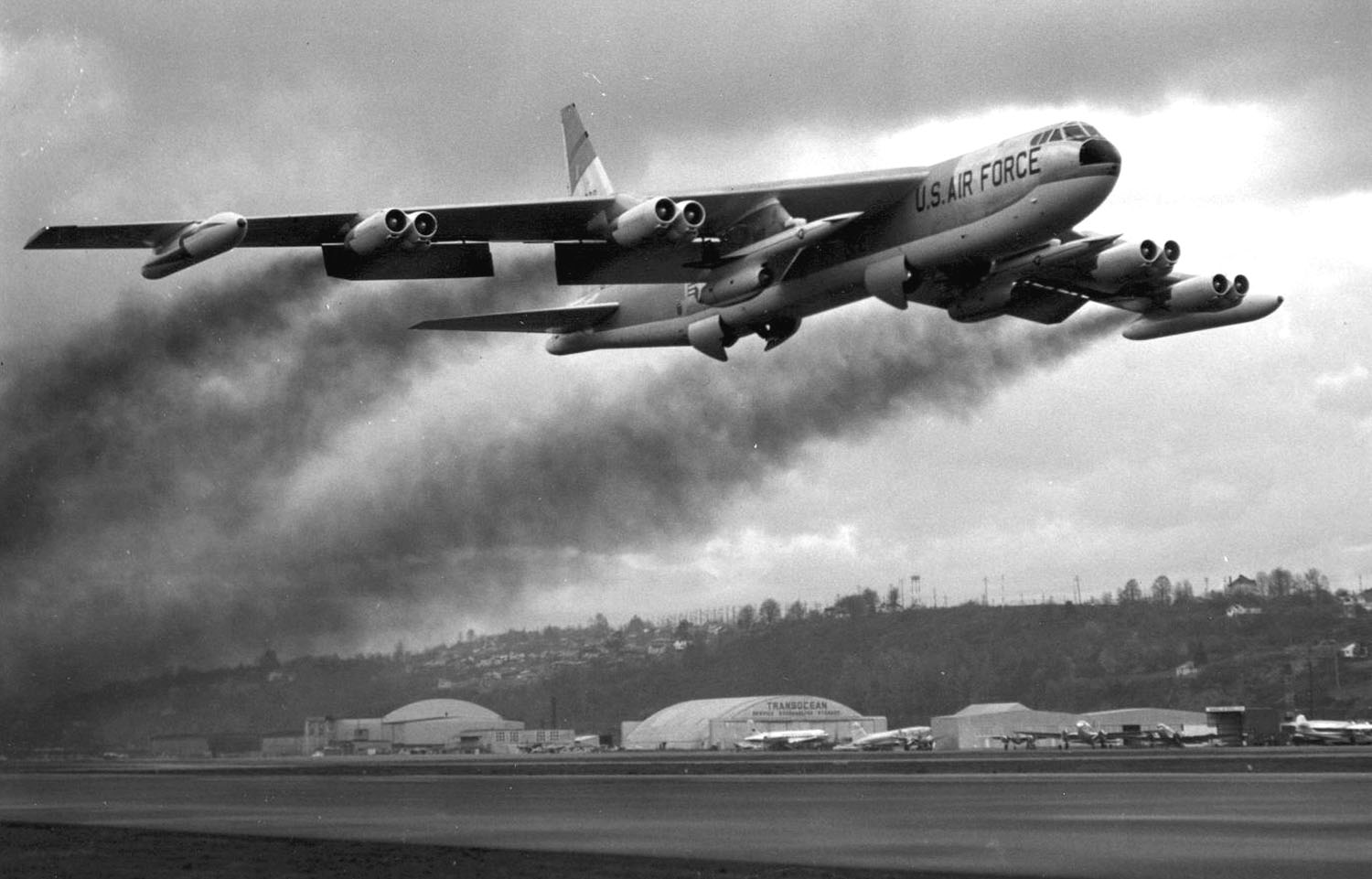
The B-52F was the last of the "tall-tail" Stratofortresses and also the last built in Seattle: in 1957 Boeing decided to concentrate all production of the following B-52G at Wichita so as to free the Washington plant for airliners. Eighty-nine F-series aircraft were built, 44 in Seattle and 45 in Wichita. The first flew in May 1958 and deliveries to the Air Force took place between the middle of that year and early 1959.
Differences from the B-52E
The main change lay in the engines. In place of the 10,500-lbf J57s of the B to E versions, the F received Pratt & Whitney J57-P-43W turbojets with a larger-capacity water-injection system and new alternators; in the J57-P-43WB version they delivered 13,750 lbf (61.2 kN) of static thrust with water injection, a marked performance gain that earned the aircraft the nickname "hot rod" among those who flew it. The same engine would later power the B-52G. Otherwise the F kept the airframe and layout of the E, including the manned tail turret and the ability to carry the AGM-28 Hound Dog missile on underwing pylons.
Its weak point was fuel leakage, a problem shared across the family because of deteriorating Marman clamps but particularly persistent on the F. It was cured by a succession of modification programmes: Blue Band in 1957, Hard Shell in 1958 and finally QuickClip, also in 1958, which added safety straps to prevent catastrophic fuel loss if a clamp failed.
Accidents with nuclear weapons
Two early accidents with atomic weapons aboard marked the F's history. On 15 October 1959, 57-0036 of the 4228th Strategic Wing at Columbus AFB, Mississippi, collided in mid-air with KC-135 57-1513 during refuelling near Hardinsburg, Kentucky; four of the bomber's eight crew and all four aboard the tanker were killed, and one of the two nuclear bombs was damaged by fire. On 14 March 1961, 57-0166 of the 4134th Strategic Wing at Mather AFB, California, suffered an uncontrolled decompression with two nuclear weapons aboard that forced a descent to 10,000 feet; the higher fuel burn at low altitude and the inability to meet a tanker in time turned the incident into one of the type's major accidents.
Operational service: Arc Light
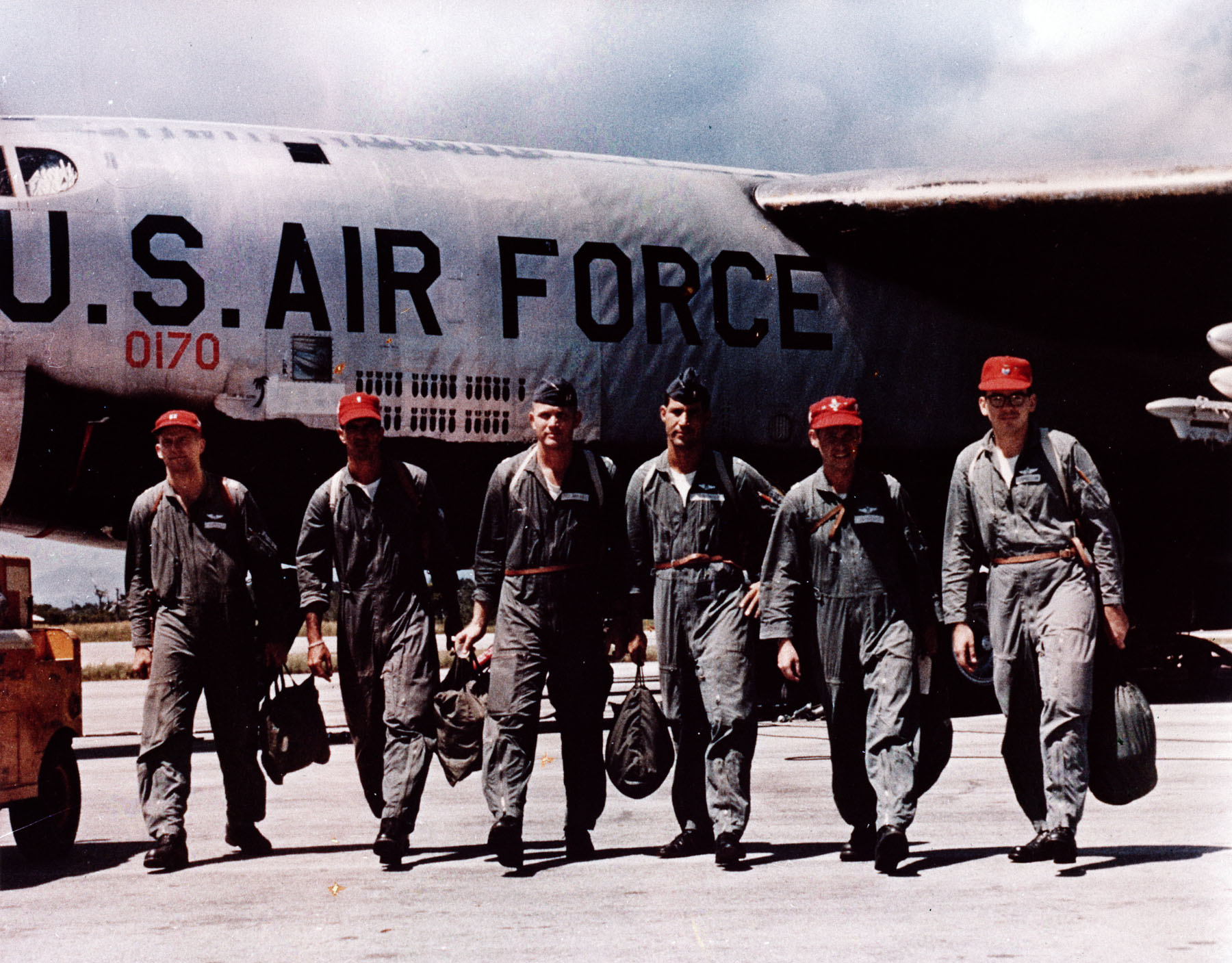
The B-52F was the first Stratofortress to go to war. As the situation in Southeast Asia escalated, in June 1964 28 aircraft were fitted with external racks for 24 750-pound (340 kg) bombs under project South Bay, and a further 46 received similar modifications under project Sun Bath; added to the 27 bombs in the bay, those loads made the F a conventional bomber of considerable capacity. The first mission, Operation Arc Light, was flown on 18 June 1965, when 30 bombers of the 9th and 441st Bombardment Squadrons struck a communist stronghold near Bến Cát in South Vietnam. The first wave reached the rendezvous point too early and, while manoeuvring to hold station, two aircraft collided and were lost with eight crewmen; another turned back with mechanical trouble. The remaining 27 bombed a one-by-two-mile target box from between 19,000 and 22,000 feet, with a little over half the bombs falling inside the zone, and the post-strike inspection suggested the Viet Cong had left the area before the raid.
Despite that start, the F was soon eclipsed. The Big Belly B-52Ds, able to carry 22,000 pounds (10,000 kg) more, were designed precisely to replace it, and from April 1966 they took over the bombing from Guam. Most Fs then returned to strategic duties, including service as Hound Dog carriers. One of the most widely reproduced images of the war, a Stratofortress releasing its load over Vietnam against a blue sky, shows a B-52F.
Retirement
As with the E, the F's career was relatively short. Most were retired between 1967 and 1973, although 23 survived as trainers until late 1978; the last left service in December 1978. Its legacy was twofold: it opened the B-52's combat record and tested the formula of more thrust and more conventional load that, with the B-52D and the new wing of the G, would define the bomber for the decades that followed.
Multimedia


-1600.webp)
_(26212420291)-1600.webp)

-1600.webp)
_(27651910345)-1600.webp)
-1600.webp)
-1600.webp)
-1600.webp)
-1600.webp)
-1600.webp)


_copy_(7257062168)-1600.webp)
_061128-F-1234S-009-800.webp)
_at_Andersen_Air_Force_Base%2C_Guam_061128-F-1234S-006-800.webp)
-1600.webp)