Bomber · Military · United States
Boeing B-17 Flying Fortress
- July 28, 1935
- First flight
- 1938
- Introduced
- 1945
- Retired
- 12,731
- Units built

-1600.webp)
-800.webp)
-1600.webp)


-800.webp)
-800.webp)

-1600.webp)


.jpg)
-800.webp)



-800.webp)


.jpg)



-800.webp)


-800.webp)


-800.webp)


-1600.webp)
-800.webp)
-1600.webp)
-800.webp)


-1600.webp)




-800.webp)
-1944-2-1600.webp)


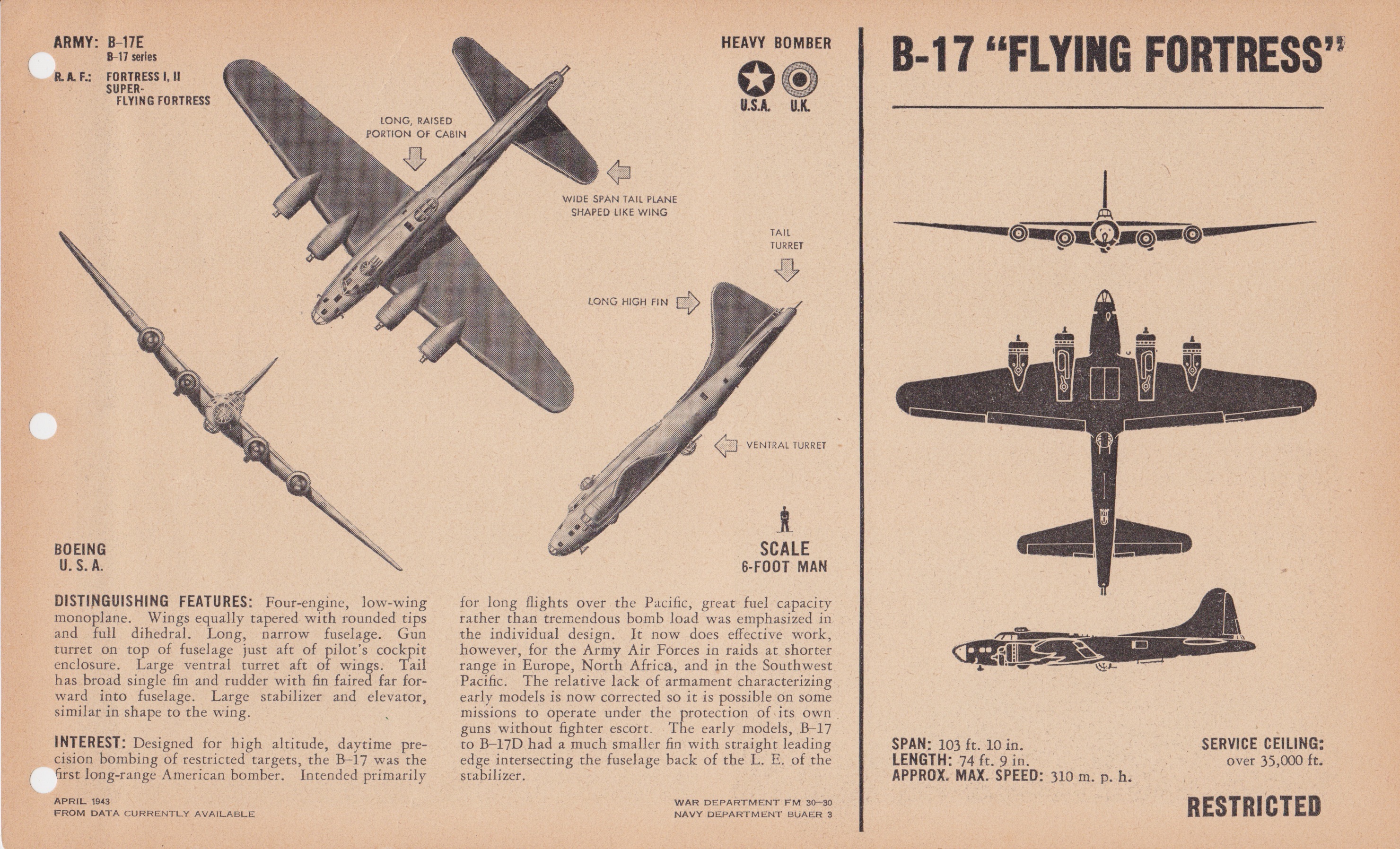
The Boeing B-17 Flying Fortress was an American four-engined heavy bomber designed in the mid-1930s for the United States Army Air Corps. Fast for its size, able to work at high altitude and bristling with defensive guns at the expense of bomb load, it dropped more bombs than any other aircraft of the Second World War and ranks as the third most-produced bomber in history, after the Consolidated B-24 Liberator and the Junkers Ju 88. The design answered an Air Corps proposal issued on 8 August 1934 to replace the Martin B-10. Boeing built the Model 299 prototype at its own expense to a design led by E. Gifford Emery and Edward Curtis Wells, borrowing from the experimental XB-15 and the Model 247 airliner. It first flew on 28 July 1935 with Leslie Tower at the controls, and the name came from Richard Williams of The Seattle Times, who looked at the guns poking from the fuselage and called it a flying fortress. On 30 October 1935 the prototype stalled and crashed because the control gust locks had not been released, killing Major Ployer Peter Hill and Tower, disqualifying the aircraft from a competition won by the Douglas B-18 Bolo, and prompting the written pre-flight checklist that pilots still use. The Army nonetheless ordered thirteen service-test machines in January 1936, and the type entered service with the 2nd Bombardment Group at Langley Field. Development moved quickly. Exhaust-driven General Electric turbo-superchargers, derived from Sanford Moss's work, gave the bomber the operating altitude that shaped how it fought. Models A through D remained defensive in conception; the B-17E, with a fuselage stretched by roughly three metres, a far larger fin and gun positions in the tail, dorsal turret and a ventral ball turret, was the first built to attack. The B-17F carried the burden of 1943, and the definitive B-17G reached thirteen 12.7 mm machine guns including a chin turret; 8,680 of that version alone were built. In action, the Royal Air Force sent it against Wilhelmshaven on 8 July 1941 with disappointing results and later moved it to maritime patrol. Its defining campaign was the American daylight offensive over Europe, opened on 17 August 1942 against the marshalling yards at Rouen-Sotteville. The raids on the ball-bearing plants at Schweinfurt showed what unescorted daylight bombing cost: on 14 October 1943, remembered as Black Thursday, 77 of the 291 Fortresses despatched were lost, and deep missions were suspended until P-51 Mustang and P-47 Thunderbolt fighters with drop tanks could escort the bombers all the way. In the Pacific its career was shorter — caught up in the Pearl Harbor and Philippines attacks, effective in the Battle of the Bismarck Sea, then displaced by the B-24 and B-29 from mid-1943, though it continued in search and rescue. Inventory peaked in August 1944 at 4,574 aircraft, and of the roughly 1.5 million tons of bombs Allied aircraft dropped on Germany and occupied Europe, more than 640,000 tons fell from B-17s. Its reputation rested as much on its ability to absorb damage and come home as on those totals; Luftwaffe pilots likened attacking a combat box formation to taking on a flying porcupine. It became the emblem of American air power, and a 1943 survey found that nine in ten people asked knew what a B-17 was. When production ended in May 1945, Boeing, Douglas and Vega had delivered 12,731 aircraft. Some forty survive in United States collections and about forty-six worldwide, only a handful of them airworthy; the oldest is The Swoose, a B-17D that fought in the Pacific in the opening days of the war.
Related events
- USAAC issues a specification for a multi-engine bomber
- First flight of the Boeing B-17 Flying Fortress
- First flight of the Model 299, the B-17 prototype
- Model 299 crashes at Wright Field, giving rise to the pilot checklist
- The Y1B-17 enters service evaluation
- Service entry of the Boeing B-17 Flying Fortress
- Attack on Clark Field and first B-17 missions in the Pacific
- Eighth Air Force's first heavy bomber mission over Europe
- Schweinfurt–Regensburg mission
- "Black Thursday": second raid on Schweinfurt
- Operation Aphrodite: B-17s converted into flying bombs
- Big Week and the arrival of the P-51 as a long-range escort
- The PB-1W brings airborne early warning radar to the US Navy
- End of B-17 production
- Retirement of the Boeing B-17 Flying Fortress
- Last active-duty USAF B-17 mission
- From hangar to wildfire: the B-17 as a civilian air tanker
Related sheets
Category
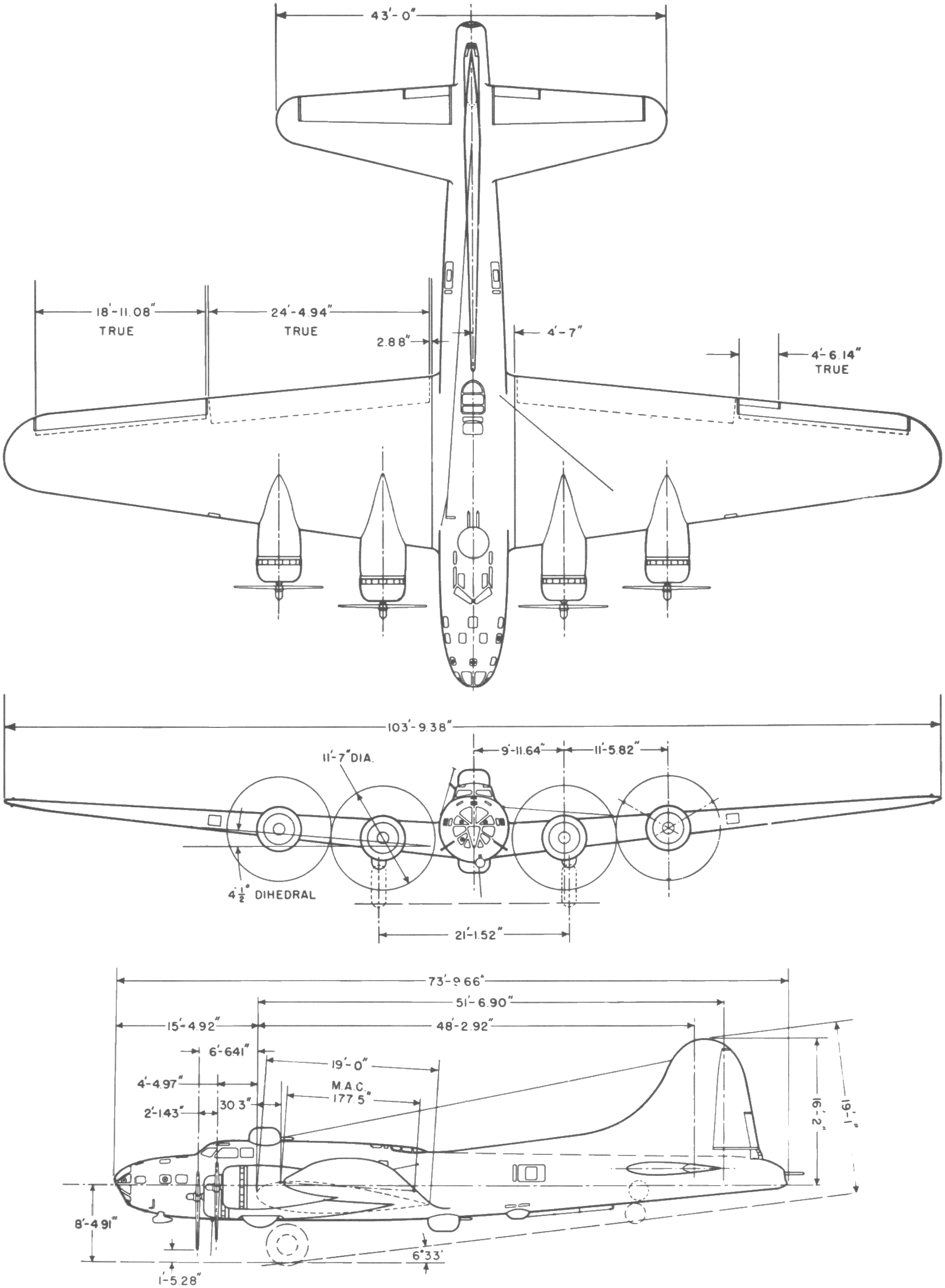
Three-view drawing
History
The 1934 competition and the Model 299
On 8 August 1934 the United States Army Air Corps issued a proposal for a multi-engine bomber to replace the Martin B-10 and to reinforce air forces stationed outside the continental United States. The requirement was to carry a useful bomb load at 10,000 ft (3,000 m) for ten hours at a top speed of at least 200 mph (320 km/h); a range of 2,000 mi (3,200 km) and 250 mph (400 km/h) were desirable but not mandatory. The contract would be settled by a fly-off at Wilbur Wright Field in Dayton, Ohio, between Boeing's design, the Douglas DB-1 and the Martin Model 146.
Boeing took the biggest gamble, building its prototype — the company's Model 299 — at its own expense. The design team, led by E. Gifford Emery and Edward Curtis Wells, drew on two earlier company programmes, the experimental XB-15 bomber and the Model 247 transport. The aircraft carried five .30 calibre (7.62 mm) machine guns and up to 4,800 lb (2,200 kg) of bombs on two racks in the bay behind the cockpit, powered by four Pratt & Whitney R-1690 Hornet radials of 750 hp (600 kW) at 7,000 ft (2,100 m). Its most distinctive gun position was in the nose, where a single weapon could be swung across nearly the whole frontal arc.
The Model 299 first flew on 28 July 1935 with Boeing's chief test pilot, Leslie Tower, at the controls. The name arrived before the flight did: on 27 July, Richard Williams of The Seattle Times counted the guns protruding from the fuselage and captioned a photograph with the phrase "15-ton flying fortress". Boeing saw the commercial value at once and trademarked it. On 20 August the prototype flew from Seattle to Wright Field in nine hours and three minutes at an average ground speed of 252 mph (406 km/h), far quicker than its rivals, and at the fly-off the four-engined machine comfortably outperformed both twins.
The timing suited the aircraft doctrinally as well. In March 1935 the Army Chief of Staff, General Douglas MacArthur, had created GHQ Air Force and promoted Frank Maxwell Andrews to brigadier general to lead it. Both men held that large four-engined aircraft offered capabilities that shorter-ranged twins could not match and fitted the doctrine the Air Corps was then developing; even before the competition ended, procurement officers proposed buying 65 aircraft.
The crash of 30 October 1935 and the written checklist
A test flight to measure rate of climb and service ceiling was scheduled for 30 October 1935. The command pilot was Major Ployer Peter Hill, chief of the flying branch of the Wright Field Material Division, flying the Model 299 for the first time; with him were Lieutenant Donald L. Putt as copilot, Leslie Tower seated behind the pilots in an advisory role, test observer John Cutting and mechanic Mark Koegler. Shortly after take-off the aircraft stalled, spun into the ground and burst into flames. Hill died within a few hours and Tower on 19 November. Interviews with Tower and Putt established the cause: the control surface gust locks had never been released. Out of that loss came a practice now universal in aviation, the written pre-flight checklist that pilots still work through item by item.
The wrecked prototype could not complete the evaluation and was disqualified. The Air Corps remained enthusiastic about its potential, but Army officials balked at the price: on a production order of 220 aircraft, Douglas quoted $58,200 per machine against Boeing's $99,620. MacArthur's successor as Chief of Staff, General Malin Craig, cancelled the order for 65 YB-17s and bought 133 twin-engined Douglas B-18 Bolos instead; in October 1938 Secretary of War Harry Hines Woodring ruled that the War Department would buy no four-engined bombers at all, B-17s included, in 1939.
Thirteen service-test aircraft and entry into service
Despite the crash, on 17 January 1936 the Air Corps used a legal loophole to order thirteen YB-17s for service testing, redesignated Y1B-17 from November 1936 to denote their special funding. They incorporated significant changes, including more powerful Wright R-1820-39 Cyclone engines. Between 1 March and 4 August 1937 twelve of the thirteen went to the 2nd Bombardment Group at Langley Field, Virginia, for operational development and flight test; the thirteenth went to the Material Division at Wright Field. One of the group's first adopted suggestions was precisely the pre-flight checklist meant to prevent another Model 299.
Those early years were part training, part publicity. In January 1938 the group commander, Colonel Robert Olds, flew a Y1B-17 coast to coast and set a transcontinental record of 13 hours 27 minutes; on the return leg he broke the west-to-east record too, averaging 245 mph (394 km/h) in 11 hours 1 minute. On 15 February 1938 six of the group's bombers left Langley Field on a goodwill flight to Buenos Aires, covering 12,000 miles (19,000 km) and returning on the 27th; three days later seven aircraft set out for Rio de Janeiro. On 12 May, in a heavily publicised mission ordered by Andrews, three Y1B-17s with Lieutenant Curtis LeMay as lead navigator "intercepted" and photographed the Italian ocean liner Rex 610 miles (980 km) off the Atlantic coast.
A fourteenth airframe (37-369), originally built for static structural testing, was fitted by Boeing with exhaust-driven General Electric turbo-superchargers and designated Y1B-17A. The turbochargers, designed by Sanford Moss, used engine exhaust to spin steel-alloy turbine blades that forced high-pressure air into the Wright Cyclone GR-1820-39's supercharger. Scheduled to fly in 1937, teething trouble delayed the first flight to 29 April 1938 and delivery to the Army to 31 January 1939. The result justified the wait: 311 mph (501 km/h) against the Y1B-17's 239 mph (385 km/h), and a service ceiling of 38,000 ft (12,000 m) against 27,800 ft (8,500 m). That altitude, more than any other figure, would define how the B-17 fought, and the turbo-superchargers went into production with the B-17B.
Opposition to buying more Fortresses faded. Ten B-17Bs — with larger flaps and rudder and a well-framed ten-panel glazed nose — were ordered in late 1937 and delivered in five small batches between July 1939 and March 1940. An order for 512 aircraft followed in July 1940, yet fewer than 200 were in Army service on the day of the attack on Pearl Harbor. Between 11 January 1937 and 30 November 1941 just 155 B-17s of all variants were delivered.
From defensive aircraft to offensive weapon
The design evolved through hard experience. The B-17C replaced three bulged oval gun blisters with two flush oval window openings and added a ventral "bathtub" gun gondola under the fuselage. Models A through D were still conceived defensively; the large-tailed B-17E was the first built for offensive warfare and amounted to an extensive revision of the Model 299: the fuselage was stretched by 10 ft (3.0 m), the rear fuselage, fin, rudder and tailplane were greatly enlarged, a gunner's position was added in the new tail, a Sperry electrically powered dorsal turret went in behind the cockpit and a manned Sperry ball turret aft of the bomb bay replaced the awkward remotely operated ventral turret of the earliest E airframes. The changes added roughly 20 per cent to the aircraft's weight.
The B-17F bore the weight of the 1943 campaign against Germany: it standardised the manned ball turret and swapped the ten-panel bombardier's glazing for an enlarged, nearly frameless Plexiglas nose that greatly improved forward vision. Two derivatives were tried and dropped. The XB-38 was an engine testbed for liquid-cooled Allison V-1710s in case Wright engines ran short; its only prototype crashed on its ninth flight. The YB-40 was a heavily armed escort conversion intended to protect formations until a genuinely long-range fighter arrived, with an extra dorsal turret in the radio room, a remotely operated Bendix chin turret under the bombardier's position, twin 12.7 mm guns at each waist station and over 11,000 rounds of ammunition. More than 10,000 lb (4,500 kg) heavier than a loaded B-17F, it could not keep pace once the bombers had dropped their loads, and the project was phased out in July 1943 — but its chin turret was adopted on the final Douglas-built B-17F blocks and from there passed into the definitive model.
The B-17G gathered every improvement: thirteen 12.7 mm machine guns, the Bendix chin turret as standard, staggered waist windows that gave the gunners room to work and, on late blocks, the revised tail position known as the "Cheyenne" turret after the United Airlines modification centre where it appeared. It was by far the most numerous variant, and many airframes were later converted into transports, engine testbeds, reconnaissance aircraft and search-and-rescue machines designated SB-17G and then B-17H.
The RAF and the disappointment of 1941
The Royal Air Force took the B-17 into combat first. In early 1940 it agreed with the Air Corps to acquire twenty B-17Cs, given the service name Fortress Mk.I. Their first operation, against Wilhelmshaven on 8 July 1941, was unsuccessful. On 24 July three Fortresses of No. 90 Squadron attacked the capital ships Gneisenau and Prinz Eugen at Brest from 30,000 ft (9,100 m), the idea being to draw German fighters away from eighteen Handley Page Hampdens bombing lower down and to leave seventy-nine Vickers Wellingtons a clear run later; the plan misfired and the Fortresses met no opposition at all. By September the RAF had lost eight B-17Cs in combat and suffered repeated mechanical failures, and Bomber Command abandoned daylight raids with the Fortress I. The experience convinced both air forces that the aircraft was not ready for combat and that better defences, larger bomb loads and more accurate bombing were needed — yet the USAAF stuck with daylight bombing over British misgivings.
The surviving Fortresses passed to Coastal Command as long-range maritime patrol aircraft, reinforced from July 1942 by 45 Fortress Mk.IIA (B-17E), 19 Mk.II (B-17F) and three Mk.III (B-17G). A Fortress IIA of No. 206 Squadron sank U-627 on 27 October 1942, the first of eleven U-boat kills credited to RAF Fortresses during the war. Once enough Consolidated Liberators arrived, Coastal Command withdrew the type from the Azores and turned it to meteorological reconnaissance, with three squadrons flying weather profiles from Iceland, Scotland and England. No. 223 Squadron, part of 100 Group, also flew Fortresses carrying the "Airborne Cigar" electronic warfare system, worked by German-speaking radio operators who identified and jammed German ground controllers — and sometimes impersonated them to steer nightfighters away from the bomber streams.
The American daylight precision offensive
The Air Corps became the United States Army Air Forces on 20 June 1941. Its doctrine was high-altitude daylight bombing built around the then-secret Norden bombsight, nicknamed the "Blue Ox": a gyrostabilised optical-electromechanical analogue computer that worked out, from variables entered by the bombardier, the moment to release. During the bomb run the bombardier effectively took over flight control and held the aircraft level until the load fell away.
The first Eighth Air Force units reached High Wycombe, England, on 12 May 1942 to form the 97th Bomb Group. On 17 August 1942 twelve B-17Es of the 97th — the lead aircraft flown by Major Paul Tibbets with Brigadier General Ira Eaker aboard as an observer — attacked the large railway marshalling yards at Rouen-Sotteville in France, closely escorted by four squadrons of Spitfire IXs with five more squadrons of Spitfire Vs covering the withdrawal, while six further aircraft flew a diversion along the French coast. It was the Eighth's first heavy bomber raid over Europe: good visibility, half the bombs in the target area, and only minor damage to one aircraft, unrelated to enemy action. Two more groups soon arrived with the first B-17Fs, which served as the principal American heavy bomber against Germany until September 1943. As raids grew in number and frequency, so did German interception — as in the attempted bombing of Kiel on 13 June 1943 — until unescorted missions came to be discouraged.
The Casablanca Conference of January 1943 married the two national strategies into the Combined Bomber Offensive, with the Americans attacking by day and the British, chiefly against industrial cities, by night. Its priority component, Operation Pointblank, aimed to destroy German fighter strength as a precondition for the ground invasion. Eaker and the Eighth put the German aircraft industry at the top of the list: fighter assembly plants, engine factories and ball-bearing manufacturers. The attacks opened in April 1943 against heavily defended plants at Bremen and Recklinghausen.
Schweinfurt and Regensburg
Because bombing airfields was not appreciably reducing German fighter strength, more B-17 groups were formed and Eaker ordered deeper missions against major industrial targets. The choice fell on the ball-bearing works at Schweinfurt. The first raid, on 17 August 1943, did no critical damage: the 230 attacking B-17s were intercepted by an estimated 300 Luftwaffe fighters, which shot down 36 aircraft with the loss of 200 men; together with the Regensburg raid flown earlier the same day, 60 B-17s were lost in a single day.
The second attempt against Schweinfurt, on 14 October 1943, is remembered as "Black Thursday". The attack disrupted the entire works and severely curtailed production there for the rest of the war, but the cost was extreme: of the 291 Fortresses despatched, 60 were shot down over Germany, five crashed on the approach to Britain and twelve more were scrapped as damaged, a total of 77 aircraft lost. Another 122 needed repairs before flying again and only 33 landed undamaged. Of 2,900 crewmen, roughly 650 did not return, though some survived as prisoners of war. The losses were the work of concentrated attacks by more than 300 German fighters.
Long-range escort
Such casualties could not be sustained. Recognising how vulnerable heavy bombers were when operating alone, the USAAF suspended deep daylight raids into Germany until an escort fighter existed that could cover the bombers from the United Kingdom to the target and back. The Eighth alone lost 176 bombers in October 1943, and took comparable losses on 11 January 1944 over Oschersleben, Halberstadt and Brunswick: Lieutenant General James Doolittle, commanding the Eighth, had ordered the mission cancelled as the weather deteriorated, but the lead units were already in hostile airspace and pressed on; most of the escorts turned back or missed the rendezvous, and 60 B-17s were destroyed.
The answer was the North American P-51 Mustang and the Republic P-47 Thunderbolt fitted with improved drop tanks, which could accompany the heavies the whole way. The third Schweinfurt raid, on 24 February 1944, fell within what became known as "Big Week", a series of missions aimed at German aircraft production and designed to force the Luftwaffe to come up and fight. With continuous escort the loss rate fell below 7 per cent: 247 B-17s were lost in 3,500 sorties during Big Week. By September 1944, 27 of the Eighth Air Force's 42 bomb groups and 6 of the Fifteenth's 21 flew Fortresses. Flak continued to take a heavy toll through 1944, but by 27 April 1945 — two days after the last heavy bombing mission in Europe — losses were so low that replacement aircraft stopped arriving and the number of bombers per group was cut. The Combined Bomber Offensive was effectively over.
The combat box and the ability to take damage
The B-17's defence rested on its .50 calibre M2 Browning machine guns and, above all, on formation flying. A 1943 USAAF survey found that more than half the bombers shot down by the Germans had left the protection of the main formation, and from that finding came the staggered combat box, in which every aircraft could cover the others with its guns; brightly painted assembly ships were used to gather the formations more quickly. Luftwaffe fighter pilots likened attacking a combat box to running into a fliegendes Stachelschwein, a "flying porcupine" pointing dozens of machine guns at them from almost every direction. The price of that rigidity was that no aircraft could manoeuvre evasively, which left the boxes exposed to flak, and German pilots came to prefer high-speed strafing passes to individual duels.
Examining wrecked B-17s and B-24s, Luftwaffe officers calculated that it took on average about twenty hits from 20 mm shells fired from the rear to bring one down, and that a pilot of average ability scored with only about 2 per cent of his rounds — a thousand 20 mm rounds per bomber destroyed. Attacking from the front, where fewer defensive guns bore and the bomber pilot lacked the armour that protected him from behind, four or five hits sufficed. That arithmetic explains the German escalation: from the Fw 190 with two MG FF cannon to the four-cannon Sturmbock, and then to 30 mm MK 108 cannon in the wings or in underwing gun pods, able to destroy a bomber with a handful of hits. The other side of the coin was the Fortress's reputation for toughness. Wally Hoffman, an Eighth Air Force B-17 pilot, said the aircraft could be "cut and slashed almost to pieces by enemy fire" and still bring its crew home, and photographs circulated of Fortresses returning with shredded tails, destroyed engines and large sections of wing torn away by flak. That durability offset its shorter range and lighter bomb load compared with the B-24 and the Avro Lancaster.
The Pacific
The B-17 entered the Pacific war on its first day. On 7 December 1941 twelve aircraft of the 38th (four B-17Cs) and 88th (eight B-17Es) Reconnaissance Squadrons, flying from Hamilton Field, California, to reinforce the Philippines, arrived over Pearl Harbor in the middle of the Japanese attack; ten of the twelve survived. In the Philippines the Far East Air Force at Clark Field had 35 B-17s, with the War Department planning to raise that to 165. On word of the attack, General Lewis H. Brereton sent his bombers and fighters up on patrol so they would not be caught on the ground and proposed raiding the Japanese airfields on Formosa under the Rainbow 5 war plan, but MacArthur overruled him; disputed discussions and a run of confused and false reports delayed authorisation, and by the time the B-17s and their Curtiss P-40 escorts were about to get airborne, Japanese bombers of the 11th Air Fleet destroyed them. The FEAF lost half its aircraft in the first strike and was all but wiped out over the following days. On 10 December Captain Colin Kelly held his burning B-17C steady long enough for his surviving crew to bail out before it crashed some 6 mi (10 km) from Clark Field; his attack, celebrated at the time as the sinking of the battleship Haruna, was later acknowledged as a near miss on the heavy cruiser Ashigara, but it made him a national hero and earned him a posthumous Distinguished Service Cross. The Japanese ace Saburō Sakai, credited with the kill, came away with a lasting respect for the Fortress's ability to absorb punishment.
In the great naval battles of 1942, the Coral Sea and Midway, results were poor: doctrine called for bombing from high altitude and only about 1 per cent of the bombs hit anything, though in exchange the B-17s operated above the height most A6M Zero fighters could reach. Their greatest Pacific success came in the Battle of the Bismarck Sea. On 2 March 1943 six B-17s of the 64th Squadron attacked a major Japanese troop convoy off New Guinea from 10,000 ft (3,000 m), using skip bombing to sink Kyokusei Maru with 1,200 soldiers aboard and to damage two other transports. The next day thirteen B-17s bombed from 7,000 ft (2,000 m) and forced the convoy to scatter, diluting its anti-aircraft defence; one Fortress broke up in the air and Japanese fighters machine-gunned its crew in their parachutes and in the water. Australian Beaufighters and American B-25 Mitchells finished the convoy at low level, and on 4 March a B-17 sank the destroyer Asashio with a 500 lb (230 kg) bomb as she picked up survivors.
The theatre was never really the B-17's. Numbers peaked at 168 aircraft in the Pacific in September 1942, but by mid-1942 General Arnold had concluded that the type did not suit the operations required there and planned to replace it with B-24s and later B-29s. The changeover was not complete until mid-1943, so B-17 combat operations in the Pacific lasted little more than a year. Surviving aircraft went to the 54th Troop Carrier Wing's special airdrop section, supplying ground forces in close contact with the enemy, among them Australian commandos operating near the Japanese stronghold at Rabaul. Later, a number of B-17Gs redesignated B-17H and then SB-17G spent the final year of the war dropping lifeboats to bomber crews shot down or ditched at sea; nicknamed "Dumbos", they stayed in service for many years.
Production: Boeing, Vega and Douglas
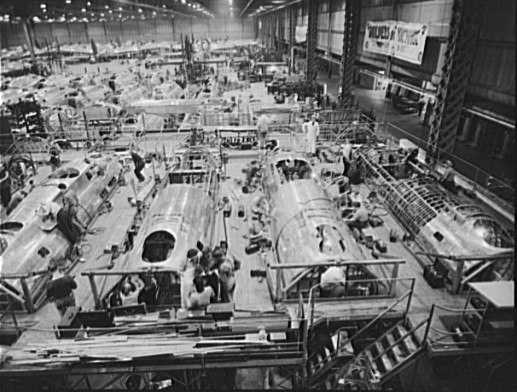
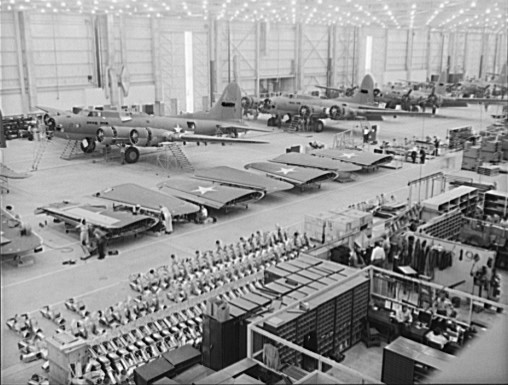
No single manufacturer could sustain the required output, and from 1942 the B-17 was built by a three-company pool: Boeing, Lockheed's Vega division and Douglas Aircraft. Of the 3,405 B-17Fs built, Boeing produced 2,300, Douglas 605 at Long Beach, California, and Vega 500 at Burbank; the famous Memphis Belle came from that series. The definitive B-17G reached 8,680 aircraft built by the three firms from 1943 onwards, the last of them leaving Lockheed's line on 28 July 1945. In all, 12,731 Fortresses were delivered, and the B-17 once held the record for the highest production rate of any large aircraft. The cost was on the same scale: roughly a third of the total, some 4,750 aircraft, was lost on combat missions. USAAF inventory peaked in August 1944 at 4,574 aircraft worldwide, with 32 combat groups deployed overseas.
After the war
Once the war ended the B-17 disappeared quickly as a bomber. Crews ferried the aircraft back across the Atlantic to the United States, where most were sold for scrap and melted down, though many stayed in second-line work as VIP transports, air-sea rescue aircraft and photo-reconnaissance platforms. Strategic Air Command, established in 1946, flew reconnaissance Fortresses — first designated F-9, later RB-17 — until 1949. About 130 airframes were converted for air-sea rescue as B-17H and later SB-17G: work on airborne lifeboats had begun in 1943, but they only entered European service in February 1945, after which they supported B-29 raids on Japan, served through the Korean War and remained with the USAF into the mid-1950s.
In 1946 surplus B-17s were chosen as drones for atmospheric sampling during the Operation Crossroads atomic tests, able to fly close to or through the mushroom cloud without risking a crew. That led to wider conversion: 107 aircraft became drones, others drone directors, both for further nuclear testing and as targets for the new surface-to-air and air-to-air missiles. The last operational USAF Fortress mission was flown on 6 August 1959, when a DB-17P (44-83684) directed a QB-17G out of Holloman Air Force Base, New Mexico, as a target for an AIM-4 Falcon fired from a McDonnell F-101 Voodoo; 44-83684 was retired days later at a ceremony at Holloman and, after appearances in film and television, went to the Planes of Fame museum at Chino, California.
The US Navy acquired 48 surplus B-17s for patrol and air-sea rescue; on 31 July 1945 they received the naval designation PB-1, and 32 B-17Gs were rebuilt as PB-1W airborne early warning aircraft with a large radome under the fuselage for an S-band AN/APS-20 search radar and extra tankage for endurance. The PB-1Ws served until 1955, when the Lockheed WV-2 replaced them. The Coast Guard received sixteen aircraft through the Navy in July 1945, designated PB-1G from July 1946 and spread across bases in the United States and Newfoundland; they flew "Dumbo" rescue missions, iceberg patrols and photo mapping until the last was withdrawn on 14 October 1959. There was even a clandestine career: the CIA used B-17s through front companies such as Civil Air Transport, Air America and Intermountain Aviation to drop agents over mainland China from Taiwan with Taiwanese crews, losing four aircraft to enemy fire. One of them, B-17G 44-85531 registered N809Z, plucked two American servicemen off the abandoned Soviet drifting ice station NP 8 with a Fulton Skyhook on 1 June 1962 during Operation Coldfeet.
Legacy
The B-17 became the emblem of American air power. A 1943 poll of 2,500 men in cities where Consolidated had advertised found that 73 per cent had heard of the B-24 while 90 per cent knew the B-17. Among pilots who flew both, many preferred the Fortress for its greater stability and its behaviour in formation; its electrical systems were less vulnerable than the Liberator's hydraulics, and it was easier to fly on three engines. Doolittle set out in writing his preference for equipping the Eighth with B-17s and P-51s, partly for the logistical advantage of keeping the number of types to a minimum, and the Eighth's statisticians backed him: despite inferior performance and a smaller bomb load than the more numerous B-24, mission studies gave the B-17 markedly greater utility and survivability, and crew surveys showed far higher satisfaction.
Of the more than 12,000 built, about forty survive in United States collections and roughly forty-six worldwide, only a few of them airworthy. Nearly complete wrecks have also been recovered, among them the B-17F Black Jack, ditched in the Pacific on 11 July 1943 and located in 1986. The oldest survivor is The Swoose, a B-17D that fought in the Pacific on the first day of American involvement in the war and whose restoration to wartime appearance was undertaken by the National Museum of the United States Air Force at Wright-Patterson, where the Memphis Belle is already displayed. The fragility of that heritage returned to the headlines in 2022, when Texas Raiders was destroyed in a fatal mid-air collision with another warbird at an airshow.
Variants
| Model 299 | Y1B-17 | B-17B | XB-38 | B-17C | B-17D | B-17E | B-17F | B-17G | BQ-7 Aphrodite | C-108 Flying Fortress | F-9 | PB-1 | PB-1G | PB-1W | QB-17 | Y1B-17A | YB-40 | |
|---|---|---|---|---|---|---|---|---|---|---|---|---|---|---|---|---|---|---|
| First flight | July 28, 1935 | December 2, 1936 | June 27, 1939 | May 19, 1943 | — | — | — | — | — | — | — | — | — | — | — | — | — | — |
| Aircraft type | heavy bomber prototype | pre-production service-test bomber | heavy bomber, first production version | engine testbed | heavy bomber | heavy bomber | heavy bomber | heavy bomber | heavy bomber | radio-controlled flying bomb drone | VIP/cargo transport | long-range photographic reconnaissance | maritime patrol | maritime search and rescue | airborne early warning (AEW) | target drone | supercharger development testbed | heavily-armed escort ("gunship") |
| Powerplant | — | — | — | — | — | — | — | — | 4 turbosupercharged Wright R-1820-97 Cyclone radial engines, 895 kW (1,200 hp) each, driving three-blade Hamilton-Standard constant-speed propellers. | — | — | — | — | — | — | — | — | — |
| Powerplant | 4 × Pratt & Whitney S1EG Hornet | 4 × Wright R-1820 Cyclone | 4 × Wright R-1820-51 | 4 × Allison V-1710-89 | 4 × Wright R-1820-65 | 4 × piston | 4 × piston | 4 × piston | 4 × Wright R-1820-97 Cyclone | 4 × piston | 4 × piston | 4 × piston | 4 × piston | 4 × piston | 4 × piston | 4 × Wright R-1820-97 Cyclone | 4 × Wright R-1820 Cyclone con turbocompresores General Electric | 4 × piston |
| Power per engine | 751 hp | — | 1,194 hp | — | — | — | — | — | 1,200 hp Best value in this row | — | — | — | — | — | — | — | — | — |
| Length | — | — | — | — | — | — | — | — | 22.7 m | — | — | — | — | — | — | — | — | — |
| Wingspan | — | — | — | — | — | — | — | — | 31.6 m | — | — | — | — | — | — | — | — | — |
| Height | — | — | — | — | — | — | — | — | 5.8 m | — | — | — | — | — | — | — | — | — |
| Wing area | — | — | — | — | — | — | — | — | 132 m² | — | — | — | — | — | — | — | — | — |
| Empty weight | — | — | — | — | — | — | — | — | 16,391 kg | — | — | — | — | — | — | — | — | — |
| MTOW | 17,261 kg | — | — | — | — | — | — | — | 29,700 kg Best value in this row | — | — | — | — | — | — | — | — | — |
| Top speed | 380 km/h | — | — | — | — | — | — | — | 472 km/h Best value in this row | — | — | — | — | — | — | — | — | — |
| Max speed altitude | — | — | — | — | — | — | — | — | 7,620 m | — | — | — | — | — | — | — | — | — |
| Cruise speed | — | — | — | — | — | — | — | — | 293 km/h | — | — | — | — | — | — | — | — | — |
| Service ceiling | — | — | — | — | — | — | — | — | 10,850 m | — | — | — | — | — | — | — | — | — |
| Initial climb rate | — | — | — | — | — | — | — | — | 4.6 m/s | — | — | — | — | — | — | — | — | — |
| Range | — | — | — | — | — | — | — | — | 3,219 km Best value in this row | 560 km | — | — | — | — | — | — | — | — |
| Ferry range | — | — | — | — | — | — | — | — | 6,035 km | — | — | — | — | — | — | — | — | — |
| Combat radius | — | — | — | — | — | — | — | — | 1,760 km | — | — | — | — | — | — | — | — | — |
| Range conditions | — | — | — | — | — | — | — | — | 3,219 km with 2,700 kg of bombs; 1,760 km combat radius with maximum bomb load and average fuel; roughly 6,035 km ferry range. | — | — | — | — | — | — | — | — | — |
| Armament | — | — | — | — | — | — | — | — | 13 × .50-cal (12.7 mm) M2 Browning machine guns in 9 positions: 2 in the Bendix chin turret, 2 on the nose cheeks, 2 staggered waist guns, 2 in the Sperry dorsal turret, 2 in the Sperry ball turret, 2 in the tail and 1 firing upward from the radio compartment. | — | — | — | — | — | — | — | — | — |
| Max weapons load | — | — | — | — | — | — | — | — | 7,983 kg | 9,100 kg Best value in this row | — | — | — | — | — | — | — | — |
| Payload | — | — | — | — | — | — | — | — | 0 kg | — | — | — | — | — | — | — | — | — |
| Cargo capacity | — | — | — | — | — | — | — | — | None; the B-17G is a military bomber with no civil cargo capacity. | — | — | — | — | — | — | — | — | — |
| Crew | — | 6 | — | — | — | 10 | — | — | 10 | 2 Best value in this row | — | — | — | — | — | — | — | — |
| Passengers | — | — | — | — | — | — | — | — | 0 Best value in this row | — | 0 Best value in this row | — | — | — | — | — | — | — |
| Units built | 1 | 13 | 39 | 1 | 38 | 42 | 512 | 3,405 | 8,680 Best value in this row | 25 | 4 | 16 | 48 | 17 | 31 | — | 1 | 26 |
Images
Elsewhere
- The Museum of FlightBoeing B-17F «Boeing Bee» del Museum of Flight ↗
- NARAFondos del B-17 en el Catálogo Nacional de Archivos de EE. UU. ↗
- B-17 PreservationSally B, el único B-17 en vuelo en Europa ↗
- 390th Memorial MuseumMuseo Conmemorativo del 390th Bomb Group y su B-17G ↗
- National Museum of the Mighty Eighth Air ForceMuseo Nacional de la Octava Fuerza Aérea ↗
- Champaign Aviation MuseumReconstrucción del B-17G «Champaign Lady» ↗
- B-17 Alliance FoundationB-17F «Lacey Lady» y su restauración ↗
- FlightGlobal (Flickr)Archivo fotográfico y de despieces de FlightGlobal ↗
- FlightGlobal ImagesDespieces (cutaways) del archivo de Flight International ↗
- 303rd Bomb Group AssociationArchivo del 303rd Bomb Group («Hell’s Angels») ↗
- Smithsonian NASMObjetos del B-17 en el National Air and Space Museum ↗
- UNT Digital LibraryFondos digitales del B-17 ↗
Show the 62 more
- This Day in AviationEfemérides documentadas del B-17 ↗
- National WWII MuseumEl B-17 en el National WWII Museum ↗
- Vintage Aviation NewsActualidad de los B-17 en vuelo ↗
- DVIDSImágenes del B-17 en DVIDS ↗
- NARAEl B-17 en producción: fondos de NARA ↗
- National Museum of the Mighty Eighth Air ForceExposición del B-17 «City of Savannah» ↗
- FlightGlobal (Flickr)Despieces del B-17 en el archivo de FlightGlobal ↗
- Smithsonian Air & SpaceReportajes del B-17 en Air & Space ↗
- Library of CongressFormation--Boeing B-17 airplanes ↗
- Library of Congress"Flying Fortress" bombadier, stripped for low-altitude practice flight on high-altitude bombing mission he wore warm gear and used oxygen mask / ↗
- Library of CongressBombs away B-17 ↗
- Library of CongressSunset silhouette of flying fortress, Langley Field, Va. ↗
- Library of CongressTop turret B-17 ↗
- Library of CongressLangley Field, Virginia. May, 1942. YB-17 bombardment squadron ↗
- Library of CongressBomb bay B-17 ↗
- Library of CongressSpaatz standing beside his B-17, "Boops", named for his daughter Carla ↗
- Library of CongressBoeing aircraft plant, Seattle, Washington. Production of B-17 (Flying Fortress) bombing planes. Material for the construction of B-17 (Flying Fortress) bombers ↗
- Library of CongressBoeing aircraft plant, Seattle, Washington. Production of B-17 (Flying Fortress) bombing planes. Material for the construction of B-17 (Flying Fortress) bombers ↗
- Library of CongressBoeing aircraft plant, Seattle, Washington. Production of B-17 (Flying Fortress) bombing planes. Material for the construction of B-17 (Flying Fortress) bombers ↗
- Library of CongressBoeing aircraft plant, Seattle, Washington. Production of B-17 (Flying Fortress) bombing planes. Material for the construction of B-17 (Flying Fortress) bombers ↗
- Library of CongressBoeing aircraft plant, Seattle, Washington. Production of B-17 (Flying Fortress) bombing planes. Material for the construction of B-17 (Flying Fortress) bombers ↗
- Library of CongressOver the Alps - Hitler's Bavarian Alps offer no barrier to high flying B-17 Flying Fortresses of the U.S. Eighth Air Force--Here they wing toward Munich Febrary [sic] 25th, where t ↗
- Library of CongressBoeing aircraft plant, Seattle, Washington. Production of B-17 (Flying Fortress) bombing planes. Material for the construction of the B-17 (Flying Fortress) bomber ↗
- Library of Congress8th Air Force B-17s lined up [on runway] for raid on Berlin ↗
- Library of CongressYB-17 bombardment squadron, Langley Field, Virginia. Tuning a bomber engine requires knowledge and skill. These three corporals of a bombardment squadron at Langley Field, Virginia ↗
- Library of CongressBoeing aircraft plant, Seattle, Washington. Production of B-17 (Flying Fortress) bombing planes. Octupus punching machine working on parts for B-17 (Flying Fortress) bombers ↗
- Library of CongressBoeing aircraft plant, Seattle, Washington. Production of B-17 (Flying Fortress) bombing planes. An electric spot welding job for a B-17 (Flying Fortress) bomber ↗
- Library of CongressProduction. B-17 heavy bomber. Sections of frameworks for B-17F (Flying Fortress) bomber fuselages at the Boeing plant in Seattle. The Flying Fortress has performed with great cred ↗
- Library of CongressProduction. B-17 heavy bomber. Completing the framework of a fuselage section for a new B-17F (Flying Fortress) bomber. The Flying Fortress has performed with great credit in the S ↗
- Library of CongressProduction. B-17 heavy bomber. Sections of framework for a B-17F (Flying Fortress) bomber fuselages at the Boeing plant in Seattle. The Flying Fortress, has performed with great cr ↗
- Library of CongressProduction. B-17 heavy bomber. Forming parts for B-17F (Flying Fortress) bombers on a huge hydraulic press in Boeing's Seattle Plant. The Flying Fortress has performed with great c ↗
- Library of CongressProduction. B-17 heavy bomber. A nearly complete B-17F (Flying Fortress) bomber at the Boeing's production line in the Seattle plant. The Flying Fortress has performed with great c ↗
- Library of CongressBoeing "Flying Fortress II" (B-17) ↗
- Library of CongressBoeing aircraft plant, Seattle, Washington. Production of B-17 (Flying Fortress) bombing planes. Tubing bent in specified shapes and ready for installation in B-17 (Flying Fortress ↗
- Library of CongressBoeing aircraft plant, Seattle, Washington. Production of B-17 (Flying Fortress) bombing planes. Tubing bent in specified shapes and ready for installation in B-17 (Flying Fortress ↗
- Library of Congress[Untitled photo, possibly related to: Boeing aircraft plant, Seattle, Washington. Production of B-17 (Flying Fortress) bombing planes. Material for the construction of B-17 (Flying ↗
- Library of Congress[Untitled photo, possibly related to: Boeing aircraft plant, Seattle, Washington. Production of B-17 (Flying Fortress) bombing planes. Material for the construction of B-17 (Flying ↗
- Library of Congress[Untitled photo, possibly related to: Boeing aircraft plant, Seattle, Washington. Production of B-17 (Flying Fortress) bombing planes. Material for the construction of B-17 (Flying ↗
- Library of Congress[Untitled photo, possibly related to: Boeing aircraft plant, Seattle, Washington. Production of B-17 (Flying Fortress) bombing planes. Material for the construction of B-17 (Flying ↗
- Library of Congress[Untitled photo, possibly related to: Boeing aircraft plant, Seattle, Washington. Production of B-17 (Flying Fortress) bombing planes. Material for the construction of B-17 (Flying ↗
- Library of Congress[Untitled photo, possibly related to: Boeing aircraft plant, Seattle, Washington. Production of B-17 (Flying Fortress) bombing planes. Material for the construction of B-17 (Flying ↗
- Library of Congress[Untitled photo, possibly related to: Boeing aircraft plant, Seattle, Washington. Production of B-17 (Flying Fortress) bombing planes. Material for the construction of B-17 (Flying ↗
- Library of Congress[Untitled photo, possibly related to: Boeing aircraft plant, Seattle, Washington. Production of B-17 (Flying Fortress) bombing planes. Material for the construction of B-17 (Flying ↗
- Library of Congress[Untitled photo, possibly related to: Boeing aircraft plant, Seattle, Washington. Production of B-17 (Flying Fortress) bombing planes. Material for the construction of B-17 (Flying ↗
- Library of Congress[Untitled photo, possibly related to: Boeing aircraft plant, Seattle, Washington. Production of B-17 (Flying Fortress) bombing planes. Material for the construction of B-17 (Flying ↗
- Library of Congress[Untitled photo, possibly related to: Boeing aircraft plant, Seattle, Washington. Production of B-17 (Flying Fortress) bombing planes. Material for the construction of B-17 (Flying ↗
- Library of Congress[Untitled photo, possibly related to: Boeing aircraft plant, Seattle, Washington. Production of B-17 (Flying Fortress) bombing planes. Material for the construction of B-17 (Flying ↗
- Library of Congress[Aerial] view of B-17 "Flying Fortresses" during raid on Stuttgart, Germany ↗
- Library of Congress[Untitled photo, possibly related to: Boeing aircraft plant, Seattle, Washington. Production of B-17 (Flying Fortress) bombing planes. Octupus punching machine working on parts for ↗
- Library of Congress[Untitled photo, possibly related to: Boeing aircraft plant, Seattle, Washington. Production of B-17 (Flying Fortress) bombing planes. An electric spot welding job for a B-17 (Flyi ↗
- Library of CongressBoeing aircraft plane, Seattle, Washington. Production of B-17 (Flying Fortress) bombing planes ↗
- Library of CongressBoeing aircraft plant, Seattle, Washington. Production of B-17 (Flying Fortress) bombing planes. Pouring a lead die to be used in the production of parts for B-17 (Flying Fortress) ↗
- Library of CongressBoeing Aircraft plant, Seattle, Wash. Dec., 1942. Detailed set on production of B-17 ("Flying Fortress") bombing planes ↗
- Library of CongressBoeing aircraft plant, Seattle, Washington. Production of B-17 (Flying Fortress) bombing planes. Kirksite dies for the forming of parts of the B-17 (Flying Fortress). Bombers are b ↗
- Library of CongressBoeing aircraft plant, Seattle, Washington. Production of B-17 (Flying Fortress) bombing planes. Truck operators ↗
- Library of Congress[Untitled photo, possibly related to: Boeing aircraft plant, Seattle, Washington. Production of B-17 (Flying Fortress) bombing planes. Pouring a lead die to be used in the producti ↗
- Library of Congress[Untitled photo, possibly related to: Boeing aircraft plant, Seattle, Washington. Production of B-17 (Flying Fortress) bombing planes. Pouring a lead die to be used in the producti ↗
- Library of CongressBoeing aircraft plant, Seattle, Washington. Production of B-17F (Flying Fortress) bombing planes. Lubricating and servicing a new B-17F (Flying Fortress) bomber ↗
- Library of CongressBoeing aircraft plant, Seattle, Washington. Production of B-17 F (Flying Fortress) bombing planes. Fuselage sections ↗
- Library of CongressBombs from a flying fortress (B-17) plane falling on the Monserrato airfield near Gagliari in Sardinia ↗
- Library of Congress[Untitled photo, possibly related to: Boeing aircraft plant, Seattle, Washington. Production of B-17 (Flying Fortress) bombing planes. Kirksite dies for the forming of parts of the ↗
- FlightGlobal ImagesDespiece (cutaway) del Boeing B-17G Flying Fortress ↗