Boeing B-17 Flying Fortress variant
Boeing B-17 Flying Fortress PB-1
United States Navy designation for the B-17 Flying Fortresses transferred from the USAAF at the end of World War II: 48 aircraft for maritime patrol and air-sea rescue, with the XPB-1 test and PB-1W airborne early warning sub-variants.
Boeing B-17 Flying Fortress sheet

- 48
- Units built
History
The PB-1 was never a factory-built version of the Flying Fortress. It was the designation the United States Navy applied to the B-17s it received from the Army Air Forces during the last year of World War II and in the months that followed. In all, the Navy took on 48 surplus USAAF Fortresses, intended at first for maritime patrol and for search and rescue work. The earliest aircraft flew for a time under their original Army designations until, on 31 July 1945, the Bureau of Aeronautics assigned them the new name PB-1, a designation that had already been used in 1925 for an experimental Boeing flying boat. The choice was questionable: most of the transferred B-17s had not come from Boeing's lines at all but from Douglas at Long Beach and Lockheed-Vega at Burbank, so under the rules of the naval system they would more logically have been called P4D-1 or P3V-1. The Navy reserved the serial block 77225 to 77258 for them and later set aside two further blocks, 82855 to 82857 and 83992 to 84027, although many of the latter were never actually assigned.
Several sub-variants lived under the PB-1 umbrella. Two airframes were designated XPB-1 for development programmes: the first was transferred to the Navy in June 1945 and the second, obtained from the War Assets Administration in August 1946, served the Cornell Aeronautical Laboratory as a jet engine test bed until it was struck off charge in 1955. Six further B-17Gs reached the Navy in May 1947, were stored at Corpus Christi and were struck from charge on 31 August of the same year without ever entering service; in 1949 and 1950 another twenty B-17Gs were transferred whose role, designations and eventual fate remain undocumented. The Fortresses handed to the Coast Guard for search and rescue received their own designation, PB-1G, which is covered on its own page.

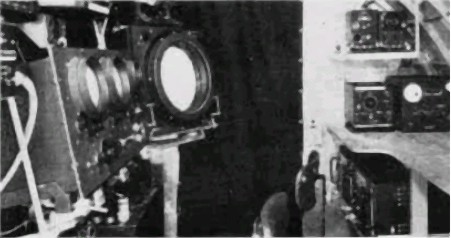
The most important sub-variant was the PB-1W, the W standing for anti-submarine warfare. Twenty-four B-17Gs, together with one B-17F brought up to G standard, were mostly flown straight from the Douglas plant at Long Beach to the Naval Aircraft Modification Unit at Johnsville, Pennsylvania, during the summer of 1945. There the bomb bay was sealed and, beneath it, a bulbous dielectric fairing housed the antenna of the one-megawatt AN/APS-20 search radar built by Hazeltine and General Electric, with the transmitter carried in the fuselage. The conversion added 300-gallon drop tanks under the outer wings and the "Tokyo tanks" in the outer wing panels, for a total of 3,400 gallons of fuel that gave the aircraft an endurance of more than 22 hours. The chin turret, the Norden bombsight, the top forward turret, the ball turret, the waist gun positions, the tail guns and the armour were all removed; in their place came two aft-facing radar consoles in the former bomb bay, a modernised IFF set, a radio direction finder, an instrument landing system, LORAN navigation, bench seats for observers at the waist, floating smoke markers and even a latrine and a galley amidships. The bombardier's station was kept as a lookout post for search missions. The first PB-1Ws retained a natural metal finish protected by wax, but they were later painted overall in the gloss Navy Blue adopted by naval aviation in late 1944.
The war ended before any PB-1W could be deployed, and the defensive armament was deleted. The first aircraft reached Patrol Bomber Squadron VPB-101 in April 1946, and the Navy eventually brought 22 of the 31 post-war B-17s up to full PB-1W standard. A typical crew consisted of six officers, among them a combat information centre officer and two radar operator-controllers, and five enlisted men. Thanks to the APS-20 the PB-1W evolved from anti-submarine work into airborne early warning as part of the Cadillac II programme, which sought a flying combat information centre able to operate with some independence from the ships below. Late in 1946 VPB-101 moved to Naval Air Station Quonset Point, Rhode Island, and became VX-4; in 1952 that unit was redesignated VW-2 and settled at Patuxent River, Maryland, with early warning as its primary mission and anti-submarine warfare and hurricane reconnaissance as secondary tasks. The same year VW-1 was formed at Barbers Point, Hawaii, with four PB-1Ws drawn from units at Miramar and San Diego, so that by 1947 early-warning Fortresses were serving with both the Atlantic and Pacific fleets. The original PB-1Ws were joined in 1950 by two EB-17Gs that the Air Force had modified to the same configuration for test programmes and which the Navy took on as 77137 and 77138.
The PB-1Ws remained in service until 1955, progressively replaced by the Lockheed WV-2, the military version of the Constellation. They were retired to the storage centre at Litchfield Park, Arizona, struck from the inventory in mid-1956 and mostly sold as surplus, so that many ended up on the civil register; thirteen were sold for scrap.
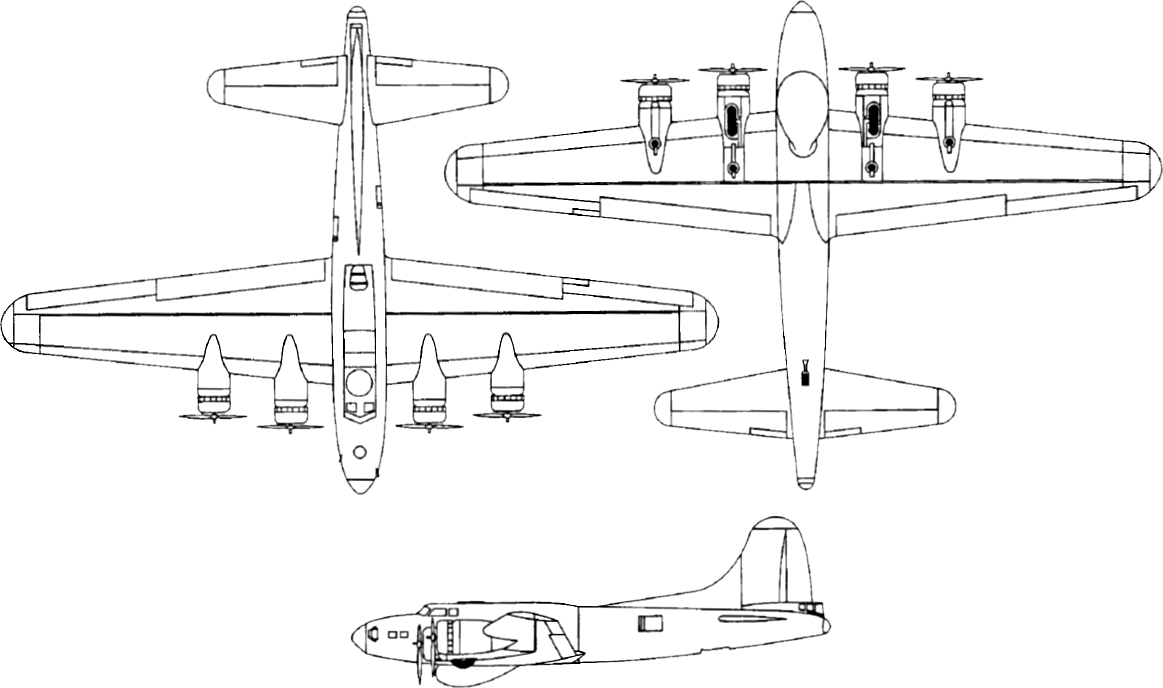
Three-view drawing
Multimedia