Boeing B-17 Flying Fortress variant
Boeing B-17 Flying Fortress B-17B
First production version of the Flying Fortress (Model 299M): 39 aircraft with turbo-supercharged R-1820-51 engines, a redesigned nose and enlarged rudder and flaps; redesignated RB-17B trainers in 1942.
Boeing B-17 Flying Fortress sheet

- June 27, 1939
- First flight
- 39
- Units built
- 4,991 km
- Range
History
The B-17B was the first production version of the Boeing B-17 and the link between the thirteen Y1B-17 service-test aircraft and the combat variants of the Second World War. Boeing knew it as the Model 299M; the project had originally been designated Model 299E, but the changes in Army Air Corps specifications were judged sufficient to warrant a new factory designation. The order came in late 1937, once opposition to the Air Corps' ambition of acquiring more four-engined bombers had faded: the first ten aircraft were ordered to equip two bombardment groups, one on each US coast. Funding remained tight, which is why the 39 B-17Bs built in a single production run carried serial numbers scattered across several batches (38-211 to 38-223, 38-258 to 38-270, 38-583 and 38-584, 38-610 and 39-1 to 39-10): the Army could only afford a few aircraft at a time.
Outwardly the B-17B differed from the Y1B-17 in its larger-area rudder, larger wing flaps and a redesigned nose. The small globe-like turret in the Y1B-17's upper nose blister disappeared, replaced by a simple ball socket for a flexible .30 in (7.62 mm) machine gun at the tip of the glazing, and the separate triangular bombardier's aiming window indented in the lower nose was eliminated in favour of an optical flat built into the lower part of the ten-panel Plexiglas nose. The new nose shortened the overall length by seven inches, and a small plastic dome was added to the cabin roof. Power came from Wright R-1820-51 Cyclones delivering 1,200 hp for take-off and 900 hp at 25,000 ft, but the most significant change was the addition of the General Electric exhaust-driven turbo-superchargers that had been tested on the Y1B-17A, which markedly improved high-altitude performance. Internally, crew stations were rearranged, many systems were changed and the pneumatic brakes gave way to hydraulic ones. The gyro-stabilised Norden bombsight was mounted above the aiming window; it was considered so secret that it was installed, carefully covered, only immediately before take-off and removed straight after landing under armed guard. Defensive armament amounted to five .30 in machine guns (nose, dorsal, ventral and two waist positions), and the internal bomb bay could carry up to eight 600 lb bombs.
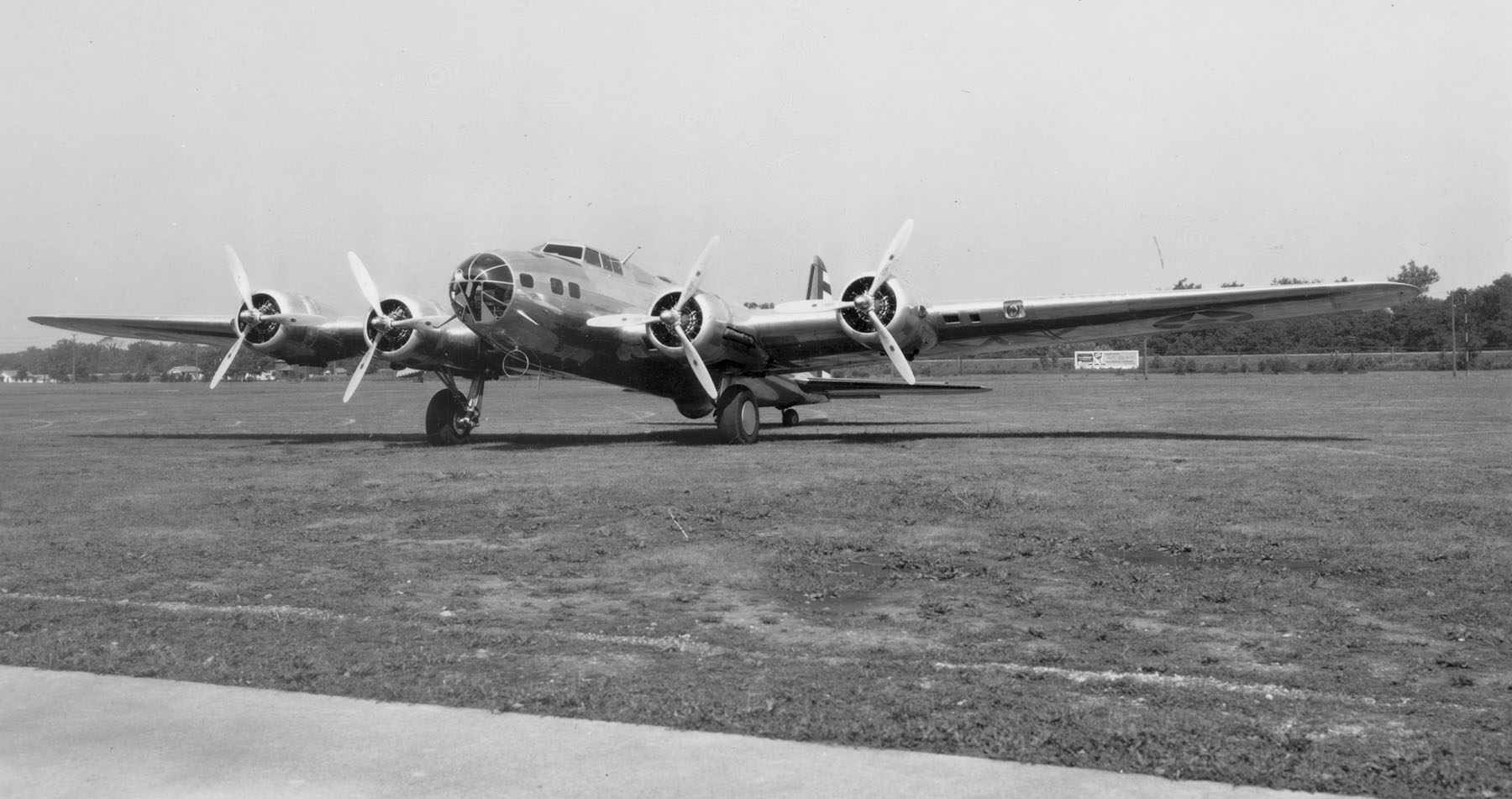
The first B-17B, 38-211, flew at Seattle on 27 June 1939 and was retained at Wright Field for tests. All 39 aircraft were delivered to the Air Corps between 29 July 1939 and 30 March 1940, in five small batches, and went to the 2nd, 7th and 19th Bombardment Groups. In November 1939 seven Fortresses flew from Langley Field to Rio de Janeiro on a goodwill mission and returned without incident, once again demonstrating the reliability of the design. In July 1940 an order for 512 B-17s of later versions was placed, although at the time of the attack on Pearl Harbor fewer than 200 Fortresses of all variants were in Army service. A B-17B of the 41st Reconnaissance Squadron, 2nd Bomb Group, based in Newfoundland, attacked a German submarine on 27 October 1941: the U-boat was undamaged, but it was the first occasion on which the Army Air Forces dropped bombs in anger against German forces, and since the United States was not yet at war the incident went unreported.
During 1940 and 1941 many B-17Bs were modernised towards the B-17C/D standard: the bulged waist blisters were exchanged for flush side windows for .50 in guns, the dorsal blister for a flatter, more aerodynamic panel, and some aircraft received the ventral "bathtub" gondola of the later versions; the level of upgrade varied from one aircraft to another, and the nose gained two additional ball sockets that were carried through to the B-17E. In October 1942 all B-17Bs still in service were redesignated RB-17B, the "R" for Restricted marking their combat obsolescence, and they were relegated to training, transport, messenger and liaison duties. Many of these RB-17Bs, together with at least one still-airworthy YB-17, were gathered at Sebring Airfield, where the exterior scenes of Howard Hawks' war drama Air Force (1943) were filmed: the real star of the picture was an RB-17B which, with its blisters replaced and a bathtub turret fitted, passed for a B-17D.
Multimedia


