BAe Jetstream variant
BAe Jetstream T.2
Royal Navy observer trainer with a nose radar: 14 ex-RAF T.1s and 2 civil Jetstreams converted between 1978 and 1983. Flew with 750 Squadron until 2011.

- 14
- Units built
History
From pilot trainer to flying observer classroom
The Jetstream T.2 began life as an existing airframe. In 1972 (in February according to the English Wikipedia; the RAF Museum dates the contract to August) the Royal Air Force ordered 26 Jetstream 201s, which Scottish Aviation delivered as multi-engine trainers under the designation Jetstream T.1. Many of those airframes came from civil Series 200 aircraft that had sat in storage at Sywell, Northamptonshire, until Jetstream Aircraft Ltd bought them in August 1971. Fourteen aircraft from that RAF fleet were then modified by the Royal Navy as observer trainers and designated Jetstream T.2, according to the English Wikipedia article on the Handley Page Jetstream and the logbookmag production list.
Replacing the Sea Prince
The Navy needed to retire the veteran Percival Sea Prince from observer training: observers are the crew members who run the radar, navigate and coordinate tactics aboard shipborne helicopters. In January 1976 a brand-new Jetstream T.1 from Prestwick was sent to RNAS Culdrose (HMS Seahawk) in Cornwall so that 705 Squadron could evaluate it as a possible Sea Prince replacement, according to the RAF Museum's record.
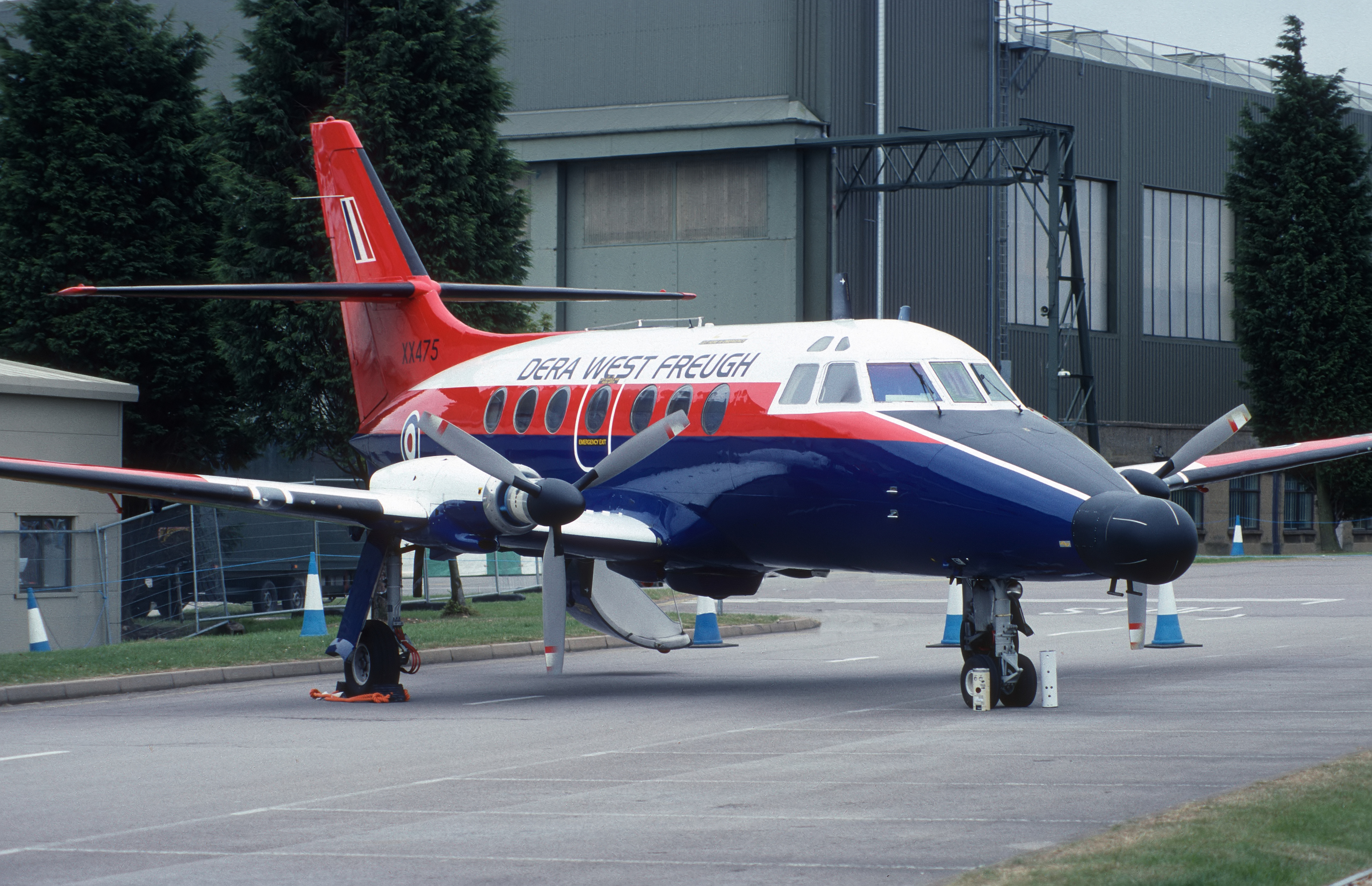
On 29 October 1976 most of the future T.2s passed from the RAF to the Royal Navy, still to T.1 standard. The conversion itself took place between August 1978 and August 1979: the logbookmag list dates each one for airframes XX478 to XX490. One of them, XX488, went by way of the A&AEE test establishment at Boscombe Down, was converted in December 1979 and reached the Navy on 1 March 1980. XX476 joined the Royal Navy on 17 November 1978.
Sixteen aircraft, not fourteen
The fourteen ex-RAF aircraft were joined by two civil Jetstreams that British Aerospace bought back in February 1978 and converted straight to T.2 standard. One, which had passed through the Gécamines company as 9Q-CTC, reached the Royal Navy as ZA111 on 9 September 1983; the other was converted in July 1981 and sold to the Navy as ZA110 on 30 April 1982. That is why airliners.net speaks of 16 Astazou-powered T.2s, matching the sixteen airframes identified by logbookmag.
Radar in the nose
For its new role the T.2 received a nose-mounted MEL E90 radar and two navigation consoles, one for the student and one for the instructor, according to Everett Aero and airliners.net. That forward radar is what sets it apart at a glance from the later Jetstream T.3, based on the Jetstream 31, which carries an underfuselage Racal ASR360 radar and Garrett TPE331 engines instead of the Astazous.
Thirty-two years with 750 Squadron
The operating unit was 750 Naval Air Squadron at Culdrose, which began replacing its Sea Princes with Jetstream T.2s from October 1978. In April 1981 the squadron merged with the Observer School into a single unit, and from April 1986 it shared the flight line with T.3s. Its cabins trained the future tacticians of the Sea King Mk7 airborne surveillance and control helicopters, the anti-submarine Merlins and the anti-surface Lynx. Logbookmag records XX478 at Culdrose in July 2007 and another airframe in storage at RAF Shawbury in December 2003. One T.2 was lost when it crashed into the sea at Portland Harbour.
.jpg)
The T.2s remained in service until March 2011, with the squadron flying its final Jetstream sortie on 14 March. They were replaced by the Beechcraft King Air 350ER, designated Avenger T.1, on which students began flying in 2012. After withdrawal, Everett Aero offered airframes, complete except for their engines, as ground instructional or museum exhibits.
Uruguay and the survivors
Two former British T.2s went to Uruguayan Naval Aviation, which assigned them to its Anti-Submarine and Reconnaissance Squadron from 1999 to 2010 as 875 and 876; aviationpress describes them as dumped at their base. Two T.2s survive today: XX476 at the Flugausstellung Hermeskeil in Germany and XX481 at the Speelpark & Maisdoolhof amusement park in Voorthuizen, the Netherlands.
Multimedia

-1600.webp)
-1600.webp)
-800.webp)
-800.webp)
-800.webp)
-800.webp)