BAe Jetstream variant
BAe Jetstream 31
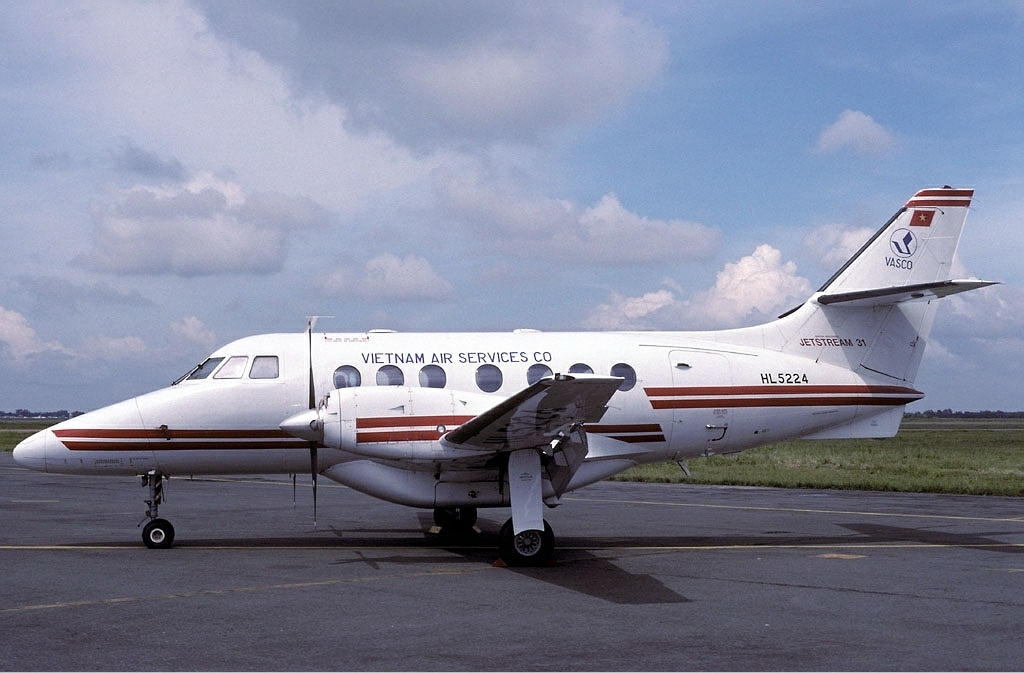
British Aerospace's Garrett TPE331-10 powered Jetstream: first flown in 1980, certificated in 1982 and built at Prestwick, it became one of the most widespread 19-seat feeder airliners for decades.
-800.webp)
- March 28, 1980
- First flight
- 220
- Units built
- 1,260 km
- Range
- 19
- Passengers
History
A "Mark 3" with Garrett engines
Scottish Aviation had inherited production of the original Jetstream after Handley Page collapsed, and when it was folded into British Aerospace in 1978 the new company concluded that the design deserved one more round of development. Work on what was internally called the "Mark 3" began that same year. The recipe repeated the one already tried on the Jetstream 3M for the US Air Force: replace the Turbomeca Astazou with Garrett TPE331 turboprops (now Honeywell), which offered more power — flat rated to 1,020 shp (760 kW), with a thermodynamic limit of 1,100 shp (820 kW) — and much longer overhaul intervals. That margin allowed an 18-seat cabin in six rows of 2+1 with an offset aisle, and a water-methanol option so that the aircraft could leave more airfields at maximum load, an argument aimed above all at the continental United States.
Prototype, certification and production at Prestwick
The prototype was not a new airframe but a converted HP.137. Fitted with TPE331s, it first flew on 28 March 1980. The application for British certification had been filed on 21 February 1980; the first production aircraft flew in March 1982 and UK certification followed in June that year (the 22nd according to the EASA type certificate data sheet, the 29th according to the encyclopaedic sources). The certification basis was BCAR Section D, supplemented by a long series of "Blue Papers"; in 1984 special conditions were added for aircraft fitted with the Automatic Performance Reserve system. The current certificate holder is BAE Systems, based at Prestwick airport in Scotland, where the series was built.

The EASA data sheet groups the type as the "Jetstream Series 3100" and explains that each aircraft received a model number according to the authority of its state of registry: 3101 for the United States (FAA), 3102 for the United Kingdom, 3103 for Germany, 3107 for Australia, 3108 for the Netherlands, 3109 for Italy, 3110 for Sweden, 3112 for Canada and 3116 for Switzerland. Series 3100 construction numbers start at 601. The certificate covers a whole family of TPE331-10 engines — from the original -10U-501H to the -10UGR-514H — which must match on both sides, driving four-bladed constant-speed Dowty Rotol propellers. Minimum crew is two pilots, maximum approved seating is 21 including crew and the maximum operating altitude is 25,000 ft (7,600 m).
The aircraft in figures
According to the Jane's data quoted by the sources, the Jetstream 31 is 14.37 m long, spans 15.85 m and stands 5.32 m high, with a wing area of 25.2 m². It weighs 4,360 kg empty and takes off at up to 6,954 kg (airliners.net rounds this to 6,950 kg). Its two TPE331-10UG engines deliver 940 shp (700 kW) each. It reaches 487 km/h, long-range cruise is around 426 km/h and range is 1,260 km; airliners.net specifies 1,185 km with 19 passengers and reserves, 1,760 km with 12 and 2,130 km with nine. The cabin took 19 seats three abreast at a 79 cm pitch, 12 in a corporate shuttle layout or nine in an executive layout — the origin of the Airliner (18-19 seats), Corporate and Special versions.
Commercial career
Unlike the original Jetstream, this one sold. Several hundred were built during the 1980s and the aircraft became a fixture of the feeder networks of the big US airlines (Continental Express, United Express, USAir Express, Northwest Airlink), of European regional operators and, later, of Latin American carriers. In 1985 four were ordered for the Royal Navy as radar observer trainers, the Jetstream T.3, later used for VIP transport. That same year a further engine upgrade was planned; it flew in 1988 as the Super 31 or Jetstream 32 and eventually replaced the 31 on the line.
The production figures in the sources do not cleanly separate the version: airliners.net gives 381 J31 deliveries, 161 of them Super 31s, while Wikipedia puts the number of 31s and 32s built by 1993, the year the last one was completed, at 386. In July 2019 seventy Jetstream 31s were still in airline service: 49 in the Americas, 15 in Europe, five in Asia-Pacific and one in Africa; the operators with five or more were Northwestern Air, Pascan Aviation, SARPA, AIS Airlines, Transmandu and FlyPelican.
Accidents
Its long life on feeder routes left a list of accidents. On 26 May 1987 Continental Express N331CY came down on a highway just after take-off from New Orleans, with no fatalities. On 26 December 1989 a United Express Jetstream 3101 (N410UE) stalled on an excessively steep, iced-up approach to Pasco, killing all six on board. On 12 March 1992 a CC Air aircraft flying for USAir Express crashed near Knoxville with its gear up, and on 1 December 1993 Northwest Airlink N334PX flew into terrain in Minnesota, killing 18. In 2012 and 2014 the same Links Air Jetstream 3102 suffered two runway excursions caused by landing-gear failures.
Multimedia


