Family: R-7
Soyuz (cohete)
Launch statistics
- 0
- Total launches
- 0
- Successes
- 0
- Failures
- —
- Success rate


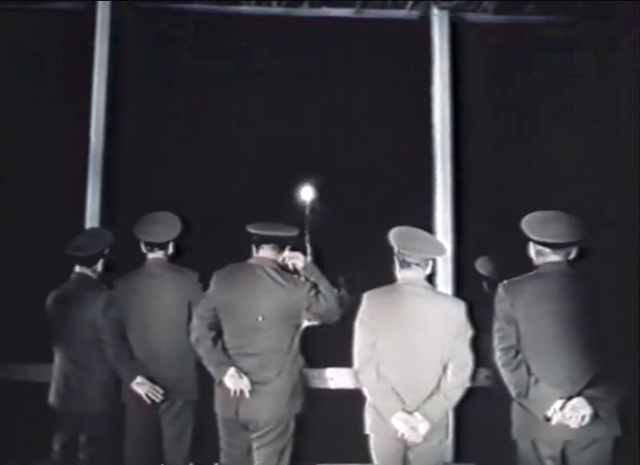


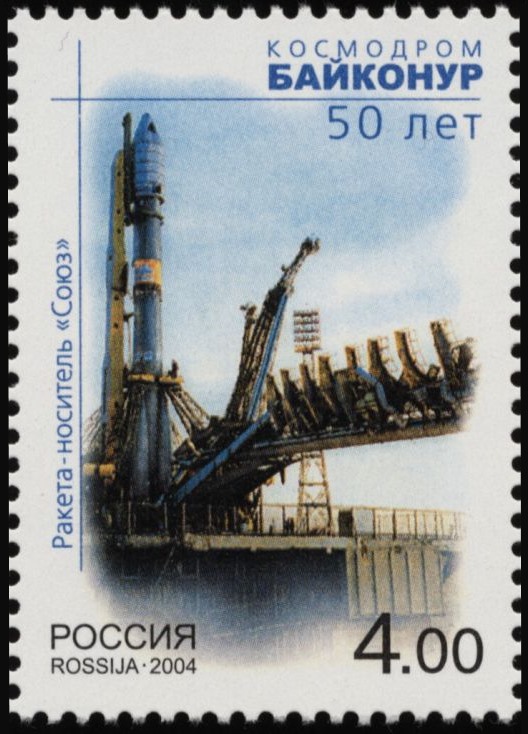

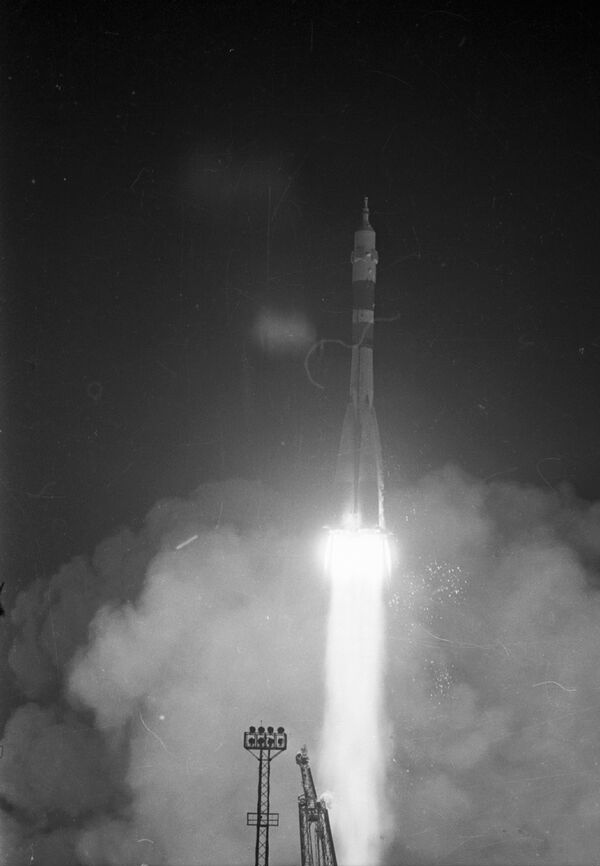


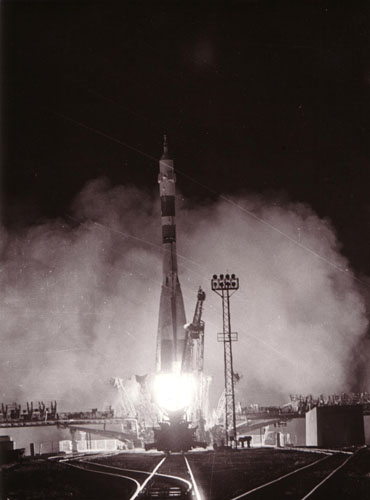


Soyuz is the expendable launcher with which the Soviet Union, from 1966 onward, brought order to the sprawling family of rockets derived from the R-7. The original 11A511 model founded a lineage that still sends Progress freighters to the International Space Station.
Three-view drawing

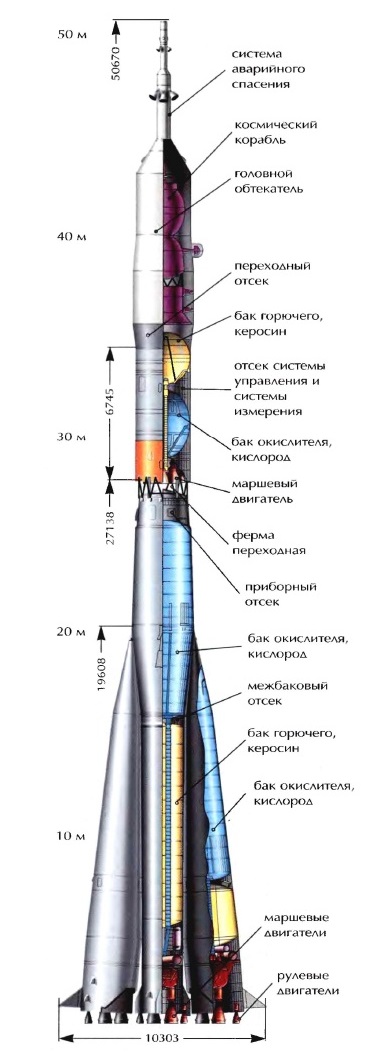
History
The original Soyuz, designated 11A511 in the GRAU index, was designed at OKB-1 during the 1960s and built at State Aviation Plant No. 1 in Kuybyshev. Its commission was to launch the crewed spacecraft of the Soyuz programme, but its technical purpose was different: to tidy up the R-7 family, which by then had branched into an unwieldy collection of variants. It was essentially a Molniya 8K78M without the Blok L stage, using that model's engines together with an uprated core and strap-ons that became standard across every R-7 derived launcher.
It first flew on 28 November 1966 with the Kosmos 133 mission and, over a decade of service, completed thirty successful missions against two failures. The vehicle has three stages, weighs some 308 tonnes at liftoff and can place 6450 kg in low Earth orbit. It carried the AVD malfunction detection system, which commanded an automatic shutdown if a parameter drifted out of range and, on crewed flights, triggered the escape system; its logic was inhibited during the first seconds of flight so that a failing rocket would not fall back on the pad.
From 1973 the original model was gradually superseded by the Soyuz-U, which went on to become the world's most prolific launcher until its retirement in 2017. The last crewed flight of the 11A511 was the aborted Soyuz 18-1 in 1975, and its final launch was Soyuz 23 on 14 October 1976. Other direct offshoots were the Soyuz-L, for low Earth orbit tests of the LK lunar lander, and the Soyuz-M.
Production peaked at sixty vehicles a year in the early 1980s, and the family has accumulated on the order of 1700 flights. In the 1990s the creation of Starsem funded the pairing of the launcher with the Fregat upper stage, which flew the Cluster 2 satellites in 2000 and the Mars Express probe in 2003. That path led to the digitally guided Soyuz-2, whose first version flew in 2004; the line remains in operation, including from the Kourou spaceport in French Guiana.
Launch timeline
| Date | Launch site | Outcome | Payload |
|---|
Versions
| Soyuz/Vostok (11A510) | Soyuz (11A511) | Soyuz-L (11A511L) | Soyuz-M (11A511M) | Soyuz-U (11A511U) | Soyuz-U2 (11A511U2) | Soyuz-FG (11A511U-FG) | Soyuz-2.1a / Soyuz-ST-A (14A14A) | Soyuz-2.1b / Soyuz-ST-B (14A14B) | Soyuz-2.1v (14A15) | Soyuz-B (11K55) | Soyuz-R (11A514) | Soyuz-U/Fregat | Soyuz-U/Ikar | Soyuz-V (11K56) | |
|---|---|---|---|---|---|---|---|---|---|---|---|---|---|---|---|
| First launch | December 27, 1965 | November 28, 1966 | November 24, 1970 | December 27, 1971 | May 18, 1973 | December 23, 1982 | May 20, 2001 | November 8, 2004 | December 27, 2006 | December 28, 2013 | — | — | — | — | — |
| Last launch | July 20, 1966 | October 14, 1976 | August 12, 1971 | March 31, 1976 | February 22, 2017 | September 3, 1995 | September 25, 2019 | — | — | February 5, 2025 | — | — | — | — | — |
| Height | — | 50.7 m | 50 m | 50 m | 50.7 m | 34.5 m | 51 m Best value in this row | — | — | — | — | — | 42.5 m | 47.4 m | — |
| Diameter | — | 10.3 m Best value in this row | 10.3 m Best value in this row | 10.3 m Best value in this row | 10.3 m Best value in this row | 3 m | 10.3 m Best value in this row | — | — | — | — | — | 10.3 m Best value in this row | 10.3 m Best value in this row | — |
| Mass | — | 308,000 kg | 300,000 kg | 300,000 kg | 313,000 kg Best value in this row | 297,800 kg | — | — | — | — | — | — | 308,000 kg | 305,000 kg | — |
| Stages | — | 3 Best value in this row | 3 Best value in this row | — | 3 Best value in this row | — | 3 Best value in this row | — | — | 3 Best value in this row | 3 Best value in this row | 3 Best value in this row | 4 | 4 | 3 Best value in this row |
| LEO capacity | — | 6,450 kg | — | — | 6,900 kg Best value in this row | — | — | — | — | — | — | — | — | — | — |
| Reusable | No | No | No | No | No | No | No | No | No | No | No | No | No | No | No |
Images