Soyuz (cohete) version
Soyuz (cohete) Soyuz-FG (11A511U-FG)
An evolution of the Soyuz-U with RD-107A and RD-108A engines fitted with new injector heads. Between 2001 and 2019 it flew 70 times from Baikonur with a single failure: it carried Soyuz TMA, TMA-M and MS crews to the International Space Station and, with the Fregat upper stage, launched probes such as Mars Express and Venus Express.

- May 20, 2001
- First launch
- 6,900 kg
- LEO capacity
- No
- Reusable
History
A transitional solution
The Soyuz-FG (index 11A511U-FG) was born as a bridge. In the late 1990s the Progress Rocket Space Centre in Samara (RKTs Progress) was working on the Soyuz-2, a modernised launcher with digital control, but development of its upgraded engines, the RD-107A for the four boosters and the RD-108A for the core, had outpaced the rest of the vehicle. Rather than wait, they were fitted straight away to a Soyuz-U-based rocket, while the Soyuz-U itself kept flying on existing engine stockpiles. The result was introduced in May 2001. According to Wikipedia, the letters FG stand for *forsunochnaya golovka*, "injector head" in Russian, which is exactly what had changed.
More injectors, more impulse
The RD-107A and RD-108A replaced the RD-107 and RD-108, switching from 260 two-component centrifugal injectors to over 1,000 one-component injectors. The finer mixing gave more complete propellant combustion, reduced high-frequency vibration in the combustion chambers and raised specific impulse by 5 seconds, roughly a five per cent improvement worth 250 to 300 kg of extra payload. Gunter's Space Page identifies the engines by their indices 14D22 (RD-107A) and 14D21 (RD-108A).
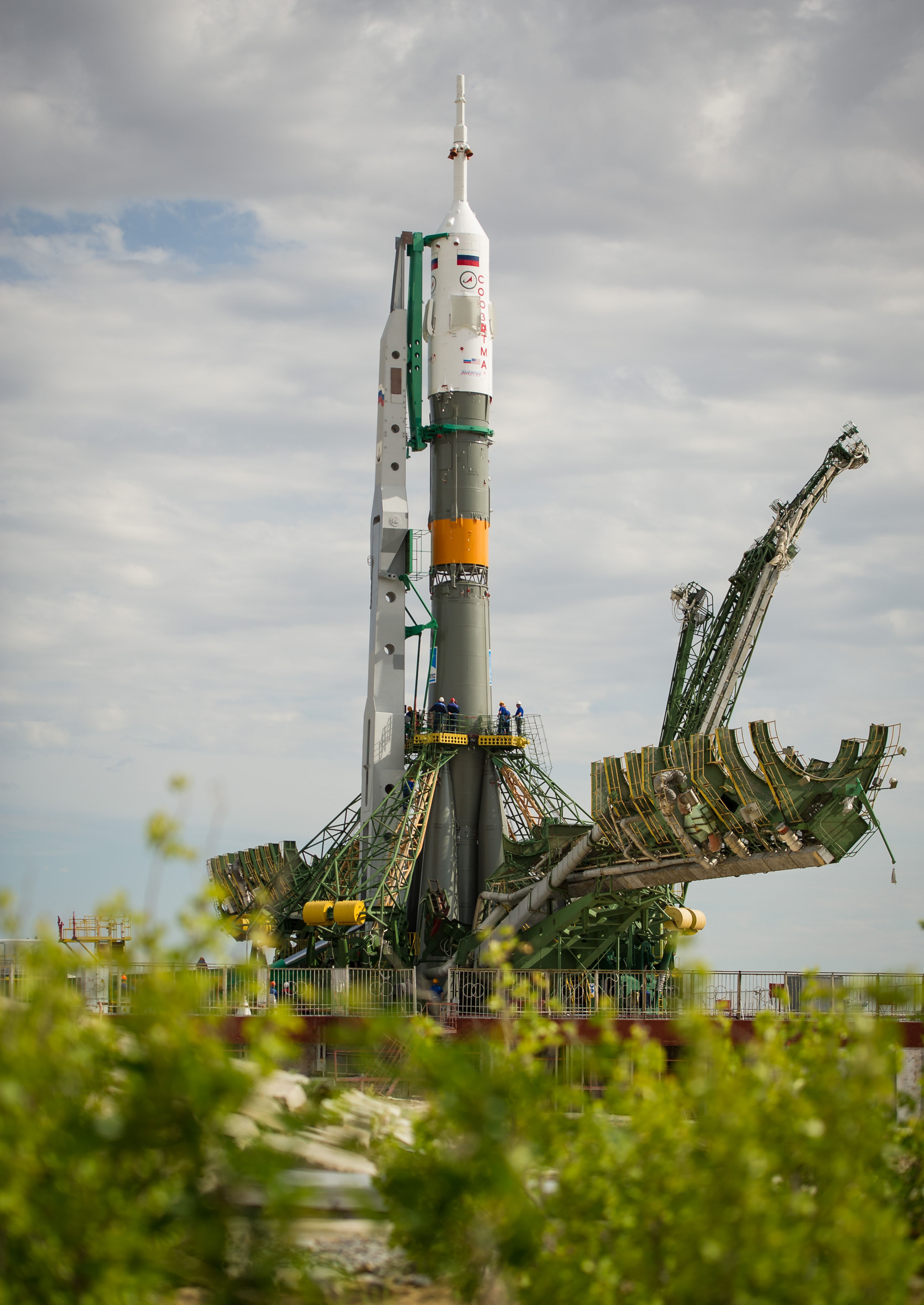
The architecture remained that of the R-7. The first stage was made up of the four strap-on boosters, Blocks B, V, G and D, each 19.6 m long and 2.68 m in diameter, weighing 43400 kg fully loaded, 40350 kg of it propellant; each RD-107A delivered 838.5 kN at sea level and 1021.3 kN in vacuum for 118 seconds. The second stage was the core, Block A, 27.1 m long and 99500 kg loaded (92600 kg of propellant), with an RD-108A producing 792.41 kN at sea level and burning for 286 seconds. On top sat the third stage, Block I, with a 297.93 kN RD-0110 and a loaded mass of 25300 kg. All of them burned liquid oxygen and RG-1 kerosene. The rocket stood 51 m tall and, in its three-stage form, could place 6900 kg into a 200 km low orbit at 51.8° inclination.
The Station's rocket
The maiden flight, on 20 May 2001, carried the Progress M1-6 freighter to the International Space Station; the second, in November, launched Progress M1-7 together with the small Kolibri 2000 satellite. The first crewed flight, Soyuz TMA-1, followed on 30 October 2002, and from then on the FG became the main launcher for Russian crewed spacecraft: Soyuz TMA, the TMA-M series from Soyuz TMA-01M on 7 October 2010, and the MS series from Soyuz MS-01 on 7 July 2016. Crewed missions lifted off from Site 1/5 at Baikonur, Gagarin's Start, while satellites also used Site 31/6. Soyuz TMA-12, in April 2008, took the first South Korean into space. The FG also launched Progress freighters, which could fly on the Soyuz-U, the Soyuz-FG or the Soyuz-2 alike.
The Fregat configuration
For uncrewed missions the FG could carry the Fregat as a fourth stage, built by Lavochkin in Khimki, with an S5.92 engine of 19.85 kN that could restart up to 20 times. This combination was not a separate variant but a configuration of the FG, marketed by the European-Russian company Starsem. It debuted on 2 June 2003 with the Mars Express probe and the Beagle 2 lander, and totalled ten launches: the AMOS-2 communications satellite, Galaxy 14, the Venus Express probe on 9 November 2005, the GIOVE-A and GIOVE-B navigation satellites, two batches of four Globalstar satellites in 2007, RADARSAT-2 and, on 22 July 2012, a cluster led by Kanopus-V.
The Soyuz MS-10 abort
The FG flew 70 times and failed only once. On 11 October 2018 Soyuz MS-10, with Aleksei Ovchinin and NASA astronaut Nick Hague aboard, lifted off for the Station. At first-stage separation, around T+117.80 seconds and some 50 km up, booster D did not move clear as intended: its nose struck the core stage fuel tank and the rocket lost stability. The escape system pulled the spacecraft away and the capsule came down on a ballistic trajectory after reaching 93 km; it landed near Dzhezkazgan, Kazakhstan, after a flight of 19 minutes 41 seconds and around 6.7 g, and the crew were unharmed. The investigation found that a sensor rod had been bent by 6°45' during assembly of the rocket at Baikonur, preventing the cover of the booster's reverse-thrust nozzle from opening. RussianSpaceWeb points to a precedent on a Soyuz-U on 26 March 1986.
Return to flight and retirement
The FG returned with Progress MS-10 on 16 November 2018 and, on 3 December, with the crewed Soyuz MS-11. Its limits were those of its analogue control: the rocket had to be "aimed" before liftoff by a complex rotating launch pad and could not handle long, wide payload fairings. The digital Soyuz-2 gradually took over, and the FG bowed out on 25 September 2019 with Soyuz MS-15.
Multimedia


-1600.webp)

-1600.webp)


