Soyuz (cohete) version
Soyuz (cohete) Soyuz (11A511)
The first Soyuz rocket (GRAU index 11A511), with which OKB-1 set out to replace the tangle of R-7 variants. Three stages, 308,000 kg at lift-off and 6,450 kg to a 200 km orbit. Between 1966 and 1976 it launched the first crewed Soyuz spacecraft from Baikonur.

- November 28, 1966
- First launch
- 6,450 kg
- LEO capacity
- No
- Reusable
History
A launcher to bring order
The original Soyuz, GRAU index 11A511 (A-2 in the Sheldon scheme and SL-4 for the US Department of Defense), was designed in the 1960s by the OKB-1 bureau and built by State Aviation Plant No. 1 in Kuybyshev. Encyclopedia Astronautica describes it as a standardised launch vehicle meant to replace a proliferation of earlier models (8K72, 8A91, 8K74, 8K78 and 11A57), designed initially for the Soyuz complex — the 7K crewed craft, the 9K rocket stage and the 11K tanker — and for the Zenit-4 reconnaissance satellite. Technically it was essentially a Molniya 8K78M without the Blok L stage: a three-stage R-7 with the Blok I upper stage.
The rocket should not be confused with the spacecraft of the same name: the 11A511 was the vehicle that put the Soyuz 7K-OK and 7K-T capsules into orbit, and their own missions and malfunctions are not the launcher's.
What changed from the Voskhod
Compared with the 11A57 Voskhod, the telemetry system was cut to no more than 150 kg, and the core-stage engines were individually selected to guarantee a specific impulse of no less than 252 s at sea level and 315 s in vacuum. The uprated core and strap-ons became standard on every later R-7 derivative. The third stage used the RD-0110, introduced on the 8K78M in 1964 for its better performance, while the Voskhod kept the less powerful RD-0107.
Architecture
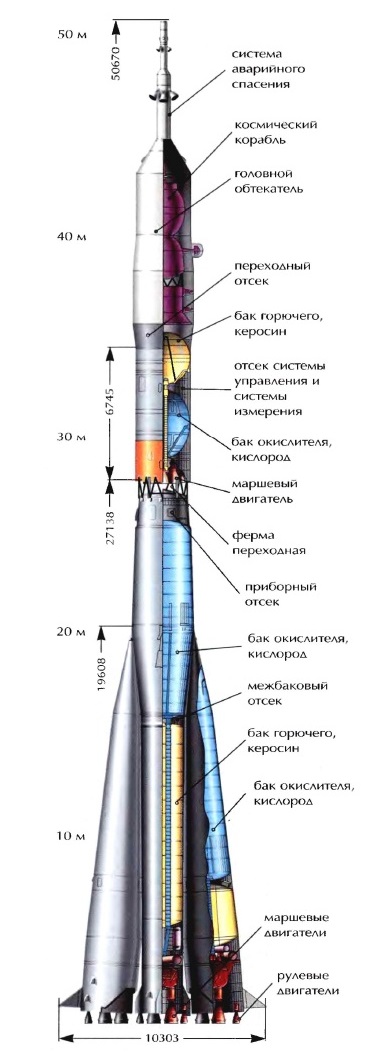
The first stage consisted of four strap-on boosters (Blocks B, V, G and D), each with one RD-107 (designated RD-107-11D511 by Encyclopedia Astronautica) burning for 118 s with a specific impulse of 257 s at sea level and 314 s in vacuum; each booster weighed 43,000 kg fuelled and 3,550 kg empty, and was 19.60 m long and 2.68 m in diameter. The Block A core carried an RD-108 (RD-108-11D512) burning for 292 s; it weighed 100,500 kg fuelled and 6,500 kg empty, and was 27.80 m long and 2.95 m in diameter. The Blok I third stage, with a 294 kN RD-0110 of 330 s specific impulse, burned for 246 s; it weighed 25,400 kg fuelled and 2,700 kg empty, and was 6.74 m long and 2.66 m in diameter. All stages burned liquid oxygen and kerosene (RG-1).

The complete vehicle weighed 308,000 kg at lift-off, spanned 10.30 m and produced 4,037.70 kN of lift-off thrust, and could place 6,450 kg into a 200 km orbit inclined at 51.6°. Its height differs by source: 50.7 m in Wikipedia and 45.60 m in Encyclopedia Astronautica. The rocket was assembled horizontally in the MIK building at the launch site, rolled out to the pad and erected there.
The AVD system
The 11A511 carried the AVD malfunction detection system, variants of which equip every Soviet and Russian launcher: it commanded an automatic shutdown if electrical power, engine performance or trajectory deviated from normal and, on crewed flights, also fired the escape tower. It was inhibited until T+8 s so the booster's systems could stabilise, and the shutdown command was not transmitted until T+20 s so the rocket would not fall back onto the pad. Even so, several launches failed over the years because the AVD itself issued erroneous shutdown commands.
A troubled start
It made its debut on 28 November 1966 from Baikonur Site 31 with Kosmos 133, the first 7K-OK test craft; that mission's failure lay in the spacecraft's attitude control, not in the rocket. On 14 December 1966, at the same pad, the core stage ignited but the strap-ons did not, and a shutdown was commanded. While crews were defuelling the rocket, 27 minutes after the attempt the escape tower fired, pulled the spacecraft away and ignited the third-stage tanks: the explosion severely damaged the pad and killed at least one person. On 7 February 1967 it launched Kosmos 140 from Site 1, and on 23 April 1967 Vladimir Komarov's Soyuz 1.
Workhorse of the Soyuz programme
It flew from Baikonur Sites 1/5 (Gagarin's Start) and 31/6, sometimes alternating them: Soyuz 2 left Site 1 on 25 October 1968 and Soyuz 3 left Site 31 the following day; from 11 to 13 October 1969 it launched Soyuz 6, 7 and 8 on three consecutive days. After eight uncrewed test flights it carried the first 19 crewed launches, among them Soyuz 4 (14 January 1969), Soyuz 10 (22 April 1971) and Soyuz 11 (6 June 1971). It also launched the four tests of the improved 7K-T spacecraft between 1972 and 1974: Kosmos 496, 573, 613 and 656.
Soyuz 18-1 and retirement
On 5 April 1975, carrying Vasily Lazarev and Oleg Makarov towards Salyut 4, the third stage failed to separate from the second but still ignited; the spacecraft was separated by ground command at 192 km and the crew endured a re-entry of more than 20.6 g before landing in the Altai mountains. Because it happened shortly before Apollo–Soyuz, the United States asked for details, and the Soviets replied that Soyuz 19 would use the newer 11A511U. Wikipedia calls it the 11A511's final crewed flight, although Encyclopedia Astronautica still assigns it Soyuz 18 (24 May 1975) and Soyuz 23 (14 October 1976).
From 1973 it was gradually superseded by the Soyuz-U, which had already launched Soyuz 21 on 6 July 1976. The last 11A511 lifted off on 14 October 1976 from Site 1 with Soyuz 23. Its record counts 32 launches, 30 successful and two failures (7K-OK No. 1 and Soyuz 18-1); the family table in Wikipedia gives 30, with 28 successes and a last flight on 24 May 1975. It gave rise to the Soyuz-L (three flights), the Soyuz-M (eight) and the Soyuz-U.
Three-view drawing
Multimedia
