Redstone version
Redstone PGM-11 Redstone
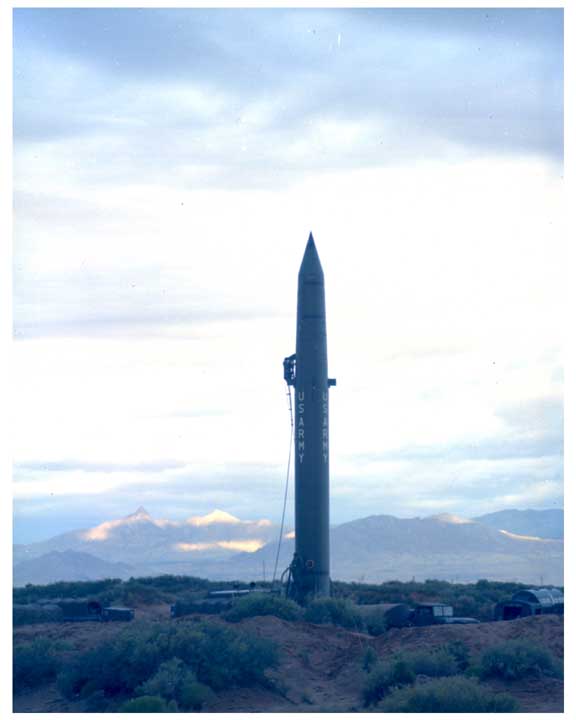
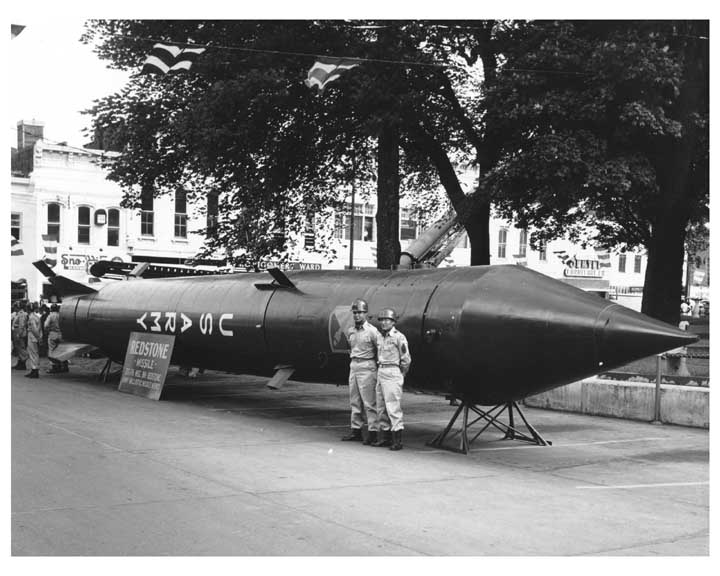
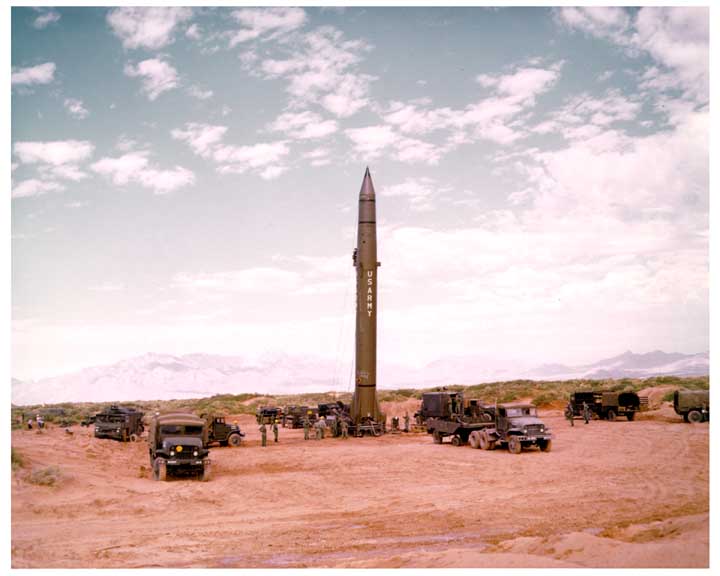
US Army short-range ballistic missile, a descendant of the V-2 designed by von Braun's team at Redstone Arsenal and built by Chrysler. The first large American ballistic missile deployed overseas (West Germany, 1958-1964) and the first to detonate a nuclear warhead in flight, in the Hardtack Teak and Orange tests.

- August 20, 1953
- First launch
- 347 kN
- Thrust
- No
- Reusable
History
From Hermes C1 to Redstone
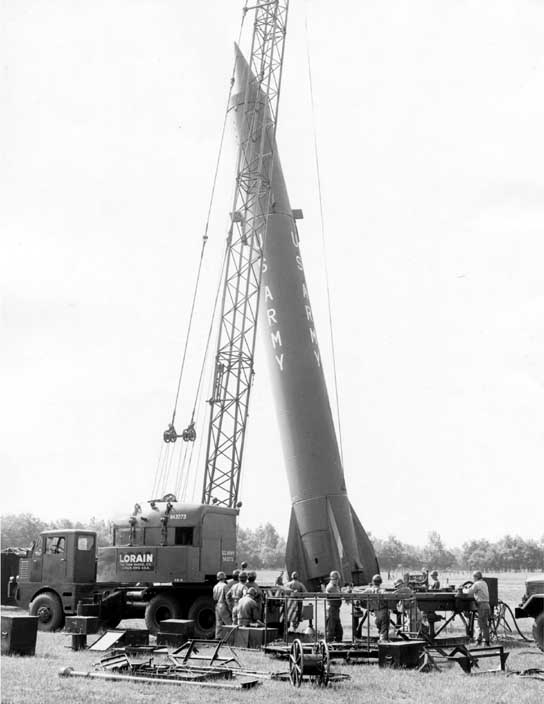
The missile grew out of Project Hermes, which the Army Ordnance Department opened on 20 November 1944 with a General Electric contract to study long-range missiles. In June 1946 General Electric began a feasibility study of the Hermes C1, which became the basis for the early Redstone work. In October 1949 the Army approved moving the rocket sub-office at Fort Bliss, Texas, to Redstone Arsenal in Huntsville, Alabama, and with it Wernher von Braun and the German team brought over under Operation Paperclip. On 10 July 1951 the Office, Chief of Ordnance formally handed the Hermes C1 development to the arsenal, and on 8 April 1952 the weapon officially received its name, taken from the arsenal, itself named for the region's red rocks and soil. It had been called Hermes C1, Major, Ursa, XSSM-G-14 and XSSM-A-14; field manuals designate it Ballistic Guided Missile M8, and its final designation was PGM-11. The V-2 ancestry showed everywhere: alcohol and liquid oxygen, and carbon jet vanes in the exhaust for steering, backed by air rudders.
A prime contractor in Warren
On 1 April 1952 the Office, Chief of Ordnance turned down the arsenal's plan to build the missiles in its own shops and required a prime contractor. In October 1952 Chrysler received a letter order to begin work in that role, a contract definitized on 19 June 1953. Production went to the missile plant at Warren, Michigan, a former Navy jet-engine factory. Because the contractor's facilities ran late, the arsenal itself built and assembled the first twelve missiles and numbers 18 through 29. Rocketdyne, a division of North American Aviation, supplied the engine; Ford Instrument, of Sperry Rand, the ST-80 inertial guidance system; and Reynolds Metals the fuselage assemblies as a Chrysler subcontractor. Chrysler received the first industrial contract on 15 June 1955, and the first Redstone fabricated and assembled by the company flew on 19 July 1956.
A rough start
The first research and development round left pad LC-4A at Cape Canaveral on 20 August 1953 and flew for one minute and twenty seconds before an engine failure dropped it into the sea. The second, on 27 January 1954, covered 89 km without a hitch; after those two prototypes an improved engine was introduced to cure cavitation in the liquid-oxygen turbopump. The third, on 5 May, shut down one second after lift-off, fell back on the pad and exploded, prompting von Braun's famously exasperated answer to General Holger Toftoy that it had exploded because it blew up. A hard push on reliability and workmanship followed, supported by an interim static test stand at the arsenal that cost $25,000 and ran its first test in April 1953. The Army declared the missile operational in mid-1955 and flights moved to the larger LC-5 and LC-6 pads. On 1 February 1956 the programme passed to the newly activated Army Ballistic Missile Agency. The last research and development missile flew in November 1958: of the 37 flown in that phase, 27 were launched successfully.
Troops, and Europe
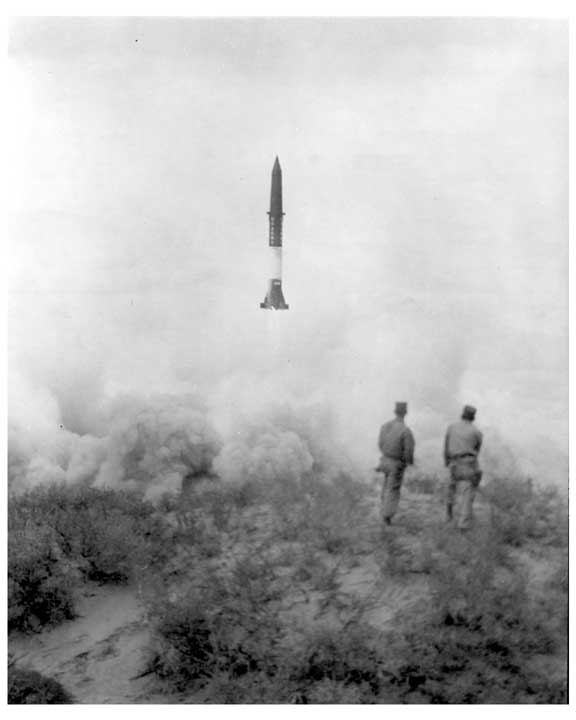
The first Redstone battalion, the 217th Field Artillery Missile Battalion, was activated at the arsenal on 15 April 1956, and the first firing with troops taking part came on 2 October 1957. On 16 May 1958 soldiers launched a tactical Redstone successfully at Cape Canaveral, and on 2 June the 40th Field Artillery Missile Group made at White Sands the first overland firing of a large US ballistic missile by combat troops. That same June the Redstone became the first large American ballistic missile deployed overseas, in West Germany as part of the NATO shield; the 46th Group joined the 40th in 1959.
Nuclear tests over the Pacific
In the Hardtack series the Redstone became the first US missile to detonate a live nuclear warhead. In the Teak shot, launched from Johnston Island on 1 August 1958 at 09:47 GMT (31 July in the Army chronology), it climbed above 60 km and set off a megaton-class device. In Orange, on 12 August 1958, the W39 warhead was detonated with an apogee of 41 km; the purpose was to measure the effects of high-altitude nuclear explosions in order to design warheads for the Nike-Zeus anti-ballistic missile.
The missile in figures
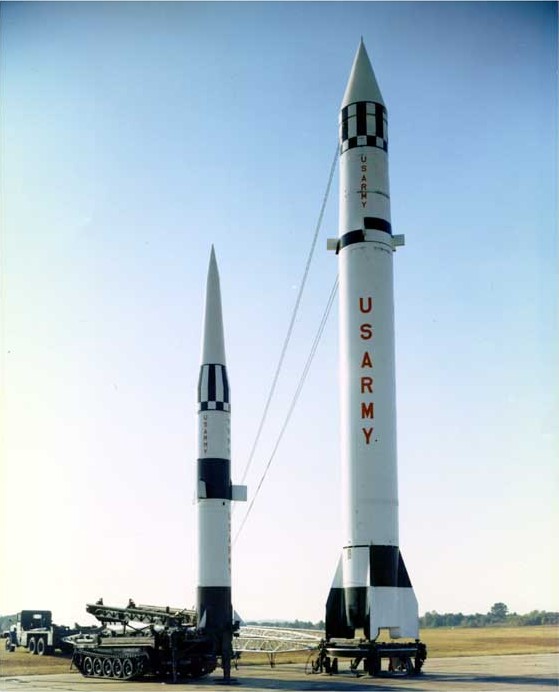
The Redstone weighed about 27,763 kg at ignition, and its Rocketdyne 75-110 engine gave 347 kN at sea level for some 121 seconds, burning a 75 % ethyl alcohol and 25 % water mixture with liquid oxygen; later Redstones used Hydyne. Range ran from 92.5 to 323 km. After engine cut-off, the missile body, carrying the instrument compartment and warhead, separated from the thrust unit 20 to 30 seconds later and flew a controlled ballistic path to the target. The W39 warhead had a yield of 3.8 megatons.
Retirement
Storable solid-fuelled missiles that needed no fuelling before launch made it obsolete: production ended in 1961, the 40th Group was deactivated in February 1964 and the 46th in June, replaced by the MGM-31 Pershing. The Redstone was classified obsolete on 25 June 1964 and ceremonially retired on the parade field at Redstone Arsenal on 30 October 1964; in December the original Chrysler production contract was closed out. Surplus airframes kept flying as test vehicles and launchers under other names.
Multimedia




.jpg)