Family: Energia
Energia
Launch statistics
- 0
- Total launches
- 0
- Successes
- 0
- Failures
- —
- Success rate


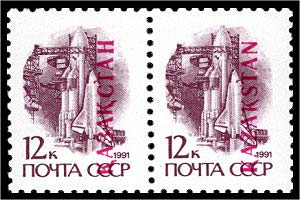


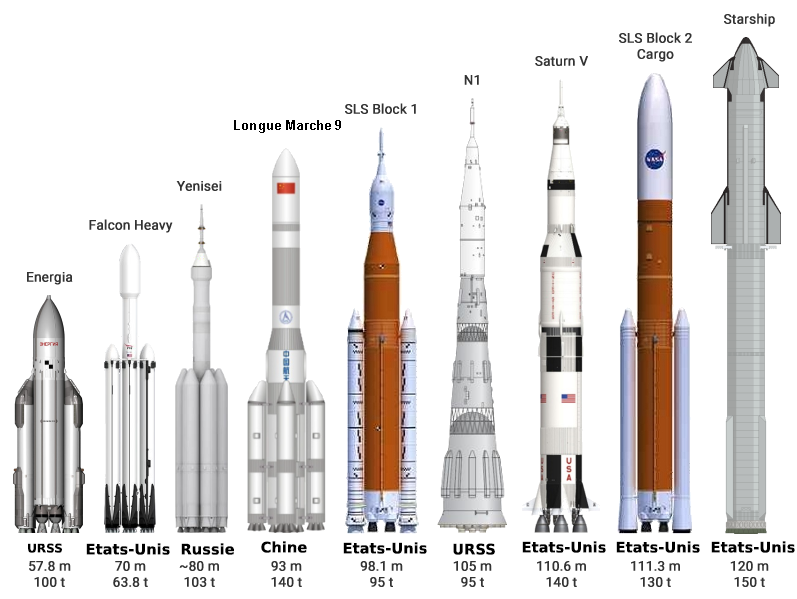


Energia was the super-heavy launcher the Soviet Union built in the 1980s as the backbone of the Buran programme, and the first of its class the country managed to fly to orbit. It launched only twice, in 1987 and 1988, before vanishing along with the shuttle it had been designed for.
Three-view drawing
History
The project began in 1976, right after the decision to cancel the N1. The facilities built for that rocket, notably the huge horizontal assembly building, were reused for the new launcher, much as NASA had recycled Saturn V infrastructure for the Space Shuttle. Energia also displaced the "Vulkan" concept, which had been based on Proton and its hypergolic propellants; the name was later applied to an Energia variant with eight boosters. Development was led by NPO Energia, with the control system entrusted to Khartron NPO "Electropribor".
Its architecture was twofold. Four strap-on boosters, each with a four-chamber RD-170 engine burning kerosene and liquid oxygen, surrounded a core stage powered by four RD-0120 engines fed with liquid hydrogen and oxygen. Each booster stood 40 m tall and 3.9 m wide and weighed some 340 tonnes fuelled, burning for 156 seconds; the core stage burned for 470 seconds. The stack reached 58.765 m in height and 17.65 m in diameter, with a liftoff mass of 2,400,000 kg, and could place about 100 tonnes in low Earth orbit, up to 20 in geostationary orbit and up to 32 on a translunar trajectory.
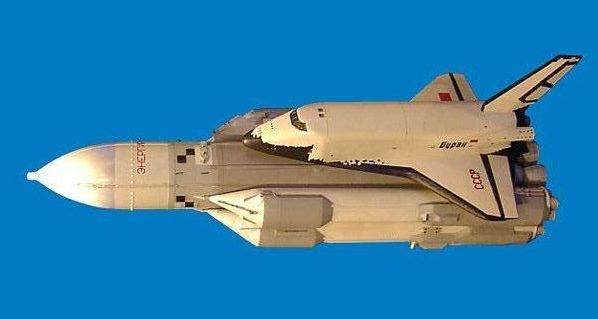
Because it was meant to carry the Buran orbiter, the payload rode on the side of the stack rather than on top, and the design allowed flight without the shuttle, as a heavy cargo launcher, by adding an upper stage for final insertion. That is how it debuted: on 15 May 1987 it lifted off with the large Polyus military satellite, which failed to complete its own orbital insertion burn. The second and last flight, on 15 November 1988, did carry Buran into orbit.
With the shuttle programme cancelled, Energia was wound up after those two launches, although attempts to revive it have followed one another since 2016. Its true legacy lies in the engines: the RD-170 was at the time the most powerful liquid-fuelled rocket engine ever built, and its scaled-down versions power the American Atlas III and Atlas V, the Russian Angara rockets, Antares 200 and South Korea's Naro-1. The first stage of the Zenit launcher is essentially one of those strap-on boosters.
Launch timeline
| Date | Launch site | Outcome | Payload |
|---|
Versions
| Energia-Polyus (6SL) | Energia-Buran (1K) | Energia-2 (GK-175) | Energia-M | Vulkan | |
|---|---|---|---|---|---|
| First launch | May 15, 1987 | November 15, 1988 | — | — | — |
| Last launch | May 15, 1987 | November 15, 1988 | — | — | — |
| Height | 58.8 m Best value in this row | 58.8 m Best value in this row | — | — | — |
| Diameter | 17.7 m Best value in this row | 17.7 m Best value in this row | — | — | — |
| Mass | 2,400,000 kg Best value in this row | 2,400,000 kg Best value in this row | — | — | — |
| Stages | 2 Best value in this row | 2 Best value in this row | 2 Best value in this row | 2 Best value in this row | — |
| LEO capacity | 100,000 kg | 100,000 kg | — | — | 200,000 kg Best value in this row |
| Reusable | No | No | No | No | No |
Images