Energia version
Energia-Buran (1K)
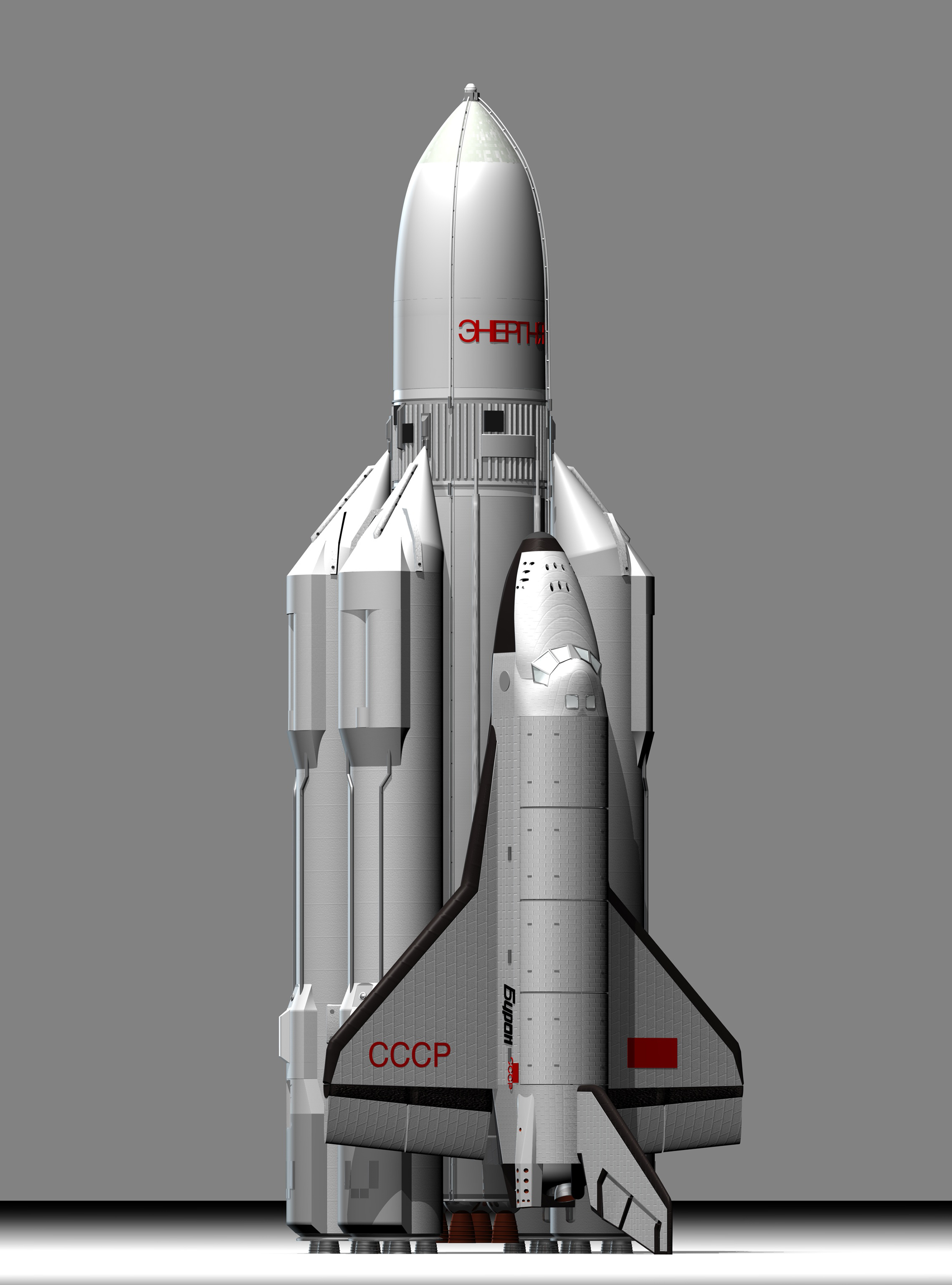
The Energia configuration with the Buran orbiter mounted on its side. It flew once, on 15 November 1988 from Baikonur: rocket 1L placed Buran (flight 1K1) on a suborbital path, the orbiter finished the insertion with its own engines and landed automatically.

- November 15, 1988
- First launch
- 100,000 kg
- LEO capacity
- No
- Reusable
History
What "1K" designates
The name of this variant mixes two different numbering schemes, and they are worth separating. "Energia-Buran" is the name of the configuration: the Energia launcher (GRAU index 11K25) with the Buran orbiter as its payload. "1K", however, is not a rocket number but an orbiter one: English Wikipedia gives Buran the GRAU index "11F35 1K" and construction number 1.01, and calls its only orbital flight "1K1", meaning first orbiter, first flight. The rocket that launched it had its own serial number: according to the same sources it was Energia "1L", just as the vehicle of the first flight, the one that carried Polyus in 1987, is listed as "6SL". "Energia-Buran (1K)" therefore identifies the flight by its payload; the actual Energia vehicle of this mission was 1L.
A configuration built for the shuttle
Work on the Energia/Buran system began in 1976 after the decision to cancel the N1, and the facilities built for that rocket were reused for this one. Energia was designed specifically to launch the reusable Soviet shuttle, which is why it carries its payload on the side of the stack rather than on top as is usual. It combined four strap-on boosters, each powered by a four-chamber RD-170 engine burning kerosene and liquid oxygen, with a central core stage carrying four single-chamber RD-0120 (11D122) engines fed with liquid hydrogen and liquid oxygen.
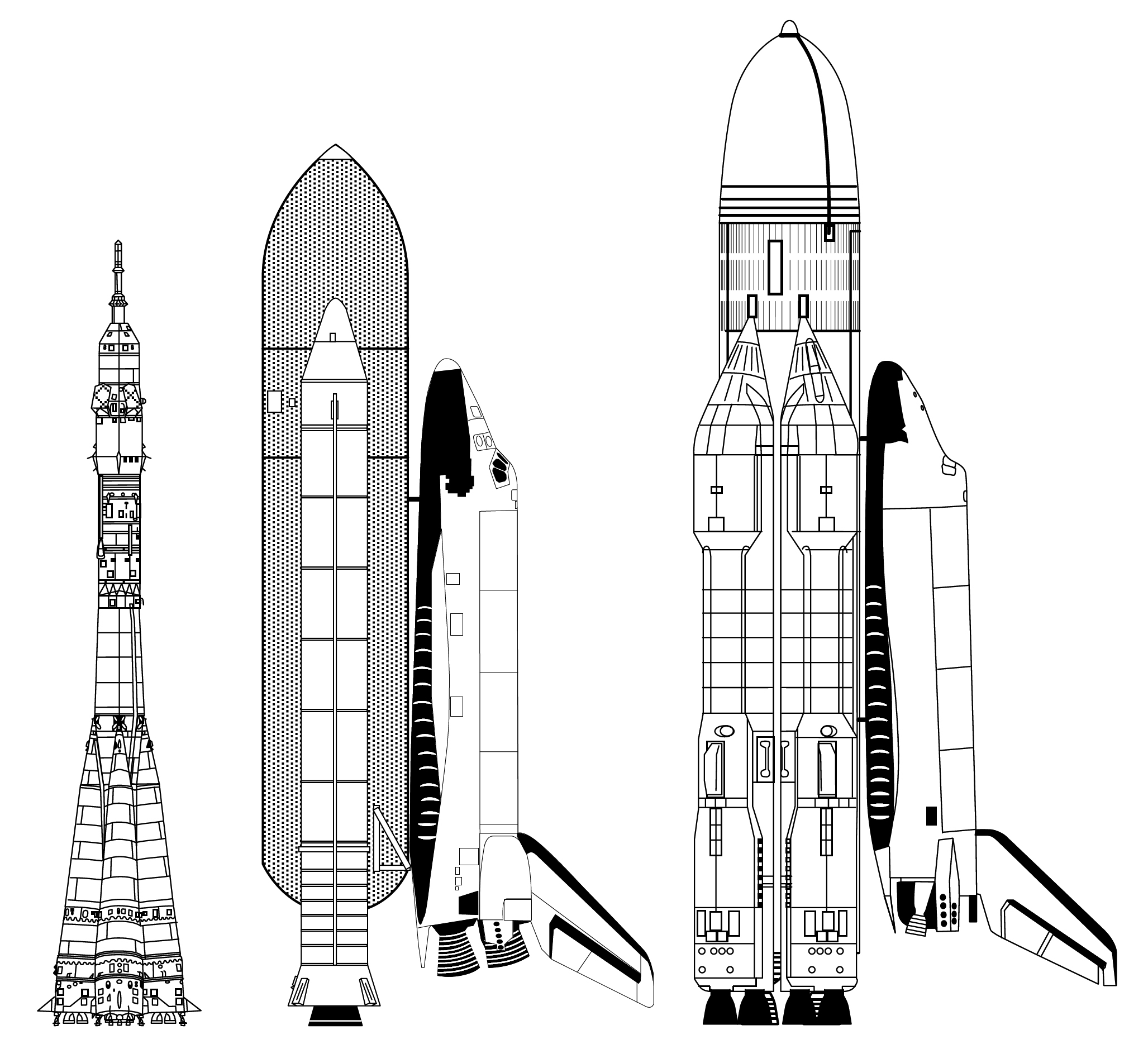
English Wikipedia distinguishes two operational variants that worked in functionally different ways: Energia-Polyus, the initial test configuration, in which Polyus itself acted as the final stage to put the payload into orbit, and Energia-Buran, in which the orbiter was both the payload and the source of the orbit insertion impulse. Russian Wikipedia explains this in more detail: in practice Energia was not a two-stage but a three-stage rocket, because the second stage gave the payload only a suborbital velocity of about 6 km/s, and the rest came either from an additional upper stage or from the payload's own engines. In Buran's case, its combined propulsion system (ODU) let it reach orbital velocity after separating from the launcher.
The flight of 15 November 1988
Energia's second and last launch lifted off on 15 November 1988 from pad 110/37 at the Baikonur Cosmodrome, carrying Buran uncrewed. The time differs between the two sources: the launch table in the Energia article gives 03:00:01, while the Buran article gives 03:00:02 UTC. Its international designation was 1988-100A. The automated launch sequence performed as specified, and Energia placed the stack on a temporary orbit with a negative perigee: the table gives −11.2 × 154.2 km at an inclination of 51.64° at payload separation. It was the first Energia flight in which the payload actually reached orbit, unlike the Polyus flight of 1987.
After separation, Buran fired its engines at apogee for a 66.7 m/s burn and reached a final orbit of 251 × 263 km. It circled the Earth twice, and then the ODU engines fired automatically to begin the descent into the atmosphere, return to the launch site and land horizontally on a runway.
The automatic landing
The orbiter made an automated approach to the Site 251 runway and touched down under its own control at 06:24:42 UTC, coming to a stop at 06:25:24, 206 minutes after launch. Under a crosswind of 61.2 km/h, it landed within 3 metres laterally and 10 metres longitudinally of the target mark. According to English Wikipedia, at the 20 km key point the automatic system chose an unlikely manoeuvre, estimated at a 3% probability, to extend the glide and bleed off excess energy. It was the first spaceplane to make an uncrewed flight including a fully automatic landing. It was later found that Buran had lost only eight of its thermal tiles.
The end
In 1989 an uncrewed second Buran flight was projected for 1993, lasting 15 to 20 days, but the dissolution of the Soviet Union dried up the funding and the programme was officially cancelled in 1993. Energia production ended with the end of the shuttle project and, more definitively, with the fall of the Soviet Union in 1991; Russian Wikipedia places the suspension of work on "Energia-Buran" in the early 1990s. The orbiter was stored in Building 112 at Baikonur, a hangar built in the late 1960s for the lunar programme, which collapsed on 12 May 2002. Flight 1K1 thus remained the only mission of the Energia-Buran configuration.
Multimedia


