Rockets
Electron
Launch statistics
- 91
- Launches (as of July 27, 2026)
- 8
- Successes
- 0
- Failures
- 100.0 %
- Success rate
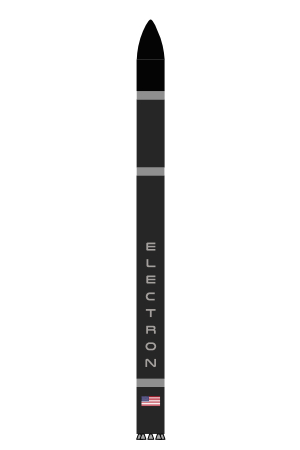

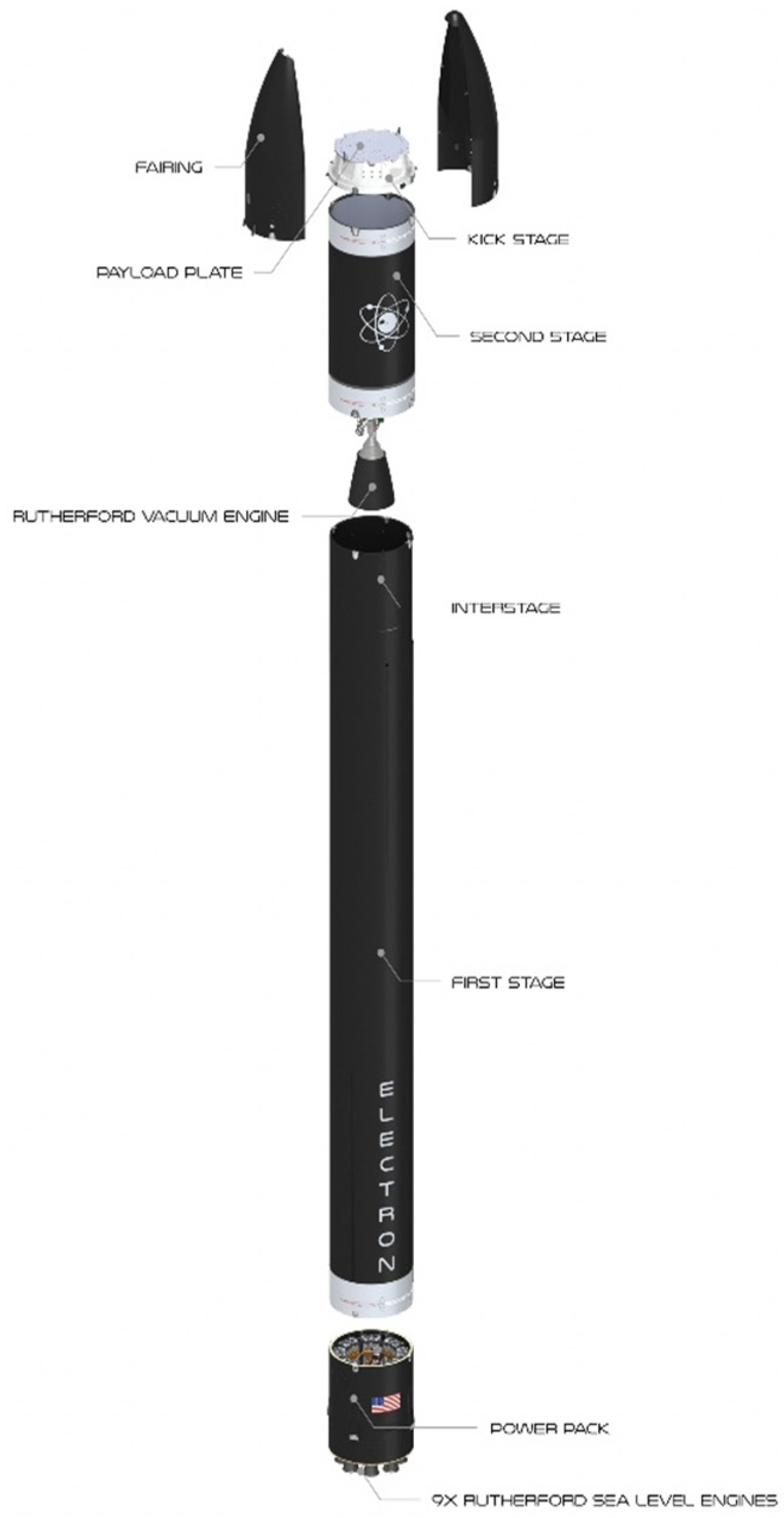
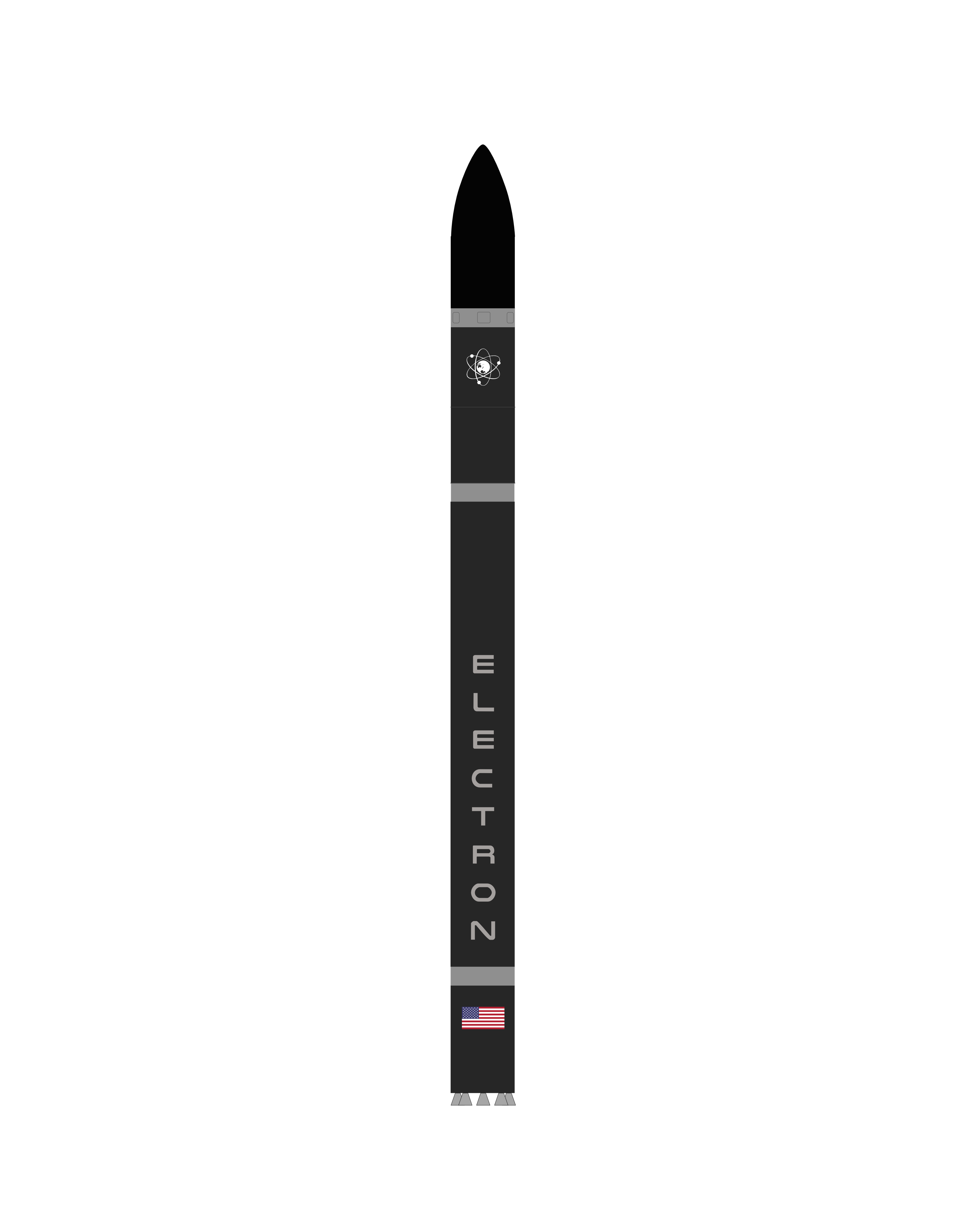
Electron is a two-stage small orbital launch vehicle developed by Rocket Lab, an aerospace manufacturer and launch service provider with roots in both New Zealand and the United States. It stands 18 m tall, measures 1.2 m in diameter and weighs about 13 tonnes at liftoff; its main airframe is built from lightweight carbon composite. Aimed squarely at the commercial small-satellite market, it is the third most launched small-lift launch vehicle in history. Its defining technical feature is the Rutherford engine, the first electric-pump-fed engine to power an orbital-class rocket: conventional turbopumps give way to electric pumps fed by lithium-polymer batteries, and almost every engine part is 3D printed. Nine Rutherfords power the first stage and a single vacuum-optimised unit powers the second, both burning RP-1 and liquid oxygen. An optional third stage, the kick stage, adds a restartable Curie engine for orbit circularisation; the Photon spacecraft is derived from that same hardware. Payload capacity grew from the original 225 kg to 300 kg in low Earth orbit, and from 150 kg to 200 kg in Sun-synchronous orbit, largely thanks to battery improvements. The starting price is around US$7.5 million per launch. Electron flies from Launch Complex 1 on New Zealand's Māhia Peninsula and from Launch Complex 2 at the Mid-Atlantic Regional Spaceport in Virginia. Although designed as an expendable vehicle, Rocket Lab recovered the first stage twice and reflew a Rutherford engine, though it eventually abandoned the idea of catching the booster in mid-air.
History
Development and early flights
Electron completed flight qualification in December 2016. The first vehicle lifted off on 25 May 2017 and reached space but not orbit, owing to a glitch in ground communication equipment. The second flight, on 21 January 2018, did reach orbit and deployed three CubeSats while also debuting the Curie-powered kick stage. The first commercial launch, the third overall, followed on 11 November 2018. Rocket Lab had privately funded both the rocket and the Māhia launch pad, the first time every element of an orbital launch operation was run entirely by the private sector.
Production and infrastructure
Manufacturing the composite flight structures traditionally required about 400 hours of largely manual labour. In late 2019 the company brought online a robotic system nicknamed "Rosie", able to produce all of an Electron's composite parts in 12 hours, with a stated goal of cutting the full manufacturing cycle to seven days. In October 2018 it opened a factory sized, according to the company, for more than 50 rockets a year, and selected the Mid-Atlantic Regional Spaceport at Wallops as its second launch site.
Recovery and reuse
In August 2019 Rocket Lab announced recovery and reflight plans for the first stage. Flight 10, in December 2019, carried a block upgrade with a reaction control system, onboard flight computers and S-band telemetry that enabled the booster's first guided re-entry; it splashed down destructively at 900 kph, as planned. In March 2020 mid-air retrieval was demonstrated by dropping a test article from a helicopter and snagging it at 1500 m. Flight 16, "Return to Sender", was the first to recover the stage via a Pacific Ocean splashdown, and the company's 40th mission reflew a previously flown Rutherford engine. Helicopter capture was ultimately dropped in favour of ocean landing.
Derivatives and record
In April 2023 Rocket Lab introduced HASTE, a suborbital derivative able to carry 700 kg on a hypersonic trajectory, whose first flight, DYNAMO-A, took place on 18 June 2023. As of 26 June 2026 Electron had accumulated 91 launches, with 87 successes and 4 failures.
Launch timeline
| Date | Launch site | Outcome | Payload |
|---|---|---|---|
| Aug 20, 2026, 1:04 PM | Rocket Lab Launch Complex 1B | Success | Synthetic aperture radar Earth observation satellite for Japanese Earth imaging company iQPS. |
| Aug 6, 2026, 9:18 AM | Rocket Lab Launch Complex 1A | Success | Synthetic aperture radar Earth observation satellite for Japanese Earth imaging company iQPS. |
| Jun 26, 2026, 5:43 PM | Rocket Lab Launch Complex 1B | Success | Synthetic aperture radar satellite for Japanese Earth imaging company Synspective. |
| Jun 19, 2026, 10:19 AM | Rocket Lab Launch Complex 1A | Success | VICTUS HAZE will see Rocket Lab design, build, launch, and operate a rendezvous proximity operation (RPO) capable spacecraft. U.S. Space Force Space Systems Command (SSC)’s Space Safari’s VICTUS HAZE mission will be an exercise of a realistic threat-response scenario and on-orbit space domain awareness (SDA) demonstration. Once the spacecraft build is complete, Rocket Lab will be entered into a Hot Standby Phase awaiting further direction. Once the exercise begins, Rocket Lab will be given notice to launch the spacecraft into a target orbit. After reaching orbit, the spacecraft will be rapidly commissioned and readied for operations. Rocket Lab will configure a Pioneer class spacecraft bus to meet the unique requirements of the VICTUS HAZE mission. The mission will improve Tactically Responsive Space (TacRS) processes and timelines, demonstrating the ability to respond to on-orbit threats on very short timelines and validating techniques for space domain awareness (SDA) and on-orbit characterization. Rocket Lab’s constellation-class production capability and discriminating technical capabilities in the areas of in-space propulsion, precision attitude control, low latency communications, and autonomous operations are key enablers for this mission. |
| Jun 11, 2026, 8:00 AM | Rocket Lab Launch Complex 2 (Launch Area 0 C) | Success | Sub-orbital launch under Rocket Lab’s Hypersonic Accelerator Suborbital Test Electron (HASTE) program, details TBD. Note: Despite reported as a strictly sub-orbital launch program, this launch was cataloged by the USSF to have left 2 rocket stages in a 200 km, 40° very low Earth orbit by the US Space Force. The payload was not cataloged and may have been deliberately de-orbited. |
| May 22, 2026, 9:33 AM | Rocket Lab Launch Complex 1B | Success | Synthetic aperture radar satellite for Japanese Earth imaging company Synspective. |
| Apr 23, 2026, 3:09 AM | Rocket Lab Launch Complex 1A | Success | JAXA-manifested rideshare of eight separate spacecraft that includes educational small sats, an ocean monitoring satellite, a demonstration satellite for ultra-small multispectral cameras, and a deployable antenna that can be packed tightly using origami folding techniques and unfurled to 25 times its size. The satellites were originally planned to launch with RAISE-4 on a Japanese Epsilon-S rocket, but the Epsilon-S was heavily delayed due to test firing failures. The 8 satellites are: * MAGNARO-II * KOSEN-2R * WASEDA-SAT-ZERO-II * FSI-SAT2 * OrigamiSat-2 * Mono-Nikko * ARICA-2 * PRELUDE |
| Apr 22, 2026, 1:36 AM | Rocket Lab Launch Complex 2 (Launch Area 0 C) | Success | Sub-orbital launch under Rocket Lab’s Hypersonic Accelerator Suborbital Test Electron (HASTE) program, details TBD. |
Versions
| Electron (two-stage) | Electron with kick stage | Electron with recovery hardware (Block upgrade) | Electron with Photon | HASTE | |
|---|---|---|---|---|---|
| First launch | May 25, 2017 | January 21, 2018 | December 6, 2019 | August 31, 2020 | June 18, 2023 |
| Last launch | — | — | — | — | June 11, 2026 |
| Height | 18 m Best value in this row | — | 18 m Best value in this row | — | — |
| Diameter | 1.2 m Best value in this row | 1.2 m Best value in this row | 1.2 m Best value in this row | — | 1.2 m Best value in this row |
| Mass | 13,000 kg | — | — | — | — |
| Liftoff thrust | 224 kN | — | — | — | — |
| Stages | 2 Best value in this row | 3 | 2 Best value in this row | 3 | 2 Best value in this row |
| LEO capacity | 300 kg Best value in this row | 150 kg | 300 kg Best value in this row | — | — |
| Reusable | No | No | Yes | No | No |
Images