Electron version
Electron with kick stage
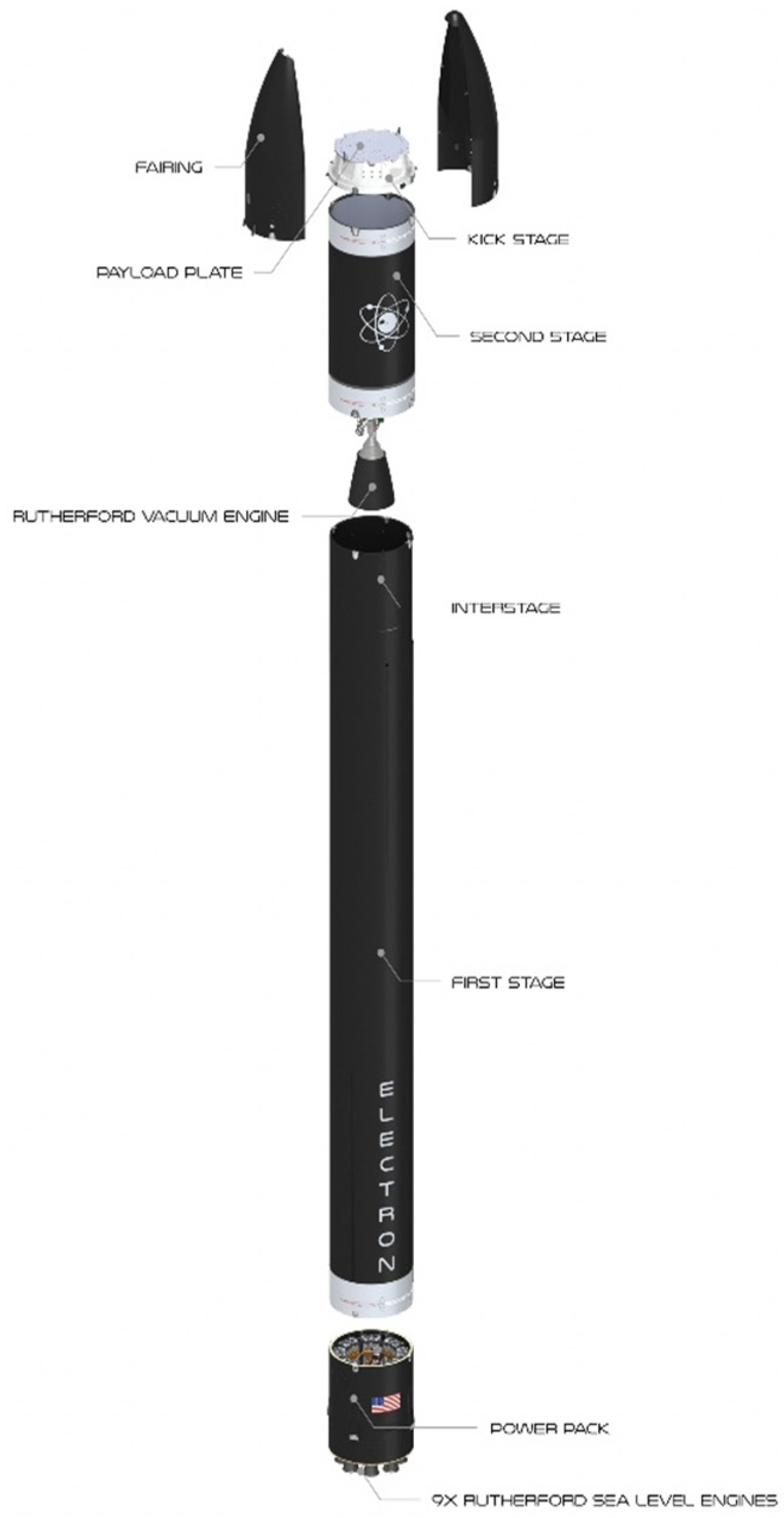
Electron with its optional third stage, the kick stage: a small module with a single restartable, 3D-printed Curie engine, a cold-gas attitude control system and its own avionics, which circularises orbits, changes planes, spreads payloads across different orbits and deorbits itself afterwards. It debuted in secret on the rocket's second flight, "Still Testing", on 21 January 2018.
- January 21, 2018
- First launch
- 150 kg
- LEO capacity
- No
- Reusable
History
Why a third stage
In its basic form Electron is a two-stage launcher: nine Rutherford engines on the first stage and one vacuum-optimised Rutherford on the second. That second stage leaves its passengers wherever its burn ends, and on shared flights that means small satellites have to settle for the orbit that suits the primary payload. Rocket Lab framed it exactly that way when it unveiled the new hardware: many small satellite operators had been forced to compromise on optimal orbits because they were not the primary passenger. The answer was an optional third stage, the "kick stage", designed to circularise the orbits of its payloads and place them more precisely and more quickly.
A debut nobody announced
The kick stage first flew on Electron's second launch, "Still Testing", which lifted off on 21 January 2018 from Launch Complex 1 on New Zealand's Māhia Peninsula; it was also the rocket's first successful launch, after the maiden flight in May 2017 failed to reach orbit. The mission, delayed six times between December 2017 and January 2018 by weather, orbital traffic, rocket and range safety issues, carried CubeSats for Planet and Spire. Rocket Lab did not reveal the stage's existence until after the flight. Once in orbit, the kick stage coasted for around 40 minutes, ignited its Curie engine, shut it down and deployed Spire's two Lemur-2 satellites into a circularised orbit of about 500 km at 85.0° inclination, while Planet's Dove Pioneer satellite was left in an elliptical 289 × 533 km orbit. The difference between them summed up what the new stage was for.
What it is
The stage carries a single Curie engine: a liquid-propellant, restartable, 3D-printed engine burning a non-toxic "green" propellant; photographs released by Rocket Lab show the four silver spheres of its propulsion system in the middle of the stage. It has a precision-pointing cold-gas reaction control system and its own avionics, power and communications, so once separated from the second stage it behaves as a small independent vehicle. It can carry up to 150 kg of payload and, because it can perform multiple burns, place different payloads into different orbits, which according to company founder Peter Beck opened up far more orbital options for rideshare customers and allowed CubeSat constellations to be deployed faster. Rocket Lab also presented it as a sustainability measure: instead of leaving a large stage decaying in orbit, the kick stage uses its own propulsion to deorbit itself once the mission is complete.
From monopropellant to bipropellant
Sources disagree on the Curie's propellant: some describe a green monopropellant, others a bipropellant. The specialist press settles it: the original engine ran on a single green propellant, and in 2019 it was upgraded to be fed by a green bipropellant mixture of fuel and oxidiser. The upgraded version debuted on 17 October 2019 on the "As the Crow Flies" mission from Māhia, carrying Astro Digital's Palisade technology demonstrator, a 16U CubeSat of about 20 kg. Electron delivered the stack to a parking orbit about nine minutes after liftoff; there it released the kick stage, which completed its manoeuvre and deployed Palisade around 71 minutes after launch into a nearly circular polar orbit of about 1200 km. A camera on the second stage beamed down views of the kick stage and the satellite against the Earth. Afterwards the stage relit the Curie to drop out of orbit; Beck celebrated a perfect deorbit burn that made sure no junk was left in space for generations to come.
Plane changes
The ability to restart turned the stage into a tool for changing orbital planes. On the "In Focus" mission, on 28 October 2020, Electron carried nine Planet SuperDove satellites and Canon Electronics' CE-SAT-IIB to a 500 km Sun-synchronous orbit; after the satellites were deployed, the kick stage changed its orbital inclination. In May 2023, on the two launches for NASA's TROPICS constellation, "Rocket Like A Hurricane" (8 May) and "Coming to a Storm Near You" (26 May), each carrying two CubeSats, the payload was so light that the second stage completed the orbital insertion on its own and the kick stage was kept for the plane-change burn to the target inclination.
Legacy
Photon, the Rocket Lab spacecraft that first flew as an Electron stage in August 2020 and is treated separately, was derived from the kick stage design; a modified Photon uses a derivative of the engine called HyperCurie. The basic kick stage remained Electron's usual third stage for spreading and fine-tuning its passengers' orbits.
%3A_TROPICS_Rocket_Launch_(KSC-20230507-PH-RLS01_0006).jpg)
Multimedia
%3A_TROPICS_Rocket_Launch_(KSC-20230507-PH-RLS01_0006)-1600.webp)
%3A_TROPICS_Rocket_Launch_(KSC-20230507-PH-RLS01_0005-reupload)-1600.webp)
%3A_TROPICS_Rocket_Launch_(KSC-20230507-PH-RLS01_0004-reupload)-1600.webp)
%3A_TROPICS_Rocket_Launch_(KSC-20230507-PH-RLS01_0003-reupload)-1600.webp)
%3A_TROPICS_Rocket_Launch_(KSC-20230507-PH-RLS01_0002-reupload)-1600.webp)
%3A_TROPICS_Rocket_Launch_(KSC-20230507-PH-RLS01_0001-reupload)-1600.webp)