Atlas (familia) version
Atlas (familia) Atlas-Agena
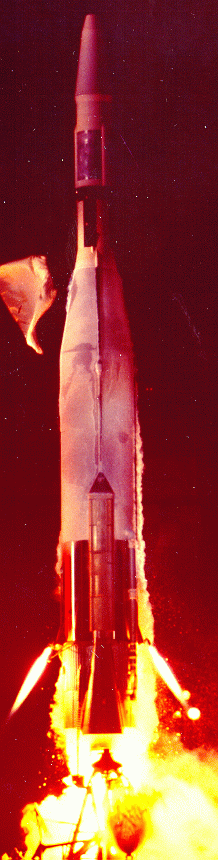
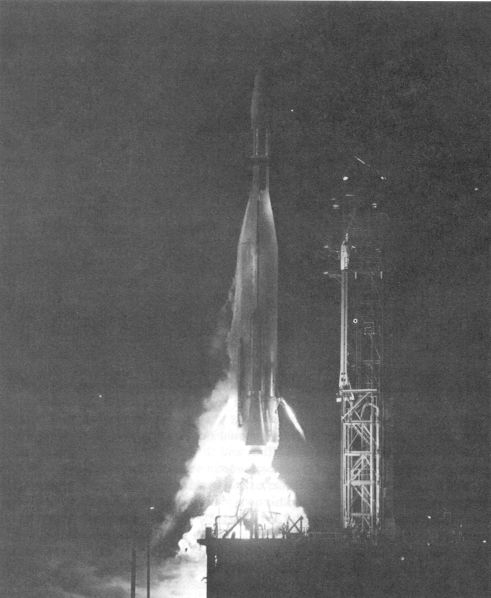
The stage-and-a-half Atlas paired with Lockheed's Agena upper stage. Between 1960 and 1978 it flew 109 times in eight configurations —Atlas LV-3, SLV-3, SLV-3A, SLV-3B and Atlas F with Agena A, B or D— with 93 successes. It launched the Ranger, Mariner and Lunar Orbiter probes and the Gemini docking targets, although most of its flights carried classified military payloads.

- February 26, 1960
- First launch
- 998 kg
- LEO capacity
- No
- Reusable
History
Two and a half stages
The Atlas-Agena was an American expendable launch vehicle derived from the SM-65 Atlas missile. It was a two-and-a-half-stage rocket: the stage-and-a-half Atlas —two booster engines jettisoned in flight plus a central sustainer, all burning RP-1 and liquid oxygen— served as the first stage, and Lockheed's RM-81 Agena as the second. Between 26 February 1960 and 27 June 1978 it flew 109 times, with 93 successes, 13 failures and 3 partial failures. It stood about 36 m tall, was 3.05 m in diameter across the Atlas body and 4.88 m wide across the booster section, and weighed about 155 tonnes at liftoff.
In the Agena D configuration described in Wikipedia's data sheet, the two booster engines delivered 1,036 kN for 134 seconds and the sustainer about 298 kN for around five minutes; the Agena D, 6.30 m long and 1.52 m in diameter, carried a single Bell engine of about 71 kN burning UDMH and inhibited red fuming nitric acid for 265 seconds. The same data sheet, without naming a sub-version, credits the vehicle with 998 kg to low Earth orbit, 699 kg to geostationary orbit, 386 kg to trans-lunar injection and 261 kg to escape velocity.
One combination, many versions
Atlas-Agena does not name a single rocket but a family of pairings. Gunter's Space Page lists eight: the Atlas LV-3 with Agena A, B or D; the Atlas SLV-3 with Agena B or D; the SLV-3A and SLV-3B with Agena D; and an Atlas F with Agena D. The LV-3 was a converted Atlas D missile with MA-2 engines; the SLV-3 and its derivatives used the MA-5, and the final Atlas F the MA-3. For the Agena, the same source gives engine 8048 for the A model, 8081 for the B and 8096 for the D (Wikipedia's data sheet gives 8247 for the Agena D).
%2C_3_June_1966.jpg)
The Agena A, which could not restart and flew mostly on Thor boosters for the Discoverer programme, went up on an Atlas LV-3 only four times, for the Midas and Samos programmes, with two failures; Gunter's credits it with 1,250 kg to low Earth orbit. Late in 1960 Lockheed introduced the Agena B, restartable and with longer propellant tanks for more burn time. It flew first on the Thor and did not debut on an Atlas until 12 July 1961, with Midas 3. The Atlas LV-3 Agena B made 28 launches up to 21 March 1965, with 21 successes, 5 failures and 2 partial failures —Rangers 1 and 2, which the Agena left stranded in a useless low orbit— and Gunter's gives it 1,725 kg to low Earth orbit.
Standardise to survive
After the Atlas malfunction on the Ranger 5 flight in late 1962, NASA convened a review board that re-evaluated the whole Atlas-Agena. It found poor quality control and checkout procedures, made worse by the several dozen configurations in existence because every Defense and NASA programme demanded its own modifications to the Atlas and the Agena, and it recommended better quality control, better hardware and a single standard launch vehicle. The result was the Atlas LV-3 Agena D: a standardised Atlas D core and an Agena that was the same on every flight as far as the Atlas was concerned, even if military payloads still called for custom setups. It debuted on 12 July 1963 and strung together 15 successes in 15 launches up to 20 July 1965.
It was followed by the Atlas SLV-3 Agena D, built on the standard SLV-3 Atlas: it first flew on 14 August 1964 from Vandenberg and logged 47 launches up to 5 November 1967, with 41 successes, 5 failures and 1 partial failure; Gunter's gives it 1,825 kg to low Earth orbit. The stretched-tank SLV-3A version made 12 launches between 1968 and 1978 with a single failure. There were also three one-offs: an SLV-3B with Agena D for the first OAO satellite on 8 April 1966, enclosed in a Centaur-type shroud; an SLV-3 with Agena B for OGO 3 on 7 June 1966; and the Atlas E/F Agena D, a refurbished Atlas F missile that put Seasat into orbit on 27 June 1978 with the last Agena ever flown.
Safety at separation
All of them carried the ISDS (Inadvertent Separation Destruct System): charges mounted on the adapter between the two vehicles that destroyed the Agena if it separated prematurely, triggered by a series of tripwires and tied into the Atlas flight termination system. The very first flight, Midas 1 in February 1960, failed precisely because the still-unproven system fired by mistake at staging, rupturing the Atlas liquid-oxygen tank and breaking up the Agena; it was redesigned and that failure never recurred. The Agena target vehicles of the Gemini programme had a modified destruct system that fired slugs into the tanks so as not to endanger the astronauts in orbit.
Sites and payloads
It flew from Launch Complexes 12, 13 and 14 at Cape Canaveral and Complexes 1 and 2 at Point Arguello and, later, SLC-3 and SLC-4 at Vandenberg. It carried the Ranger probes, the first five Mariners, all five Lunar Orbiters and the Gemini target vehicles, but most of its launches were classified Air Force payloads: Midas missile-warning satellites, Samos and KH-7 Gambit photoreconnaissance satellites, Vela nuclear-test monitors and, on the SLV-3A, the Canyon and Rhyolite signals-intelligence satellites.
%2C_23_October_1964.png)
Multimedia


_launching_Ranger_4%2C_23_April_1962-1600.webp)




_lifting_off_with_Mariner_1%2C_22_July_1962-1600.webp)