Project Mercury · NASA · Crewed
Mercury-Redstone 4
- July 21, 1961
- Launch date
- 1
- Crew size
- 15 min
- Duration
- Success
- Outcome
-1600.webp)

-1600.webp)
-1600.webp)

-1600.webp)
-1600.webp)
-1600.webp)
-800.webp)
-800.webp)
-1600.webp)

-1600.webp)
-1600.webp)
-1600.webp)
-1600.webp)

-1600.webp)

-800.webp)
-1600.webp)
-800.webp)
-800.webp)


-1600.webp)
-1600.webp)
-800.webp)
-800.webp)
-1600.webp)
Mercury-Redstone 4 was the second United States crewed spaceflight and the second suborbital hop of Project Mercury. It lifted off from Cape Canaveral on 21 July 1961 at 12:20:36 UTC atop Redstone MRLV-8, carrying Mercury spacecraft number 11, which its pilot, U.S. Air Force Captain Virgil I. "Gus" Grissom, named Liberty Bell 7. The profile repeated that of MR-3: a ballistic arc of about fifteen minutes reaching 118.26 statute miles and travelling some 302 statute miles downrange before splashing down in the Atlantic. The spacecraft itself was new in important ways. Capsule 11 was the first operational Mercury vehicle with a centreline trapezoidal window instead of the two side portholes of Freedom 7, and the first to fly the explosively actuated side hatch meant to let an astronaut get out within seconds in an emergency. It also carried a rate stabilisation system that made manual attitude control far less demanding, a rearranged instrument panel, and changes to the adapter clamp-ring fairing and couch padding intended to damp the vibration felt during boost. Grissom had an irregular white stripe painted down the side to echo the crack in the Philadelphia bell that gave the capsule its name. The flight went as planned. Grissom exercised the manual controls, described the arc of the Earth's horizon from peak altitude, picked out Cape Canaveral, Merritt Island and the Banana and Indian rivers through the new window, and rode a nominal reentry back down. What failed came after splashdown. While he lay in the couch waiting for the helicopter to hook on, the explosive hatch fired on its own; seawater poured in, Grissom climbed out and very nearly drowned, because he had left his suit inlet valve open and was steadily losing buoyancy. The primary helicopter did hook the capsule, but the flooded spacecraft weighed more than the aircraft could lift and had to be cut loose. Liberty Bell 7 sank in water reported at about 2,800 fathoms. The consequences went well beyond the lost hardware. NASA investigated the hatch, could not reproduce a premature firing and never established a cause; recovery procedures were rewritten, a flotation balloon was added to later capsules, and a mechanical hatch studied as a backup proved far too heavy. A rumour that Grissom had triggered the plunger followed him for decades. He always denied it, and the Astronaut Office plainly believed him, keeping him in the prime rotation and later assigning him to command the first Gemini flight and the first crewed Apollo mission. On 18 August 1961 NASA cancelled the remaining Mercury-Redstone flights and turned the programme towards the Atlas and orbital flight. Liberty Bell 7 lay on the sea floor for 38 years until an expedition raised it in 1999.
Payload
The payload was McDonnell Mercury spacecraft no. 11, named Liberty Bell 7 by its pilot. Compared with spacecraft no. 7 of Mercury-Redstone 3 it added the centerline observation window, a rearranged instrument panel with an earth-path indicator that flew inoperative, the rate stabilization and control system (RSCS), which commands angular rates and damps to within ±3 deg/sec, and the explosively actuated side hatch, flown for the first time on this mission: 23 pounds (10 kg) as installed against the 69 pounds (31 kg) of the mechanical hatch of MR-3. A single crew member flew aboard, pilot Virgil I. «Gus» Grissom, in a Mercury full-pressure suit, semisupine in his contour couch and breathing pure oxygen; he wore his personal biosensor harness: two electrocardiographic leads, sternal and axillary, with floating electrodes filled with bentonite paste over four tattooed sites, a respiration sensor whose housing was altered for MR-4, and a body temperature probe, with 3 h 35 min of medical monitoring. NASA records the astronaut observer camera film as lost with the sunken spacecraft; Wikipedia adds that in 1999 the camera and its film rolls were recovered with no usable imagery, along with the logbook, flashlight, survival knife and 35 «Mercury dimes», while the Cosmosphere puts at 52 the Winged Liberty Head dimes found during preservation. The 1,286 kg mass comes from the Wikipedia infobox and is not supported by any NASA source.
History
A capsule closer to the orbital version
The vehicle assigned to Mercury-Redstone 4 was Mercury capsule number 11, which came off McDonnell's St. Louis production line in May 1960 and had been earmarked since October of that year for the second crewed suborbital flight. Although the mission profile repeated that of Freedom 7, the spacecraft was considerably closer to the definitive orbital configuration than Alan Shepard's had been. NASA's programme chronology records that on 24 June 1961 the modifications to the second crewed flight's spacecraft were completed: an observation window replaced the two view ports, and an improved manual control system was installed.
Grissom chose the name Liberty Bell because the capsule looked like a bell and because of the symbolism of the Philadelphia original; the seven came from the seven astronauts of the original group, a convention Shepard had started almost by accident when he named a vehicle carrying factory number 7 Freedom 7 and the others adopted the digit. To finish the joke, Grissom had an irregular white diagonal stripe painted on the side, starting at the base and running about two-thirds of the way towards the nose, imitating the crack in the bell. That detail later fuelled a good deal of teasing once the spacecraft sank.
The explosive hatch
The most consequential change was the side hatch. The original hatch was bolted shut with seventy bolts and covered by several shingles, so opening it was slow; the planned egress route obliged the pilot to climb out through the antenna compartment after removing a small pressure bulkhead, awkward for a fit man and nearly impossible for an injured or unconscious one. McDonnell developed two quick-release designs. The first, a mechanical latching hatch, flew on the chimpanzee Ham's MR-2 and on Shepard's MR-3, but it weighed 69 lb (31 kg), too much of a penalty for the orbital spacecraft. The second was the explosively actuated hatch, far lighter at 23 lb (10 kg).
.jpg)
The explosive design kept the seventy quarter-inch (6.35 mm) titanium bolts of the original, but each carried a 0.06 in (1.5 mm) hole drilled through it to create a weak point. A mild detonating fuse ran in a channel between the inner and outer seals all around the hatch periphery; when it fired, gas pressure between the seals made the bolts fail in tension. There were two ways to fire it during recovery. From inside, the pilot pulled a safety pin and pushed a knobbed plunger: with the pin removed, 5 or 6 lbf (25 N) sufficed, and with the pin still in place, 40 lbf (180 N) were needed. From outside, a rescuer could remove a small panel beside the hatch and pull a lanyard. On firing, the hatch cover was thrown some 25 ft (7.6 m) clear in one second. The official flight report notes that MR-4 was the first use of the explosively actuated side hatch; the side hatch on MR-3 had been mechanically operated.
The window and the controls
Liberty Bell 7's trapezoidal window replaced the two 10 in (250 mm) side portholes of Freedom 7. Corning Glass Works, of Corning, New York, designed and built it as a multi-layer assembly: the outer pane was Vycor glass 0.35 in (8.9 mm) thick, able to withstand 1,500 to 1,800 degrees Fahrenheit (820 to 980 degrees Celsius), while the inner pane was made of three glass panels bonded into one piece, one of them 0.17 in (4.3 mm) Vycor and the others tempered glass. The finished assembly was as strong as any part of the spacecraft's pressure vessel. A removable polaroid filter to cut glare and a red filter for night adaptation were also provided.
The controls changed as well. A new rate stabilisation system allowed attitude corrections with small movements of the hand controller instead of the constant jockeying the earlier arrangement demanded, and added a redundant path for firing the pitch, yaw and roll thrusters. Two smaller but telling refinements accompanied it. Engineers at Lewis Research Center and the Space Task Group had found that firing the posigrade rockets inside the spacecraft-booster adapter rather than in the open produced 78 percent more thrust through a kind of pop-gun effect, raising separation velocity from about 15 ft/s (4.6 m/s) to about 28.1 ft/s (8.6 m/s). The fairing over the adapter clamp-ring was redesigned and extra foam padding was added at the head end of the contour couch, both to reduce the vibration the pilot felt during boost, and the instrument panel was rearranged to give a better eye-scan pattern.
Pilot and preparation
In January 1961 Robert Gilruth, director of NASA's Space Task Group, told Gus Grissom that he would be the prime pilot for Mercury-Redstone 4; John Glenn was named backup. Grissom, an Air Force fighter pilot with combat experience in Korea, was thereby set to become the second American in space.
.jpg)
The build-up appears in detail in the programme chronology. Redstone launch vehicle number 8 was delivered to Cape Canaveral on 12 June 1961 and erected on Pad 5. On 22 June the Space Task Group sent the Navy the mission's recovery requirements. On 11 July Walter C. Williams issued the key personnel assignments, covering Mercury Control Center, Atlantic Missile Range central control, the landing-area aircraft carrier, the supporting destroyers, the support aircraft and base operations at Patrick Air Force Base. Mission rules were published on 13 July by Eugene F. Kranz of the Flight Control Branch, and a spacecraft, launch vehicle and flight safety review held on 13-15 July pronounced Redstone MRLV-8 and spacecraft 11 ready to fly.
The count: four attempts and a misaligned bolt
The launch was first set for 16 July, but cloud cover was too thick and it slipped to the 18th, when weather stopped it again. On both occasions the pilot had not yet boarded. On 19 July Grissom was aboard when the count was halted once more for weather, with ten minutes and thirty seconds left to go.
On the morning of 21 July Grissom entered Liberty Bell 7 at 8:58 UTC and the seventy hatch bolts were installed. Forty-five minutes before the scheduled lift-off, a pad technician found that one of them was misaligned. A thirty-minute hold was called, during which McDonnell and Space Task Group engineers judged that the remaining sixty-nine bolts would be enough both to hold the hatch and to blow it when required; the faulty bolt was not replaced. The count resumed and ran to T-30 minutes, when a brief hold was called to switch off the pad searchlights, no longer needed in daylight and a source of interference with launch-vehicle telemetry. The pilot's total time in the spacecraft during the countdown was three hours and twenty-two minutes. Liberty Bell 7 lifted off at 12:20:36 UTC on 21 July 1961.
The flight
Grissom admitted at the postflight debriefing that he had been a bit scared at lift-off but that confidence returned as the acceleration built. Like Shepard, he was struck by how smooth the release was, though he then noticed progressively harsher vibration, never violent enough to blur his instruments. The cabin sealed at the proper altitude, about 27,000 ft (8.2 km), and cabin and suit temperatures of roughly 57.5 and 97 degrees Fahrenheit (14.2 and 36.1 degrees Celsius) were comfortable. The Redstone pitched over on programme at about one degree per second.
.jpg)
On the way up, under about 3 g, Grissom watched the horizon change from light blue to jet black. The noise of the escape tower jettison rocket distracted him; he felt the separation and watched the tower drift away to his right trailing smoke. Two minutes and twenty-two seconds after lift-off the Redstone's Rocketdyne engine cut off, having built a speed of 6,561 ft/s (2,000 m/s). The change from high acceleration to weightlessness produced a strong tumbling sensation, familiar from centrifuge training but disorienting for a moment. The stack coasted for ten seconds and then a sharp report marked the posigrade rockets popping the spacecraft free; although Grissom watched through the window throughout the turnaround, he never caught sight of the booster.
With turnaround complete he took manual-proportional control. Concentrating was hard because the window kept pulling his attention: he told Shepard in Mercury Control that the panorama of the Earth's horizon, an arc of some 800 mi (1,300 km) at peak altitude, was fascinating. Turning back to the stick, he overshot a pitch change, worked the controller trying to damp the oscillations, then overshot in yaw as well, so that the time allotted ran out and he skipped the roll manoeuvre altogether. The manual controls felt far more sluggish than the procedures trainer. Switching to the new rate command system he found the response perfect, though fuel consumption was high. He then rolled the spacecraft to look down: land showed hazily through the clouds, later identified as the Apalachicola area of western Florida, and suddenly Cape Canaveral came into view so sharply that he found it hard to believe his slant range was over 150 mi (240 km). He picked out Merritt Island, the Banana River, the Indian River and what looked like a large airport runway, and south of the Cape what he took to be West Palm Beach.
The programme chronology summarises his experience as similar to Shepard's: some five minutes of weightlessness with no ill effects, and easy attitude control in the manual mode. NASA's flight data appendix gives MR-4 a maximum altitude of 624,400 ft (118.26 statute miles), a maximum range of 302.10 statute miles, a maximum velocity of 6,618 ft/s earth-fixed and 7,580 ft/s space-fixed, equal to 5,168.2 mph, and a flight duration of 15 minutes 37 seconds from lift-off to impact. The official report notes that those velocities slightly exceeded the planned 6,414 and 7,388 ft/s.
Reentry and splashdown
At peak altitude, 118.26 mi, it was time to set up for reentry. Grissom started the retrorocket sequence with his pulse at 171 beats per minute; retrofire gave him the odd impression that he had reversed his backward flight and was now moving face forward. Falling, he thought he saw two of the spent retrorockets cross the periscope view after the package was jettisoned. He pitched the spacecraft to a reentry attitude of fourteen degrees from Earth-vertical and tried to see stars through the window, but sunlight glare filled the cabin and made the panel dials hard to read, particularly the blue-lit ones. Reentry was uneventful: he could not feel the oscillations that followed the deceleration peak and could only read them on the rate indicators, while he kept reporting electrical current, fuel quantity and acceleration to Mercury Control. Condensation and smoke trailed off the heatshield at about 65,000 ft (20 km).
.jpg)
The drogue deployed on schedule at 21,000 ft (6.4 km) and the main parachute at 12,300 ft (3.7 km), roughly 1,000 ft (300 m) above the design nominal altitude. As it unfurled Grissom spotted a 6 in (150 mm) L-shaped tear and a 2 in (51 mm) puncture in the canopy; they worried him but grew no larger, and his descent rate settled at about 28 ft/s (8.5 m/s). He dumped the control peroxide and began transmitting panel readings. A clunk confirmed the landing bag had dropped. Grissom removed his oxygen hose and opened his visor but deliberately left the suit ventilation hose connected. Impact was milder than expected, though the spacecraft heeled over until he was lying on his left side; it gradually righted itself and, as the window cleared the water, he jettisoned the reserve parachute and threw the rescue-aids switch. Liberty Bell 7 still seemed watertight, though it rolled heavily in the swell.
The hatch blows
The recovery helicopters, airborne since launch time and tracking the contrails and parachute descent visually, were about 2 mi (3.2 km) from the impact point, itself only 3 mi (4.8 km) from the bullseye. Lieutenant James L. Lewis, flying the primary helicopter, asked Grissom whether he was ready for pickup. Grissom asked for five minutes to record his panel data; writing with a grease pencil in pressure-suit gloves was awkward, and suit ventilation kept ballooning the neck dam, which he relieved by slipping a finger between neck and rubber.
With the data logged, he called the helicopters in, pulled the pin from the hatch detonator and lay back on the couch. By his own account he was flat on his back, wondering whether he could take the survival knife with him as a souvenir, when he heard a dull thud. The hatch cover blew away and seawater poured in as the spacecraft began to sink. Grissom could not afterwards reconstruct his own movements precisely, but he was certain he had not touched the plunger. He had already unbuckled most of his harness; he pulled off his helmet, grabbed the right side of the instrument panel and climbed out through the hatchway. The copilot of the nearest helicopter reported that as he was preparing, per procedure, to cut the spacecraft's antenna whip with a squib-actuated cutter on a pole, the hatch cover flew off, struck the water about 5 ft (1.5 m) away and skipped over the waves; next he saw Grissom climb out and swim clear.
Losing the spacecraft
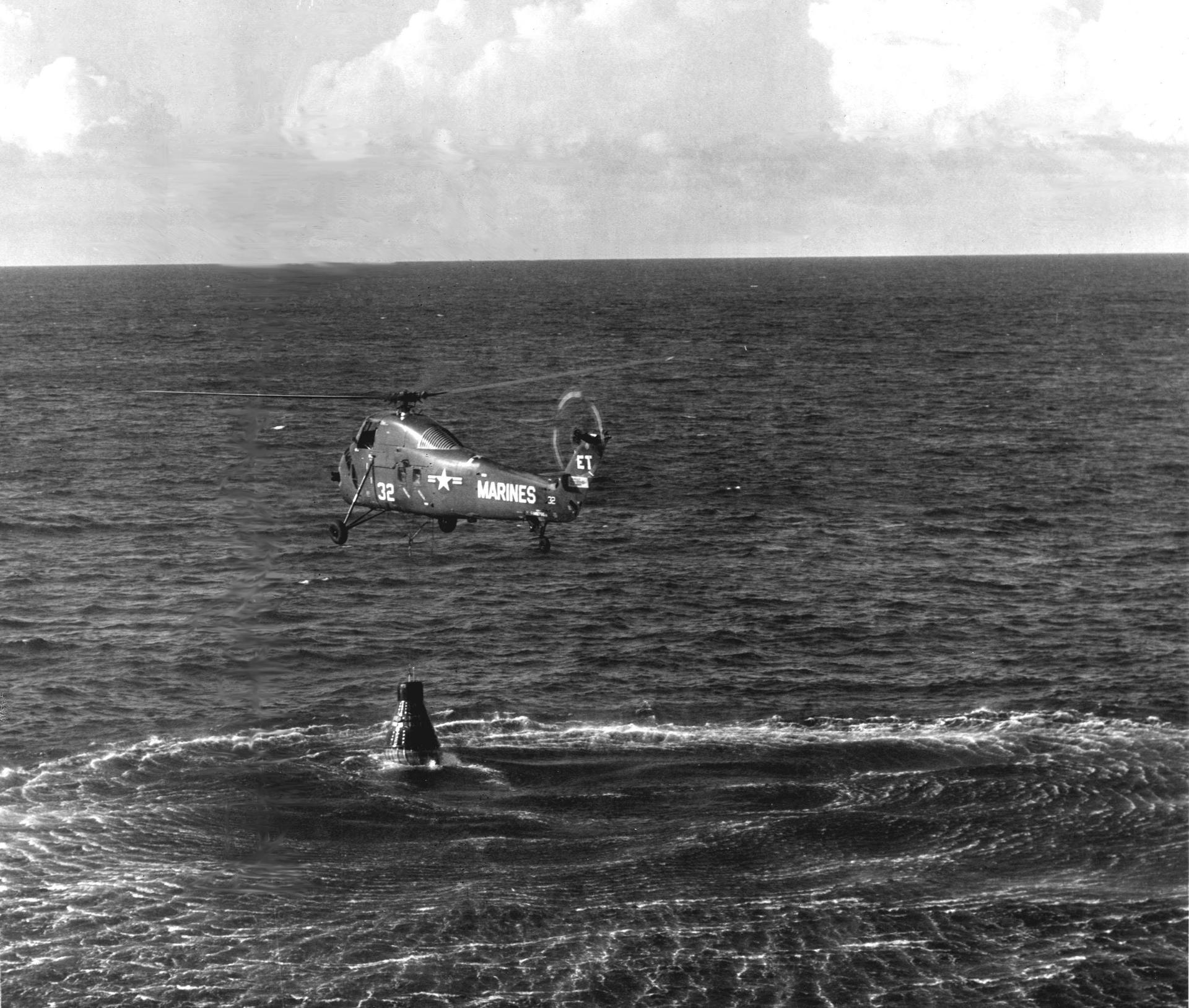
Lewis pressed on with his approach to the sinking capsule rather than to the swimming astronaut, and copilot John Reinhard did likewise: a conditioned reflex from training, in which the astronauts had always seemed at home in the water. Reinhard cut the high-frequency antenna, dropped the cutter and threaded the shepherd's-hook pole through the recovery loop on top of the spacecraft, with the helicopter low enough that its three wheels were in the water. The capsule sank from sight, but the pole twanged as the cable went taut, telling the crew they had made the catch.
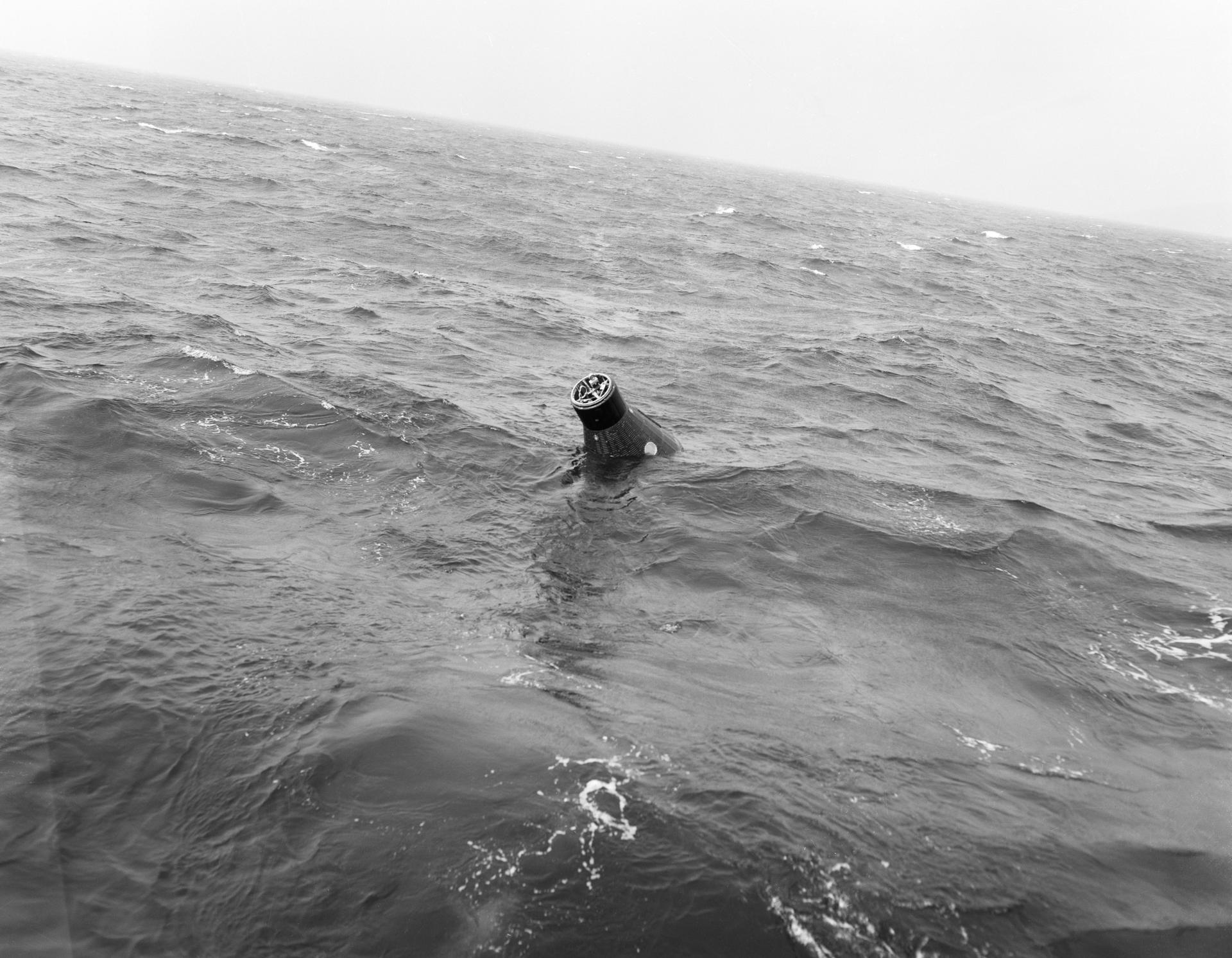
Reinhard was about to pass Grissom the personnel hoist when Lewis warned that a detector light had come on, indicating metal chips in the oil sump from engine strain. Facing the prospect of engine failure, Lewis had the hoist retracted and called the second helicopter in for the astronaut. Meanwhile Grissom, having checked that he was clear of any lines, saw that the primary helicopter was struggling to lift the spacecraft and swam back to help; he found the cable properly attached, and when he looked up for the personnel line he saw the aircraft moving away.
It was then that he realised he was riding lower in the water. Air had been escaping through the neck dam the whole time and, worse, he had forgotten to secure his suit inlet valve. Swimming became hard work, and the rotor wash between the two helicopters made it harder still. Ducking under the waves, scared and angry, he was looking for a rescue swimmer when he recognised George Cox in the second helicopter, the copilot who had picked up both the chimpanzee Ham and Shepard. Cox threw the horse-collar sling straight to him and Grissom climbed into it backwards, past caring about orthodoxy; two more swells dunked him before he was hoisted aboard, and his first thought on getting in was to put on a life preserver. He reckoned he had been swimming or floating for only four or five minutes, though, he said, it felt like an eternity; NASA's official report puts the time in the water at about three to four minutes.
The primary helicopter, meanwhile, fought to raise the spacecraft high enough to drain the impact bag. At one point the capsule was almost clear of the water, but it acted like an anchor: flooded, it weighed over 5,000 pounds (2,300 kg), some 1,000 lb (450 kg) beyond the helicopter's lifting capacity. With the red warning light insistent, the pilot decided not to risk losing two craft in one day and cast the load loose; Liberty Bell 7 sank quickly. Aboard the carrier, Martin Byrnes suggested marking the spot for later recovery, but Rear Admiral J. E. Clark told him the depth there was about 2,800 fathoms (16,800 ft; 5.1 km). The postflight medical examination on the carrier was brief and uneventful; Grissom wrote afterwards that losing the spacecraft was a great blow to him.
The investigation
NASA investigated the premature firing. According to the internal report of 30 August 1961, tests were run in an environment more severe than the prelaunch programme had used, and no premature firings occurred. A further series of environmental tests on the explosive egress hatch ran from 5 August to 12 October. As a backup, McDonnell was asked to design a mechanical hatch, but the model came out some sixty pounds heavier than the explosive one, so other ways had to be found to prevent a recurrence. The practical fix was procedural: from then on the firing plunger's safety pin would stay in place until the helicopter hook was attached to the spacecraft and tension applied to the recovery cable. In September it was also decided to fit a thirty-inch diameter balloon in the spacecraft so that a ship could recover it if a helicopter had to drop the load, precisely what had happened on MR-4.
.jpg)
An independent technical review carried out between August and October 1961 raised doubts about the theory that Grissom had blown the hatch and was responsible for losing the spacecraft. The Astronaut Office evidently believed him, since it kept him in the prime rotation, later assigning him to command the first Gemini flight and the first crewed Apollo mission. Three Mercury flights later, Wally Schirra deliberately blew Sigma 7's hatch with the spacecraft already on the recovery ship's deck, explicitly to counter the rumour: as expected, the kickback from the manual trigger left him with a visible injury to his right hand. Grissom's postflight physical documented no such injury, which strongly supports his account, since an accidental strike on the plunger would have been even more likely to hurt him.
Grissom himself offered an explanation in 1965: he believed the external release lanyard had come loose and triggered the hatch. On Liberty Bell 7 that lanyard was held by a single screw. Guenter Wendt, pad leader for most of the early American crewed flights, accepted the theory. In 2021 an analysis of recovery footage pointed instead at static electricity built up by the helicopter's rotors: Reinhard, who used explosively charged shears to cut the antenna, recalled that touching the antenna produced an arc, that both cutters fired at once and that the hatch came off at the same instant, which suggested to him that a static charge might have set it off. None of these accounts is confirmed; no cause was ever established.
The end of the suborbital flights
Project Mercury's original plan called for four more suborbital flights with the Redstone, numbered MR-5 through MR-8, with Glenn tentatively assigned to MR-5. By the time Grissom flew, however, the programme had fallen behind its timeline and there was concern about trailing the Soviet effort. The Space Task Group concluded that nothing further could be gained from this phase, and on 18 August 1961 NASA announced the cancellation of the remaining Mercury-Redstone flights, clearing the way for Glenn to fly a Mercury-Atlas mission and become the first American to orbit the Earth.
.jpg)
The day after the flight, on 22 July 1961, NASA Administrator James Webb presented Grissom with the agency's Distinguished Service Medal at the close of the MR-4 press conference at Cape Canaveral. Later, in a joint ceremony, Shepard and Grissom received the first Astronaut Wings awarded by their respective services.
The shadow over Grissom, and the hatch's long echo
The rumour that Grissom had blown the hatch followed him for decades, helped along by the irony of the painted crack and by the mission's dramatisation on screen: Philip Kaufman's The Right Stuff (1983) restaged the episode with Fred Ward as Grissom, and the character also appears in HBO's From the Earth to the Moon (1998) and in Hidden Figures (2016).
The explosive hatch had a tragic echo. During an Apollo 1 launch simulation in 1967, the combination of a cabin fire and an inward-opening hatch contributed to the deaths of Grissom and his crewmates Ed White and Roger B. Chaffee. An explosive egress system had been rejected for Apollo after engineers concluded that such a system could fire inadvertently; following the fire, Block II Apollo spacecraft were fitted with rapid-opening hatches.
1999: raising Liberty Bell 7
After unsuccessful attempts in 1992 and 1993, Oceaneering International lifted Liberty Bell 7 off the floor of the Atlantic and onto a recovery ship's deck on 20 July 1999, the thirtieth anniversary of the Apollo 11 landing and a day short of the thirty-eighth anniversary of the loss. The team was led by Curt Newport and financed by the Discovery Channel; the spacecraft was found after a fourteen-year search at a depth of nearly 16,000 ft (4,900 m), some 300 nautical miles (560 km) east-southeast of Cape Canaveral. The Cosmosphere of Hutchinson, Kansas, took part in the expedition alongside the Discovery Channel and Oceaneering.
Once on deck, specialists removed and disposed of an explosive location device, a SOFAR bomb that should have detonated when the spacecraft sank in order to mark its position and had failed to fire. The capsule was then placed in a container of seawater to slow further corrosion. Its condition was what thirty-eight years in deep water would predict: the titanium hull and the plastic components, indifferent to salt water, survived essentially intact, while aluminium and steel parts were heavily corroded and in some cases gone altogether, the steel instrument panels almost entirely eroded away with their gauges and controls lying loose in the couch, still attached to the wiring harnesses. Grissom's camera and film rolls were recovered, the film in poor condition and yielding no usable imagery, along with the astronaut's logbook, a flashlight, a survival knife and a batch of dimes carried as flight souvenirs.
The Cosmosphere disassembled and cleaned the spacecraft. Restoration took nearly six months and some 7,300 hours of work by twelve full-time specialists and eight volunteers: the entire system had to be flushed of salt water and corrosion removed from its 20,000 parts, from which about ten miles of wiring were stripped; the preservation project cost 250,000 dollars in 1999. The capsule then toured nationally through 15 September 2006 and returned to the Cosmosphere, where it is on permanent display; in 2016 it was lent temporarily to The Children's Museum of Indianapolis. The hatch cover was never found.
Legacy
Mercury-Redstone 4 met its technical objectives: it flight-proved the large window and the rate command control system that the orbital spacecraft would carry, repeated the MR-3 profile with a different pilot, and confirmed that a human being could work normally through the weightless minutes of a ballistic hop. Its deeper mark, though, is operational. It was the first time the United States lost a spacecraft after a successful splashdown and came close to losing the crewman with it, and out of that came concrete changes in recovery procedure, in capsule flotation and in a lasting distrust of pyrotechnic egress systems. It was also the programme's last crewed suborbital flight: four weeks later NASA cancelled the rest of the Redstone series and committed Mercury entirely to orbit.
Images
Elsewhere
- CosmosphereLiberty Bell 7 tal como fue rescatada del Atlántico en 1999, antes de la restauración ↗
- CosmosphereRestauración de Liberty Bell 7 en el Cosmosphere: limpieza de sus cerca de 25.000 componentes ↗
- CosmosphereExpedición de 1999 financiada por Discovery Channel para recuperar Liberty Bell 7 del fondo del Atlántico ↗
- CosmosphereTrabajos de recuperación de Liberty Bell 7 en 1999 (expedición Discovery Channel / Oceaneering / Cosmosphere) ↗
- Smithsonian National Air and Space MuseumRecovery of Liberty Bell 7 ↗
- Wikimedia CommonsLiberty Bell 7 recuperada del Atlántico, 1999 ↗
- Google Arts & CultureLa cápsula Liberty Bell 7 es mostrada a la prensa en Port Canaveral tras su recuperación, 1999 ↗
- Indiana Historical SocietyLos astronautas Mercury Glenn, Grissom y Shepard ↗
- AlamyUn helicóptero intenta izar la Liberty Bell 7 inundada, momentos antes de tener que abandonarla, 21 de julio de 1961 ↗
- AlamyLa cápsula Liberty Bell 7, restaurada, expuesta en el Kansas Cosmosphere ↗
- AmericaSpaceHelicópteros del Cuerpo de Marines y la Armada de EE. UU. intentan izar la Liberty Bell 7 tras el amerizaje, 21 de julio de 1961 ↗
- AmericaSpaceUna de las últimas imágenes de la Liberty Bell 7 antes de hundirse, 21 de julio de 1961 ↗