SpaceX Falcon 1: The Second First Step Into Space
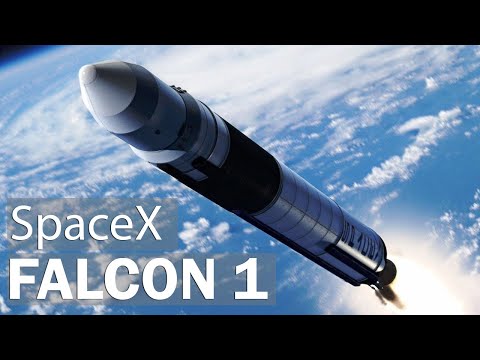
Video from the channel SkyShips en Español about SpaceX, linked on its Above Ten Thousand entry. Duration: 18:38. Language: Spanish. Video type: Documentary.
What it's about
An educational documentary, dubbed into Spanish, about the early days of SpaceX and its first launch vehicle, the Falcon 1. It covers the company's founding, the rocket's development and its five launches, and ends with a technical description of the vehicle.
Historical context
According to the video, Elon Musk moved from Silicon Valley to Los Angeles after his time at X.com, the future PayPal, and came into contact with the Mars Society. He planned to send a small automated greenhouse to Mars and tried to buy Dnepr launch vehicles, derived from the SS-18 missile, in Moscow, but the negotiation fell through. He then decided to build his own rocket, and in May 2002 Space Exploration Technologies was born in a former Los Angeles warehouse. The company first tested engines in Mojave and, from 2003, in McGregor, Texas, and set up its launch site in Kwajalein, in the Marshall Islands. The first launch, on 26 March 2006 with DARPA's FalconSAT-2 satellite, ended in an engine failure a few seconds into flight. The 2007 and 2008 attempts also failed to put their payload into orbit. The first success came at the end of 2008 with a simulated payload, and in 2009 the Malaysian satellite RazakSAT was launched.
Key facts
The Falcon 1 was a lightweight two-stage launch vehicle powered by RP-1 kerosene and liquid oxygen. The first stage, mostly made of aluminium, used a Merlin 1A engine of about 340 kN and later a Merlin 1C of about 454 kN. It carried a parachute meant to recover it that never worked. The second stage used the Kestrel engine, restartable and of about 31 kN. The rocket was 21.3 m tall and 1.7 m in diameter, with an initial mass of about 28 tonnes. The heaviest payload it put into orbit was RazakSAT, at about 180 kg. The Falcon 1e and Falcon 5 versions were never built: the company focused its efforts on the Falcon 9.