Did you know…
What is high gravity in space?
Short answer
Nothing in space has high gravity in the everyday sense; what crews actually feel is high g-load, the acceleration of a launch or a re-entry pressed into them as extra weight. Real high gravity needs mass: Jupiter's cloud tops pull at 24.79 m/s² against Earth's 9.80 m/s². Astronauts never meet that.
g-load is not gravity
Gravity is the pull of a mass; g-load is the acceleration a vehicle imposes on the people inside it, expressed in multiples of the 9.80 m/s² we feel at sea level. The two produce the same sensation, weight, which is why the words get mixed up. A crew strapped in during ascent, or decelerating in the upper atmosphere on the way home, feels several times its normal weight for minutes at a time. That is high g-load, and it comes from the engines and from the air, not from any gravitational field out there. Space itself offers no such thing: between the planets, gravity is weak rather than strong.
Where gravity really is high
High gravity needs mass, and the Solar System keeps most of it in the giant planets. At Jupiter's cloud tops the pull is 24.79 m/s², two and a half times Earth's 9.80 m/s². Further out the numbers fall back: Saturn, Uranus and Neptune all sit close to the terrestrial value despite their bulk, because their radii are so large and gravity weakens with the square of the distance from the centre. Genuinely extreme gravity belongs to collapsed objects, where a stellar mass is folded into a sphere a few kilometres across and nothing material survives at the surface.
Hypergravity by design
The only way to experience sustained high gravity is to manufacture it. Large centrifuges spin samples, cell cultures and occasionally people at several times Earth gravity, to study how organisms respond when weight increases instead of disappearing; pilots train on the same principle. Those machines also hint at the eventual answer to weightlessness in space, since a rotating habitat would press its occupants outwards against a floor. Nothing flown so far does it, so crews still swing between minutes of high g-load and months of almost none.
More questions
- Image pending
Astronauts and life in space
Why does astronauts float in space?
Because they are in free fall, not because gravity is absent. At the International Space Station's altitude of about 400 km, Earth still pulls almost as hard… more…
- Image pending
Astronauts and life in space
Why did yuri gagarin die?
Gagarin died in an aircraft crash, not in a spacecraft. On 27 March 1968 the MiG-15UTI trainer he was flying with instructor Vladimir Seryogin went down in… more…
- Image pending
Astronauts and life in space
How much an astronaut is paid?
NASA's civilian astronauts are ordinary federal employees, paid on the General Schedule grade-and-step scale with no bonus per flight, per spacewalk or per… more…
.png)
Astronauts and life in space
Why is blue origin so slow?
Blue Origin was built on deliberate, owner-funded incrementalism: its motto is Gradatim Ferociter, step by step, and it spent its first two decades on… more…
Astronauts and life in space
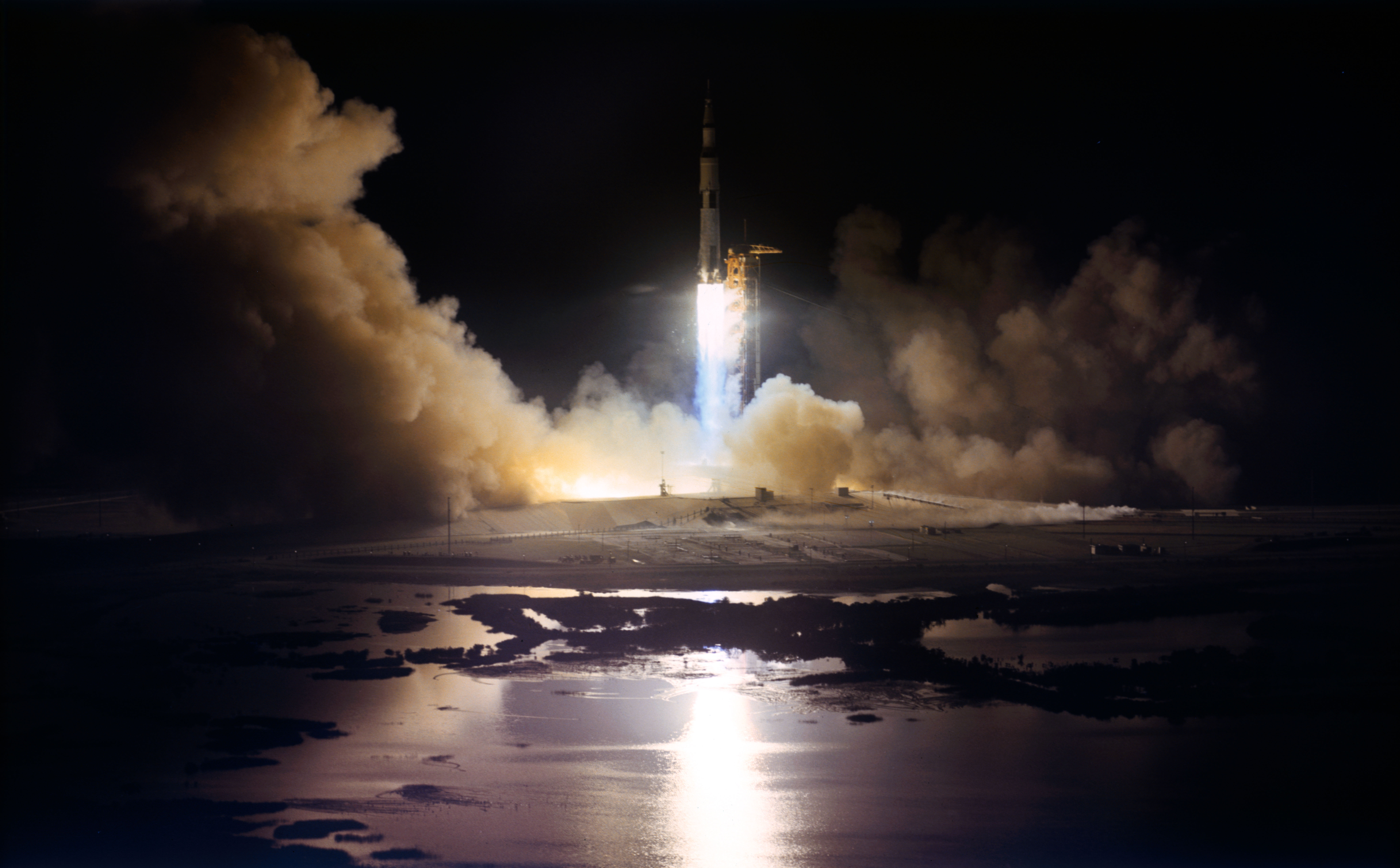
When did astronauts last walk on the moon?
Apollo 17, in December 1972. Eugene Cernan and Harrison Schmitt landed in the Taurus-Littrow valley on 11 December 1972, worked on the surface for three days… more…
- Image pending
Astronauts and life in space
How high do astronauts orbit the earth?
Crewed spaceflight today happens a few hundred kilometres up. The International Space Station orbits at about 400 km, lapping the planet roughly every 90… more…
