Did you know…
How does the Falcon 9 land?
Short answer
The Falcon 9's first stage lands under power: after separating, it flips around, performs a boostback burn if returning to land, slows during reentry with another burn, steers using four grid fins, and seconds from the ground ignites a Merlin engine, deploys four legs, and touches down vertically on a landing pad or a drone ship.

Only the first stage comes back
It's worth clarifying what actually lands: the first stage, the large roughly 41 m cylinder with nine Merlin engines. The second stage, which carries the payload to orbit, remains expendable. The first stage separates at about two and a half minutes into flight, at roughly 70 km altitude and a speed of between 6,000 and 8,000 km/h depending on the mission. From that point it flies on its own, with propellant held in reserve for the return.
Three burns and four grid fins
Right after separation, cold nitrogen thrusters flip the stage to point its engines in the direction of travel. If the target is a landing zone on land, three engines perform the boostback burn that reverses the trajectory; if the mission demands more performance, this is skipped and the stage continues on a ballistic path toward a drone ship stationed hundreds of kilometers out at sea. Before entering the dense atmosphere, a reentry burn slows the stage down and protects the structure from heat. Four grid fins deployed at the top of the stage steer it during descent, correcting its course with meter-level precision.
The final second
A few kilometers from the ground, the landing burn begins, almost always using the center engine. The stage can't hover: even with a single engine at minimum throttle, the thrust exceeds its weight, so the flight computer calculates a maneuver in which the speed reaches zero right as it touches the surface. The four legs, made of carbon fiber and aluminum, deploy in the final seconds. The first time it worked was on December 21, 2015, at Cape Canaveral; the first drone ship landing came on April 8, 2016. Since then the procedure has been repeated hundreds of times, and some stages have flown more than twenty missions (as of September 2026).
More questions
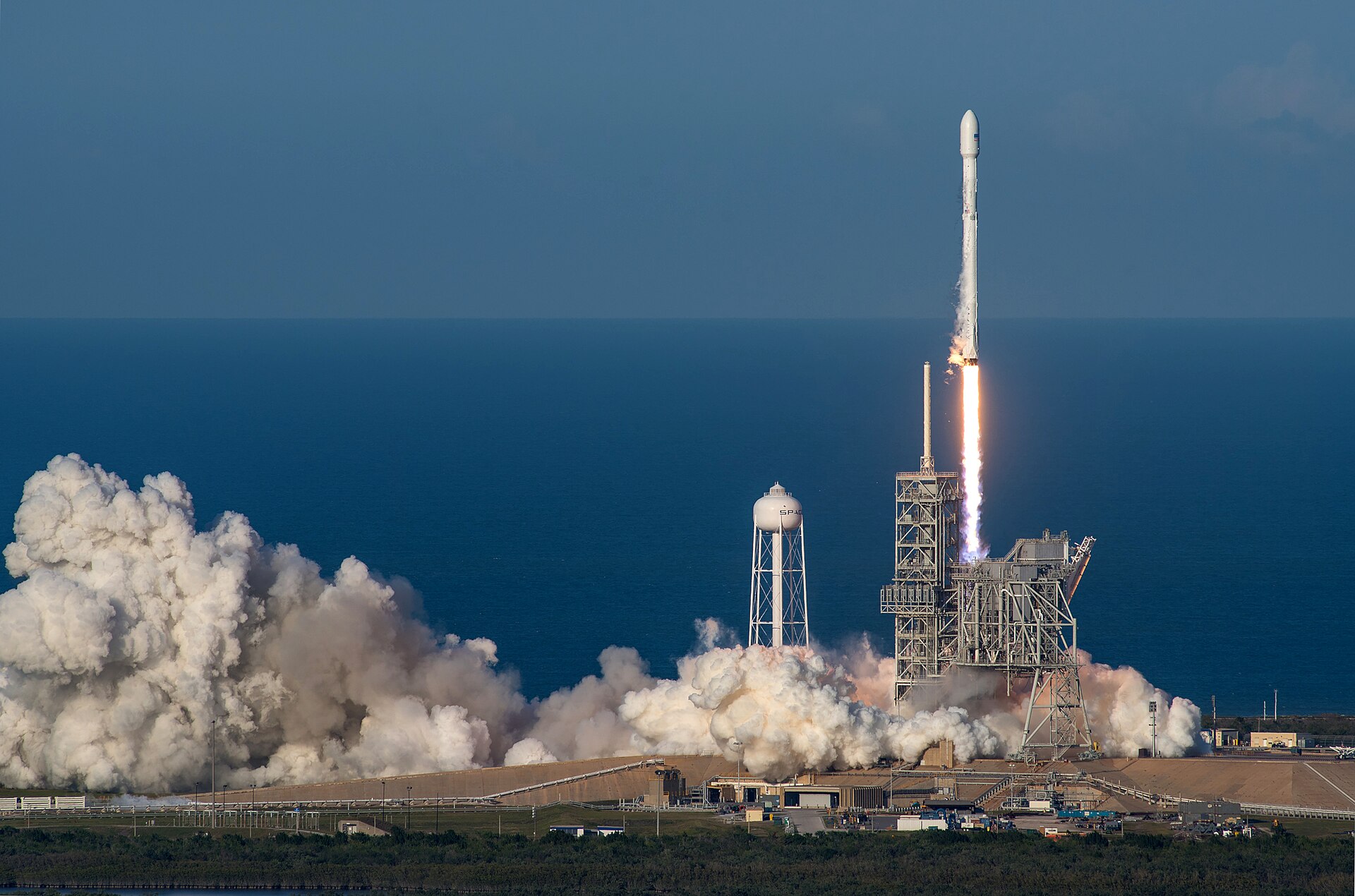
Foto: SpaceX (CC0) Rockets and launches
How many horsepower does the Falcon 9 have?
Rockets aren't measured in horsepower, but in thrust: the Falcon 9's first stage's nine Merlin engines deliver 7,686 kN (1,710,000 lbf) combined at sea level… more…
Foto: SpaceX (CC0) Rockets and launches
How much a rocket weight?
Rockets range from about 13 t for Rocket Lab's Electron to roughly 549 t for Falcon 9, 2,800 t for Saturn V and close to 5,000 t for Starship with its Super… more…

Rockets and launches
What does the saturn v look like?
Saturn V looked like a white needle 110.6 m (363 ft) tall and 10.1 m wide at the base, painted with black roll-pattern stripes, the words UNITED STATES and… more…
Foto: SpaceX (CC0) Rockets and launches
Why do rockets launch from florida?
Rockets launch from Florida because the Cape sits at 28.5 degrees north, low enough to gain about 410 m/s from the Earth's rotation on an eastward launch, and… more…
Foto: SpaceX (CC0) Rockets and launches
How much falcon 9 launch cost?
SpaceX lists a standard Falcon 9 mission at 69.75 million dollars, with the booster recovered (data as of January 2025). Small satellites can share a ride… more…
Rockets and launches
How does the saturn v work?
Saturn V worked by staging: a kerosene first stage with five F-1 engines (about 34,000 kN) lifted the 2,800 t rocket for two and a half minutes, a… more…
