Did you know…
What does "a rocket in your pants" mean?
Short answer
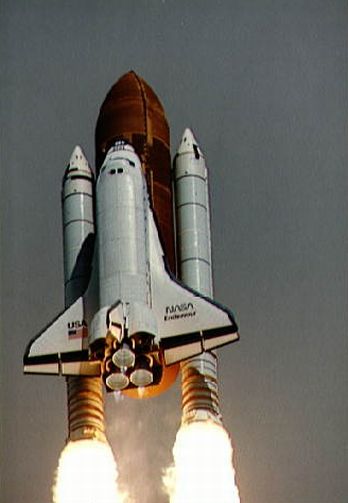
"A rocket in your pants" isn't an aerospace term: it's a colloquial expression that uses the rocket as an image of speed and sudden takeoff. The comparison holds up: an orbital launcher goes from 0 to over 28,000 km/h in about nine minutes, and a firework rocket reaches its peak height in just seconds.
Where the image comes from
The rocket has been synonymous with speed in everyday language for centuries: phrases like "to take off like a rocket," "to go like a rocket," or more colorful variants describe someone who starts off suddenly and doesn't stop. The expression doesn't appear in flight manuals or technical glossaries; it's a popular hyperbole. Even so, the metaphor picked the right machine, because few devices built by humans accelerate so continuously and so steadily.
What a real rocket does
An orbital launcher lifts off with modest acceleration, barely 1.2 to 1.5 times gravity, because it starts out with full tanks. As it burns propellant it gets lighter, and the same thrust accelerates it more and more, until the flight computer throttles down to avoid exceeding about 4 g. In about nine minutes it goes from standstill to the 7.8 km/s (about 28,000 km/h) that low Earth orbit requires. A firework rocket is a different thing: a gunpowder motor that burns for one or two seconds and launches the casing to a height of 100 to 300 m, where it explodes.
Why it's not as simple as it looks
The rocket's speed comes at a steep price. For one ton to reach orbit, twenty to thirty tons of propellant are needed, and the entire vehicle is designed around that imbalance: tanks that take up almost all the volume, structures pushed to the limit of their strength, and stages discarded in flight. Not even the fastest aircraft comes close: a fighter jet exceeds Mach 2, about 2,400 km/h, twelve times slower than a rocket in orbit. The popular image captures the blazing takeoff, but leaves out the engineering that makes it possible and the years of preparation behind every minute of ascent.
More questions

Foto: SpaceX (CC0) Rockets and launches
How many horsepower does the Falcon 9 have?
Rockets aren't measured in horsepower, but in thrust: the Falcon 9's first stage's nine Merlin engines deliver 7,686 kN (1,710,000 lbf) combined at sea level… more…
Foto: SpaceX (CC0) Rockets and launches
How much a rocket weight?
Rockets range from about 13 t for Rocket Lab's Electron to roughly 549 t for Falcon 9, 2,800 t for Saturn V and close to 5,000 t for Starship with its Super… more…

Rockets and launches
What does the saturn v look like?
Saturn V looked like a white needle 110.6 m (363 ft) tall and 10.1 m wide at the base, painted with black roll-pattern stripes, the words UNITED STATES and… more…
Foto: SpaceX (CC0) Rockets and launches
Why do rockets launch from florida?
Rockets launch from Florida because the Cape sits at 28.5 degrees north, low enough to gain about 410 m/s from the Earth's rotation on an eastward launch, and… more…
Foto: SpaceX (CC0) Rockets and launches
How much falcon 9 launch cost?
SpaceX lists a standard Falcon 9 mission at 69.75 million dollars, with the booster recovered (data as of January 2025). Small satellites can share a ride… more…
Rockets and launches
How does the saturn v work?
Saturn V worked by staging: a kerosene first stage with five F-1 engines (about 34,000 kN) lifted the 2,800 t rocket for two and a half minutes, a… more…

