Bomber · Military · Russia
Tupolev Tu-95
- November 12, 1952
- First flight
- 1956
- Introduced
- In service
- Status
- 500
- Units built


-1600.webp)


%2C_28_September_2006_(0609-1600.webp)


-1600.webp)
-1600.webp)


%2C_in_1987_(6412403)-1600.webp)


_at_Vladivostok_Airport_(1)-800.webp)
-1600.webp)


-1600.webp)
-1600.webp)


-1600.webp)

-1600.webp)

_intercepting_a_Soviet_Bear_bomber_060922-F-1234S-036-1600.webp)

-1600.webp)

-800.webp)
The Tupolev Tu-95 — "Bear" in NATO parlance — is a Soviet four-turboprop heavy strategic bomber, conceived to reach targets in the United States without refuelling and capable of carrying nuclear weapons. It first flew on 12 November 1952, entered service with Soviet Long-Range Aviation in 1956 and, seven decades later, is still on the flight line of the Russian Aerospace Forces, which expect to operate it until at least 2040. It is the only turboprop-powered strategic bomber still in operational use and the only propeller-driven aircraft with swept wings built in large numbers: a combination so improbable that Western intelligence took years to believe the figures it was measuring. Its origin lies in a Soviet requirement of 1950, issued simultaneously to the Tupolev and Myasishchev design bureaus, calling for a bomber with an unrefuelled range of 8,000 km and the ability to carry an 11,000 kg load to the target. The previous generation — the Tu-4, an unlicensed copy of the Boeing B-29, and its scaled-up development, the Tu-85 of 1949 — had shown that piston engines had reached their ceiling. The available turbojets, on the other hand, drank too much fuel. Andrei Tupolev backed a third path that almost everyone considered old-fashioned: four turboprops of extreme power, with which he promised to exceed 13,000 km of range and 800 km/h at 10,000 metres. The government formally approved the "95" project on 11 July 1951. The bet rested on an extraordinary engine. The Kuznetsov NK-12, developed by a team that included German engineers interned after the war under Ferdinand Brandner, remains the most powerful turboprop ever to enter service. Each of the four drives two contra-rotating four-blade propellers 5.6 metres in diameter. At cruise settings the tips of those blades turn at supersonic speed, and from that comes the aircraft's most famous signature: the Tu-95 is one of the loudest military aircraft ever built, audible from the cockpits of the fighters escorting it and detectable by the submarine hydrophones of the SOSUS network. In service, the Bear was the backbone of Soviet nuclear deterrence. Its crews rehearsed transpolar strikes against North America on routine ten-hour missions twice a week, in an aircraft whose early versions had neither lavatory nor galley. A modified Tu-95V dropped the Tsar Bomba on 30 October 1961, the most powerful thermonuclear device ever detonated. And from the first recorded contact in December 1961 to the end of the Cold War, the "Bear intercept" became the recurring image of the confrontation: around Iceland alone some 3,000 interceptions were logged between 1962 and 1991, with F-102s, F-4s and F-15s flying formation alongside the bomber while both sides photographed each other. The airframe proved so adaptable that it spawned an entire family. The Tu-114 Rossiya carried the bomber's wing, undercarriage and powerplants over to a pressurised fuselage of much greater diameter and became the fastest, longest-ranged airliner of its day; it still holds the official record for the fastest propeller-driven aircraft. From the Tu-114 in turn came the Tu-126, the first Soviet airborne early warning aircraft. The Tu-142, with a stretched fuselage and reinforced undercarriage, gave the Soviet Navy its long-range anti-submarine warfare platform. And in 1981 the production line reopened for the Tu-95MS, a missile carrier built on the Tu-142 fuselage and designed around the Kh-55 cruise missile. After the dissolution of the USSR, Ukraine inherited between 23 and 29 aircraft, most of them scrapped under the Nunn–Lugar programme before 2001, while Russia concentrated its fleet at Engels and Ukrainka. Long-range patrols resumed in August 2007 on Vladimir Putin's orders, and the bomber saw combat for the first time in its history in November 2015 over Syria, almost sixty years after entering service. Since 2022 it has been used as a launch platform for Kh-101 cruise missiles in the war against Ukraine, and Ukrainian drone attacks have destroyed several examples on the ground. The most recent version, the Tu-95MSM, replaces the radar, navigation and defensive systems and fits NK-12MPM engines with AV-60T propellers that halve vibration levels. What explains its permanence is not the excellence of any single figure of merit, but the same virtue that has kept the American B-52 flying: a large, robust airframe with margin to spare, able to accept missions nobody had imagined when it was drawn. From free-fall bomber it became a missile carrier, a maritime patrol aircraft, an airliner and an early warning platform. Around 500 units were built from 1952 into the 1990s. If it meets the forecast of serving until 2040, the design will have accompanied strategic aviation for nearly ninety years.
Related sheets
Category
Three-view drawing
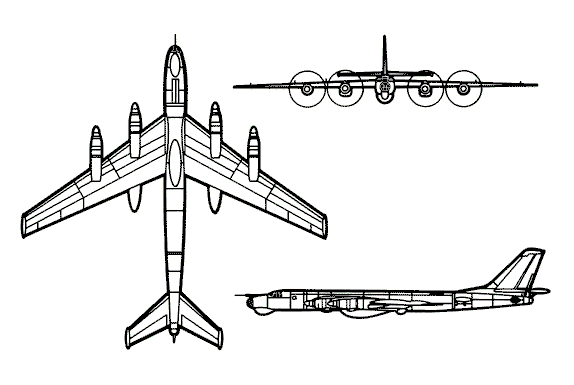
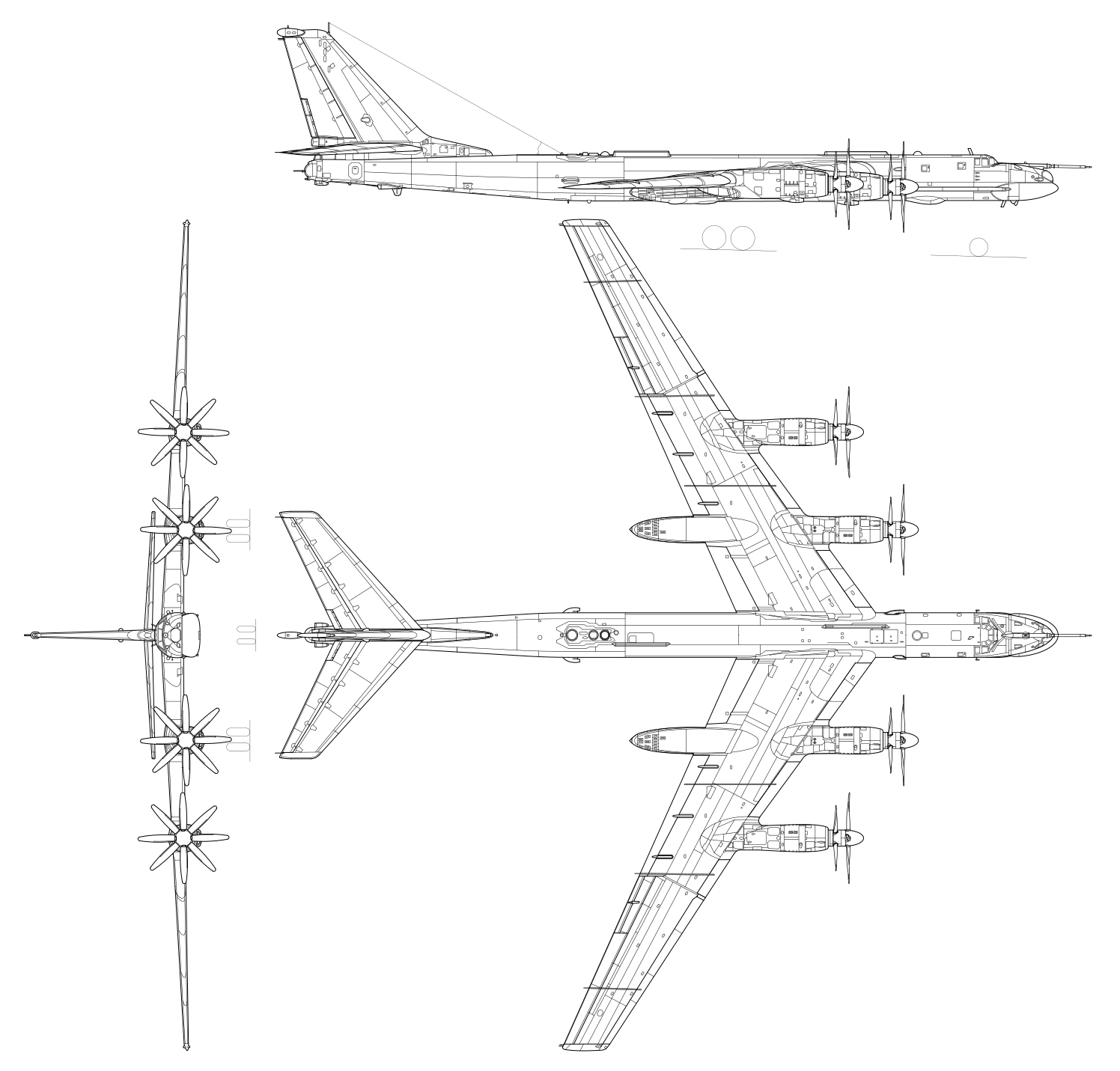
History
The 1950 requirement and the range problem
Soviet strategic aviation was born on borrowed design. The Tupolev Tu-4, which entered service in the late 1940s, was an unlicensed copy of the Boeing B-29 Superfortress reverse-engineered from aircraft interned in the USSR, and its range sufficed for Europe but not for the American continent. The next step, the Tu-85 of 1949, was a scaled-up version of that same design and was obsolete before it reached production: no matter how large the airframe grew, the piston engine could not cross the Arctic and come back.
In 1950 the government issued a new requirement, addressed simultaneously to the Tupolev and Myasishchev design bureaus. It called for a bomber with 8,000 km of unrefuelled range — far enough to threaten key targets in the United States — and the ability to carry an 11,000 kg load to the release point. Between 1949 and 1951 several solutions were studied and tested, including modifications of the Tu-4 itself and new aircraft with reciprocating engines; the conclusion was unanimous and discouraging: no piston-engined bomber would deliver the performance required for an intercontinental mission.
In March 1951 development formally began on the T-4, an intercontinental jet bomber. Tupolev did not support it. His bureau calculated that the projected AM-3 turbojets would burn so much fuel that the aircraft would not exceed 10,000 km, far short of what a round trip demanded. The disagreement was not stylistic but arithmetical: in the early 1950s turbojet thermodynamics still punished specific fuel consumption, and the combat radius of a Soviet bomber was, quite literally, a matter of political geography.
Turboprop versus jet: Tupolev's bet
Against the T-4, the Tupolev bureau proposed an aircraft with four turboprops that, by its calculations, would exceed 13,000 km of range and fly at more than 800 km/h at 10,000 metres. The turboprop offered more power than the piston engine and far better fuel economy than the turbojets of the period, at the cost of an intermediate top speed. It was not an eccentric choice: Boeing initially considered turboprop engines for the B-52 Stratofortress for exactly the same range reasons, and British industry was adopting them for its large long-range transports, from the Saunders-Roe Princess to the Bristol Brabazon Mk 2 and the Bristol Britannia. What was exceptional was sticking with the bet to the end and applying it to a heavy bomber.
The project received the internal designation "95" and the government approved it officially on 11 July 1951, authorising two configurations in parallel: one with eight TV-2F engines coupled in four tandem pairs through reduction gearboxes, and another with four TV-12 engines. The wing drew directly on the experience Tupolev and the Central Aerohydrodynamic Institute (TsAGI) had accumulated with the Tu-16: 35 degrees of sweep, mid-mounted, and one detail that governed the whole fuselage, because that angle made the main spar pass through the fuselage just ahead of the bomb bay, leaving the load over the centre of gravity. The retractable tricycle undercarriage folded all three struts rearwards, with the main units housed in extensions of the inboard engine nacelles.
N. I. Bazenkov became chief designer of every subsequent Tu-95 version; on his death in 1975 N. V. Kursanov took over, and from the late 1980s D. A. Antonov led the programme. That continuity — three project chiefs in forty years — partly explains why the airframe was able to absorb so many transformations without losing its identity.
The NK-12 and the contra-rotating propellers
The programme's greatest difficulty lay not in the wing but in the powerplant. In the late 1940s the most powerful turboprop available was the BK-2 prototype, at some 4,800 shp, far below the 10,000 shp per engine the "95" project demanded. N. A. Kuznetsov's OKB-276 first developed the TV-2 and its boosted TV-2F version, of 6,250 shp, while work continued on the 12,000 shp TV-12.
The engine's lineage is one of the most singular stories of the postwar years. The design that would become the NK-12 was developed by a team of Soviet scientists and interned German engineers within Operation Osoaviakhim, led by Ferdinand Brandner, a former Junkers man, under chief engineer Nikolai D. Kuznetsov. It grew out of late-war German turboprop studies: first the development of the 6,000 shp, 3,000 kg Jumo 022, then a 5,000 shp, 1,700 kg unit completed in 1947, and finally the evolution to the 12,000 shp TV-12, which required extensive use of newly developed Soviet alloys and was completed in 1951.
The result remains, more than seventy years later, the most powerful turboprop ever to enter service, ahead of the Europrop TP400. It has a fourteen-stage axial compressor, with pressure ratios between 9:1 and 13:1 depending on altitude, variable inlet guide vanes and blow-off valves; a cannular combustion system of twelve flame tubes; a five-stage axial turbine driving both the compressor and the propellers; and a mass flow of 65 kg/s. The NK-12MV version delivers 11,033 kW and turns AV-60 propellers 5.6 metres in diameter. Each engine drives two contra-rotating four-blade propellers, so the aircraft carries eight blades per nacelle and thirty-two in all.
From this comes its most remembered trait. At normal settings the tips of those large-diameter blades exceed the speed of sound, and the resulting noise made the Tu-95 one of the loudest military aircraft ever built. The racket is not an anecdote: the underwater acoustic sensors of the SOSUS network, designed to track submarines by their faint acoustic signatures, could detect a Bear flying overhead. Fighter pilots sent to intercept it described an unmistakable drone audible over the noise of their own jets; a former P-3 Orion naval flight officer recalled that ambient noise at his own station ran around 95 dB and that he flew with earplugs under his headset, and imagined conditions inside the Bear were considerably worse.
The NK-12 family eventually outgrew the bomber: the NK-12M powered the Tu-114, the NK-12MV the Tu-95, Tu-126 and Tu-142, the NK-12MA the gigantic Antonov An-22, the NK-12MK the A-90 Orlyonok ekranoplan, and the NK-12MP the Tu-95MS and Tu-142M versions.
From prototype to service (1952-1957)
The first prototype, the "95/1" fitted with eight coupled 2TV-2F engines, was built in 1952 at Plant No. 156; the reduction gearbox and the four-blade contra-rotating propellers were developed by OKB-120 under K. N. Zhdanov, and each coupled pair produced 12,000 shp. It first flew on 12 November 1952 with Alexey Perelet at the controls. On 11 May 1953, on its seventeenth flight, the aircraft crashed and burned; Perelet was killed. The failure is attributed to the coupled engines, although sources disagree on the exact mechanism — some describe a propeller gearbox failure, others an engine fire — and the practical lesson was the same: the tandem-pair solution was not reliable.
The second prototype, the "95/2", carried four independent TV-12s. It was completed in June 1954 and flew on 16 February 1955. In testing, with a 5,000 kg load, it reached around 15,000 km of range, 993 km/h and an 11,300 m ceiling: figures that vindicated the turboprop bet at a stroke. The first two fully equipped aircraft left the factory in August 1955 and began flight testing in October. Series production started in January 1956 at Plant No. 18 in Kuibyshev, with production trials still under way, and the aircraft entered Long-Range Aviation that same year. The first Tu-95 division, the 106th Heavy Bomber Air Division, was formed in 1956 under A. G. Molodchi, twice Hero of the Soviet Union.
Production performance fell short of the prototype. The initial Tu-95, with a 5,000 kg load, gave 850 km/h, a 10,200 m ceiling and 12,100 km of range; its bomb bay was 14.2 metres long and it carried six radar-directed AM-23 cannon in turrets. The following version, the Tu-95M, fitted more powerful and more economical NK-12M engines that allowed a higher take-off weight: in tests in September and October 1957 it reached 905 km/h, 12,150 m and 13,200 km. Even falling short of the speed and range requirement, deployment began in October 1957. Nineteen Tu-95Ms were built.
There was also a naming confusion that lasted decades. For a long time US intelligence knew the aircraft as the Tu-20, which had been the original Soviet Air Force designation; by the time it reached operational units it was already known internally as the Tu-95, and Tu-20 quickly fell out of use in the USSR, but because that designation appeared in numerous captured documents it persisted in the West. Early Department of Defense estimates were no better: they credited it with a 640 km/h top speed and 12,500 km of range, figures that had to be revised upward repeatedly.
The Bear in Soviet nuclear deterrence
The Tu-95 was born as a free-fall bomber and served in that role through its first decade. It was the delivery platform for much of the Soviet thermonuclear arsenal under test: the 42-kiloton RDS-4 "Tatyana" fission bomb; the RDS-6S thermonuclear bomb; the 2.9-megaton RDS-37; and the 200-kiloton RP-30-32.
Its most remembered moment came on 30 October 1961, when a specially adapted Tu-95V dropped the AN602, known as the Tsar Bomba, the most powerful thermonuclear device ever detonated. The aircraft had its ventral surfaces painted in anti-flash white and carried the bomb semi-externally, slung beneath the fuselage, because its size prevented stowage in the bay: a solution analogous to the Avro Lancaster B.1 Special carrying the ten-tonne Grand Slam. The test was filmed in full, and the footage of the take-off, the interior in flight and the detonation ranks among the most widely circulated visual documents of the Cold War.
The airframe also served as a test bed for extreme ideas. The Tu-95LAL was an experimental nuclear-powered aircraft project. The Tu-96 was a high-altitude strategic bomber prototype, designed to climb to 16,000-17,000 metres with boosted TV-16 turboprops and an enlarged wing; its factory trials were flown in 1955-1956 with conventional TV-12 engines and development stopped once it became clear that extra altitude did not improve the bomber's survivability. The Tu-95N was converted in 1958 to air-launch the "RS" attack aircraft from P. V. Tsibin's bureau, and an experimental Tu-95K was used for air-launch trials of the SM-20 derived from the MiG-19.
The line that really prospered was the missile carrier. The Tu-95K-20 weapon system — the Tu-95K bomber plus the supersonic Kh-20 air-to-surface missile — began in March 1955; the prototype flew on 1 January 1956, series production started in the spring of 1958 and operational deployment in September 1959. The weight and drag added by the missile and supplementary tanks cut into range, and the compensation was air-to-air refuelling: the probe-and-drogue system was developed between May 1960 and 1961, and bombers so equipped were redesignated Tu-95KD, the first version with a nose probe. In the 1960s several Tu-95Ks and KDs received a new radio-electronic and navigation suite and were redesignated Tu-95KM, recognisable by two pairs of reconnaissance radomes on the sides of the rear fuselage. By the 1970s many of those aircraft were reconfigured to carry the supersonic Kh-22 missile with the guidance system used on the Tu-22M: these became the Tu-95K-22, first flight-tested in October 1975 and taken into the active inventory in 1982; by 1998 more than 45 remained operational. In them the defensive concept changed fundamentally: an extended tailcone replaced the tail turret, the dorsal turret was deleted and a single ventral position remained, while radomes and fairings for the electronic warfare suite proliferated.
Life on board was hard. Early versions lacked elementary amenities — neither lavatory nor galley — and crews described dank, dingy interiors. Routine missions lasted ten hours and were flown twice a week, with around 1,200 flight hours a year per crew, a tempo that guaranteed a high degree of combat readiness. Unlike their American counterparts in Operation Chrome Dome, Tu-95s did not fly with live nuclear weapons aboard: the ordnance was kept in bunkers on the base and loading it, through a servicing trench beneath the bomb bay, could take up to two hours, which was regarded as a hindrance to overall readiness. During the Falklands War, Tu-95s flew intelligence-gathering sorties around Ascension Island.
The interception ritual
No other Cold War setting brought American and Soviet combat forces into such regular and potentially lethal proximity. From 1946 American doctrine had adopted the "polar concept": an attack would come from the north, and in 1949 the Joint Chiefs of Staff formalised that every nation capable of waging war on the United States lay north of the 45th parallel. When Soviet bombers reached the necessary radius — the M-4 Bison in 1955, the Tu-16 Badger in 1954 and, best of all, the Tu-95 in 1956 — the response was a complete defensive architecture: NORAD, created by the United States and Canada in 1958; the Iceland Defense Force under NATO auspices; the DEW Line of radars, begun in 1957 and eventually stretching more than 3,000 miles from Alaska to Greenland; the computerised SAGE system; and air defence identification zones reaching more than 200 miles into international airspace, because strict sovereignty extended only 14 miles from the coast.
There were visual contacts from the early 1950s, but serious incursions began in 1958, when radar detected Soviet bombers off the Alaskan coast; F-102s scrambled but could not catch them, and sixteen similar incidents followed before Alaskan Air Command's first successful intercept. That first recorded interception came on 5 December 1961: two F-102s from the forward operating base at Galena intercepted two Soviet bombers over the Bering Sea — Tu-16s, not Tu-95s. From then on the ritual repeated thousands of times until 1991. By the official tally, Alaskan units flew 306 successful intercept missions and intercepted 473 Soviet aircraft between December 1961 and the end of the Cold War, nearly 90 per cent of them from the forward bases at Galena and King Salmon.
By far the busiest sector was Iceland: some 3,000 interceptions between 1962 and 1991, mostly of Tu-95s flying out of Murmansk and the Kola Peninsula, picked up by Norwegian radar as they rounded the North Cape and then tracked by the Icelandic defences. The USAF 57th Fighter-Interceptor Squadron at Keflavik intercepted more Soviet aircraft than any other unit: it began with F-89s in 1954, moved to F-102s in 1962, F-4s in 1973 and F-15s in 1985. In 1985-1986 alone it conducted 340 interceptions. Canada followed a parallel path, from the CF-100 Canuck — whose cruising speed was slightly lower than the Bear's, which was enough to retire it — to the CF-101 Voodoo and, in 1984, the CF-18 Hornet. In the United States the sequence ran F-102, F-106 from 1959, F-4 and F-15.
The incursions were not attempts to break through and attack. They were cat-and-mouse intelligence operations of a kind both sides had practised since the 1950s: flying along the edge of the other's territory allowed collection of electronic intelligence, helped crack command-and-control procedures and, above all, timed the interceptors' reaction and measured radar accuracy. To obtain that data one had to come close enough to make the fighters scramble. The typical encounter ended with the interceptors flying close formation alongside the bomber until it left the buffer zone, both sides taking photographs and everyone careful to avoid provocative gestures. The Bear itself made the job easier: besides the noise, it returned an enormous radar echo, so its approach was seldom a surprise — still less once E-3 AWACS aircraft deployed to Alaska and Iceland in the 1980s.
The cycle broke off at the end of the Cold War, with scattered episodes — F-15s intercepted two Tu-95s off Iceland in 1999 — and resumed on Vladimir Putin's orders on 17 August 2007. In November of that year an F-22 Raptor flew its first interception, and the target was a Tu-95MS. Since 2019 Tu-95MSs have also flown joint patrols with Chinese Xian H-6 bombers; by 2025 ten such flights had taken place, prompting interceptions by South Korean, Japanese and American fighters.
The family: Tu-114, Tu-116, Tu-126 and Tu-142
Few military airframes have given so much. The Tu-114 Rossiya — "Cleat" to NATO — grew from a Council of Ministers directive of August 1955 calling for an airliner with 8,000 km of range based on the bomber. It kept the Tu-95's wing, empennage, undercarriage and powerplants and married them to an entirely new pressurised fuselage of much greater diameter, now in low-wing configuration; flap area and chord had to be increased to cope with the extra weight, and a new nose gear strut three metres tall was required, the inevitable consequence of combining a low wing with 5.6-metre propellers. That height caused trouble more than once: on its first arrivals at Andrews, London and Paris there were no airstairs tall enough to reach the cabin door.
Its figures were remarkable. It flew at 880 km/h — jet speeds, although its cruise Mach of 0.71 was markedly lower than the 0.83 typical of a Boeing 707 or DC-8 — had a range of 10,900 km and could take up to 224 passengers, though Aeroflot usually configured it for 170 with sleeping berths and a dining lounge. For a time it was the largest, fastest and longest-ranged airliner in the world, and since 1960 it has held the official title of fastest propeller-driven aircraft. It was shown to the West at the 1958 Brussels World Exhibition and carried Nikita Khrushchev to the United States in September 1959, the first such visit by a Soviet leader; the aircraft was still in testing and hairline cracks had been found in the engines after its first long-range flight, but Khrushchev insisted and Andrei Tupolev himself put his son Alexei aboard the same flight. It entered regular Aeroflot service on 24 April 1961 on the Moscow Vnukovo-Khabarovsk route and later flew to Copenhagen, Havana, Montreal, New Delhi, Paris and Belgrade. It carried more than six million passengers before being replaced by the jet-powered Ilyushin Il-62. Its weakness was inherited from the bomber: cabin noise of 108 to 112 dB and constant vibration. Thirty-two were built at Plant No. 18 in Kuibyshev in the early 1960s. The first example, registration CCCP-L5611, made its last flight in 1968 and is preserved at the Central Air Force Museum at Monino, outside Moscow.
As insurance against a possible delay to the Tu-114A, two Tu-116s were prepared: Tu-95 bombers fitted with passenger compartments, comprising an office, two sections seating twenty VIP passengers each, and the rest of the 70 m³ cabin in conventional layout. They never served their original purpose and ended up as crew ferries for the various Tu-95 squadrons; one is preserved at Ulyanovsk Central Airport. From the Tu-114 in turn came the Tu-126, the first Soviet airborne early warning and control platform.
The weightiest military derivative was the Tu-142. Its origin lies in the American Polaris programme: when USS George Washington sailed from Charleston on 15 November 1960 with nuclear-armed ballistic missiles aboard, the Soviet government ordered its design bureaus to study dedicated anti-submarine warfare platforms. Tupolev first proposed the Tu-95PLO, a Tu-95 with sonobuoys, mines and torpedoes and a 10.5-hour loiter time, which was dropped for lacking a powerful radar, a thermal imaging system and a magnetic anomaly detector. On 28 February 1963 the Council of Ministers issued the directive that produced the Tu-142 proper.
The new aircraft deleted the dorsal and ventral turrets, leaving only the tail position with two AM-23 cannon; it introduced the 360-degree Berkut search radar, a navigation system integrated with weapons targeting, a wing enlarged to 295 m², elevators increased in area by 14 per cent, improved hydraulic actuators and metal fuel tanks in place of rubber bladders; and it replaced the Tu-95's four-wheel main bogies with twelve-wheel units for operation from semi-prepared strips. The first Tu-142 was built at the Kuibyshev plant and flew on 18 June 1968 from Zhukovsky airfield with I. K. Vedernikov at the controls; testing quickly showed the fuselage needed lengthening, and the second prototype joined the programme on 3 September with a 1.7-metre front fuselage stretch that every subsequent Tu-142 inherited. Soviet Naval Aviation began receiving production aircraft for operational trials in May 1970 and the type deployed in December 1972.
Rough-field capability proved of limited practical use, so the twelve-wheel bogies of the first twelve aircraft were replaced with reinforced four-wheel units taken from the Tu-114; that, together with deletion of the thermal imaging system and part of the electronic countermeasures equipment, cut 4,000 kg from the empty weight and allowed installation of a crew rest area. Between 1968 and 1972 the Kuibyshev plant delivered eighteen Tu-142s; in the early 1970s production moved to the Taganrog Machinery Plant near the Black Sea, which after several years of preparation began building in 1975 the version with the factory designation Tu-142M. Then came the Tu-142M2, with a magnetic anomaly detector in a spike-like tail fairing and a lengthened sonobuoy bay, and the Tu-142M3, the most capable of the series, first identified by Western intelligence in 1986 and still in low-volume production at the end of the 1990s. A specialised variant, the Tu-142MR, was dedicated to long-range communications with ballistic missile submarines. Production continued at both plants until 1994, and the type served with Soviet and Russian naval aviation, the Ukrainian Air Force and the Indian Navy.
Production, plants and the Tu-95MS revival
Tu-95 production was concentrated at Plant No. 18 in Kuibyshev — today Samara — which started in January 1956 and built the bomber versions and the first maritime patrol machines. From the mid-1970s Plant No. 86 at Taganrog took on the Tu-142, and Western sources place in 1983 the reopening of that line to build Bear-F and Bear-H simultaneously. In all, some 500 units were built, with production running from 1952 into the early 1990s.
The most striking industrial episode belongs to the 1970s and 1980s, when the Bear fleet was ageing and its inventory declining. In the mid-1970s development began on the long-range Kh-55 cruise missile, initially intended for the new supersonic Tu-160 bombers. Adapting it to the Tu-95 was studied: trials of the Tu-95M-55 began in 1978, but on completion the project was rejected in favour of developing an entirely new aircraft, the Tu-95MS. Earlier, the Tu-95K-5, which would have carried two KSR-5 missiles, had also been explored and abandoned in favour of the Tu-95K-22 and the Tu-95MS itself.
The Tu-95MS is not a modification of the classic Tu-95 but an aircraft built on the Tu-142 fuselage, and it differs in numerous details: a nose similar to the Bear-C and Bear-G but with a deeper, shorter radome, cable ducts running along both sides of the fuselage, without the 178 cm forward fuselage plug of the maritime Tu-142, and with a shorter fin and an undrooped refuelling probe. The tail turret is of new design, with a single twin-barrelled GSh-23L cannon in place of the pair of single-barrel NR-23s of earlier models. The first tests were flown in September 1979 and series production started in 1981. It was the first new production of a strike version of the Bear airframe since the 1960s, and with it the decline of the inventory was reversed. By 1988 Bear-Hs were regularly simulating attacks against North America.
Two configurations were produced. The Tu-95MS6 carries six Kh-55, Kh-55SM or Kh-555 missiles on a rotary launcher inside the bay; thirty-two were built. The Tu-95MS16 adds underwing pylons to the rotary launcher, up to a maximum of sixteen Kh-55s or fourteen Kh-55SMs; fifty-six were built. That difference in fit would prove decisive forty years later, because only the MS16s with the K-016 Sprut missile initialisation system — that is, those manufactured from 1986 onwards — would be candidates for modernisation.
After 1991: inheritance, modernisation and combat
The dissolution of the USSR split the fleet. In 1992 newly independent Kazakhstan began returning to the Russian Federation the Tu-95s of the 79th Heavy Bomber Aviation Division based at Dolon, which joined those already at the Far Eastern Ukrainka air base. Ukraine inherited between 23 and 29 Tu-95MSs; in 2000 it handed three aircraft and 581 Kh-55 cruise missiles to Russia in exchange for gas debt relief, and the remainder were scrapped under the US-led Nunn-Lugar Cooperative Threat Reduction programme, completed in 2001. Two examples converted into ecological reconnaissance aircraft were stored at the Mykolaiv repair plant and sold for scrap in 2013; one Tu-95MS survives at the Museum of Long Range Aviation in Poltava and one Tu-95 in Mykolaiv Oblast.
Russia, for its part, revived the type. On 17 August 2007 Vladimir Putin announced the resumption of strategic aviation flights and of the long-range patrols interrupted in 1991. In January 2008 Tu-95s took part in a naval exercise off the coasts of France and Spain alongside Tu-22M3s and A-50s. During the Stability 2008 exercise in October, Tu-95MSs fired live air-launched cruise missiles for the first time since 1984, restoring the aircraft's standing as an effective strategic system thanks to the Kh-55's range. In July 2010 two Tu-95MSs set a world record for non-stop flight in their class: more than 43 hours airborne and more than 30,000 km covered over the Atlantic, Arctic and Pacific oceans and the Sea of Japan, with four in-flight refuellings. In December 2017 two Tu-95MSs landed for the first time at Biak air base in Indonesia after covering more than 7,000 km with refuelling, and flew from there their first patrols over the southern Pacific.
The modernisation programme began in the 2000s. As early as 2003 the aircraft were made compatible with the Kh-555 missile, and formal development started with a research and development contract awarded to Tupolev by the Defence Ministry on 23 December 2009. The first phase consisted of enabling them for the Kh-101 and its nuclear counterpart the Kh-102: since those missiles do not fit in the internal bay, external hardpoints were added, so the aircraft can carry eight Kh-101/102 under four double pylons in addition to six Kh-55/55SM/555 on the rotary launcher. The satellite signal reception system, the instrument landing system and other navigation equipment were also replaced. The first modernised aircraft, the Tu-95MS Saratov, rolled out of the Beriev plant at Taganrog in early 2015 and was handed to the air force in March; from that same year the Aviakor plant in Samara took on serial modernisation at three aircraft a year, and its first example, the Tu-95MS Dubna, was delivered on 18 November 2015. By April 2019 twenty-one aircraft had been modernised, ten joined the fleet in 2019-2020 and four more in 2021; the first batch was completed in March 2020. The candidate fleet is put at 30 to 35 aircraft.
The second and deeper phase is the one that gives the Tu-95MSM its name: a Novella NV1.021 passive electronically scanned array radar in place of the Obzor-MS, an S021 navigation system, a Meteor-NM2 airborne defence complex, upgraded Kuznetsov NK-12MPM engines with Aerosila AV-60T propellers that halve vibration levels, and deletion of the tail turret. The first Tu-95MSM flew on 22 August 2020 — some sources place that first flight at the end of 2019 — and in August 2021 a new contract for upgrades to MSM standard was signed. In November 2024 Rostec stated that it continued to refine the model with lessons from the ongoing conflict, stressing its ability to employ ultra-long-range cruise missiles: the Kh-101 and Kh-102 can strike targets up to 5,500 km away, allowing launches from deep within Russian airspace.
Its baptism of fire came late and all at once. On 17 November 2015 Tu-95s entered combat for the first time in sixty years of service, in long-range strikes as part of the Russian intervention in the Syrian civil war; a year later, on 17 November 2016, Tu-95MSs carried out their first combat deployment with Kh-101 missiles. Since 24 February 2022 they have taken part in the invasion of Ukraine as cruise missile launch platforms: on 6 March 2022, according to Ukrainian sources, Tu-95MSs and Tu-160s launched eight missiles — presumably Kh-101s — at Vinnytsia airport from the Black Sea area, and on 26 June another four to six at Kyiv from the Caspian Sea area. The war has also reached the aircraft on the ground: on 5 December 2022 an attack with modified Tu-141 drones damaged two Tu-95s at Engels-2; on 1 June 2025 Ukraine's Operation Spider's Web destroyed four Tu-95s at Olenya air base and three or four at Belaya; and on 17 July 2026 an SBU drone strike destroyed another at Engels-2. In 2020 the Russian Aerospace Forces reported 55 Tu-95MSs in service, spread between Engels-2, Ukrainka, Olenya and the Dyagilevo training centre.
An exceptional longevity
The comparison with the Boeing B-52 Stratofortress is inevitable and, in this case, illuminating. Both aircraft have watched entire generations of bombers come and go — faster, stealthier, more expensive — and both are still flying, for the same reason: a large, oversized airframe with structural margin accepts modifications that a tightly optimised design cannot bear. The Tu-95 was conceived to drop free-fall nuclear bombs and ended up a cruise missile carrier, a maritime patrol aircraft, a long-range airliner and an early warning platform. None of those missions appeared in the 1950 requirement.
To that must be added a choice of powerplant that time eventually rewarded. The turboprop, regarded as an anachronism while the rest of the world migrated to jets, gave the Bear extraordinary endurance at a fuel cost no jet bomber of its generation could match, in exchange for only a slightly lower speed. That same turboprop is responsible for its greatest tactical vulnerability — the noise, the acoustic signature and the enormous radar echo that announced its arrival long before it was visible — and for its most recognisable trait. In a world of stealth aircraft, the Tu-95 is precisely the opposite: a machine that is heard before it is seen.
Its symbolic role has been as important as the military one. The "Bear intercept" — the photograph of a Western fighter flying wingtip to wingtip with a Soviet bomber over the North Atlantic — is among the most enduring images of the Cold War, and the aircraft has served not only as a weapons platform but as an emblem of national prestige, first Soviet and later Russian. The ritual, interrupted in 1991, resumed in 2007 with the same protagonists and a different generation of interceptors.
For dimensional reference, the Tu-95MS is 46.2 metres long with a 50.1-metre span, 12.12 metres high and 310 m² of wing area; it weighs 90,000 kg empty and up to 188,000 kg at take-off; its four 11,000 kW NK-12s give it a 925 km/h maximum speed, 710 km/h cruise, a 13,716-metre ceiling and 15,000 km of range; it is flown by a crew of six or seven and retains two 23 mm GSh-23 cannon in the tail. Outside the former Soviet Union hardly any preserved examples survive: there is a Tu-116 at Ulyanovsk, the first Tu-114 at the Central Air Force Museum at Monino — 40 km east of Moscow, with 173 aircraft on display, the world's largest collection of Soviet aircraft — and a Tu-95MS at the Museum of Long Range Aviation in Poltava.
If the forecast of service to 2040 holds, a design approved in July 1951 will have remained on the front line for almost ninety years. Very few military aircraft, of any country and any era, can say the same.
Variants
| Tu-95 | Tu-95K | Tu-95RTs | Tu-95K-22 | Tu-95K-5 | Tu-95KD | Tu-95KM | Tu-95M | Tu-95M-55 | Tu-95MS | Tu-95N | Tu-95U | Tu-95V | |
|---|---|---|---|---|---|---|---|---|---|---|---|---|---|
| First flight | November 12, 1952 | January 1, 1956 | September 21, 1962 | — | — | — | — | — | — | — | — | — | — |
| Aircraft type | — | — | — | — | — | — | — | — | — | Strategic bomber and cruise-missile carrier | — | — | — |
| Powerplant | — | — | — | — | — | — | — | — | — | Four Kuznetsov NK-12 turboprop engines, each rated at 15,000 PS (11,000 kW), driving contra-rotating propellers. | — | — | — |
| Powerplant | 4 × Kuznetsov NK-12 | 4 × Kuznetsov NK-12M | 4 × Kuznetsov NK-12M | 4 × Kuznetsov NK-12M | 4 × Kuznetsov NK-12M | 4 × Kuznetsov NK-12M | 4 × Kuznetsov NK-12M | 4 × Kuznetsov NK-12M | 4 × Kuznetsov NK-12M | 4 × Kuznetsov NK-12MP | 4 × Kuznetsov NK-12 | 4 × turboprop | 4 × Kuznetsov NK-12M |
| Power per engine | 12,471 hp | — | — | — | — | — | — | — | — | 14,795 hp Best value in this row | — | — | — |
| Length | 53.1 m Best value in this row | 53.1 m Best value in this row | 53.1 m Best value in this row | 53.1 m Best value in this row | 53.1 m Best value in this row | 53.1 m Best value in this row | 53.1 m Best value in this row | 53.1 m Best value in this row | 53.1 m Best value in this row | 46.2 m | 53.1 m Best value in this row | 53.1 m Best value in this row | 53.1 m Best value in this row |
| Wingspan | 50 m | 50 m | 50 m | 50 m | 50 m | 50 m | 50 m | 50 m | 50 m | 50.1 m Best value in this row | 50 m | 50 m | 50 m |
| Height | 12.1 m Best value in this row | 12.1 m Best value in this row | 12.1 m Best value in this row | 12.1 m Best value in this row | 12.1 m Best value in this row | 12.1 m Best value in this row | 12.1 m Best value in this row | 12.1 m Best value in this row | 12.1 m Best value in this row | 12.1 m Best value in this row | 12.1 m Best value in this row | 12.1 m Best value in this row | 12.1 m Best value in this row |
| Wing area | — | — | — | — | — | — | — | — | — | 310 m² | — | — | — |
| Empty weight | 91,800 kg | — | — | — | — | — | — | 91,800 kg | — | 90,000 kg Best value in this row | — | — | — |
| MTOW | 185,000 kg | — | — | — | — | — | — | — | — | 188,000 kg Best value in this row | — | — | — |
| Top speed | 855 km/h | — | — | — | — | — | — | 905 km/h | — | 925 km/h Best value in this row | — | — | — |
| Cruise speed | 555 km/h | — | — | — | — | — | — | — | — | 710 km/h Best value in this row | — | — | — |
| Service ceiling | 11,000 m | — | — | — | — | — | — | 12,150 m | — | 13,716 m Best value in this row | — | — | — |
| Initial climb rate | — | — | — | — | — | — | — | — | — | 10 m/s | — | — | — |
| Range | 12,000 km | — | — | — | — | — | — | 13,200 km | — | 15,000 km Best value in this row | — | — | — |
| Range conditions | — | — | — | — | — | — | — | — | — | Range of 15,000 km without refuelling, at a cruise speed of 710 km/h. | — | — | — |
| Armament | — | — | — | — | — | — | — | — | — | Two 23 mm Gryazev-Shipunov GSh-23 autocannon in the tail turret. Up to 15,000 kg of weapons, including Kh-20, Kh-22 and Kh-55/101/102 missiles, or eight Kh-101/102 cruise missiles on underwing pylons. | — | — | — |
| Max weapons load | 9,000 kg | 9,000 kg | 0 kg | 9,000 kg | — | 9,000 kg | 9,000 kg | 9,000 kg | — | 15,000 kg Best value in this row | — | 0 kg | — |
| Payload | — | — | — | — | — | — | — | — | — | 0 kg | — | — | — |
| Cargo capacity | — | — | — | — | — | — | — | — | — | There is no cargo or passenger configuration: apart from the six or seven crew members, capacity is given over entirely to weapons in the internal bay and on the underwing pylons. | — | — | — |
| Crew | 11 | 11 | 11 | 11 | 11 | 11 | 11 | 11 | 11 | 7 Best value in this row | — | — | 11 |
| Passengers | — | — | — | — | — | — | — | — | — | 0 | — | — | — |
| Units built | — | — | 40 Best value in this row | — | — | — | 23 | 19 | — | — | 1 | — | 1 |
Images
Elsewhere
- JetPhotosTu-95MS «Bear-H» de las Fuerzas Aéreas rusas en vuelo ↗
- JetPhotosTu-95MS «Bear-H» conservado en el Museo de Aviación de Largo Alcance de Poltava ↗
- JetPhotosTu-95MS «Bear-H» RF-94123 de las Fuerzas Aéreas rusas ↗
- JetPhotosTu-95MS «Bear-H» de las Fuerzas Aéreas de Ucrania expuesto en museo ↗
- JetPhotosTu-142M3 de la Aviación Naval soviética ↗
- JetPhotosTu-142MZ RF-34097 de la Aviación Naval rusa ↗
- Wikimedia CommonsCategoría Commons: variante Tu-95K-22 (portamisiles Kh-22) ↗
- Wikimedia CommonsCategoría Commons: variante Tu-95MS ↗
- Wikimedia CommonsCategoría Commons: variante Tu-95RTs, incluye interceptaciones por cazas de EE. UU. ↗
- Wikimedia CommonsCategoría Commons: Tupolev Tu-142 (patrulla marítima) ↗
- Wikimedia CommonsCategoría Commons: Tu-95 en vuelo, todas las variantes ↗
- Wikimedia CommonsCategoría Commons: ejemplares de Tu-95 conservados en museos ↗
Show the 8 more
- Wikimedia CommonsCategoría Commons: cabina del Tu-95 ↗
- Wikimedia CommonsCategoría Commons: tren de aterrizaje del Tu-95 ↗
- Wikimedia CommonsCategoría Commons: aterrizajes del Tu-95 ↗
- The AviationistTu-95 «Bear» fotografiado desde un Eurofighter Typhoon de la RAF en interceptación ↗
- The AviationistImágenes desde el interior de un Tu-95 con sus hélices contrarrotantes en vuelo ↗
- Key.AeroVídeo desde cabina de un Tu-95 «Bear» ruso durante una interceptación de la RAF ↗
- AirHistory.netArchivo fotográfico del Tupolev Tu-95 ↗
- Airliners.netÁlbum fotográfico de ejemplares Tu-95 y Tu-142 ↗