Fighter · Civil · Russia
Sukhoi Su-57
- January 29, 2010
- First flight
- In service
- Status
_(49581303977)-800.webp)
-800.webp)
-800.webp)




_-_16-800.webp)
_303-1600.webp)
The Sukhoi Su-57 «Felon» is a twin-engine fifth-generation multirole fighter and the first aircraft designed with stealth technology to enter service with the Russian armed forces. It grew out of the PAK FA programme — the Russian acronym for "prospective aeronautical complex of front-line aviation" — launched by the Russian Ministry of Defence in 1999 as a more modern and, above all, cheaper alternative to Mikoyan's MFI, the 1.44/1.42 project that the post-Soviet financial collapse had left stranded. Sukhoi's internal designation was T-50; it won the competition in April 2002, and the aircraft was not renamed Su-57 until July 2017, seven years after the first prototype flew. The guiding idea was a single machine that could replace both the MiG-29 and the Su-27 without giving anything up: stealth, supermanoeuvrability about all three axes, supersonic cruise without afterburner, and an internal payload capacity that Sukhoi regarded as the weak point of the Lockheed Martin F-22, which it cited openly both as the baseline and as the counter-example. The result is a wide blended wing body with widely spaced engines, leaving room between them for two tandem main weapons bays roughly 4.4 m long, all-moving horizontal and vertical stabilisers, canted thrust-vectoring nozzles on both engines, and adjustable leading-edge vortex controllers (LEVCONs) at the wing root that allow stall recovery even if the vectoring system fails. The figures published by Rosoboronexport and the United Aircraft Corporation for the Su-57E export version give a length of 20.1 m, a span of 14.1 m, a maximum take-off weight of 34,000 kg, Mach 2 at altitude, supercruise at Mach 1.3 and a subsonic range of 3,500 km. The programme, however, has been anything but quick. T-50-1 flew on 29 January 2010, and testing soon revealed structural fatigue cracks in the early prototypes that forced a full redesign known as the "second stage"; the fifth airframe was destroyed by fire on the ground in June 2014, and the first production aircraft crashed in December 2019 before delivery. Entry into service was announced on 25 December 2020, five years later than planned, and the engine conceived for the aircraft — the izdeliye 30, or AL-51F-1 — has still not fully displaced the izdeliye 117 inherited from the Su-35S: in 2025 Rostec unveiled a third powerplant, the izdeliye 177, combining technologies from both and first flown that December. The Su-57 is also one of the harder contemporary military aircraft to write about accurately. Almost everything known about its operational employment comes from Russian Ministry of Defence statements, from Rostec, from UAC or from the TASS and Interfax agencies, without independent verification; at the other end, Ukrainian and Western sources supply indications — satellite imagery, enthusiast video — that do not settle the underlying questions either. The real number of aircraft delivered, the effective degree of stealth, the build quality visible on the prototypes displayed at Zhuhai in November 2024, and the air-to-air kills Moscow claims in Ukraine are all matters of open disagreement between credible sources, and this entry presents them as such. In November 2025 UAC announced the delivery of the first two aircraft to an unnamed foreign customer; Algerian state television had confirmed in February of that year that Algeria was the Su-57E's first export buyer, and outside estimates place visual evidence of that delivery in February 2026. With it the Felon became the first stealth fighter operated by an air force outside the United States, Russia and China — though in numbers that remain modest against the 76 aircraft ordered by Russia's own Aerospace Forces.
Related events
Category
History
An aircraft with two stories
Few contemporary military aircraft are described so differently depending on who is doing the describing. For Rostec, the United Aircraft Corporation and the TASS news agency, the Su-57 is a combat-proven fifth-generation fighter, superior to Western air-defence and electronic-warfare systems, and the object of growing international demand. For much of the Western analytical community it is a programme that took twenty years to put a bare dozen or so aircraft on the flight line, whose definitive engine has still not arrived, and whose stealth is optimised almost entirely in the frontal arc. Both descriptions rest on verifiable facts, and neither exhausts the subject.
This article adopts an explicit rule: where a claim rests solely on an official Russian source — the Ministry of Defence, Rostec, UAC, Rosoboronexport, TASS, Interfax — the source is named, and where solvent sources disagree the disagreement is reported rather than resolved. There is a good deal of solid material here — the technical development, the configuration, the programme chronology, the documented accidents — and there are areas where public information runs out long before the claims do.
From the I-90 to the PAK FA: an unfinished inheritance
The distant origin of the Su-57 lies in 1979, when the Soviet Union defined a requirement for a next-generation fighter to enter service in the 1990s. The programme was called I-90 — "fighter of the 1990s" — and demanded a "multifunctional" aircraft, meaning one with substantial air-to-ground capability alongside air combat, intended to replace the MiG-29 and the Su-27 in front-line tactical aviation. Two projects emerged from it, begun conceptually in 1983: the MFI, the multifunctional front-line fighter, and the LFI, its lightweight equivalent. Mikoyan was selected for the MFI and developed the MiG 1.44/1.42.
Sukhoi was not part of the MFI effort, but in 1983 it opened its own technology programme for a next-generation fighter, which produced the forward-swept-wing S-32 demonstrator, later redesignated S-37 and finally Su-47. The dissolution of the Soviet Union left the MFI unfunded: Mikoyan's prototype did not fly until 2000, nine years behind schedule. Faced with the cost, both the MFI and the LFI were cancelled, and in 1999 the Russian Defence Ministry opened a new programme, the PAK FA or I-21, whose competition was formally announced in April 2001.
The logic of the PAK FA was fundamentally economic. Russia could not afford two aircraft, so it wanted one multirole design to replace both the Su-27 and the MiG-29. Savings were sought in size as well: an aircraft intermediate between the two, with a normal take-off weight considerably lower than the 28.6 tonnes of Mikoyan's MFI or the 26.8 tonnes of the Su-47.
April 2002: why Sukhoi won
The two competing proposals differed not only in the aircraft but in the organisational model. Mikoyan proposed that the three design bureaux — Mikoyan, Sukhoi and Yakovlev — work as a consortium, with the winning team leading. Sukhoi positioned itself from the outset as prime designer and brought a joint working agreement covering the full development and production cycle, from propulsion and avionics suppliers to research institutes.
They also differed in philosophy. Mikoyan's E-721 was smaller and cheaper, with a normal take-off weight of 16 to 17 tonnes and two Klimov VK-10M engines of 10 to 11 tonnes of thrust each. Sukhoi's T-50 was larger and more ambitious: a target normal take-off weight of 22 to 23 tonnes and two Lyulka-Saturn AL-41F-1 engines in the 14.5-tonne maximum thrust class.
In April 2002 the Defence Ministry chose Sukhoi. Beyond the merits of the proposal, the bureau's record through the 1990s counted heavily: its Su-27 derivatives and their many export sales had given it a financial stability Mikoyan lacked. Russian Air Force Commander-in-Chief Vladimir Mikhaylov then projected that flight testing would begin in 2007. Mikoyan continued developing its E-721 independently as the LMFS.
The research and development programme was code-named Stolitsa — "capital". Alexander Davidenko was appointed chief designer of the T-50 in 2002. Manufacture was split between the Novosibirsk aircraft production association (NAPO) and the Komsomolsk-on-Amur plant (KnAAZ), with final assembly at the latter. A competition held in 2003 distributed avionics development among the Tekhnokompleks centre, the Ramenskoye instrumentation design bureau, the Tikhomirov institute (NIIP), the Urals optical-mechanical plant (UOMZ) in Yekaterinburg, the Polet firm of Nizhny Novgorod and the Moscow central radio engineering institute. In April 2004 NPO Lyulka-Saturn was contracted for the AL-41F-1 engines, development designation izdeliye 117.
Sukhoi reduced risk by testing subsystems on existing airframes: the Su-47 served as a testbed for the internal weapons bays, and Su-27M prototypes flew the flight control system and the engines. With the same logic of spreading cost and bridging to the fourth generation, part of the T-50's technology — propulsion and certain avionics elements — was incorporated into an advanced Su-27 derivative called the T-10BM, ordered by the Defence Ministry in 2009 and entering service as the Su-35S in 2014. That decision mattered more than it looked: the Su-35S became the realistic alternative to the Su-57 for much of the following decade.
In December 2004 the T-50's conceptual design and shape were approved by the Defence Ministry. State funding began in 2005 and grew sharply in 2006, by which time detailed design was under way. On 8 August 2007 Commander-in-Chief Alexander Zelin declared the development phase complete and construction of the first test aircraft imminent, with three flyable prototypes expected in 2009. The design was officially approved in 2009.
India in, India out
From the beginning Russia sought foreign partners to fund the programme and secure export orders. On 18 October 2007 Russia and India signed a contract for Sukhoi and Hindustan Aeronautics Limited (HAL) jointly to develop a PAK FA derivative called the FGFA, Fifth Generation Fighter Aircraft. In September 2010 the two countries agreed a preliminary design contract with a 6 billion dollar investment from each side; the memorandum was signed in December 2010 and development was estimated at eight to ten years. India planned at one point for 166 single-seaters and 48 two-seaters, later reformulated as 214 single-seaters and cut in 2012 to 144 aircraft.
The FGFA was to be the principal export version of the PAK FA and to differ from the Russian aircraft in 43 respects, with improvements in stealth, supercruise, sensors, networking and combat avionics. One of the programme's documented contradictions surfaces here: while the Indian side detailed numerous improvements over the baseline PAK FA, Mikhail Pogosyan, then head of UAC, stated in 2013 that the PAK FA and the FGFA would use "identical" onboard systems and avionics.
By 2014 the Indian Air Force was voicing public reservations about performance, cost and workshare. Two specific objections are the ones most often cited and remain so: that the stealth characteristics were confined to a frontal arc of around 60 degrees, reducing the advantage over a fourth-generation fighter, and that the aircraft lacked supercruise, a defining feature of other fifth-generation fighters. In April 2018 India left the project. Indian Chief of the Air Staff Birender Singh Dhanoa told the Russian Defence Ministry newspaper Krasnaya Zvezda that the Su-57 was not being considered for service, though it might be evaluated once it entered service with Russian forces; UAC director general Yuri Slyusar denied the matter was closed. In October 2019 Chief of the Air Staff RKS Bhadauria settled it: India would not import stealth fighters and would focus on its own programme, the HAL AMCA.
The Indian withdrawal was a heavy blow. Indian investment had been considered essential to accelerating development, in the same way the Su-30MKI purchase had underwritten the development of the multirole Flanker in the late 1990s, acquired by Russia only afterwards.
The file has not closed entirely, however. In February 2025, during Aero India, Rosoboronexport and UAC were reported to have unofficially offered the Su-57E to the Indian Air Force, with manufacture at HAL's Nashik plant and full technology transfer. That September the Indian outlet ThePrint reported that India was evaluating the Su-57 not as a fifth-generation stealth fighter but as a stopgap long-range strike platform, with two squadrons bought directly from Russia and the possibility of a further three to five built locally; the report itself stressed that the plan was preliminary. A Russian technical team toured HAL's facilities at Nashik and Koraput and the Strategic Electronics Factory in September, and its report assessed HAL's infrastructure as compatible with 50 per cent of Su-57E production requirements.
The prototypes: cracks, fire and a "second stage"
The T-50's first flight slipped repeatedly from early 2007 for unspecified technical reasons. In August 2009 Zelin acknowledged that engine and technical research problems remained unsolved. Mikhail Pogosyan, Sukhoi's director general, had announced in February 2009 that the airframe was nearly complete and the first prototype would be ready in August; in August he said the first flight would come before year's end. In December, Deputy Prime Minister Sergei Ivanov moved initial testing to 2010.
The first high-speed taxi run was completed on 21 January 2010 — the same day an Su-27M flight-tested the AL-41F-1 engine — after an initial taxi test on 24 December 2009. The T-50-1's maiden flight took place on 29 January 2010 at Dzemgi airfield in the Russian Far East, flown by Sukhoi test pilot Sergei Bogdan and lasting 47 minutes. The first supersonic flight followed on 14 March 2011 at a test range near Komsomolsk-on-Amur. By the end of October 2013 the test programme had accumulated more than 450 flights across five aircraft.
Ten flyable prototypes and three non-flying airframes were built in total. The original plan called for up to six prototypes before serial production began, but testing revealed that the early aircraft lacked adequate fatigue life: structural cracks appeared early. When the first two prototypes were displayed publicly at the MAKS-2011 air show, the airframes cracked despite a restrictive 5 g flight limit, forcing them to be grounded and reinforced for over a year.
Out of this came the structural redesign known as the "second stage": greater use of composites, a strengthened airframe meeting the full life cycle, a lengthened tail sting and a slightly increased wingspan. The sixth flyable prototype was the first of the new configuration, and the first five were classified as "first stage" aircraft, needing additional reinforcement to keep flying. The last two flyable prototypes were representative of production aircraft, with complete mission systems. Even with the redesign, normal take-off weight grew to some 26.7 tonnes. The three non-flying airframes served for static testing — one of first-stage structure, one of second — and for avionics integration.
Testing was organised in two blocks: the preliminary PI trials, run by Sukhoi at the Gromov institute in Zhukovsky, and the joint state trials GSI, run by the Defence Ministry at the 929th State Flight Test Centre (GLITs) at Akhtubinsk. Completing GSI-1 certifies airworthiness; completing GSI-2, which tests mission systems and armament, is what authorises operational service. The two blocks partly overlapped.
In February 2014 the first preliminary phase, PI-1, concluded, and that same month the 929th GLITs received its first T-50. The problems found were severe: alongside the structural ones there were engine difficulties, including an AL-41F-1 compressor stall during the MAKS-2011 display that forced a take-off to be aborted. On 10 June 2014 the fifth flyable prototype, T-50-5, was badly damaged by an engine fire after landing; the pilot was unhurt and the aircraft was written off. Its salvageable parts were used to complete the sixth "first stage" prototype, which took the fifth aircraft's fuselage number and was redesignated from T-50-6-1 to T-50-5R, though official accounting still treats them as "the same" airframe.
The second preliminary phase, PI-2, ran from 2014 to 2019 with reinforced first-stage aircraft, while GSI-1 was halted until 2016 awaiting second-stage airframes. Weapons testing also slipped: external-store trials began in May 2014, and internal weapons trials did not start until March 2016. GSI-1 finished on 8 February 2018 and was formally signed off in May. After more than 3,500 flights, GSI-2 was planned for 2019 and moved to 2020, partly because of the crash of the first production aircraft in December 2019.
The shape of the aircraft, and the argument about stealth
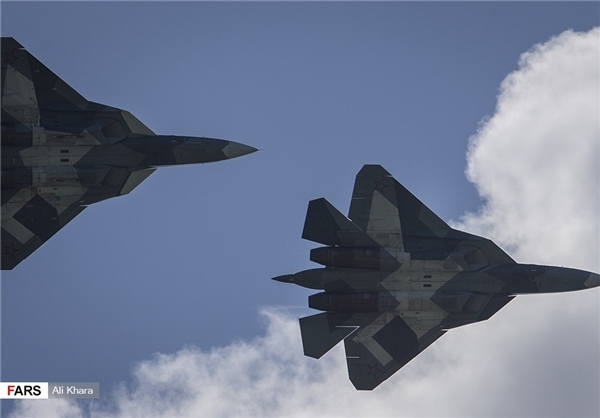
The Su-57 is a wide blended wing body with widely spaced engines, all-moving horizontal and vertical stabilisers, and canted fins for stealth reasons. The trapezoidal wing carries leading-edge flaps, ailerons and flaperons. The large leading-edge root extensions move the aerodynamic centre forward and increase static instability; mounted on them are the LEVCONs, adjustable surfaces that control the vortices generated, provide trim, and improve high-angle-of-attack behaviour, including rapid stall recovery if thrust vectoring fails. For aerodynamic braking, the ailerons deflect up, the flaperons down and the fins converge inward to increase drag.
In materials, most of the structure remains metallic — between 40.5 and 44.5 per cent aluminium alloys and 18.6 per cent titanium — but composites account for 22 to 26 per cent of structural weight and cover roughly 70 per cent of the outer surface.
Pronounced static instability in pitch and yaw, the KSU-50 flight control system and the canted thrust-vectoring nozzles make the aircraft resistant to loss of control and manoeuvrable in all three axes, capable of very high angle-of-attack manoeuvres such as the Pugachev cobra or the bell, and of flat rotations with little height loss. Aerodynamics and engines allow it to reach Mach 2 and to fly supersonically without afterburner — supercruise — at Mach 1.3, extending the effective reach of missiles and bombs. With its large fuel load, supersonic range exceeds 1,500 km, more than double that of the Su-27, and a retractable in-flight refuelling probe extends it further.
For low observability the Su-57 uses the familiar repertoire: planform alignment — wing and control-surface leading and trailing edges, and the serrated edges of skin panels, oriented in a few directions — internal weapons carriage, antennas flush with the skin, and radar-absorbent materials (RAM). The infrared search and track sensor rotates rearward when not in use and its rear face is treated with RAM. To mask the engine face, the intake duct walls carry RAM and the partly serpentine ducts hide most of the compressor and the inlet guide vanes; what remains exposed is covered by a canted blocker grid placed ahead of the vanes at a distance of 0.7 to 1.2 duct diameters, on a principle similar to that used on the Boeing F/A-18E/F. The canopy carries metal-oxide layers 70 to 90 nanometres thick that cut the cockpit's radar return by 30 per cent and shield the pilot from ultraviolet and thermal radiation.
On the result, the figures deserve care, because they come from estimates and from Sukhoi's own patent rather than from published measurements. The combined effect of shaping and RAM on production aircraft has been estimated at a radar cross-section thirty times smaller than that of the Su-27; the T-50 patent states the intention of reducing average radar cross-section to values on the order of 0.1 to 1 m², against the roughly 10 to 15 m² of the Su-27. The design clearly prioritises the forward hemisphere: rear fuselage shaping is less optimised than on the F-22 or F-35, probably for cost reasons and because Russian doctrine expects the aircraft to operate under the umbrella of its own integrated air defence systems. As with any stealth fighter, the measures are effective mainly against super-high-frequency radars — between 3 and 30 GHz — the sort carried by other aircraft, while low-frequency early-warning radars are more likely to detect it because of its size, at the cost of accuracy.
The episode that has fuelled the argument most occurred in November 2024. The fourth prototype, T-50-4 "054 Blue", travelled to China for the Zhuhai air show and landed there on 3 November after a refuelling stop at Taiyuan, where the public was able to approach and film the aircraft. The videos that circulated showed clearly visible screws and rivets not flush with the panels, poorly aligned sections with gaps between fuselage parts, and different types of fastener on the tail — single-slotted, Phillips and hex-head. The weapons bay door did not fully close. The second aircraft taken to Zhuhai, the seventh prototype T-50-7 "057 Blue", travelled disassembled aboard an An-124, without radome, wings or fins, for static display.
Readings of that episode diverge. Critics noted that the airframe was not built to low-observable standards; The Aviationist reported that the problem appeared to be limited to the prototypes and addressed on production aircraft, which have a cleaner finish, and that the Russian side maintains the goal was a frontally optimised radar cross-section. The same coverage carried radar cross-section comparisons — on the order of 0.005 m² for the F-35, 0.0005 m² for the F-22 and 0.1 to 0.5 m² for the Su-57 — which should be treated as press estimates rather than measured data. Wikipedia likewise records that the aircraft has been criticised for build quality, particularly on the test aircraft used at air shows, and that production examples generally have better finish. "054 Blue", it is worth remembering, had first flown on 12 December 2012: it was a twelve-year-old prototype.
Engines: 117, 30, 177
The Su-57 flies on two NPO Lyulka-Saturn izdeliye 117 afterburning turbofans, or AL-41F-1, a deep evolution of the AL-31 delivering 9 tonnes — 88.3 kN — of dry thrust, 14.5 tonnes — 142.2 kN — with afterburner and 15 tonnes — 147.1 kN — in emergency rating. They have full-authority digital engine control (FADEC) and are integrated with the flight control system. The AL-41F-1 is closely related to the izdeliye 117S of the Su-35S; the main difference is that the latter has a separate engine control system.
Thrust vectoring follows the scheme introduced on the Su-30MKI: the nozzle pivot axes are canted, so that although each nozzle vectors in a single plane, the cant allows roll and yaw moments to be generated by vectoring each nozzle differentially. The intakes have variable ramps for supersonic efficiency and retractable mesh screens against foreign object ingestion, intended for operation from short and poorly prepared runways.
The known weakness is that the izdeliye 117 was never the intended engine. The Su-57M was to carry the izdeliye 30, later designated AL-51F-1, with an estimated 11 tonnes — 107.9 kN — dry and 16.5 tonnes — 162 kN — with afterburner, plus reduced radar and infrared signature thanks to fibreglass inlet guide vanes and a serrated-edge nozzle. The izdeliye 30 first flew on 5 December 2017 on the second prototype, T-50-2 "052 Blue", flown by Sergei Bogdan; images of that flight showed the new engine fitted only in the port position, with an izdeliye 117 to starboard.
Development since then has been slow and difficult, to the point that Saturn launched an alternative programme called Udlinitel — "extender" — to keep improving the AL-41F-1 as a fallback. In 2025, at the Dubai Air Show, Rostec unveiled the izdeliye 177, which combines components and technology from the AL-41F-1 and the AL-51F-1 and is offered as an alternative to the latter; it is likely the product of the Udlinitel project. Wikipedia credits it with 11 tonnes — 107.9 kN — dry and 16 tonnes — 157 kN — with afterburner, and dates its first flight to December 2025.
A divergence in figures is worth pausing on here. Rostec's press service, as carried by Eurasian Times, announced that first flight quoting Lyulka design bureau director general Evgeny Marchukov, according to whom "the new engine performed normally and demonstrated reliable operation"; the same outlet credits the izdeliye 177 with a maximum thrust of 16,000 kgf and gives the AL-51F1 108 kN dry and 167 kN with afterburner, values that do not match Wikipedia's for the same engine. Neither set of figures is supported by verifiable public technical documentation, and this article presents them for what they are: values declared by the Russian industry or reported from it. The same outlet explains that under Rostec's classification a fifth-generation engine is defined by a turbine inlet temperature of 1,750 K, three-dimensional cooling, advanced superalloys and ceramic coatings, against roughly 1,600 K for a fourth-generation unit.
In parallel, UEC Saturn has been reported since 2023 to be developing a flat, non-axisymmetric nozzle for the Su-57, with flight testing beginning in late 2024. Because the requirement came long after Sukhoi had frozen the design, the nozzle was conceived to fit with minimal airframe changes; it is an option for both the AL-51F-1 and the izdeliye 177. At the 2025 Dubai show a Su-57E model with two-dimensional vectoring nozzles was also displayed.
Sensors, cockpit and armament
One of the central technical objectives of the PAK FA was full avionics integration — sensor fusion — to increase the pilot's situational awareness and reduce workload. Integration is handled by an information and control system whose computer was developed by GRPZ in Ryazan; unlike earlier Sukhoi aircraft, integration was done by Sukhoi itself rather than by RPKB of Ramenskoye. The resulting suite, called IMA BK, uses fibre-optic channels and runs on more than four million lines of code.
The two major systems are the Sh-121 multifunctional integrated radio-electronic complex and the 101KS "Atoll" electro-optical complex. The Sh-121 comprises the N036 Byelka radar system and the L402 Himalayas electronic countermeasures suite. Developed by the Tikhomirov institute, the N036 consists of the N036-1-01 main nose radar, an active electronically scanned array (AESA) in X-band with 1,514 transmit-receive modules, and two N036B-1-01 side-facing radars, also X-band AESA with 404 modules each, embedded in the cheeks of the forward fuselage to widen angular coverage. The nose array is tilted back for stealth reasons. The side arrays would allow the Su-57 to use side-lobe guidance tactics without losing target illumination. The suite also includes two N036L-1-01 L-band transceivers in the leading-edge flaps, used both for the N036Sh Pokosnik identification friend-or-foe system and for electronic warfare. X-band and L-band signal processing is handled by GRPZ's N036YeVS and Solo-21 computers. The L402 Himalayas, from the Kaluga radio engineering institute, uses both its own antennas and the N036 radar system, with one of its arrays mounted in the dorsal sting between the engines. The export data sheet credits the Byelka with a range of 400 km, 60 tracks and 16 targets engaged.
UOMZ's 101KS "Atoll" complex groups the 101KS-V infrared search and track sensor, the 101KS-O directional infrared countermeasures, the 101KS-U ultraviolet missile approach warning sensors, the 101KS-P thermal imager for low-level flight and landing, and the 101KS-N navigation and targeting pod. The IRST turret is mounted to starboard, ahead of the cockpit. The Su-57 is the first fighter to carry a DIRCM system, with one turret behind the canopy and another beneath the cockpit. Countermeasure dispensers — flares, radar decoys and programmable single-use jammers — are in the tail cone between the engines. Navigation rests on KRET's BINS-SP2M inertial system, integrable with GLONASS and governed by the IVS-50 computing system.
The cockpit is fully glass, with no analogue instruments: two 38 cm main multifunction LCDs, a smaller multifunction display, a digital control panel and a wide-angle head-up display, 30° by 22°. The canopy is a two-piece unit whose rear section slides forward, with metallised coatings. The ejection seat is an NPP Zvezda K-36D-5, with the SOZhE-50 life support system; the pilot wears a ZSh-10B helmet with the NSTsI-50 digital display system, which tracks the pupil and allows high off-boresight target engagement. The 30 kg oxygen generator provides unlimited supply; the system allows 9 g manoeuvres for up to 30 seconds at a time, and the seat and PPK-7 suit together permit safe ejection from ground level to 20,000 m and from 0 to 1,300 km/h indicated airspeed.
Armament is carried in two tandem main bays some 4.4 m long and 0.9 m wide, and two side bays with triangular-section fairings under the fuselage near the wing root. The main bays use two types of Vympel ejection launcher — the UVKU-50L for missiles up to 300 kg and the UVKU-50U for stores up to 700 kg — while the side bays use VPU-50 rails. In the air-to-air configuration the aircraft carries four beyond-visual-range missiles in the main bays and two short-range weapons in the side bays. The medium-range weapon is the K/R-77M (izdeliye 180), an improved R-77 with an AESA seeker and a dual-pulse motor; the short-range weapon is the infrared-guided R-74M2 (izdeliye 760), with reduced cross-section for internal carriage, to be succeeded by the clean-sheet K-MD (izdeliye 300). For long range there is the izdeliye 810, derived from the R-37M with shortened control surfaces, two per main bay.
Against surface targets the Su-57 can carry internally KAB-250 and KAB-500 guided bombs, the Kh-38M air-to-surface missile, the Kh-35U anti-ship missile, the Kh-58UShK anti-radiation missile and the Kh-69 cruise missile, originally designated Kh-59MK2. For missions where stealth does not matter it has six external hardpoints — twelve in total including the internal stations — and a maximum payload of 7,500 kg. The United States assesses that it will become nuclear-capable through a missile similar to the Kh-47M2 Kinzhal, dimensionally adapted to fit the main bays. The internal gun is a 30 mm 9A1-4071K (GSh-30-1) with 150 rounds, mounted near the root of the right LEVCON, with an effective range of 800 m against air targets and 1,800 m against surface targets.
Syria, February 2018
On 21 February 2018 two Su-57s made the type's first international flight when they were seen landing at the Russian base of Khmeimim in Syria. They arrived accompanied by four Su-35s, four Su-25s and a Beriev A-50 early warning aircraft; three days later two more Su-57s were reported to have arrived. The deployment was criticised by some experts as unduly risky — Khmeimim had been subject to drone attacks — and of limited value given its brevity, only a few days. It coincided with Defender of the Fatherland Day and with the Russian president's state-of-the-nation address, which led it also to be read as political endorsement and as a shop window for sales.
On 1 March 2018 Defence Minister Sergei Shoigu stated that the two Su-57s had spent two days in Syria and had successfully completed a test programme including combat trials with weapons parameter measurement. On 25 May 2018 the Defence Ministry disclosed that during that deployment a Su-57 had fired a cruise missile in combat, likely a Kh-59MK2. On 18 November 2018 it released an extended video and claimed the aircraft had flown ten sorties during the deployment, without giving dates. In December 2019 Chief of the General Staff Valery Gerasimov announced that the Su-57 had been tested in Syria again and that all tasks had been successfully completed. All of these claims come from the Russian Defence Ministry and have not been independently verified.
Orders, production and entry into service
The procurement story is one of expectations progressively cut back. In 2011 the Defence Ministry expected to acquire the first ten evaluation aircraft after 2012 and sixty production aircraft after 2015; the 2011-2020 state armament programme set 52 aircraft by 2020 and a further 150 to 160 through 2025, with serial production starting in 2016 and export orders of 250 to 300 FGFAs from 2017.
In 2015 all of that collapsed. Technical obstacles, Indian ambivalence and the Russian economic crisis brought on by international sanctions after the annexation of Crimea and by the fall in oil prices led Deputy Defence Minister Yuri Borisov to announce that production would be slowed, the initial order cut to twelve aircraft, and large fleets of upgraded fourth-generation fighters — Su-35S and Su-30SM — operated instead. Borisov went so far as to praise the Su-35S as comparable to the Su-57 apart from stealth, and cheaper. On 30 June 2018 the order for twelve aircraft was agreed; on 22 August that year, at the ARMY-2018 forum, the first contract for two production aircraft was signed, for 2019 and 2020.
The reversal came on 15 May 2019, when Vladimir Putin announced that 76 aircraft would be bought for delivery to the Aerospace Forces before 2028, after a 20 per cent reduction in the price of the aircraft and its equipment had been negotiated. The contract was signed on 27 June 2019 at the ARMY-2019 forum. Serial production began in July 2019.
On 24 December 2019 the first production Su-57, "01 Blue", crashed 110 to 120 km from Dzyomgi airfield in Khabarovsk Krai during the final phase of its factory trials, due to a control system malfunction. The pilot ejected and was recovered by helicopter. According to TASS, the flight was at 8,000 metres when the failure occurred, the aircraft entered a rapid spiral descent and, after attempts to stabilise it with the manual system failed, the pilot left the aircraft at 2,000 metres.
On 25 December 2020 the Defence Ministry announced that the Su-57 had entered service with the delivery of the first production aircraft to a Southern Military District regiment at Lipetsk. That initial batch was assigned to military evaluation, tactics development and crew conversion. The first operational unit to be equipped was the 23rd Guards Fighter Aviation Regiment, based at Dzyomgi in the Eastern Military District, with deliveries from 2023; co-location with the KnAAZ plant eases support. The first fully operational regiment, of 24 aircraft, was expected by 2025.
Delivery pace is one of the points where sources do not agree. Wikipedia's chronology indicates that four more aircraft had been delivered by May 2022, that the total reached six by the end of that year, that opening a new production line in 2022 raised the rate to twelve new aircraft delivered in 2023, and that Yuri Slyusar announced a further twenty for 2024. The same source records, in its operators section, ten prototypes and 21 production aircraft in service as of December 2023, seven delivered in 2024 in three batches, two more in April 2025 and an additional batch with upgraded systems in February 2026 whose size Rostec did not disclose. TWZ, by contrast, writes that the Aerospace Forces began receiving production examples in 2022 and that around 18 were understood to have been delivered between then and the end of 2024, with no certainty about deliveries since. The two sets of figures cannot be reconciled without further information, and this article does not average them.
On the industrial background there is one point both sides concede: since 2024 international sanctions on the Russian defence industry have made it considerably harder to source the Western avionics and micro-electronics that have been essential components of its advanced fighter cockpits.
Ukraine: what is claimed and what can be checked
Su-57 employment in Ukraine is the ground where the gap between claim and evidence is widest, and it is best walked in order.
Russian sources maintained in May 2022 that Su-57s had been used two to three weeks after the start of the invasion, attacking targets with missiles from outside the engagement area of Ukrainian air defences, like the rest of Russian aviation, which was in practice restricted to Russian airspace. GlobalSecurity attributes that first claim to TASS and adds that it lacked verification. In June 2022 RIA Novosti reported that four networked Su-57s had been used on suppression of enemy air defences missions, and the same source stressed that their low radar visibility had been demonstrated in combat.
On 19 October 2022 General Sergei Surovikin, then commander of all Russian forces in Ukraine, stated that the Su-57 had been used in both air-to-air and air-to-ground roles and had achieved kills in both. Subsequently some Russian sources claimed that a Su-57 had shot down a Ukrainian Su-27 and an Su-24 with long-range R-37 missiles. No hard evidence for any of these engagements has surfaced. What could be verified was where the aircraft were: commercial satellite imagery from late December 2022 showed five Su-57s deployed at Akhtubinsk, some 500 km from Ukraine.
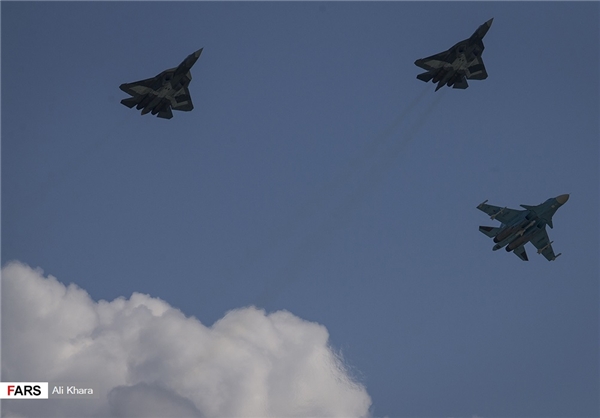
From 2024 the documented pattern is standoff attack. On 18 February 2024 a Su-57 escorted by two Su-35s launched a Kh-69 stealthy cruise missile while operating over Luhansk Oblast. In May 2024 Ukrainian sources reported an intensification of such attacks from the airspace of Kursk, Bryansk and occupied Luhansk, again with the Kh-69. GlobalSecurity describes the general pattern as cautious and evolving employment, balancing operational needs against the extreme strategic value of a very small stealth fleet: the Su-57s launch from Russian airspace or occupied territory and avoid penetrating Ukrainian air-defence coverage. The same source records that by August 2025 Ukrainian defence sources were reporting whole formations of Su-57s on coordinated missions, with some aircraft providing air cover with long-range R-77M missiles while others struck with Kh-69s and guided bombs, and it notes that the purpose of that exposure was also to validate the aircraft for foreign buyers, chiefly India. It is worth noting that much of that tactical description comes from Ukrainian rather than Russian sources, which makes it interesting but does not make it verified.
On the other side of the ledger is vulnerability. On 9 June 2024 Ukraine's Main Directorate of Intelligence claimed to have damaged or destroyed two Su-57s with drones in an attack on Akhtubinsk air base in Astrakhan Oblast — some 370 miles, according to GlobalSecurity, from Ukrainian-held territory. Several Telegram channels affiliated with the Russian military confirmed the strike and that at least one Su-57 had been damaged by shrapnel, criticising the absence of protective shelters; the Fighterbomber channel added that the aircraft's repairability was being assessed. Maxar satellite imagery showed a crater beside a Su-57. This is one of the few episodes where the Ukrainian claims, unofficial Russian sources and photographic evidence all point the same way.
On 5 October 2024 a Su-57 deliberately shot down an out-of-control Russian S-70 Okhotnik-B with an air-to-air missile some 16 km behind Ukrainian lines. In November 2024 The National Interest suggested Russia was reluctant to commit the Su-57 to combat but might be forced to if aircraft losses continued to outpace replacement. In May 2026 the type returned to operations, with at least ten cruise missile launches over Kursk Oblast, the Sea of Azov and Crimea.
The most recent claim is also the hardest to verify. Alexander Mikheyev, director general of Rosoboronexport, stated — according to TASS — that the Su-57 had demonstrated its superiority in real combat conditions against the most advanced air-defence and electronic-warfare systems, and that it had struck numerous air, ground and surface targets with Russian munitions, including the new RVV-SDM guided missile. Eurasian Times presented this as Russia's first official acknowledgement of a Su-57 air-to-air kill in the Ukraine war. The same article recalls that in April 2026 a report attributed to Sergei Lebedev circulated claiming a Su-57 had destroyed a Ukrainian aircraft over the Mykolaiv region with a long-range missile, and that in May 2026 Russian media and Telegram channels claimed a Su-57 had downed a Swedish Saab 340 early warning aircraft transferred to Ukraine using an R-37M. None of these claims has independent confirmation, and the context in which they were made — a sales presentation for the Su-57E — counsels caution. The RVV-SDM is a medium-range air-to-air missile introduced by Rosoboronexport to arm the export version, with fire-and-forget capability, active-passive radar guidance and high resistance to electronic warfare; analyst and former Indian Air Force pilot Vijainder K. Thakur considers it most likely a derivative of the RVV-SD adapted for the Su-57's internal carriage.
Finally, on 23 July 2026 the Kyiv Post reported that a Su-57 had crashed during a training flight in the Moscow region. According to Russian Telegram channels the pilot ejected unharmed and there were no casualties on the ground. The cause is disputed: InformNapalm suggested a Ukrainian cyber attack may have triggered friendly fire from Russian air defences, while the Russian Defence Ministry attributed the accident to a "technical failure".
Export: Algeria and the rest
Sukhoi maintains that the PAK FA's principal export advantage is cost, below that of American fifth-generation fighters. The list of prospects that came to nothing is long. Russia offered it for South Korea's F-X Phase 3 competition but did not submit a bid by the January 2012 deadline. In 2013 it offered Brazil participation and joint production; Brazil chose the Swedish Gripen E. In May 2019, with Turkish participation in the F-35 programme in doubt over the purchase of the S-400, Rostec CEO Sergei Chemezov said Russia was ready to cooperate with Turkey on export and local production of the Su-57, and in September a Su-57 took part in the Technofest festival in Istanbul; in February 2020 Erdogan announced that the F-35's replacement would be the Turkish TF-X. The United Arab Emirates received a Su-57E offer at IDEX 2021 but have avoided signing so as not to expose themselves to American CAATSA sanctions. Vietnam announced in July 2021 its intention to buy the aircraft, with explicit reservations about its build quality, and Iraq expressed interest without opening formal negotiations.
The export version, the Su-57E, was officially unveiled at the MAKS-2019 show on 28 August 2019. It differs from the Russian aircraft in a different IFF, instrument software adjusted to present readings in imperial units and English cockpit labelling; it also supports integration of non-Russian weapons at customer request. Rosoboronexport markets it as the "Perspective multirole fighter" (PMF).
The Algerian case is the only one to have reached delivery, and reconstructing it requires setting the sources side by side, because they do not say the same thing. Wikipedia records that on 27 December 2019 Algeria signed a contract for fourteen aircraft within a military package that included Su-34s and Su-35s, the decision reportedly taken in the summer of 2019 after an Algerian delegation inspected the Su-57 at MAKS-2019. In November 2024, at the Zhuhai show, Mikheyev announced the signing of "the first contracts" for Su-57 sales to a foreign country without naming it. In February 2025, during Aero India, Rosoboronexport said deliveries to an unidentified foreign customer would begin that year; days later Algerian state television confirmed that Algeria was the first export customer and that its pilots were training in Russia. TWZ, covering that announcement, noted that unconfirmed accounts suggested Algeria might initially be acquiring just six aircraft, and cautioned that sluggish Russian production made the schedule questionable.
On 18 November 2025 UAC director general Vadim Badekha stated that the first two aircraft had been delivered to a foreign customer and had entered combat service, without identifying it: "our foreign customer, our foreign partner, has already received the first two aircraft. They have begun performing combat duty and are demonstrating their best qualities. Our customer is satisfied." Defence Security Asia, citing Interfax and Russian state television, identified the recipient as Algeria and described the deal as a total of twelve Su-57Es delivered in phases, with analysts estimating a price of 100 to 120 million dollars per aircraft including training, spares, mission equipment and weapons. Wikipedia, for its part, lists two aircraft delivered to the Algerian Air Force in November 2025, dates visual evidence of the delivery to February 2026, and keeps the contractual figure at fourteen.
There are therefore three different figures for the same contract — six, twelve, fourteen — from three sources that do not cite one another, and none confirmed by the parties. What can be stated is that in November 2025 UAC announced the delivery of two aircraft, that Algeria declared itself a customer in February 2025, and that the aircraft was flown in display at the 2025 Dubai Air Show on 17 November, piloted by Sergei Bogdan and carrying the tail number "509".
The counterpoint is worth keeping in view: as recently as 2024 Wikipedia still recorded that no Su-57 had been exported and that export models were reported unlikely to be available before the end of the decade, and that the war and sanctions had reduced Russia's capacity to continue developing its advanced fighters. The distance between that assessment and the announcements of 2025 is precisely the ground this article cannot close.
Variants and derivatives
The production Su-57 for the Russian Aerospace Forces is the baseline variant: flight testing from the T-50 in 2010, serial production from 2019, and a plan for three regiments, 76 aircraft, with the first delivery in December 2020. The Su-57E is the export version described above. The Su-57D is the two-seater, its rear cockpit equipped to serve both as a trainer station and as a weapons systems officer's position; it was announced in July 2021 and first flew on 19 May 2026.
The Su-57M is the deep upgrade, developed under the programme name Megapolis, with improved mission systems, reliability and maintainability improvements, new flight control actuators, electromechanical drives, and the AL-51F-1 engines or eventually the izdeliye 177. The formal contract was signed in 2018 and component flight testing began in 2022. UAC reported that an upgraded Su-57 first flew on 21 October 2022, though it is unclear whether that airframe already represented the Su-57M, since it reportedly did not carry the second-stage engine.
Among proposed variants that never came to exist, the most prominent is the Indo-Russian FGFA, cancelled in 2018 before any prototype was built. A naval version with folding wings and stabilators has also been proposed for the Project 23000 "Shtorm" aircraft carrier, capable of operating from a ramp or with an electromagnetic catapult; the draft state armament programme for 2024-2033 includes development of a new carrier-based fighter based on the Su-57, though with substantial modifications.
Outside the strict family there are two associated developments worth mentioning without confusing them with variants of the aircraft. The first is the S-70 Okhotnik, an unmanned combat air vehicle with which the Su-57 has tested joint operation: the third flyable prototype, "053 Blue", was configured in 2018 and 2019 for tests of interaction with the Okhotnik and its avionics, and the Defence Ministry released video of those trials on 27 September 2019. The second is the LTS "Checkmate", a mock-up of a single-engine light tactical fighter revealed at MAKS-2021, sharing the Su-57's radar, main weapons bay, fins and wings. Neither is a Su-57 and neither is treated as one here.
Networked operation has also been trialled: on 28 June 2020 TASS, citing anonymous sources in the military-industrial complex, reported a "swarm" experiment with a group of Su-35s and a Su-57 acting as command and control aircraft, supposedly under "real combat conditions". This is another official Russian claim without external verification. In 2016 KRET announced development of a multifunctional video processing system called Okhotnik — sharing its name with the drone — to increase detection range and improve automatic detection and tracking, and the aircraft carries a monitoring system that assesses airframe condition in real time and predicts the remaining life of composite parts by means of optical fibres woven into the structure.
What the Su-57 is today
Seen at a distance, the Su-57 is an aircraft coherent with the doctrine that commissioned it and disappointing against the expectations loaded onto it. It was not conceived as a pure air superiority fighter with stealth above all else, but as a long-range, high-payload, extremely manoeuvrable platform capable of standoff attacks against air and surface targets under the protection of friendly air defences. Measured by that yardstick, the documented employment in Ukraine — Kh-69 launches from Russian airspace, without penetration — is not a failure but the literal application of the concept.
Measured by the yardstick used to sell it, the accounts do not balance. The fifth-generation engine is still not in general service a decade and a half after the first flight. The production figures are those of a niche programme, not of a replacement for two entire fighter families. The only confirmed export customer has received two aircraft. And the most emphatic claims about its combat performance come, almost without exception, from those selling it.
Chemezov himself offered the cleanest formulation of that ambiguity at Dubai in 2025: "the improvement of the fighter is a kind of endless process that continues as long as our special military operation continues; we receive the information from our pilots in the war zone and adjust our equipment accordingly." It is at once a sales argument and an exact description of an aircraft that is still not finished. This article will be updated as verifiable material appears, and in particular as independent evidence documents the real delivery rate, the entry into service of the definitive engine, and the actual scope of the Algerian contract.
Variants
| Su-57 | T-50 | Su-57D | Su-57E | Su-57M | Sukhoi/HAL FGFA | |
|---|---|---|---|---|---|---|
| First flight | January 29, 2010 | January 29, 2010 | May 19, 2026 | — | — | — |
| Aircraft type | Fifth-generation stealth multirole fighter | Fifth-generation fighter prototype | Two-seat trainer and UAV-control version | Export version of the Su-57 stealth fighter | Upgraded Su-57 (Megapolis programme) | Proposed version for India (cancelled programme) |
| Powerplant | Two Saturn AL-41F-1 (izdeliye 117) afterburning turbofans, heavily uprated derivatives of the AL-31: 88.3 kN dry, 142.2 kN with afterburner and 147.1 kN in emergency power, with FADEC and canted thrust-vectoring nozzles giving moments about all three axes. | Two Saturn AL-41F-1 (izdeliye 117) afterburning turbofans, the same as the production Su-57. The second flying prototype served from 2017 as the izdeliye 30 flying testbed. | Two Saturn AL-41F-1 (izdeliye 117) afterburning turbofans, as on the production Su-57. | Two Saturn AL-41F-1 (izdeliye 117) afterburning turbofans, 88.3 kN dry and 142.2 kN with afterburner, unchanged from the Russian production aircraft. | Planned with the NPO Saturn izdeliye 30, later designated AL-51F-1: 107.9 kN dry and 162 kN with afterburner according to the released figures, with glass-fibre plastic IGVs and a serrated-flap nozzle that reduce radar and infrared signature. The izdeliye 177, at 107.9 kN dry and 157 kN with afterburner, has been proposed as an alternative. | Never finalised: the programme was cancelled before any prototype was built. |
| Powerplant | 2 × Saturn AL-41F-1 (izdeliye 117) | 2 × Saturn AL-41F-1 (izdeliye 117) | 2 × Saturn AL-41F-1 (izdeliye 117) | 2 × Saturn AL-41F-1 (izdeliye 117) | 2 × NPO Saturn izdeliye 30 / AL-51F-1 | — |
| Thrust per engine | 142 kN Best value in this row | — | — | 142 kN Best value in this row | — | — |
| Length | 20.1 m Best value in this row | — | — | 20.1 m Best value in this row | — | — |
| Wingspan | 14.1 m Best value in this row | — | — | 14.1 m Best value in this row | — | — |
| Height | 4.6 m Best value in this row | — | — | 4.6 m Best value in this row | — | — |
| Wing area | 78.8 m² Best value in this row | — | — | 78.8 m² Best value in this row | — | — |
| Empty weight | 18,500 kg Best value in this row | — | — | 18,500 kg Best value in this row | — | — |
| MTOW | 34,000 kg Best value in this row | — | — | 34,000 kg Best value in this row | — | — |
| Top speed | 2,135 km/h Best value in this row | — | — | 2,135 km/h Best value in this row | — | — |
| Cruise speed | 1,400 km/h | — | — | — | — | — |
| Service ceiling | 18,800 m Best value in this row | — | — | 18,800 m Best value in this row | — | — |
| Range | 3,500 km Best value in this row | — | — | 3,500 km Best value in this row | — | — |
| Ferry range | 4,500 km Best value in this row | — | — | 4,500 km Best value in this row | — | — |
| Combat radius | 1,250 km Best value in this row | — | — | 1,250 km Best value in this row | — | — |
| Range conditions | 3,500 km subsonic range and 1,500 km supersonic; 1,250 km combat radius and 4,500 km ferry range with two external tanks. Internal fuel of 9,700 kg, up to 12,900 kg with two PTB-2000 drop tanks. | No published range figures for the prototypes: the released specifications belong to the production and export aircraft. | No dedicated published range figures for the two-seat version. | 3,500 km subsonic and 1,500 km supersonic; 1,250 km combat radius and 4,500 km ferry range with two external tanks. The published Su-57 specifications correspond precisely to this export version. | No dedicated published range figures for this version. | No published figures: no aircraft was ever built. |
| Armament | One 30 mm GSh-30-1 autocannon and twelve hardpoints (six internal, six external) with a 7,500 kg maximum payload: R-77M, R-74M2 and R-37 air-to-air missiles; Kh-38M and Kh-69 air-to-surface; Kh-35U and Kh-31 anti-ship; Kh-58UShK anti-radiation; and KAB-250 and KAB-500 guided bombs. | Test airframes; armament was integrated progressively, and the last two flying prototypes already carried the full production mission systems. | It keeps the base Su-57 weapons fit; the extra crew member is aimed at complex missions and command-and-control duties. | A 30 mm GSh-30-1 autocannon and twelve hardpoints with a 7,500 kg maximum load, with the distinction that non-Russian weapons can be integrated as requested. | No documented differences from the base Su-57 weapons fit. | Never finalised; the improvements India sought included combat avionics and networking. |
| Max weapons load | 7,500 kg Best value in this row | — | — | 7,500 kg Best value in this row | — | — |
| Payload | 0 kg Best value in this row | — | — | 0 kg Best value in this row | — | — |
| Cargo capacity | Pure fighter: it carries no cargo or passengers. | — | Pure fighter: it carries no cargo or passengers. | Pure fighter: it carries no cargo or passengers. | Pure fighter: it carries no cargo or passengers. | Pure fighter: it carries no cargo or passengers. |
| Crew | 1 Best value in this row | 1 Best value in this row | 2 | 1 Best value in this row | 1 Best value in this row | — |
| Passengers | 0 Best value in this row | 0 Best value in this row | 0 Best value in this row | 0 Best value in this row | 0 Best value in this row | — |
| Units built | — | 10 Best value in this row | — | — | — | 0 |
Images