Hawker Siddeley Trident variant
Hawker Siddeley Trident 3B
Stretched Trident for BEA's high-density European and domestic routes: a 5 m longer fuselage, up to 180 seats and a fourth Rolls-Royce RB162 boost engine in the tail for take-off; 26 were built.
%2C_Manchester_Airport_Runway_Park_-_geograph.org.uk_-_3736233.jpg)
- December 11, 1969
- First flight
- 26
- Units built
- 3,593 km
- Range
- 180
- Passengers
History
The Trident 3B grew out of a capacity problem. By the mid-1960s the Trident had become the backbone of British European Airways' (BEA) fleet, and the airline wanted an even larger aircraft. In 1965 Hawker Siddeley offered two new designs: the HS132, a 158-seat twin otherwise similar to the Trident, and the HS134, a 185-seater with its engines under the wings, very similar to the Boeing 737; both depended on the Rolls-Royce RB178, a high-bypass engine then under development. BEA preferred a mixed fleet of Boeing 727s and 737s, but the British government vetoed the plan, and in 1966 the airline returned to Hawker Siddeley with a requirement for an extended-range aircraft to serve its Mediterranean destinations.
The answer was the Trident 3. The 2E fuselage was stretched by 5 m (16 ft 5 in), 8 ft 5 in ahead of the wing and 8 ft aft of it, by inserting three plugs, making room for up to 180 passengers in an all-economy layout. Hawker Siddeley raised the gross weight to 143,000 lb (about 65,000 kg) and modified the wing to increase its chord, but kept the same engines. BEA rejected the design: after the difficulties experienced with the 2E at hot and high airports, it feared the stretched aircraft would not perform adequately there. Since the Spey 512 was the last of the Spey line, extra thrust from the three engines would be hard to find, and replacing them with another type would have been very difficult with one engine buried in the tail.
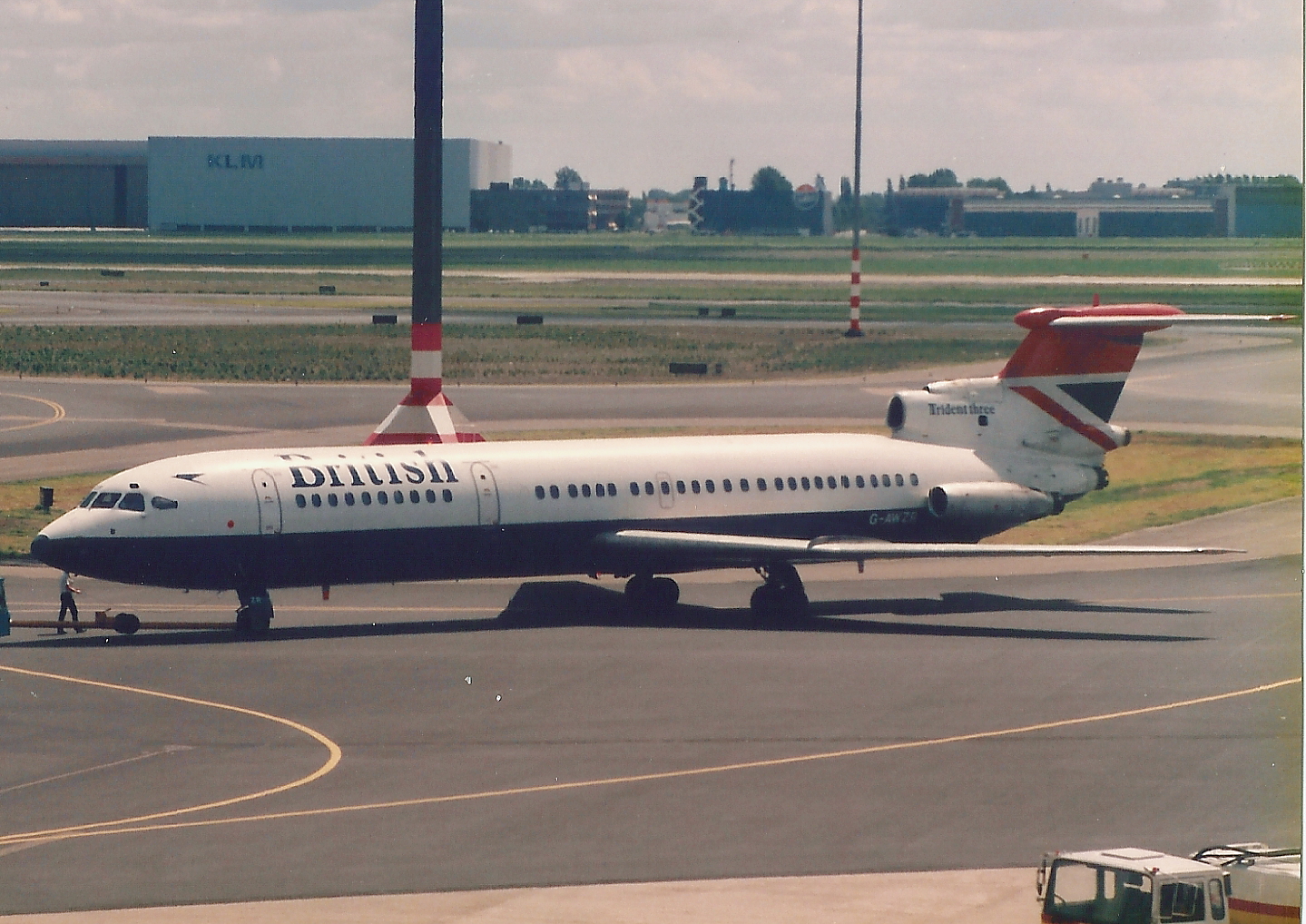
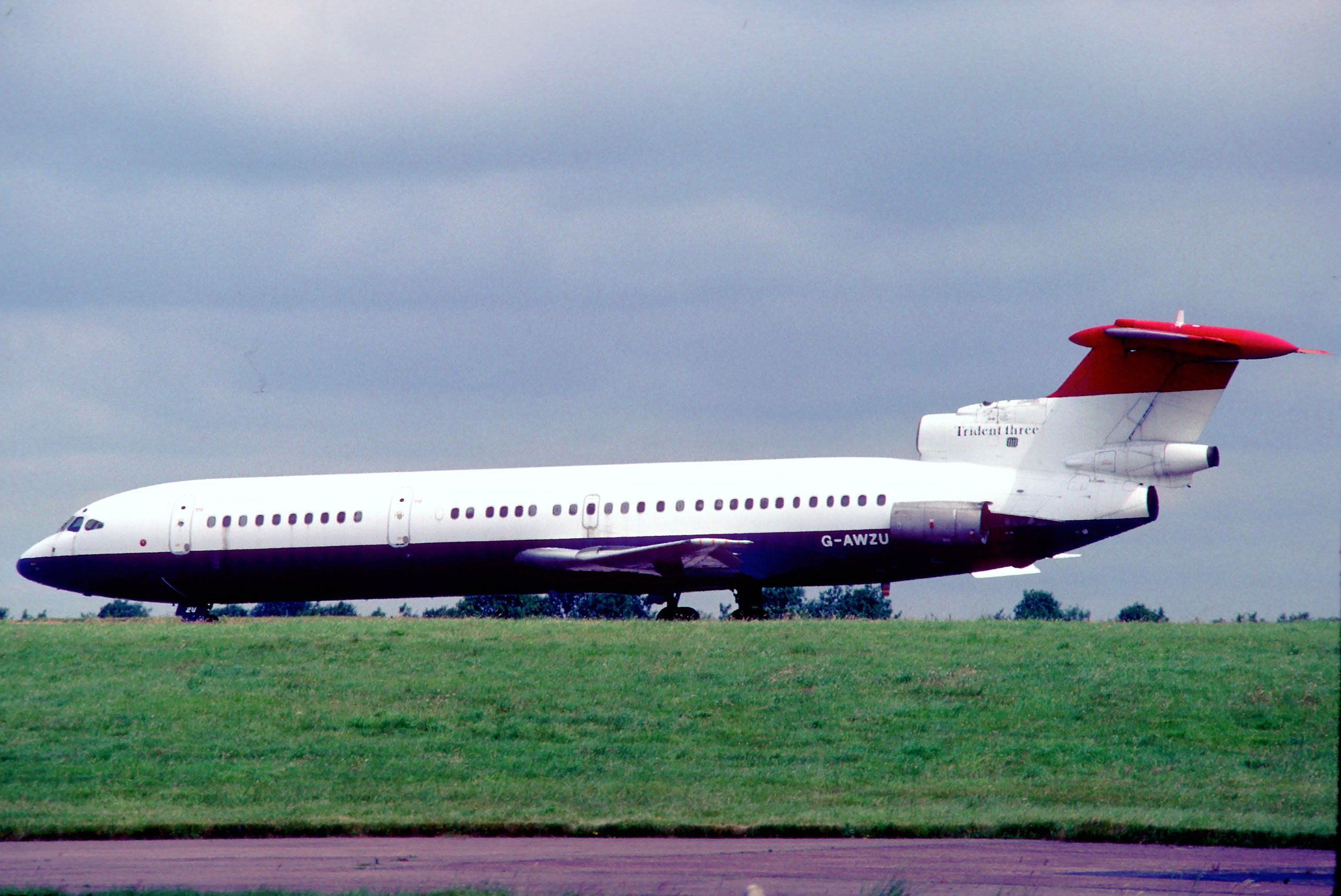
The engineers chose an unusual solution: a fourth engine. They picked the tiny Rolls-Royce RB162 turbojet, designed as a lift engine for vertical take-off aircraft, which had to be converted from vertical to horizontal installation. The RB162-86, only about 1.3 m long, was mounted at the base of the fin, where the auxiliary power unit had previously been, just above the exhaust of the centre Spey, and was fed from its own intake behind a pair of movable doors. It was used only for take-off and climb and shut down in the cruise. It delivered about 5,250 lbf (23.4 kN): 15 per cent more take-off thrust for only 5 per cent more engine weight. According to Russian sources, it cut the take-off run by 550 m and allowed 6577 kg more payload. BEA accepted the formula as the Trident 3B and ordered 26.
The first flight took place on 11 December 1969, and the first take-off with all four engines running followed on 22 March 1970. The first 3B, G-AWYZ, carried a nose probe for high-speed trials. The aircraft was fitted with the Smiths Autoland system and in December 1971 it was certified for automatic landings in Category II weather. It entered service with BEA on 1 April 1971.
With three Spey 512s of 11,960 lbf (53.2 kN) each plus the RB162 booster, the 3B was 39.98 m long, spanned 29.87 m (the same 135.8 m² wing as the 2E) and stood 8.61 m high. Maximum take-off weight was 150,000 lb (about 68,039 kg), with an operating empty weight of 83,000 lb and 5,440 imperial gallons of fuel. It cruised at Mach 0.84 (495 knots, about 917 km/h) at FL300 and had a ceiling of 35,000 ft (10,668 m). It could seat up to 180 passengers in high density, or around 14 first and 119 economy in two classes.
All 26 passed from BEA to British Airways in 1974, and the new airline's Tridents were used intensively on European and domestic schedules, in particular on the Shuttle services out of Heathrow. G-AWZS, for example, was delivered to BEA on 5 May 1972 and retired on 5 December 1985; G-AWZJ accumulated 19,784 landings. In 1977 fatigue cracks were found in the wings of British Airways' Trident 3s; they were returned to the manufacturer, repaired and put back into service.
On 10 September 1976 G-AWZT, operating flight BA476 from London to Istanbul with 54 passengers and nine crew, collided at FL330 near Vrbovec, north-east of Zagreb, with an Inex-Adria DC-9 (YU-AJR). The accident was caused by error on the part of Zagreb air traffic controllers; all 176 people on both aircraft were killed, and it remains the only British Airways accident with fatalities.
Faced with new ICAO noise rules, British Airways phased out its Tridents in 1985. Five former British Airways 3Bs went to Air Charter Service of Zaire in 1984-86. G-AWZK survives at the Runway Visitor Park at Manchester Airport, moved from Heathrow in September 2005 and displayed in BEA livery, and G-AWZM is in the Science Museum's store at Wroughton; nose or fuselage sections of G-AWZI, G-AWZJ, G-AWZP and G-AWZU are also preserved, and an RB162-86 is shown at the East Midlands Aeropark. CAAC's two Super Trident 3Bs, with extra fuel, are a separate variant and are not included in these 26.
Multimedia


_ex_British_Airways._(5652804430)-1600.webp)


-1600.webp)


-1600.webp)
-1600.webp)

-1600.webp)


-1600.webp)
-1600.webp)
-1600.webp)

-1600.webp)

-1600.webp)

-800.webp)
-1600.webp)
_(2)-1600.webp)


-1600.webp)


-1600.webp)
