Hawker Siddeley HS 748 variant
Hawker Siddeley HS 748 HAL 748
Licence-built 748 produced at Kanpur, India, by Hindustan Aeronautics and the Indian Air Force Manufacturing Depot: 89 aircraft between 1961 and 1984, 72 for the Indian Air Force and 17 for Indian Airlines.

- November 1, 1961
- First flight
- 89
- Units built
History
An early licence
The Indian government took an interest in the Avro 748 before the first British prototype had even flown. In 1960 the manufacturing licence went to Hindustan Aircraft Ltd., which set up a Transport Aircraft Division for the express purpose of building the 748. Aircraft from the Indian line were designated HAL-748, and in Indian Air Force service the type came to be known simply as the "Avro", the name of the original manufacturer, which disappeared in Britain in July 1963 when the company was absorbed into its parent, Hawker Siddeley.
Kanpur, not Woodford
Indian production did not take place at the British factory at Woodford but at Kanpur. The European type certificate for the HS 748 puts it on record: HAL 748 aircraft with serial numbers 500 to 588 inclusive were assembled or manufactured by the Indian Air Force Manufacturing Depot or Hindustan Aeronautics Limited at Kanpur between 1961 and 1984. That serial range covers exactly 89 airframes, the same number of Indian-built aircraft given by the English and Spanish Wikipedia, Aircraft Survivors and Simple Flying. All-Aero gives a lower figure, 79 aircraft assembled in India from parts made in both countries, and the English Wikipedia's list of variants places the licence production at Bangalore rather than Kanpur. The first Indian-assembled HAL-748 made its first flight on 1 November 1961.
Series by series
HAL did not build a model of its own but the same series as the British line. According to the Aircraft Survivors count, of the 24 Series 1 aircraft, with Rolls-Royce Dart RDa.6 Mk.514 turboprops, four were built in India; of the 150 Series 2, with a higher take-off weight and Dart RDa.7 Mk.531 engines, 65 were Indian. Production was completed by the 20 HAL 748M (Series 2M), an Indian-developed version with a large cargo door and Dart RDa.7 Mk.536-2T engines, the first of which flew on 16 February 1972; a further 11 Series 2 aircraft were later retrofitted with that door. Four, 65 and 20 add up to the 89 Indian aircraft. The Dart engine itself was also licence-built in India by Hindustan Aeronautics. The Series 2M and the airborne early warning testbed have pages of their own; this one covers the production as a whole.
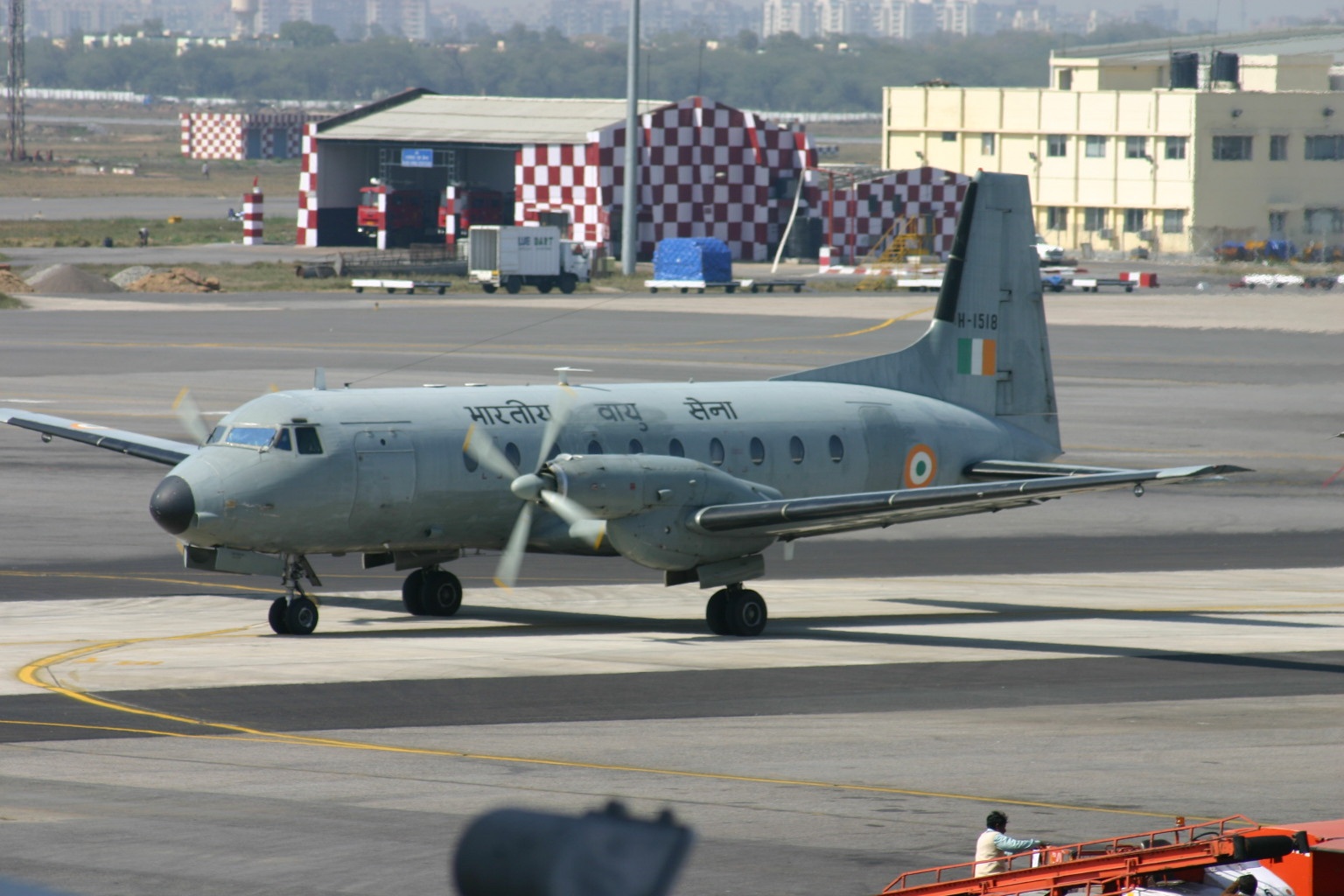
The English Wikipedia also records a project, the 757 or 748M, a Series 1 with a strengthened floor and revised avionics for the Indian Air Force that was never built.
Customers: the air force and the flag carrier
Of the 89 aircraft, 72 went to the Indian Air Force and 17 to the national flag carrier Indian Airlines. Within ten years of the type's launch India had become its largest single market and Indian Airlines its largest operator, with a fleet of 26 aircraft. Indian users also included Vayudoot, now defunct, and Hindustan Aeronautics itself, which used BH-572 as its chairman's aircraft. The 748 proved itself in hot-and-high conditions such as those of the Himalayas.
Accidents
On 4 August 1979 Indian Airlines HAL-748 VT-DXJ, on a scheduled flight from Pune to Bombay, crashed in the Kiroli Hills near Panvel, about 11 km east of Bombay; all 45 people on board were killed. On 19 August 1981 HAL 748 VT-DXF, operating Indian Airlines Flight 557, overshot the runway in wet weather at Mangalore-Bajpe Airport; there were no fatalities, but the aircraft was written off. On 11 January 1999 the ASTE's HAL-748 ASP H-2175 crashed at Attur, Tamil Nadu, after the pilots lost control, killing its two crew and six passengers.
Military service and survival
In the Indian Air Force the 748 has been used for transport, communications, navigation training, photo-survey and as a trials platform, and the service is now the type's only large-scale operator. When, on 1 July 2025, the British authority withdrew the HS 748 type certificate at the request of BAE Systems, the measure did not apply to HAL-built aircraft, which hold a different type certificate. They continue to fly pending replacement by the Airbus C295, which Aircraft Survivors does not expect to be complete before 2030, with delivery of the last of 56 C295s.
.jpg)
Multimedia

-800.webp)

